
DVD-quality lessons (including tabs/sheet music) available for immediate viewing on any device.
Take your playing to the next level with the help of a local or online banjo teacher.
Weekly newsletter includes free lessons, favorite member content, banjo news and more.
Premier Sponsors


|
Please note this is an archived topic, so it is locked and unable to be replied to. You may, however, start a new topic and refer to this topic with a link: http://www.banjohangout.org/archive/287115
BlowingRockNC - Posted - 06/27/2014: 04:29:27
I recently got a 1925 Washburn A-Scale conversion. It has a newish Ren head. The head is stretched out and sits about 1/4" or a tad less below the upper edge of the tension hoop. Is this good or bad, or does really matter? At a jam last night, someone told me that I had to get the head changed to a raised head. That's why I'm asking. Or, is it just as well to leave it be? Thanks.
beegee - Posted - 06/27/2014: 04:58:52
Do you mean that the tension hoop is below the top edge of the head?
Aradobanjo - Posted - 06/27/2014: 05:27:32
Hello,
What has been described is an optimum setting. I like a result as described.
Edited by - Aradobanjo on 06/27/2014 05:27:51
carlb - Posted - 06/27/2014: 05:59:25
Many years ago, after mounting a new skin head, the top of the tension hoop was below the skin. Here's what I did for a fix: 1) went to a store that had supplies for cross-stitching and other sewing needs and bought an 11" aluminum hoop, 2) I filed and sanded the joint until it was the same size as the rest of the hoop, 3) I removed the tension hoop carefully so not to disturb the overlap end of the skin, 4) I slid on the aluminum hoop so that it would be just below the tension hoop when it was replaced, and finally 5) replaced the tension hoop. This method raised the tension hoop the thickness of aluminum hoop and that was enough for me.
rudy - Posted - 06/27/2014: 06:07:13
Renaissance heads don't really "stretch" much, so the head is probably where it should be under normal tension. The amount that the head surface is below the tension band top is mostly a function of the crown height of the head. Heads are sold in low, medium, and high crown sizes. Going with the description that you gave it sounds like a low crown head was installed so the tension band is about 1/4" above the head. It's really more a matter of personal preferance, but there are other factors to consider before you change to a high crown head to lower the height of the tension band.
Changing to a high crown head may let the tension band drop down to the point where the head bead interferes with the bottom of the clearance notch at the neck heel.
The ends of the J bolts may protrude through the nuts.
There may not be enough threaded shank on the J bolts for a high crown head to be tightened sufficiently.
I offer these possibilities to demonstrate why someone may have went with a low crown head. Any previous modifications to the rim or tone ring can effect the relationship of the assembly, so you just need to keep all those factors in mind when you consider changing the head to a alternate crown height.
Here's a quick view of a typical cross section to clarify the need clearance below the head bead at the neck heel notch:
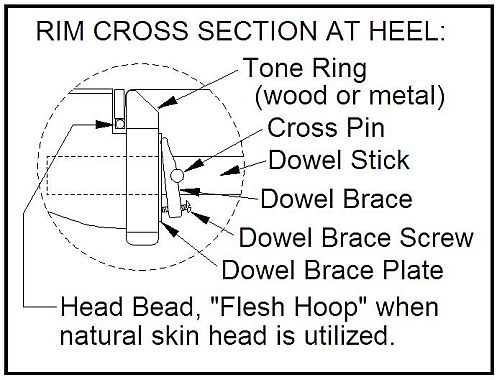
Edited by - rudy on 06/27/2014 06:10:48
BlowingRockNC - Posted - 06/27/2014: 06:10:13
quote:
Originally posted by beegeeDo you mean that the tension hoop is below the top edge of the head?
No, I mean that the top of the head is below the tension hoop. In other words, the flat surface of the head is about 1/4" below the upper rim of the tension hoop. Is this good or bad? I was told it is bad, but I'm not sure the person who told me really knows all that much about banjos, thus I'm asking here. Thanks for any advice on this subject. I would hate to change the head in order to make the flat part of the head even with the upper rim of the tension hoop, unless it's necessary. It would seem that one consequence is that I have a taller bridge than what I'm normally used to (its a 3/4" bridge). A shorter bridge results in the strings actually touching the surface of the fretboard.
Edited by - BlowingRockNC on 06/27/2014 06:14:37
rudy - Posted - 06/27/2014: 06:17:24
quote:
Originally posted by BlowingRockNCquote:
Originally posted by beegeeDo you mean that the tension hoop is below the top edge of the head?
No, I mean that the top of the head is below the tension hoop. In other words, the flat surface of the head is about 1/4" below the upper rim of the tension hoop. Is this good or bad? I was told it is bad, but I'm not sure the person who told me really knows all that much about banjos, thus I'm asking here. Thanks for any advice on this subject. I would hate to change the head in order to make the flat part of the head even with the upper rim of the tension hoop, unless it's necessary.
Nothing particularly wrong with 1/4". I like my bands to end up only slightly above the head, on the order of 1/16".
Another clearance factor is if the strings have enough clearance over the tension band at the neck heel. A low crown head can raise the tension band high enough that the strings don't have proper clearance. If that's OK and you don't mind the look I'd go with what you have.
BlowingRockNC - Posted - 06/27/2014: 06:21:22
I think what I'm reading here is that there's nothing wrong with the way it is right now, which is fine with me. I have a vintage style wire armrest, so my right forearm isn't sitting on the top of the tension hoop, rather on the top of the wire armrest. It doesn't look shocking to me at all, but it seemed to really concern the guy doing the talking last night.
xnavyguy - Posted - 06/27/2014: 06:27:37
Besides possibly interfering with the strings at the neck, as pointed out earlier, the only other possible problem, on some banjos, is that the tension band being too high above the head can prevent some tailpieces from being properly adjusted because the tension band keeps them too high above the head.
rudy - Posted - 06/27/2014: 06:31:59
quote:
Originally posted by xnavyguyBesides possibly interfering with the strings at the neck, as pointed out earlier, the only other possible problem, on some banjos, is that the tension band being too high above the head can prevent some tailpieces from being properly adjusted because the tension band keeps them too high above the head.
Good point!
BlowingRockNC - Posted - 06/27/2014: 06:32:25
I don't have a string or tailpiece issue, so I guess that means I'm ok as is. Thanks for all the thoughts. It's really great that people like me who don't know nothing can get some straight answers from people who actually do know something.
tomberghan - Posted - 06/27/2014: 11:43:00
For most banjoists, it is preferred to have the head surface below the tension hoop. To achieve that, the proper crown height is selected for each particular banjo.
For instance, most Gibson flatheads take a medium crown. Look at this photo. This is the most common relationship of head surface to tension hoop. But it is not a rule, I have a 1926 Gibson TB2 and the head sits just above the tension hoop and is not a problem. The only time it becomes a problem is if the strings bottom out and touch the flesh hoop of the head when you fret above the 12th fret. But this can also be caused by a bridge that is too low or a neck that is set at a poor angle, or a neck that has no bow at all in it . . . or worse, a backward bow . . . which can be easily fixed if the banjo has a dual truss rod. Of course antique banjos do not have dual truss rods, But there is always a way to set things right.

BlowingRockNC - Posted - 06/27/2014: 12:00:06
Tom, your picture is almost exactly what I have on my A-Scale. Mine might be a tiny bit lower, but not enough to write home about. My other banjo heads are about even with the tension hoop, give or take a tad. This is all good news to me, because the guy last night made it sound as if the world would come to an end if I didn't change the banjo head. Thanks again. Bill.
tomberghan - Posted - 06/27/2014: 12:37:10
Excellent News Bill!
The guy last night was probably well meaning but incorrect - and I guess the moral of the story is to always consult the banjo hangout (which you did).
Of course as you see, there are often differing opinions. And sometimes down-right incorrect information, but when that happens the subject-matter-experts always jump in and dispense the truth. Now, I am not a luthier . . . I am just a banjo player here learning from the experts just as you are. But on this specific matter I am pretty confident. This is my favorite forum! Best Wishes, Tom
Ken LeVan - Posted - 06/27/2014: 13:32:03
Here is my favorite setup - the top edge of the tension hoop is up about 1/4" m/l, and the string space is a hair lower than the top edge of the fingerboard. I think this is what many have been talking about

Ken
BlowingRockNC - Posted - 06/27/2014: 13:39:33
You guys are great. Thanks for the help. And a picture is worth a thousand words on this subject matter. Thanks again.
tomberghan - Posted - 06/27/2014: 13:59:38
NICE photos Ken.
Your explanations are always so clear with photos and mechanical drawings. I really think you should self publish a book. I would definitely buy it. These days, you do not need distribution nor even need to have it bound (although that is best). Books are often offered as PDF files these days.
Seriously, you should consider it because you already have much of it written and ready!
Ken LeVan - Posted - 06/28/2014: 14:11:55
quote:
Originally posted by tomberghanNICE photos Ken.
Your explanations are always so clear with photos and mechanical drawings. I really think you should self publish a book. I would definitely buy it. These days, you do not need distribution nor even need to have it bound (although that is best). Books are often offered as PDF files these days.
Seriously, you should consider it because you already have much of it written and ready!
Thanks, Tom,
I AM working on it, and have been for a couple of years. I've written a few technical manuals and books about historic architecture, so I am familiar with the process. I have this belief that the ability to write technical stuff in an understandable way is becoming a lost art.
As you suggest, I have a LOT of pictures and info, and have been using the Banjo Hangout as a source of understanding what banjo players are interested in, and what they are confused about. More importantly, I have been using the Hangout as a way to see if I can explain geometric concepts, some of which I can't. What's been slowing me down is that I keep changing what I am writing about as new things come to light that need explanation. I have been adding more drawings.
This particular subject is of recurring interest, and I have made a lot of drawings and photos. It is essentially geometrical in nature but not well understood. It encompasses several things:
(1) crown height of head
(2) relationship of tension hoop to fingerboard
(3) relationship of tension hoop to head (this thread)
Archtops are different.
I am trying to figure out how to tie all this together and make a clear explanation.
Another geometrical thing I have been trying to learn how to explain is the centerline of the neck. This, while purely geometrical and measurable, has become contentious at times. So far, I have a 6-page spread explaining it, and I have "floated" pages when the subject comes up, and realize I am not there yet.
Probably, the most pursued subject on the Banjo Building, Setup, and Repair forum on the Hangout is compensated bridges, which I will devote as little space as possible to - maybe a few sentences and diagram of how to do it in the spreads about bridge placement.
It's a long haul and a moving target, but I will do it - it's a lot of fun.
Dan Drabek - Posted - 06/28/2014: 16:03:13
quote:
Originally posted by tomberghanNICE photos Ken.
Your explanations are always so clear with photos and mechanical drawings. I really think you should self publish a book. I would definitely buy it. These days, you do not need distribution nor even need to have it bound (although that is best). Books are often offered as PDF files these days.
Seriously, you should consider it because you already have much of it written and ready!
We've all been looking forward to it Tom. I may not always choose to follow Ken's advice, but I have yet to see him give bad advice. And I find myself often asking "how would Ken do this?". His book would be very useful for that. There are other fine books on banjo building, but none so clearly and beautifully presented as the information Ken generously shares with us. Being self-taught, I can appreciate the hundreds of hours I might have saved had I had a book like that when I started making banjos. I think the best banjo builders have to be a blend of engineer, artist and player. The last being important because only a player can really understand how a good instrument should feel in the hands and under the fingers. Ken happens to be all three. As well as being a particularly good communicator. Not many folks can claim that combination. And the few that can, often lack the fifth quality. That being the inspiration and energy to put it all together and publish it. I think Ken may well have that going for him as well, but we can only wait and anticipate.
DD
rudy - Posted - 06/28/2014: 17:42:21
quote:
Originally posted by Ken LeVanProbably, the most pursued subject on the Banjo Building, Setup, and Repair forum on the Hangout is compensated bridges, which I will devote as little space as possible to - maybe a few sentences and diagram of how to do it in the spreads about bridge placement.
If you run out of ideas for "everything you need to know about compensated bridges", I know a guy...
tomberghan - Posted - 06/28/2014: 18:02:54
About Ken LeVan
I recently had the pleasure of visiting Ken. I only knew him from the Banjo Hangout, but like many people, I was really drawn to Ken's amazing posts containing mechanical drawings and three dimensional explanations. I was working in Allentown PA and I had a free weekend so I drove north to go visit Ken and his lovely wife (and terrific dog) in their remarkable mountain home. Now, my home is in the state of Washington, so I was a long way from home.
They have built an amazing home in a beautiful hollow in the woods up in the mountains of Sullivan County, PA. The entire county has less than 7,000 people and it it is the second least populated county in the state. First you drive through World's End State Park (drop dead gorgeous) and then you come to this little village named Shunk. Now, it really feels like you are at "the end of the world" . . . and your GPS and cell phone quit working long before you arrive at Shunk . . . and so I had to stop at the little general store and get directions to Ken's house, which included handy tips like "When you see the beaver dam you are getting close!"
They are amazing people (both engineers and artists) and they make a lot more than banjos I can tell you! They are very self sufficient people and know "how to make things . . . all sorts of things!" It was a wonderful experience to visit Ken's home and shop! Extremely creative people! If you ever get the chance, go pay Ken a visit. Just go to the end of the world, take a left (and a right and right and a left and right and another left) and then look for a beaver dam, then drive another mile or so, then right up onto the hillside and into the hollow. Maybe you will find it!
Terms of Use | Privacy Policy | Privacy Consent (EU/GDPR Only)
Copyright 2026 Banjo Hangout. All Rights Reserved.


