DVD-quality lessons (including tabs/sheet music) available for immediate viewing on any device.
Take your playing to the next level with the help of a local or online banjo teacher.
Weekly newsletter includes free lessons, favorite member content, banjo news and more.
Premier Sponsors


|
Please note this is an archived topic, so it is locked and unable to be replied to. You may, however, start a new topic and refer to this topic with a link: http://www.banjohangout.org/archive/283133
Mark Ralston - Posted - 04/12/2014: 16:05:54
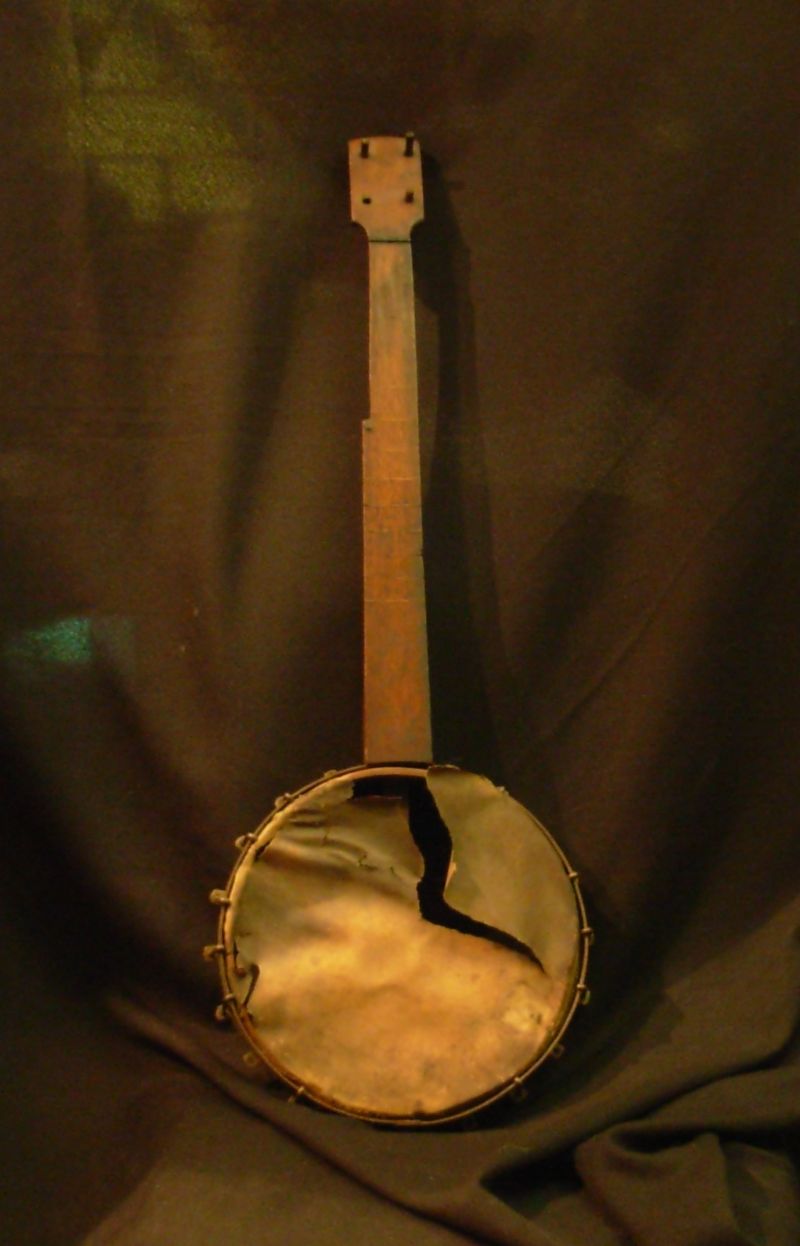
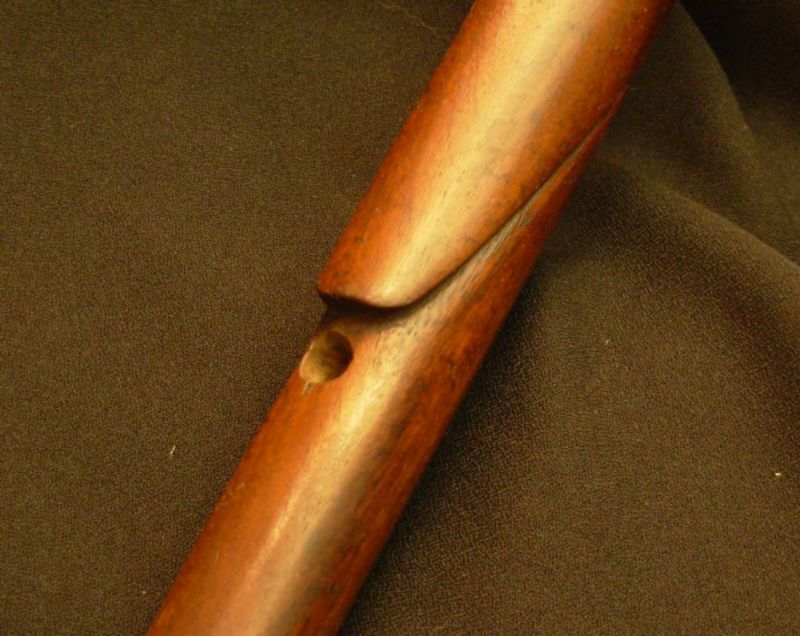
This banjo followed me home from an antique co-op today. If the seller's story is to be believed, this is a GENUINE CIVIL WAR BANJO. However, I didn't pay a Civil War price for this one and I'm trying to puzzle it out.
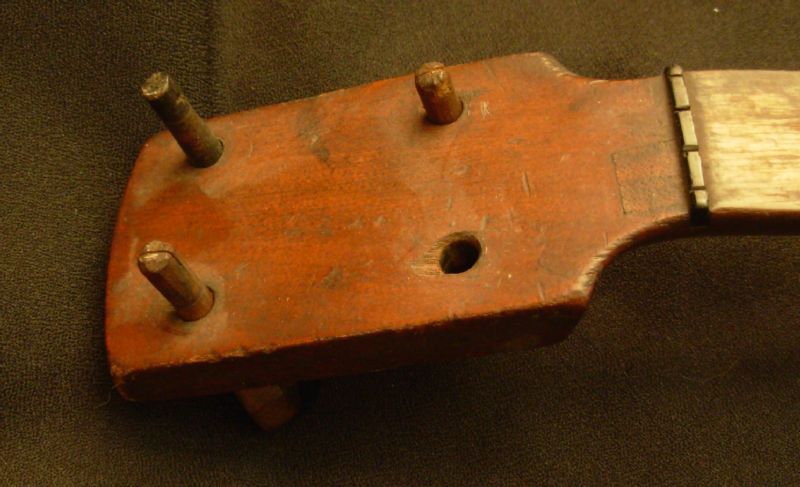
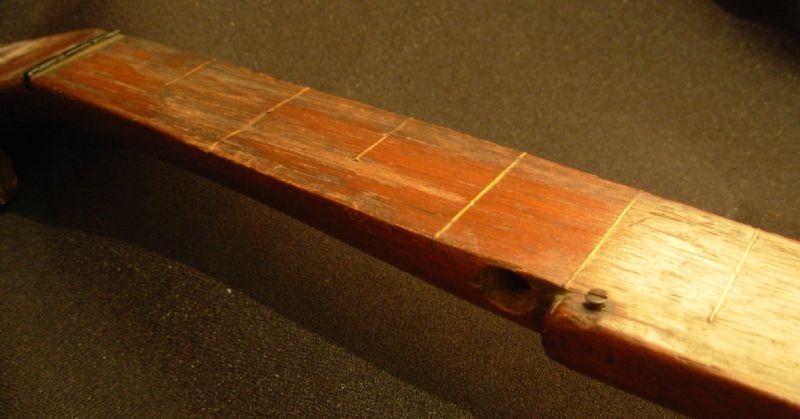
Neck - looks old & bona-fide. Graduated flush-fretting (photo #07) looks like another banjo that I have which I believe to be genuine. It appears that the original finish on the fingerboard was glossy, like my other flush-fret. Rutting on 1st & 3rd strings from frets 1-5 looks authentic.
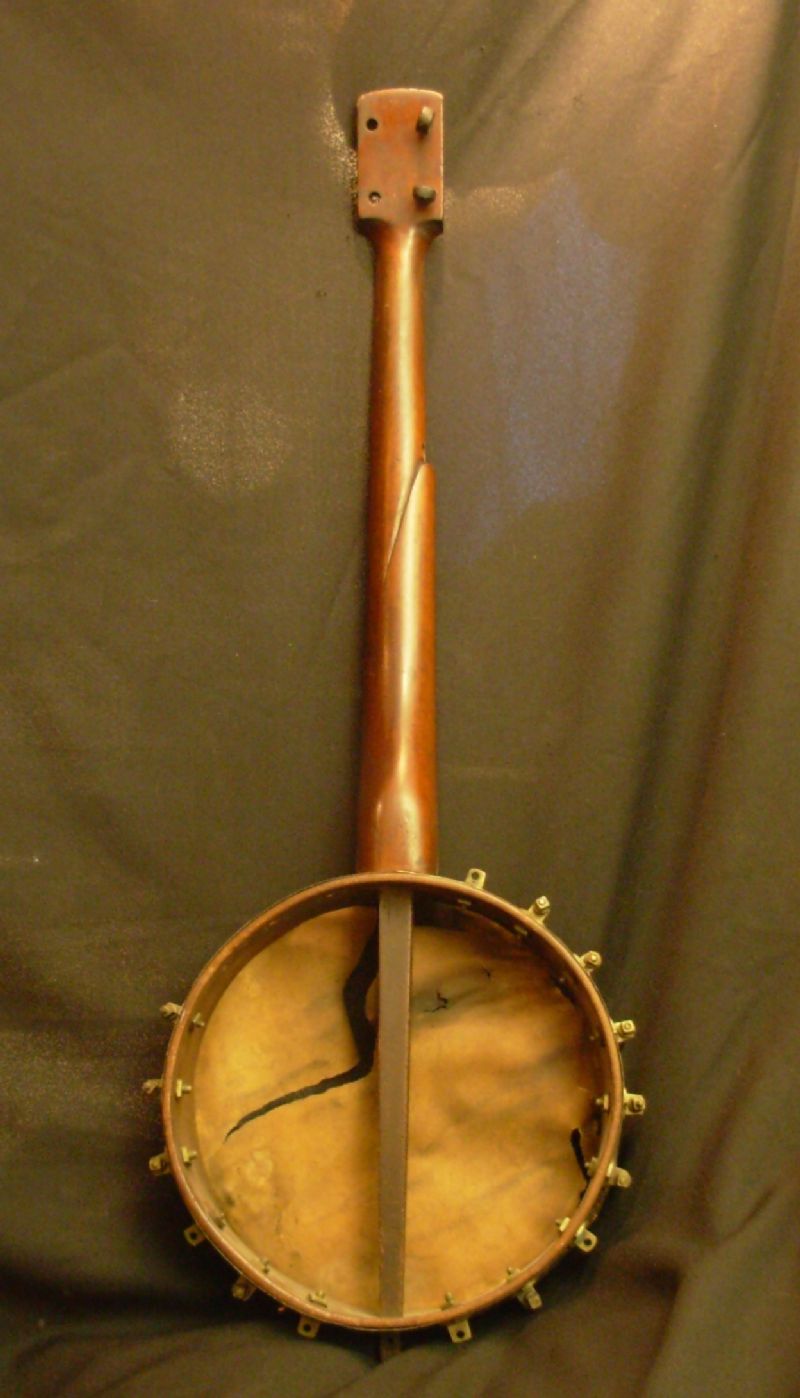
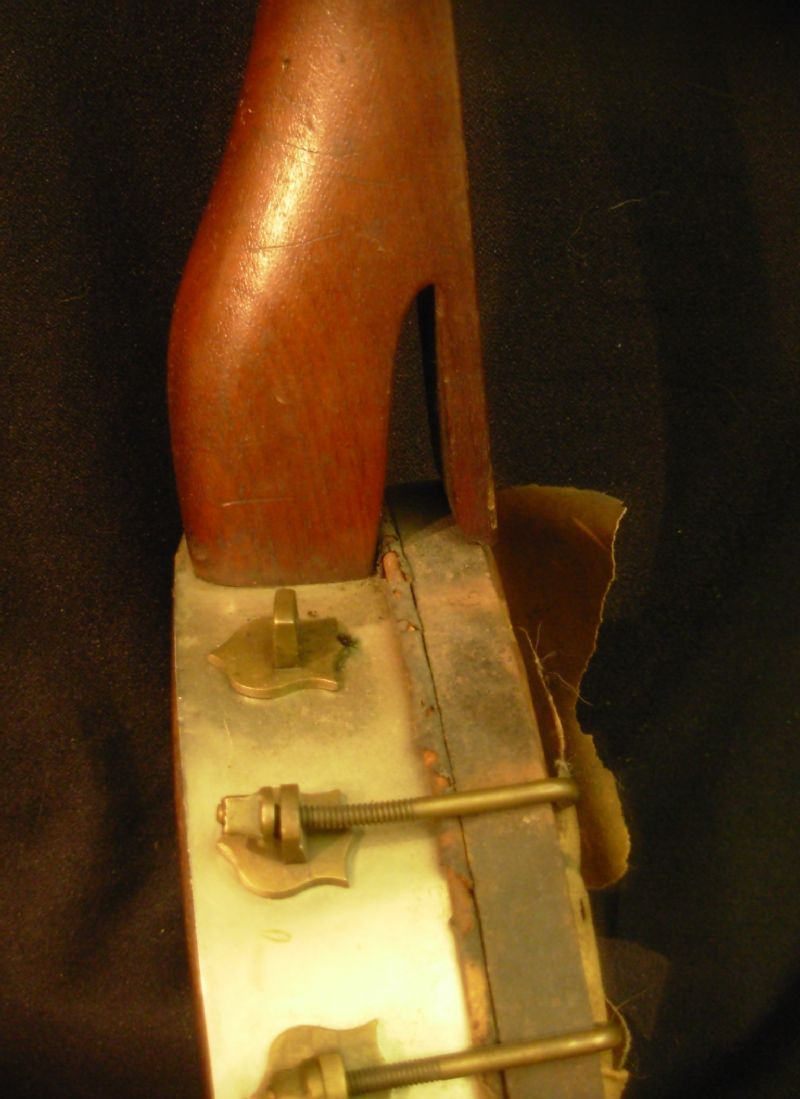
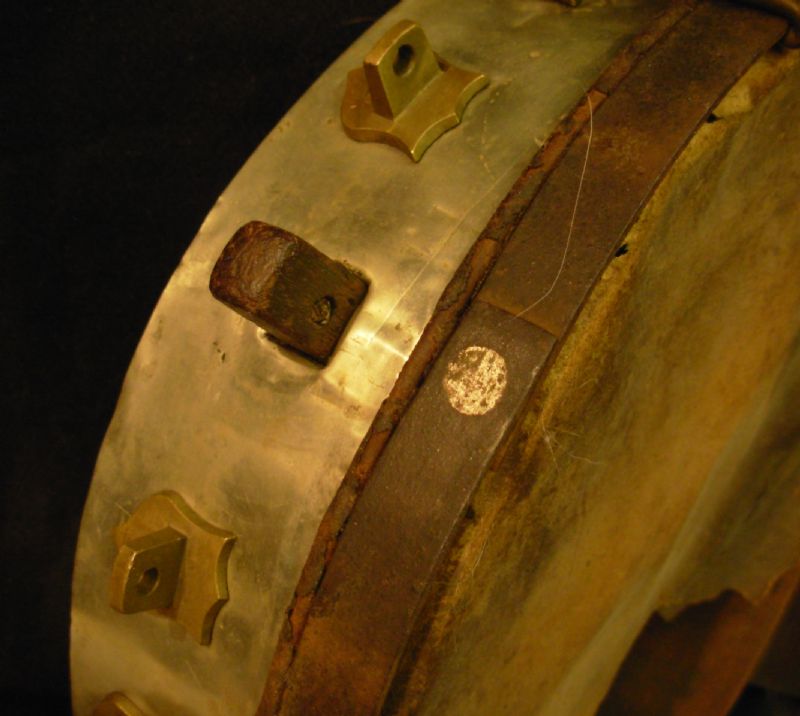
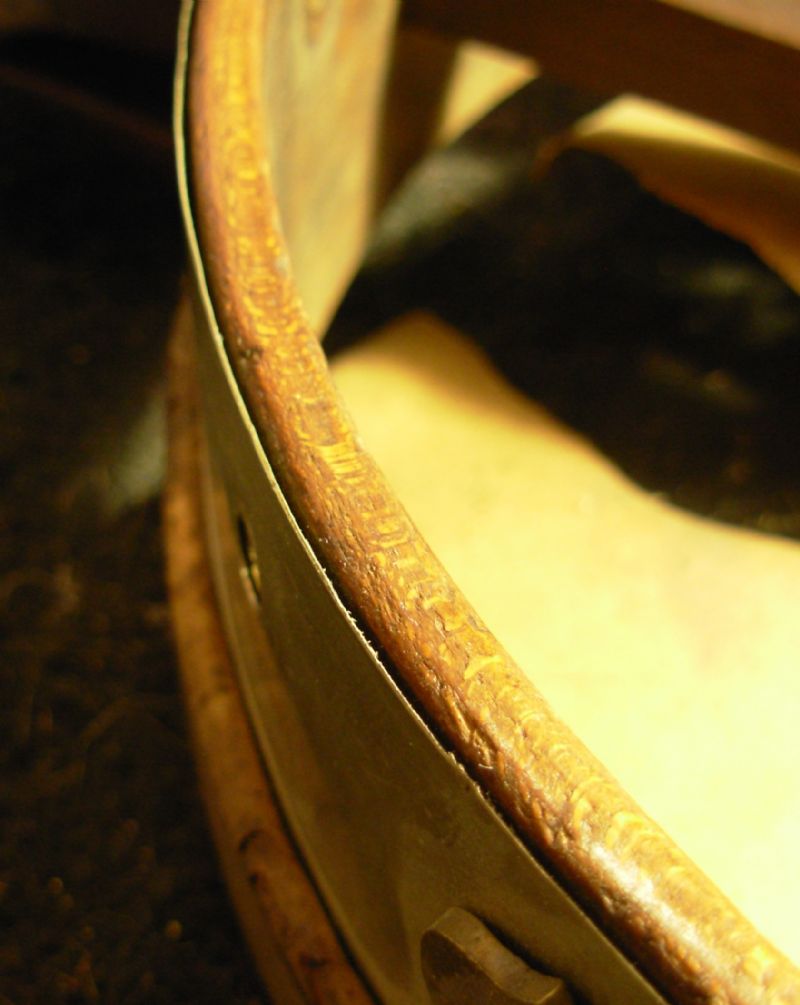
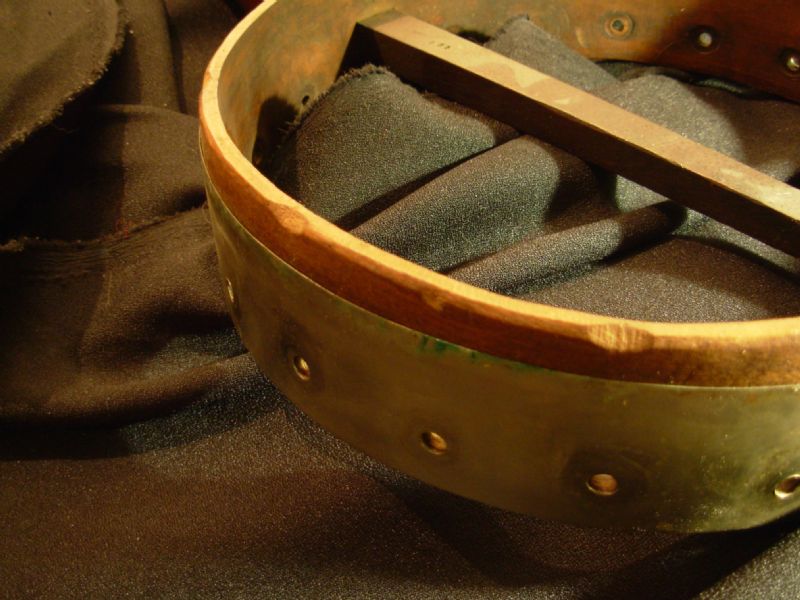
Pot - Wood looks old & bona-fide - roughly 1/4" thick w/ single, approx 6" scarf joint, roman numeral III near heel. Not sure about the metal - gage looks right (#10), has dense, tiny pitting away from shields (#12), glossier nickle plate under shields. Looks to me like the metal might be old, but heavily polished and oiled in the not-too-recent past. I've also seen non-ferrous metal cladding that was painted and the metal beneath the paint stayed in pretty good shape. Tension hoop looks genuine.
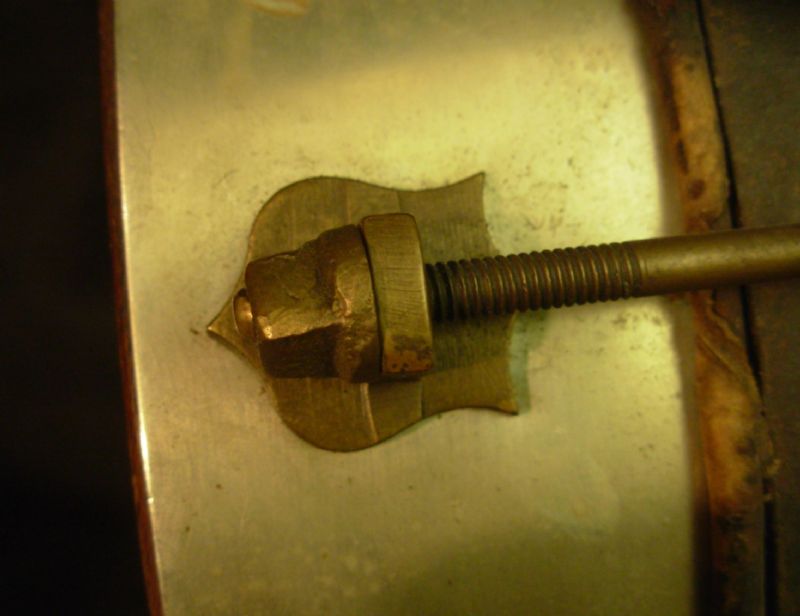
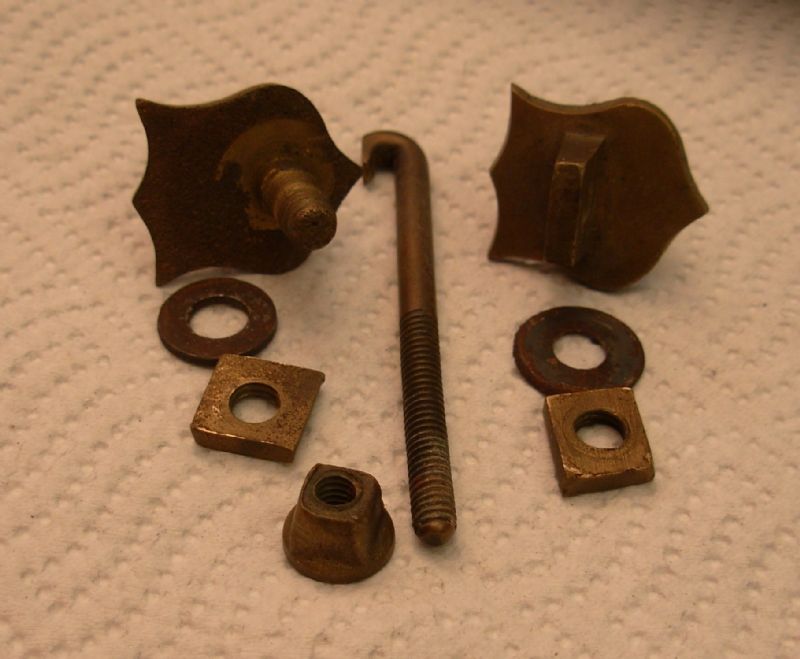
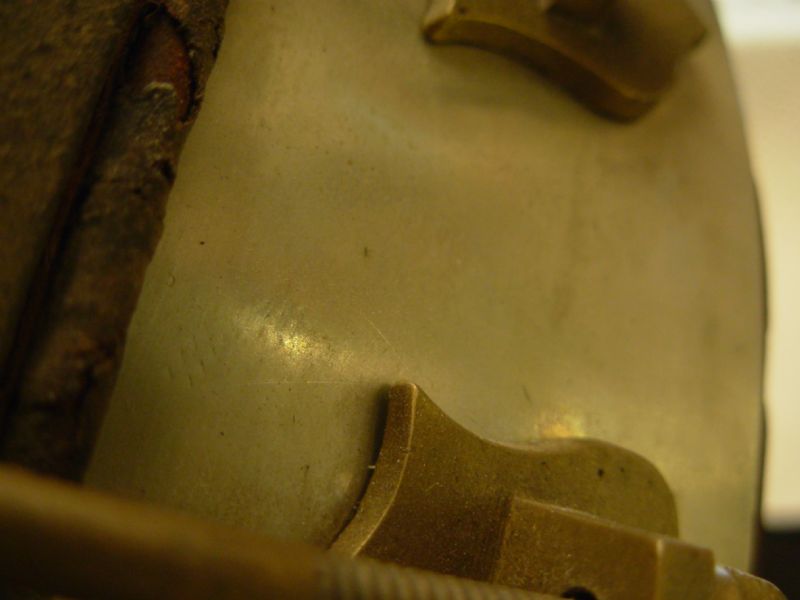
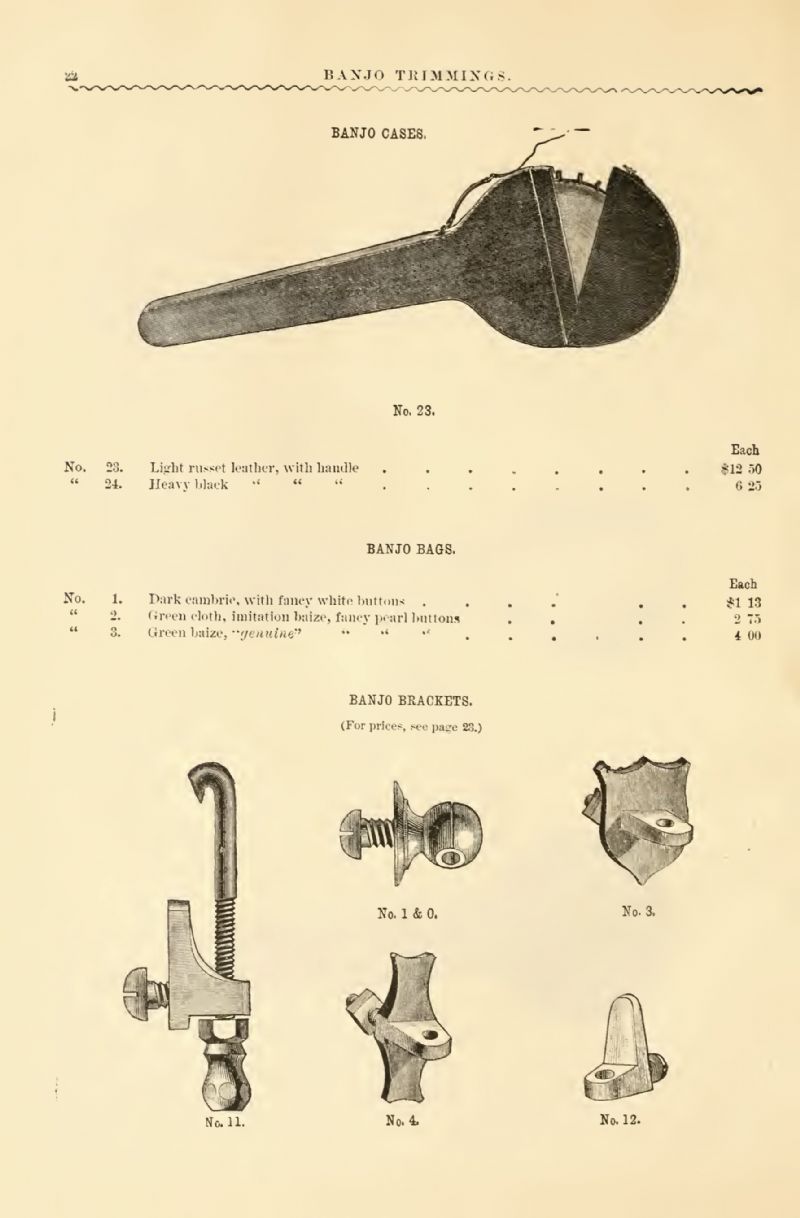
Hardware - looks questionable. I don't recall seeing very plain shields like these before. It's possible that the shields were heavily polished in the not-too recent past, because they're so clean yet they do have a little tarnish. Shields are pitted and tarnished on the back side. Hooks and square nuts also look too clean, maybe also heavily polished (#11).
SO..............
1. Does the pot cladding look original?
2. Is the pot hardware (shields, hooks and nuts) reproduction ?
3. Has anyone ever seen plain shields like these (either original or reproduction) ?
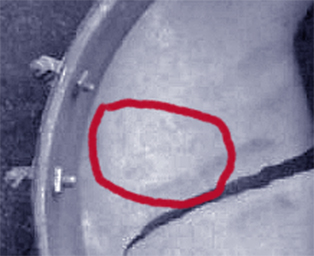
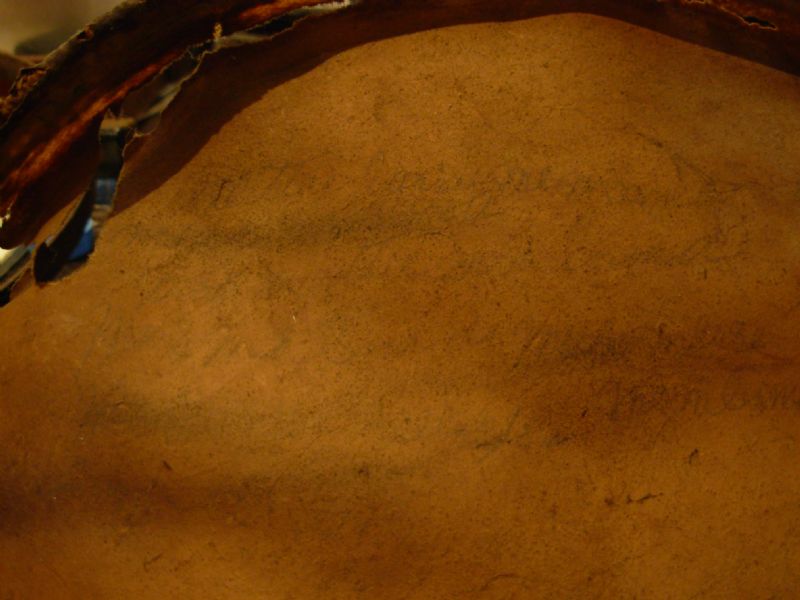
4. There is writing on the back that I can't read - it appears to be in an old penmanship style - and the "provenance" for the banjo is that the writing describes the name and unit of the Civil War soldier owner. Does anyone have suggestions for making very faint writing on hide more legible ?
Mark
Jim D - Posted - 04/12/2014: 17:10:52
Mark I played with the photo of the inside of the pot... I'm not even sure that I know where the supposed name and unit are written... this is my guess... but it's still unreadable.
If you'd take a high res closeup and PM me, I'll PM back my email so you can send it to me and I'll see what I can do to enhance it a bit more.
Jim
 |
skip sail - Posted - 04/12/2014: 17:56:34
I reckon the pot hardware is original to the banjo. The crudeness of the workmanship on the hardware matches the rest of the instrument and, even though there is a difference in patina,my gut instinct is telling me this instrument is a cohesive unit.
trapdoor2 - Posted - 04/12/2014: 18:48:59
This banjo has many of the early earmarks: hardware is hand-made (square bolts with off-center holes, evidence of file marks, etc.). Unfortunately, much of this hardware was catalog-sold well into the 20th cent. There has been some discussion as to whether the "Shield" motif brackets even existed until after the war. Foundries could make far much more money in war production (buttons, buckles, etc.) than banjo parts.
Another clue can be the bolt threads. Thread pitch in the US was not standardized until 1864. If they turn out to be a modern "standard" pitch, I'd say post war. Not definitive...but a clue nevertheless. Many small shops hand-cut threads with files, etc. A good test is to find out if the nuts and threads are interchangeable. If they aren't = handcut = early, if they are = machine cut = later.
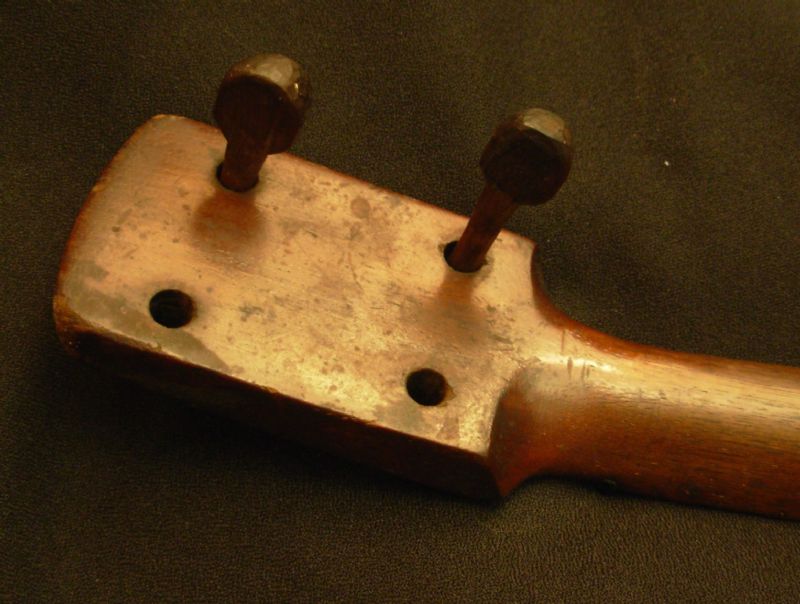
The form of the neck, the 5th string peg being horizontal, is somewhat later...maybe 1860's but certainly 1870's...and it looks like a factory banjo to me. Interesting carving to the 5th string...back of the neck. Early Buckbee?
The signature and unit number don't mean much. Could have been owned by a proud veteran.
Without very specific provenance, I'd say 1870's, maybe mid-to late 1860's if the threads are hand-cut.
beegee - Posted - 04/13/2014: 04:37:46
I agree with Trapdoor. I think it's closer to the Spanish-American War era.
Mark Ralston - Posted - 04/13/2014: 04:39:51
There are at least 4 different thread pitches and/or diameters of the threaded posts that pass from the shields through the pot wall. You would expect a modern reproduction to have consistent diameter & thread pitch. There are at least 2 thread pitches and/or diameters of the hooks and nuts.
I agree that this looks like a "factory" banjo, and it has construction features that look like Buckbee, in my opinion.
I'm interested to hear if anyone recognizes the plain shields.
Jim D - thanks for the offer to help with the writing. I'll take some high-res pictures, and send you the one that contains the area w/ the most legible writing. All of the writing is very faint, and I think that it may take something like different wavelength light or else physical/chemical treatment to make it legible. I'm in no hurry, won't do anything to hurt the head.
BTW, the pot cladding doesn't attract a magnet, and the tension hoop does.
Edited by - Mark Ralston on 04/13/2014 04:42:55
Joel Hooks - Posted - 04/13/2014: 04:45:24
Tell us what size the rim is and I'll post a catalog image from the 1880s of your banjo. That is not to say that is not from an earlier vintage, just that (as Marc wrote) still made and marketed all the way through the 19th.
Funny thing about ACW era banjos. We have accounts from folks who lived through that era as or becoming famous banjoists. The way they tell it, before and at that time good banjos came from just a couple of folks.. Wilson and Farnham or Jimmy Clarke. These folks did not build in large numbers (and in the case of Clarke continued to build until he died of TB). Clarke banjos were especially famous being played by Converse, E. M. Hall, Horace Weston, Lon Morris, Al Baur... heck anyone of banjo merit pre 1880.
These folks built for Pro players-- the minstrel stage. There were also the Jacobs banjos (these seem to have been produced in numbers). Patterns of all these styles can be seen in the photos I posted of pro minstrels on the ning site.
Before the war, banjos varied greatly.
It was the Clarke pattern that really took hold. That is what the later factory banjos tried to look like including this one (until the Stewart pattern, then they look like SSS').
I've mentioned before, but think in terms of modern electric guitars. Most folks cannot get the same custom guitar as played by their favorite guitar icon-- but they can buy affordable Chinese imitations that look just like it.
People wanted to play banjo because of the popular stage minstrels. Naturally they wanted their banjos to look like the one they saw Frank Converse play.
This development of standards took place parallel to the ACW. The factory versions of Carke banjos begin to show up right at the end and just after the war.
I'll side with Marc and say that your banjo is 1870+, still very cool. If the rim is 11"+ then it is exceptionally cool and should be re-headed and played.
Mark Ralston - Posted - 04/13/2014: 05:07:12
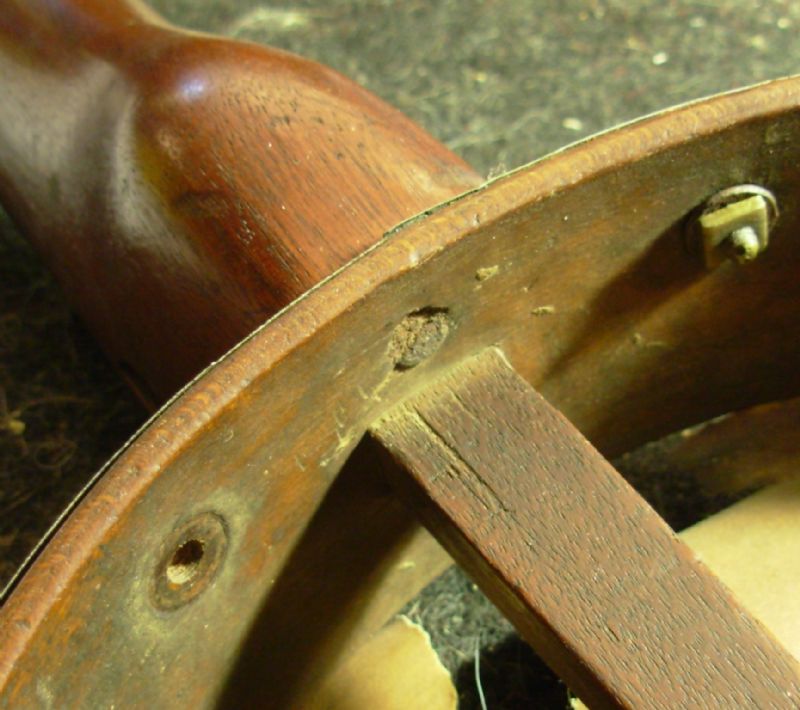
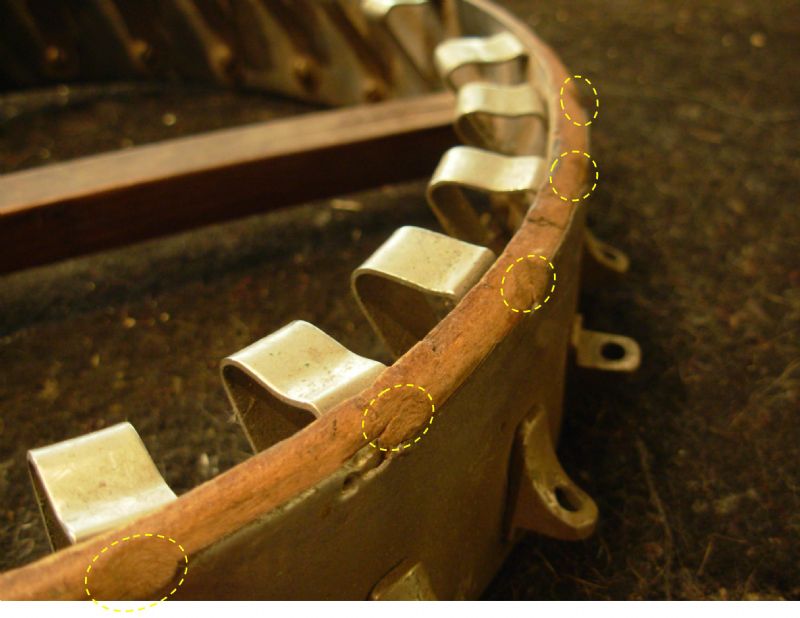
I took the head off for photos, pot is ~ 10 3/4" dia and ~ 2 3/4" deep. It also has dimples on the top of the rim. I've seen these dimples before on other probable-Buckbee banjos, but I think that the other dimples were spaced every shoe/hook. These dimples are spaced every other shoe/hook. Anyone have an idea why these dimples were made? When I saw these dimples before I thought that they were intended to keep the top of the hooks away from the skin, but that would only work if the dimples are spaced every shoe/hook.
The top of the pot appears to be roughly hand-rounded, i.e., not turned. Top of dowel also has Roman numeral III. The entire banjo minus tension hoop is light as a feather.
Definitely a keeper......... and thanks for the comments.
Edited by - Mark Ralston on 04/13/2014 05:15:53
 |  |
Andy FitzGibbon - Posted - 04/13/2014: 05:17:29
Looks all original, probably Buckbee made, 1870s-1880s vintage. I have seen the plain shield brackets on many cheap banjos of the era.
The Sellers thread standard was adopted in 1864, but implementation of the standard took place over many years after that- particularly in non-critical applications like banjo hardware. Lots of banjos from the 1880s and 1890s have non-standard "proprietary" threads.
Joel Hooks - Posted - 04/13/2014: 05:22:01
Bruno, did a lot of trade with JHB, 1889 (date written inside the cover, late 1880s anyway).
Thanks for sharing!
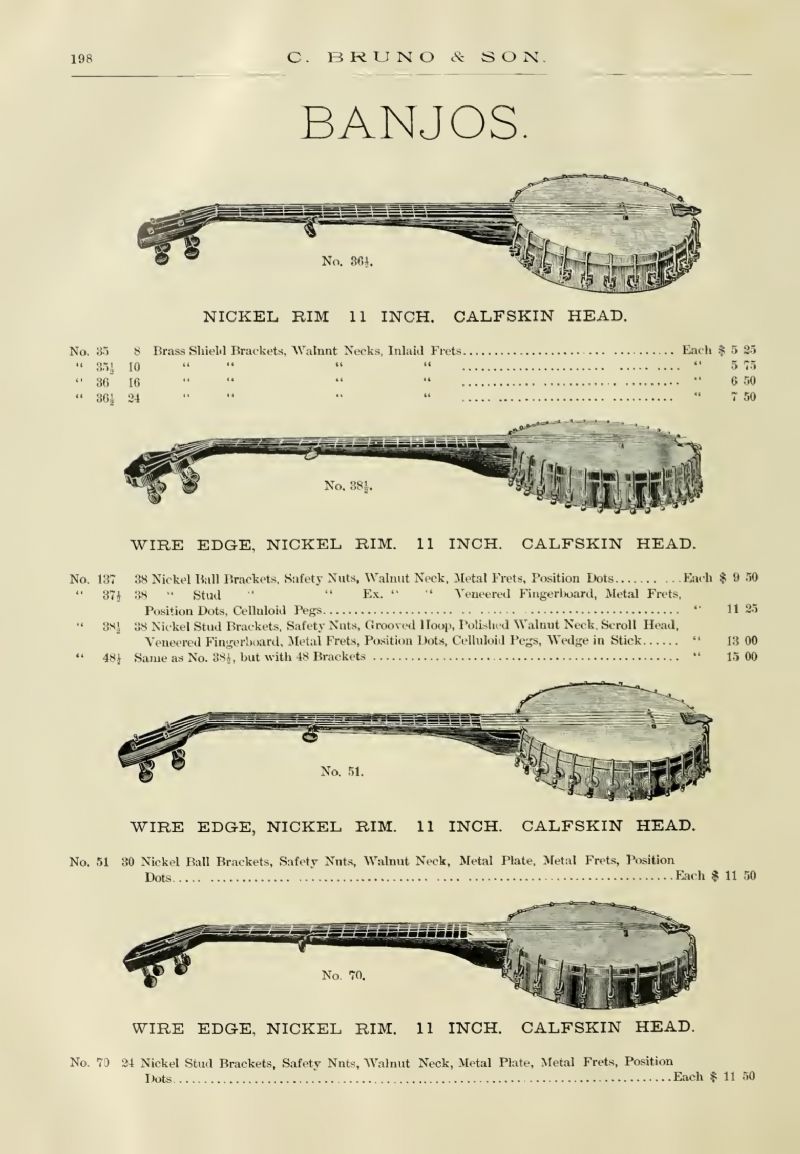 Bruno late 1889ish |
Mark Ralston - Posted - 04/13/2014: 05:53:14
Here's another probable-Buckbee pot with dimples (outlined). This banjo has the common, double-teardrop peghead that I associate w/ Buckbee. The dimples on this one are shallower than the ones on the banjo I found yesterday, the rounded top of the pot looks as though it may have been turned on a lathe rather than hand-shaped, and the dimples are placed at each shoe/hook location.
 |
trapdoor2 - Posted - 04/14/2014: 07:33:00
I think your "dimples" are an artifact of the really thin tension hoops used on these banjos. The hooks overhang the inside of the tension hoop by quite a bit and as you crank down the hoop and get close to level with the head surface, they start to cut into the head. These dimples are probably clearance cuts so that the hooks do not dig into the head and cause a cut or stress point.
RioStat - Posted - 04/15/2014: 19:17:01
Similar "shields" on this thing?
ebay.com/itm/Antique-1870s-5-S...016.l4276
davidwigal - Posted - 04/15/2014: 19:35:31
Why only four tension-hooks? Do the fewer hooks mean an older instrument?
wwatson - Posted - 04/15/2014: 21:04:23
It may be possible that extra brackets were added, at a later date, in-between the originals. This could explain the dimples at every other bracket and the different thread sizes. The quality of banjos were often judged by the number of brackets, the more the better. So this could have been a cosmetic upgrade.
Mark Ralston - Posted - 04/16/2014: 14:56:19
Bill - I bet you're right...... the pot has 18 hooks & shoes now, I bet half were added as an upgrade after manufacture and no additional dimples were filed in the top of pot to correspond with the new hooks & shoes.
Mark R.
Terms of Use | Privacy Policy | Privacy Consent (EU/GDPR Only)
Copyright 2026 Banjo Hangout. All Rights Reserved.