
DVD-quality lessons (including tabs/sheet music) available for immediate viewing on any device.
Take your playing to the next level with the help of a local or online banjo teacher.
Weekly newsletter includes free lessons, favorite member content, banjo news and more.
Premier Sponsors


|
Please note this is an archived topic, so it is locked and unable to be replied to. You may, however, start a new topic and refer to this topic with a link: http://www.banjohangout.org/archive/281837
EggerRidgeBoy - Posted - 03/21/2014: 15:45:10
Today's Tune of the Week is Arkansas Hoosier, which comes to us from Ozark fiddler George Mert Reves. I learned of the piece last month when it was my local jam's own Tune of the Week. I liked the tune itself, and I was intrigued by its seemingly oxymoronic title (for those who may not know, Indiana is known as the "Hoosier State", and its residents are commonly referred to as "Hoosiers").
GEORGE MERT REVES
George Mert Reves was a fiddler from the Ozark region of Arkansas, Oklahoma, and Missouri. I have been unable to uncover much information about him, other than that he was active in Arkansas in the 1960s. (He may have been the George Mirt Reves I found who was born on March 15, 1894 in Arkansas and died on January 6, 1992 in Cookson, Oklahoma. That George Reves gave his profession as "farmer" and spent much of his life moving back and forth between northern Arkansas and eastern Oklahoma.) In 1964, his nephew Merle Reves made home recordings of George in Dennard, Arkansas, and it is from that session of about 30 tunes that we get Arkansas Hoosier. As far as I know, the recordings were never released commercially, but they can be found on the Slippery Hill site. slippery-hill.com/Arkansas/
"ARKANSAS HOOSIER"
As noted above, I assumed the title of the tune referred to both Arkansas and Indiana, and I wondered what kind of historical or demographic quirk had created a community of people known as "Arkansas Hoosiers". It turns out, however, that the term "hoosier" predates its use as a nickname for Indiana. The origin of the word is murky at best, as are the reasons it came to be applied to people from Indiana, but it is clear that it was around before 1828 (when it was first used in reference to that state) and that it has had various shades of meaning in the decades since. What, exactly, those meanings were or are is not always clear, but the definition given in the 1877 "Dictionary of Americanisms" is probably a good place to start: "a big, burly, uncouth specimen or individual; a frontiersman, countryman, rustic."

Arkansas Hoosier is most commonly played in D. The tune has a somewhat unusual AABCC structure - a short first part that's repeated, a bridge phrase that's not repeated, and a regular-length last part that is repeated. Fiddle notation can be found in the Millner-Koken Collection (#718), but I have not yet tracked down any banjo tablature.
Audio and Video Versions
The 1964 recording of George Mert Reves: slippery-hill.com/M-K/GDAE/D/A...osier.mp3 (missing the first couple of notes on the first part)
Claire Millner and friends: youtube.com/watch?v=BwsaiX3jjJM (recording begins in the midst of the last part)
Edited by - EggerRidgeBoy on 03/21/2014 16:50:32
LyleK - Posted - 03/22/2014: 19:11:19
Definitely a new one for me.
And then there's the theory that the tune is actually "Arkansas Hussars" (see listserv.brown.edu/archives/cg...mp;P=4784), though the thought of Hungarian light calvary roaming through Arkansas seems a bit far-fetched.
Anyhow, I'm ponying up a version and tab (as that does seem to be unavailable elsewhere)
 Arkansas Hoosier Tab |  Arkansas Hoosier |
EggerRidgeBoy - Posted - 03/24/2014: 15:20:39
quote:
Originally posted by RGWhat a great tune!
Glad you liked it, RG!
EggerRidgeBoy - Posted - 03/24/2014: 15:36:44
quote:
Originally posted by LyleKDefinitely a new one for me.
And then there's the theory that the tune is actually "Arkansas Hussars" (see listserv.brown.edu/archives/cg...mp;P=4784), though the thought of Hungarian light calvary roaming through Arkansas seems a bit far-fetched.
Anyhow, I'm ponying up a version and tab (as that does seem to be unavailable elsewhere)
Yes, it was new to me, too. In the weekly email sent out by the jam leader, he described Arkansas Hoosier as "a tune that's been popular on the festival circuit for awhile and well worth learning even though it's a bit of a challenge". I hadn't come across it until that jam session, but then I guess the fact that our local group was playing it could be considered a sign of its current popularity.
I, too, came across the "Hoosier = Hussar" theory, which probably makes sense when considering the tune The Wounded Hoosier. As you note, it is somewhat more difficult to find a connection between Hungarian Hussars and Ozark farmers.
Thank you very much for posting your version, both the audio and the tablature. I think this is the first time I have posted a TOTW that included neither a solo banjo version nor banjo tab. I was actually considering two or three other tunes for this week's submission, but had to pass on them for one reason or another, and ended up going with Arkansas Hoosier as a bit of a last-minute emergency back-up tune. I was assuming or hoping that I could find tab somewhere online or in my tune book collection, but never did. So thanks again for helping to make this TOTW a bit more complete.
Edited by - EggerRidgeBoy on 03/24/2014 15:39:38
Don Borchelt - Posted - 03/25/2014: 07:25:13
This is definitely one of the best tunes I've heard lately, a great choice for TOTW. A great version by Lyle, smooth like it is supposed to be. It didn't come easy for me to figure it out; I've been working on it off and on since Friday, and as I've gone along, I've been taking out more notes than I have been putting in. I'm kind of happy with it now, though I still need to practice it for a few more years! I worked mostly from the Cliffhangers fine version. I have posted the tab of my three-finger arrangement on my webpage.
- Don Borchelt
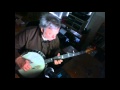 VIDEO: Arkansas Hoosier (click to view) |
Don Borchelt - Posted - 03/25/2014: 13:14:46
Oh yeah, ERB, I loved the discussion of the etymology of "hoosier."
Nita - Posted - 03/25/2014: 15:33:52
Great tune choice. I was only familiar with the tune via Mark Simos & the Cliffhangers, and it's wonderful to hear the source, George Reves. Ever since I first heard it on the Cliffhangers CD, it's a tune that's stuck with me. There's something special about it. - My father-in-law was a Hoosier from Indiana, and proud of that moniker. He became a flutist, composer, & conductor, but started out playing fife in his highschool marching band. It's only now I learn that Hoosier was very often a derogatory term.
BrendanD - Posted - 03/25/2014: 17:00:52
EggerRidgeBoy, thanks much for posting this tune, as well as all those references to the term "Arkansas Hoosier"! I'm the banjo player on that Cliffhangers recording of the tune, and it was my banjo-playing wife, Maxine Gerber, who suggested we record it. We have a homemade CD of field recordings of George Mert Reves, as well as one of his nephew, Merle Reves, and they both play this tune. My friend Paul Harnik (a wonderful fiddler and guitar player) located and visited Merle a few years ago on a cross-country driving trip when his family moved from California to North Carolina.
The Cliffhangers also recorded George Mert Reves' tune "Rare Up", though the version we recorded has morphed a bit, containing bits of versions from Kerry Blech and Bruce Greene, as well as Mark Simos's own variations on the tune; I like all the versions.
Now I've got to go back and listen to all the various "Arkansas Hoosier" recordings linked to in this thread!
Tamarack - Posted - 03/25/2014: 19:33:58
Every week brings another great tune and great story.
I lived in metro St. Louis in the 1980s -- the term "hoosier" was most often applied to people from south St. Louis. As the son of an Indiana native, I had never heard it in a derogatory form. I enjoyed reading Elaine Viets' columns -- she was careful to distinguish "Hoosier" (a proud son or daughter of Indiana) and "hoosier" (as described above...).
JanetB - Posted - 03/26/2014: 06:41:58
A great treasure on Slippery Hill you've uncovered, Brett. I've enjoyed all the versions here. This one is played in aDGBD.
My only playing friend from Arkansas is Molly Pyatt. She could sing one Carter Family song after another and had their timing down pat. She outlived three husbands, and not that long ago got hit by a big truck as she was walking out of her driveway. Molly survived that and was walking around last I heard. She'd be in her 80's by now.
Arkansas Hoosier |
EggerRidgeBoy - Posted - 03/26/2014: 15:34:45
quote:
Originally posted by Don BorcheltThis is definitely one of the best tunes I've heard lately, a great choice for TOTW. A great version by Lyle, smooth like it is supposed to be. It didn't come easy for me to figure it out; I've been working on it off and on since Friday, and as I've gone along, I've been taking out more notes than I have been putting in. I'm kind of happy with it now, though I still need to practice it for a few more years! I worked mostly from the Cliffhangers fine version. I have posted the tab of my three-finger arrangement on my webpage.
- Don Borchelt
I'm glad to hear you enjoyed the tune (and the etymology discussion) so much, Don. I enjoyed your version very much - thanks for working it out and posting it.
EggerRidgeBoy - Posted - 03/26/2014: 15:59:36
quote:
Originally posted by NitaGreat tune choice. I was only familiar with the tune via Mark Simos & the Cliffhangers, and it's wonderful to hear the source, George Reves. Ever since I first heard it on the Cliffhangers CD, it's a tune that's stuck with me. There's something special about it. - My father-in-law was a Hoosier from Indiana, and proud of that moniker. He became a flutist, composer, & conductor, but started out playing fife in his highschool marching band. It's only now I learn that Hoosier was very often a derogatory term.
Like you, I never knew "Hoosier" as anything but a positive nickname for Indiana and its inhabitants - until researching this tune I didn't realize that at one time it had been used as a derogatory term (and evidently still is in some places).
How it came to be connected to Indiana is still, after all this time, quite the mystery. I had over the years come across the most popular folk explanations, none of which really made too much sense (for instance, most people, no matter where they live, probably answer a knock on the door by asking "Who's there?"). It seems likely that the term was first applied in the negative sense ("rough, rustic, uncultured") to early settlers in Indiana, who then over time remade it into a positive description ("tough, proud, independent"). However, one would think that the term could have been - and almost certainly was - applied to other frontier setters of the time in Ohio, Illinois, Kentucky, Missouri, etc., leaving unanswered the question of how it came to be associated with only one state. The ultimate derivation of the word "hoosier" itself - regardless of its past or current meanings - is also unclear.
(In case you are interested in learning more, the paper by Jeffry Graf mentioned in the post - indiana.edu/~librcsd/internet/...sier.html - discusses in great detail all the various theories and possibilities regarding the word's connection to Indiana.)
I'm glad you enjoyed the tune's appearance as a TOTW.
Edited by - EggerRidgeBoy on 03/26/2014 15:59:52
EggerRidgeBoy - Posted - 03/26/2014: 16:04:06
quote:
Originally posted by BrendanDEggerRidgeBoy, thanks much for posting this tune, as well as all those references to the term "Arkansas Hoosier"! I'm the banjo player on that Cliffhangers recording of the tune, and it was my banjo-playing wife, Maxine Gerber, who suggested we record it. We have a homemade CD of field recordings of George Mert Reves, as well as one of his nephew, Merle Reves, and they both play this tune. My friend Paul Harnik (a wonderful fiddler and guitar player) located and visited Merle a few years ago on a cross-country driving trip when his family moved from California to North Carolina.
The Cliffhangers also recorded George Mert Reves' tune "Rare Up", though the version we recorded has morphed a bit, containing bits of versions from Kerry Blech and Bruce Greene, as well as Mark Simos's own variations on the tune; I like all the versions.
Now I've got to go back and listen to all the various "Arkansas Hoosier" recordings linked to in this thread!
Thank you for those Cliffhangers CDs - I discovered them as a result of researching this tune.
I'll have to check out "Rare Up" - George Reves seems to be one of those relatively obscure fiddlers who, fortunately, was able to pass down to us a handful of wonderful tunes we might not know of otherwise.
EggerRidgeBoy - Posted - 03/26/2014: 16:09:26
quote:
Originally posted by TamarackEvery week brings another great tune and great story.
I lived in metro St. Louis in the 1980s -- the term "hoosier" was most often applied to people from south St. Louis. As the son of an Indiana native, I had never heard it in a derogatory form. I enjoyed reading Elaine Viets' columns -- she was careful to distinguish "Hoosier" (a proud son or daughter of Indiana) and "hoosier" (as described above...).
One of the things I like most about tune research - whether doing my own or reading that done by others - is the somewhat random but often very interesting bits of information it uncovers, whether biographical, historical, linguistic, cultural, scientific, or otherwise. You just never know where a tune is going to lead you.
Glad you enjoyed this tune and its story.
EggerRidgeBoy - Posted - 03/26/2014: 16:14:32
quote:
Originally posted by JanetBA great treasure on Slippery Hill you've uncovered, Brett. I've enjoyed all the versions here. This one is played in aDGBD.
My only playing friend from Arkansas is Molly Pyatt. She could sing one Carter Family song after another and had their timing down pat. She outlived three husbands, and not that long ago got hit by a big truck as she was walking out of her driveway. Molly survived that and was walking around last I heard. She'd be in her 80's by now.
Your friend Molly sounds like a true Arkansas Hoosier- using the term in its positive sense, as it seems to have been applied to people like the woman in the Dorothea Lange photo, or the former slave Laura Hart. Strong and independent. She probably deserves an old-time tune of her own.
Thanks for posting your version - it's lovely.
Terms of Use | Privacy Policy | Privacy Consent (EU/GDPR Only)
Copyright 2026 Banjo Hangout. All Rights Reserved.


