
DVD-quality lessons (including tabs/sheet music) available for immediate viewing on any device.
Take your playing to the next level with the help of a local or online banjo teacher.
Weekly newsletter includes free lessons, favorite member content, banjo news and more.
Premier Sponsors


|
Please note this is an archived topic, so it is locked and unable to be replied to. You may, however, start a new topic and refer to this topic with a link: http://www.banjohangout.org/archive/281020
Page: 1 2
beezaboy - Posted - 03/07/2014: 14:13:37
Yes. (Well, pretty much).
First: Thank you Ed Ball, Ed Britt and Polle Flaunoe for your graciousness in sharing your knowledge and insights.
Second: A timeline.
Procedure: Gretsch/Bacon serial numbers have been thought to be chaotic and indecipherable. So, in seeking a solution I concentrated only on the Bacon "S"'s (Senorita, Serenader and Symphonie) - the primary models identified in catalog 50. I did not consider the Belmont (Polle once thought the Montgomery Ward inspired Belmont banjos had a separate serial numbering system) nor did I consider the Bacon Folk Models (Ed Britt had the impression that the Folk Models also had their own system). The keys were the change in tone ring design for the Serenader and Symphonie (traditional no-hole flat head to archtop) and the establishment of a fixed fretboard design for the Senorita that differed from the traditional. The immediate post-war models had followed Bacon Banjo Co. cues. These newly designed Bacon banjos had serial numbers with a zero prefix (f. ex. Senorita MB 0067 and TB 0116 (archtop); Serenader 0130 (archtop); Symphonie 0123 (archtop). Thereafter the serial numbers appear to be sequential. Note: I had very few models from the immediate post-war period to the early 1950's to work with.
Conclusion: Serial Number/Date for the Bacon "S"'s (Senorita, Serenader and Symphonie):
Problems: Four-Digit Serial Number - Pre or Post 1953? For Serenader and Symphonie if banjo is flathead then pre 1953. If archtop then 1953 et al. If Senorita pre-1953 will have traditional Bacon Banjo Co. fretboard design. cues. Four-Digit Serial Number - Date Coded or earlier Sequential? This is a problem for 1966 numbered banjos before the "USA" stamp in 1967. Many are Five-Digits so no issue. If pesky four-digit there is no answer except to examine build characteristics. The newer the banjo the more poorly will be the quality.
Finally: This is a work in progress. Posted to encourage comments and discussion. Not stone-carved - more like stone shaped I think it's real close. Maybe one day we'll be able to completely finish this monument to Gretsch/Bacon banjos.
Polle Flaunoe - Posted - 03/08/2014: 02:44:09
John,
Great ideas and work! I´m in the progress cross-checking your sequences with the infos in my extended database.
Sadly I did some years ago - in connection with an up-grade of the DB - loose the zero prefixes - I´ll try re-constructing the entries for these examples.
After a quick glance at my infos I do however expect some problems confirming your ideas. But - they make a splendid starting point - let´s see how it all ends.
More later
Polle
beezaboy - Posted - 05/05/2014: 07:39:55
Hello Gretsch/Bacon enthusiasts.
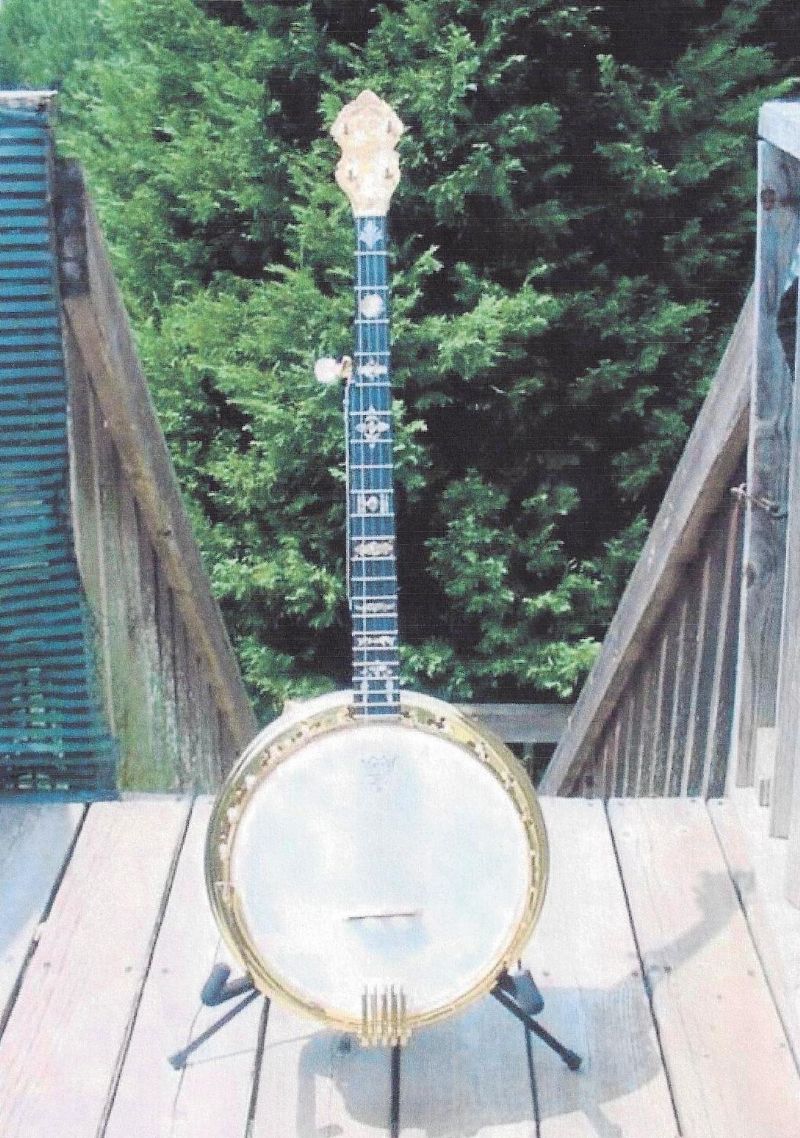
Five years ago B&D Serenader #36805 five-string sold on ebay. This banjo once belonged to Gunter Amendt.
The serial number is stamped on the dowel and rim. A couple of photos are attached.
See the curleycue on the seRenader? That is a Gretsch (not a Bacon) curleycue. Bacon curleycues were larger and with a definite flourish.
I believe Serenader 36805 was made during the year 1940 after Gretsch acquired the Bacon assets in Feb/Mar 1940.
I also believe that Gretsch continued the Bacon serial number consecutive sequence model until the war caused the cessation of Gretsch banjo making. After the war and in 1946 Gretsch banjo making resumed with serial numbers beginning at one (1). I've got a Gretsch #40 with a Dolar-Zink pot is one of the reasons I believe this to be the case.
Also, thanks Ed Britt for the Rajah information. As Ed has told us the Bacon Rajah brand was made for jobber Chicago Musical Instrument Co. Attached is the Rajah in the 1937 Chicago Musical Instr. Co. catalog. The Rajah is important to Gretsch/Bacon folks because Gretsch continued to make B&D Rajah banjos as we have seen with the 40XXX serial numbers.
I realize Gretsch/Bacon banjos are not of much interest to most banjo people UNTIL someone here buys a B&D Serenader or Bacon Symphonie represented to be a pre-war from Groton when it was actually a post-war from Brooklyn and the price paid for said banjo exceeded its fair market value because of the misapprehension concerning its lineage.
Edited by - beezaboy on 05/05/2014 07:44:23
 Serenader 36805 | 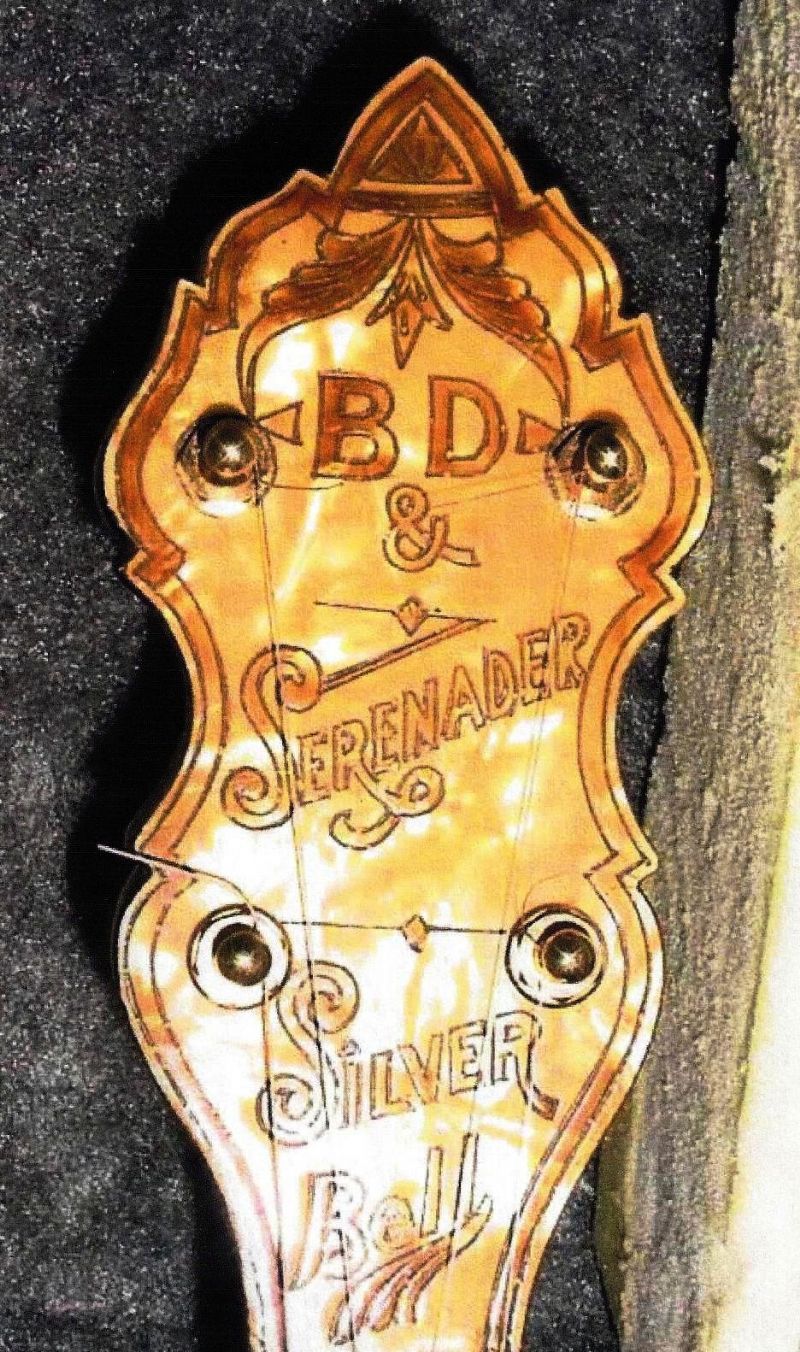 Serenader 36805 |  Tatham @ CMI 1937 | 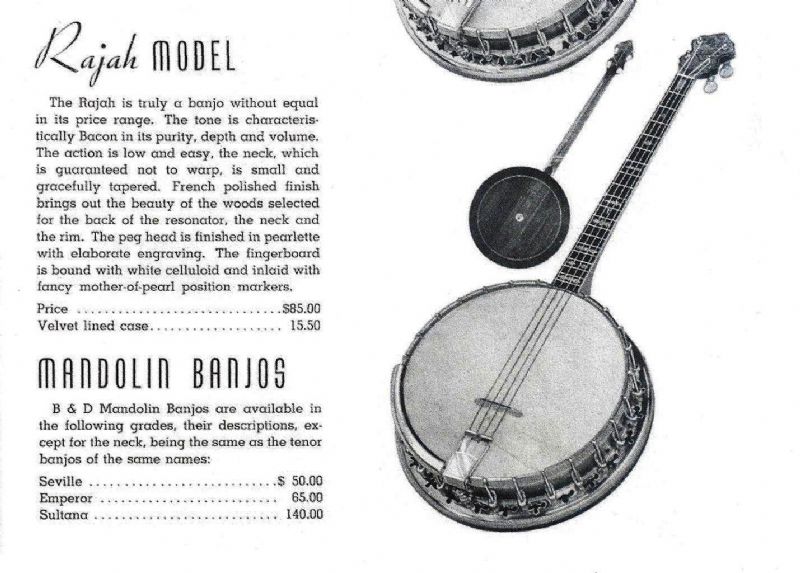 Tatham @ CMI 1937 |
Polle Flaunoe - Posted - 05/05/2014: 10:34:27
John,
Sorry - but I´ll have to gently disagree. Have a look at my DB - I have only 4 banjos in the Gretsch upper 3XXXX range (between the Groton sequence for now ending at 35713 and the Gretsch 4XXXX sequence:
SN 36805 - the Serenader as mentioned - this is a hybrid conversion/up-date - I wouldn´t trust this at all.
SN 37600 - the well known Symphonie #9 - banjoworld.de/High354.htm - it belongs to a friend of mine - I´ve worked on it several times - it´s a parts banjo/hybrid - the reso back is f.ex. prewar and the neck is most likely from the 50s/60s.
SN 39203 - a Bacon Symphonie SB - I have a confirmed first sales date in 1967 for this.
SN 39777 - a Bacon Symphonie SB - owned and later sold by me - another mid 60s build:

Sorry! 
Polle
Edited by - Polle Flaunoe on 05/05/2014 10:39:26
beezaboy - Posted - 05/05/2014: 10:57:56
Well, shucks. I thought I'd found a smoking gun.
Still, the #36805 matching numbers is intriguing.
Polle Flaunoe - Posted - 05/05/2014: 11:36:22
John,
Don´t despair - keep up the good spirit - the banjos in the upper 3XXXX range are too few to be noticed - for now.
I´m extremely busy these months - having my "mansion" overhauled and put up for sale - but once I can see some light at the end of the tunnel, I´ll give your ideas some thoughts - based on my DB´s and archives.
Regards
Polle
PS!
Too many luthiers/craftsmen do/did own and use number stamps like the ones owned/used by Bacon. I´ve seen very many number fakes - of the past - but sadly also of the present.
Polle Flaunoe - Posted - 05/07/2014: 01:26:29
John,
I have this morning had a chance looking closely at the Post-Groton Senorita, Serenader and Symphonie examples.
I have relatively few dating fix points and/or detailed infos for them - however it turns out, that none of these (except of course for the 4XXXX and some MMYYNNN examples) do fit the SN sequence order as suggested by you above.
It´s simply a mess - I doubt, that I´ll ever myself be able finding my way through this.
Do you recall our BHO friend - the Gretsch guitar researcher? Has he maybe in the later years stumbled over some factory records? Or maybe a compliance with the banjo SN´s?
BTW - I did also this morning manage persuading my DB-programs to accept SN´s starting with a zero - however I can´t for now recreate any missing zero´s - most of them have been lost icw. earlier up-dates of the DB´s. So - please have an eye open for any missing zero´s after your SN 0130 and up to SN (0)999.
Regards
Polle
beezaboy - Posted - 05/07/2014: 07:27:24
Polle -
Thank you for taking the time to look at your Gretsch/Bacon database. I know that it is a real brain cell killer to study this topic!
Ed Ball is primarily a guitar-man. He has been busy solving the Gretsch guitar serial numbering system especially the 6120 model. He is also interested in banjos and has done a nice job solving the Gretsch branded banjo serial numbering system. I've been studying Gretsch/Bacon serial numbers for five years now and Ed asked if I had reached any conclusions. Hence, the work in progress estimates listed above. Ed is also skeptical about my estimates but I thought I'd post my theory here in hopes that it might develop some new and revealing information. To my knowledge Ed has not encountered any new data for this inquiry.
One of the fundamental difficulties in solving the Gretsch/Bacon serial numbering system is their change from consecutive numbering to date-coded numbering. This is where the appearance of duplicate numbers comes into play.
So,
When did Gretsch institute the date-coded serial numbers? Gruhn says 1965. Jay Scott says 1965. Ed Ball says Aug. 1966.
When did Gretsch institute the "Made In USA" stamp followed by date-coded serial numbers? Gruhn says 1967. Jay Scott says 1967. Ed Ball says June 1967.
So, there is a period of time ca 1965-1966 to 1967 that Gretsch was stamping date-coded serial numbers that have the same appearance and perhaps the same number as one of the earlier consecutively numbered examples. Once the "USA" stamp was employed the matter became easy. All "USA" stamped serial numbers are date-coded (MM-YY-Unit).
For example in the public database we see listed RB Symphonie 4976 archtop. The public database is otherwise silent about cues as to whether this is a consecutive or date coded serial number. It turns out that this particular banjo bears a "USA" stamp (attached) so we know that it is date coded (April 1969). The pre-"USA" date-coded serial numbers that do not bear the "USA" stamp from ca 1965/66-1967 are extremely problematic. See for example my personal Symphonie #26020 (attached). I believe this is a bungled attempt to employ the initial date-coded serial numbering system in 1966. And the second smaller "26" following the traditional serial number stamp is to reinforce that this is a February 1966 banjo. So, to repeat myself - differentiating consecutive numbers from pre-"USA" date coded numbers that occurred from ca 1965/66 to 1967 would seem to be perhaps impossible.
So, it may be that I have been engaged in a fool's errand for the past several years and a definitive interpretation of the Gretsch/Bacon serial numbering system is not within the realm of probability. Still, we've learned something about Gretsch/Bacon serial numbers and the serial number can be used as one of the factors to be considered together with build characteristics and other cues to date one of the Gretsch/Bacon "S"'s models.
John
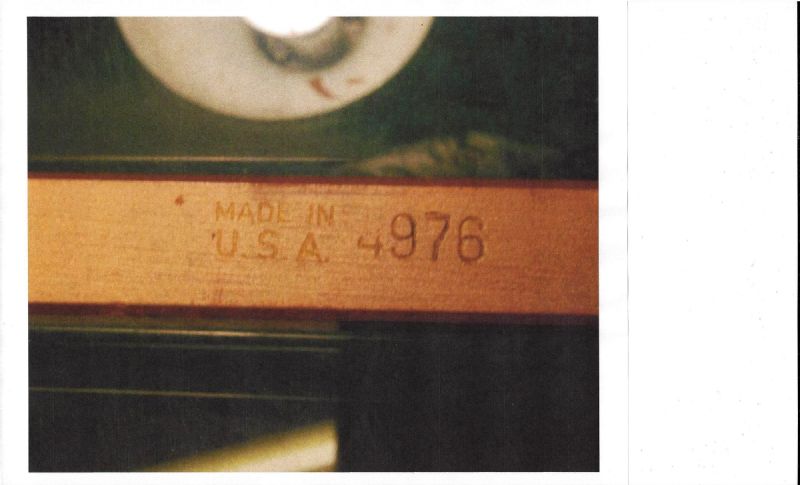 Symphonie USA4976 | 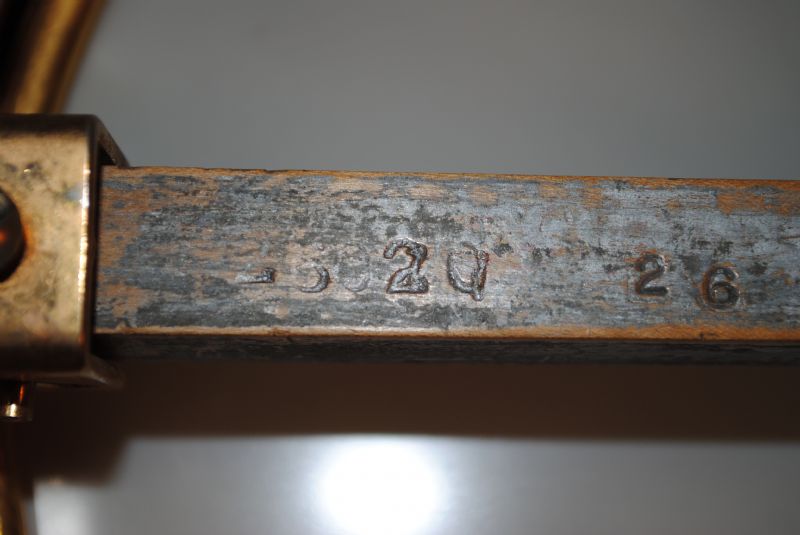 Symphonie 26020 |
Polle Flaunoe - Posted - 05/08/2014: 02:12:18
John,
I´ve deleted all guessed/estimated datings for the Post-Groton´s - extremely few partly/fully documented datings are now present. Do have a look.
If the date-coding was in fact used post 1965 or so - it´s for now my guess, that Gretsch for a while kept 2 sequences - one for Bacon/B&D banjos only (4-digit) and one with both these banjos and their guitars and other instruments (5/6-digit).
As for the MADE IN USA stamp - this is even more tricky - most of my detailed infos about it fit the 2 mentioned sequences above - but ONE banjo - SN 893 (or maybe 0893) does also carry this.
Oh Dear - I hope, that some more detailed infos will soon pop up.
Polle
beezaboy - Posted - 05/08/2014: 06:23:28
Polle -
DB looks good with the zero prefixes in the early models.
We'll just remain alert for future examples that may help to solve this serial numbering mystery.
John
beezaboy - Posted - 05/08/2014: 06:55:50
Polle -
One thing. Belmont 107 does not have a zero prefix. It's just #107. See attached)
John
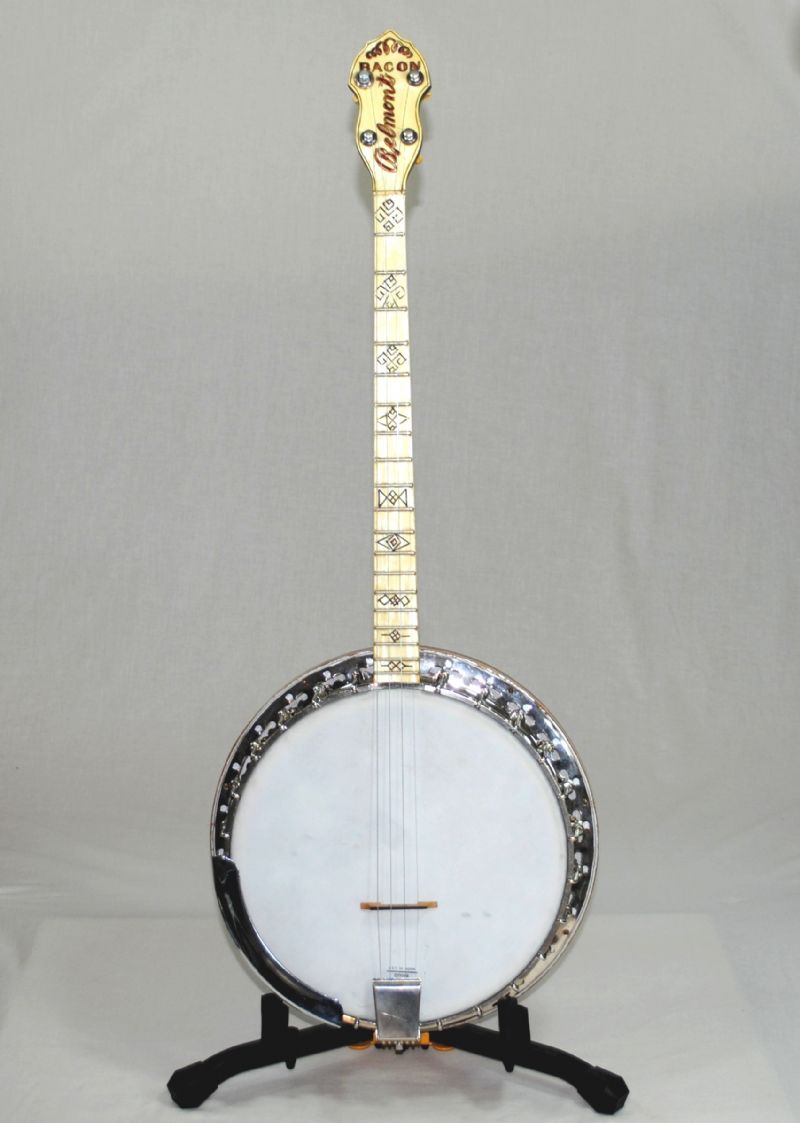 Belmont 107 | 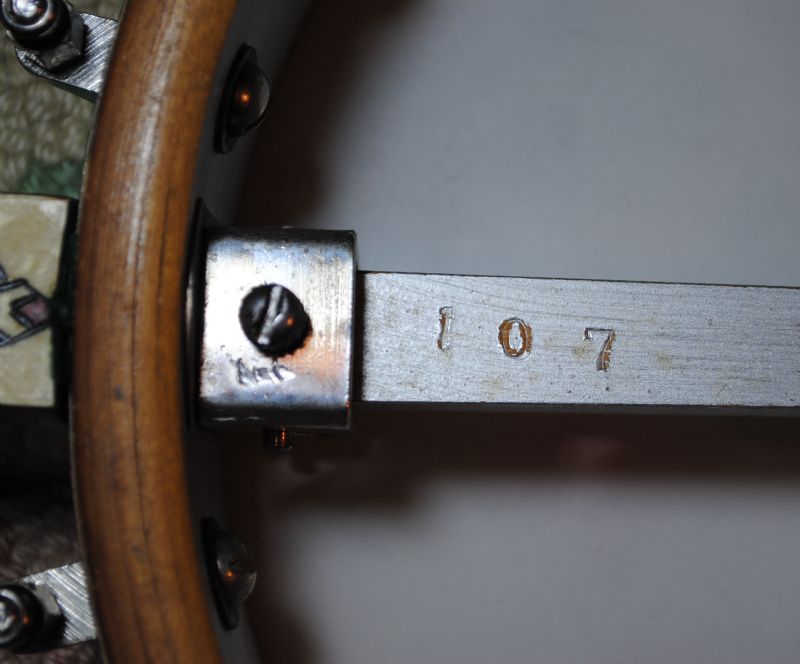 Belmont 107 |
beezaboy - Posted - 05/09/2014: 08:01:23
The manner of dating Gretsch/Bacon banjos is not widely known.
Here is an example of one in which the seller, unfortunately, has not tuned in to our thread.
This Senorita banjo is stamped "Made in USA" 5886. The seller opines it was made "within a few years either way of 1960".
ebay.com/itm/Gretsch-B-D-Senor...e8b524e7d
Oh, well.
Edited by - beezaboy on 05/09/2014 08:09:45
Polle Flaunoe - Posted - 05/09/2014: 23:18:18
If the date-coding was used - this fits the 4-digit sequence as mentioned very well.
If so - this will be the 86th build in May 1968.
The rim lamination and the locking washers are typically late 60s. And on top we have the MADE IN USA stamp.
Polle
beezaboy - Posted - 05/10/2014: 14:08:17
Is this ebay Symphonie #4454 a flat head or arch top?
It looks to be a flat head to me with an archtop appearance because the tension hoop is pulled down too far.
If this is a flathead then (according to my theory) it would predate the zero pre-fix serial numbers and be an example of the consecutively numbered post war models 1946-1953.
(somebody removed the mute and Oettinger-style (sic) tailpiece and misinformed the seller about the banjo's vintage)
ebay.com/itm/Bacon-Symphonie-S...38e6b84b1
jims38134 - Posted - 05/10/2014: 17:06:44
Appears to be an archtop to me. Appearance is same as a Symphonie I once owned. jim
Polle Flaunoe - Posted - 05/11/2014: 00:07:30
I have its sister - SN 4455 - factory ordered late 1961 and delivered in DK early 1962.
And yes - it has an archtop tone ring.
BTW - mine still has the original Paramount style TP. Otherwise the two banjos are identical.

Entertaining a bunch of girls in my home a decade ago - using it. BTW John - the guitar on the wall is an Orpheum Imperator B.

Polle
Edited by - Polle Flaunoe on 05/11/2014 00:21:53
beezaboy - Posted - 05/11/2014: 15:09:06
Thanks Polle and Jim. Very helpful.
More:
It is clear to me that immediate post-war Gretsch/Bacon Symphonie and Serenader banjos continued with the traditional Bacon no-hole, flat-top tone ring. In addition, the immediate post-war Gretsch/B&D Senorita banjos continued some of the traditional Bacon Senorita fretboard designs.
At some point the Gretsch/B&D Serenader and the Gretsch/Bacon Symphonie were redesigned with an arch-top tone ring and the flat-top was discontinued. Also, the B&D Senorita banjos stopped using the old Bacon traditional fretboard design cues.
In my first attempt to crack the Gretsch/Bacon serial number system I mistakenly thought the year 1953 was when the design changes took place. The assistance that I've received here has caused me to reassess that benchmark. (I originally chose the year 1953 because that was when the Gretsch branded Broadkaster and New Yorker disappeared and was Gretsch's 70th anniversary and Gretsch liked to make changes on their anniversary so I've read plus known serial numbers did fall within that benchmark).
I have reassessed the design benchmark and now submit that the design change was motivated by outside events and factors and not generated by factors within the company and its culture.
Here is the basis for my reassessment. In 1955 there was a 4-string banjo boomlet in the USA. Please see attached Time magazine article August 1, 1955 ("Plinky Plunk"). This is one of many articles about this topic that appeared in 1955-1956. I chose this article because of the Fred Gretsch, Jr. interview. The article confirms that In 1955 Mr. Gretsch was aware of blossoming banjo demand and sales. Next, in early 1956, Gretsch engaged Perry Bechtel to endorse the Gretsch/Bacon banjo line and went public with "news" that Gretsch/Bacon banjos were available in the market place (see attached Fretted Instrument News - Jan 1956). This little 1956 newsy article is unusual because little, if anything, was written in the press about Gretsch/Bacon banjos in the post-war period until this article appeared. In addition the mid-fifties 4-string banjo revival saw Harmony bring out its first post-war banjo (Roy Smeck) in 1956 and Kay brought out its Silva line also in 1956.
Therefore, it appears and I submit that Gretsch redesigned its Bacon "S"'s line of banjos in 1956 in response to the banjo boom in sales and the competition from Harmony and Kay for a piece of the burgeoning banjo market.
Therefore, the following hypothetical serial number date chart is proposed:
1946/1947 - (Zero) 000 - 999. (examples: Senorita #181 (Groton Design); Symphonie #192 (flathead).
1948/1949 - 1XXX. (examples Senorita Banjo Mandolin #1073 (Groton Design); Recording King (flathead).
1950/1951 - 2XXX.
1952/1953 - 3XXX. (example Serenader 3107 (flathead).
1954/1955 - 4XXX.
1956 - 00XX (example Senorita Banjo Mandolin #0067 (fretboard dots no design).
1957 - 0XXX (example Serenader #0130 (archtop).
1958 - 1XXX.
1959 - 2XXX. (example Symphonie #2043 (archtop).
1960 - 3XXX.
1961 - 4XXX. (examples Symphonie #4454 & #4455 (archtops).
1962 - 5XXX.
1963 - 6XXX.
1964 - 7XXX.
1965 - 8XXX.
1966 - 9XXX to June 1966 then beginning of date code. [Thanks to Ed Ball and his Gretsch 6120 guitar book.]
1967 - Plain date code to June 1967 then beginning of "USA" prefix followed by date code.
1968/1971 or 1972 - The final Gretsch/Bacon banjos appear to occur in very late 1971 or early 1972.
So, here's a template we can test. Right now the number of Gretsch/Bacon examples is somewhat limited. The first keys are the no-hole flathead for the Symphonie and Serenader for the older models versus the archtop and the fretboard designs for the Senorita on the older models versus the new. The date coding period before the "USA" stamp was originated will probably always present a problem.
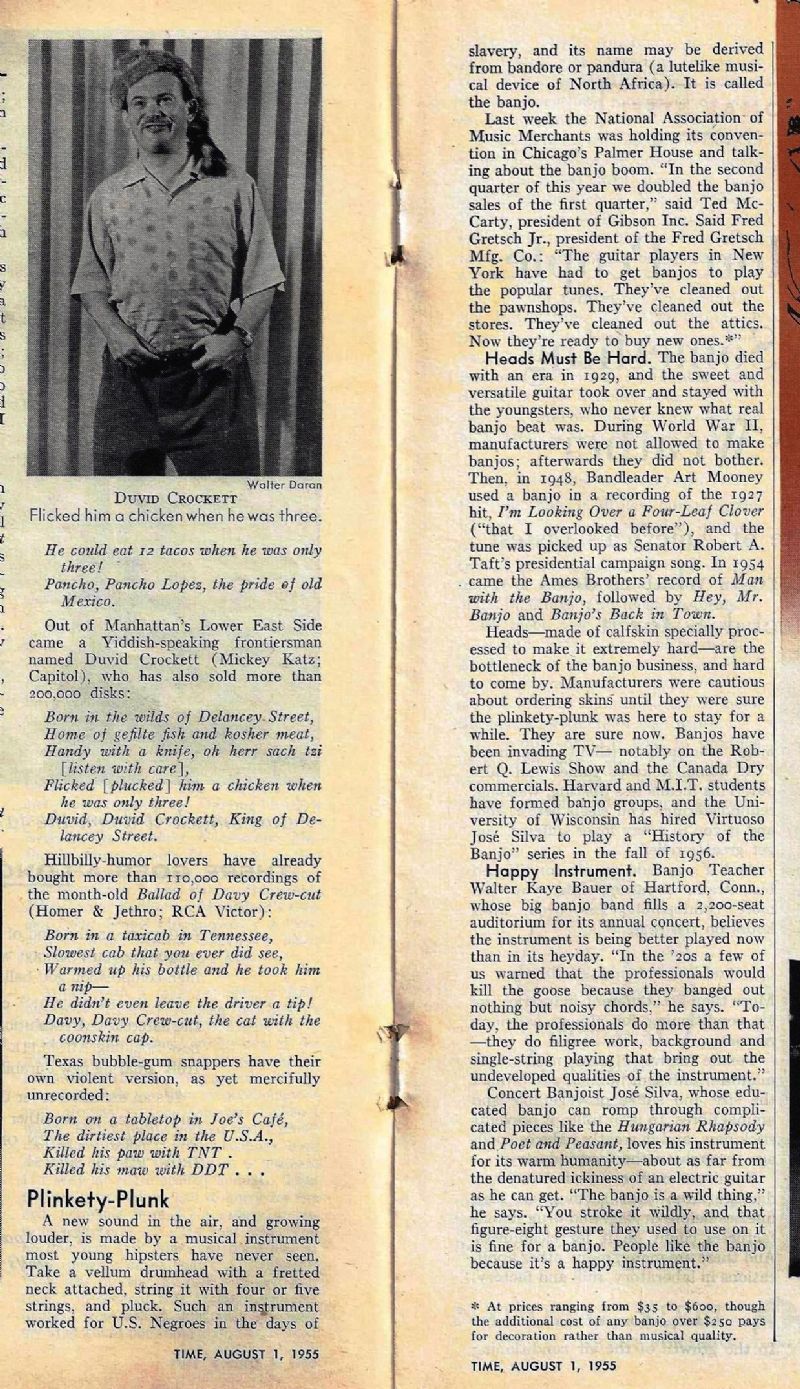 Time Aug 1, 1955 | 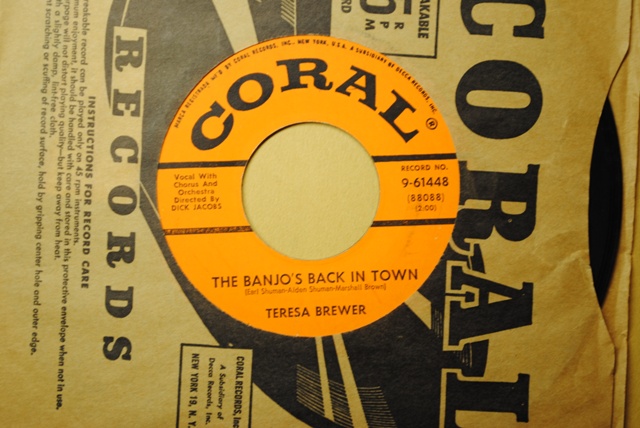 The Banjo's Back In Town - 1955 | 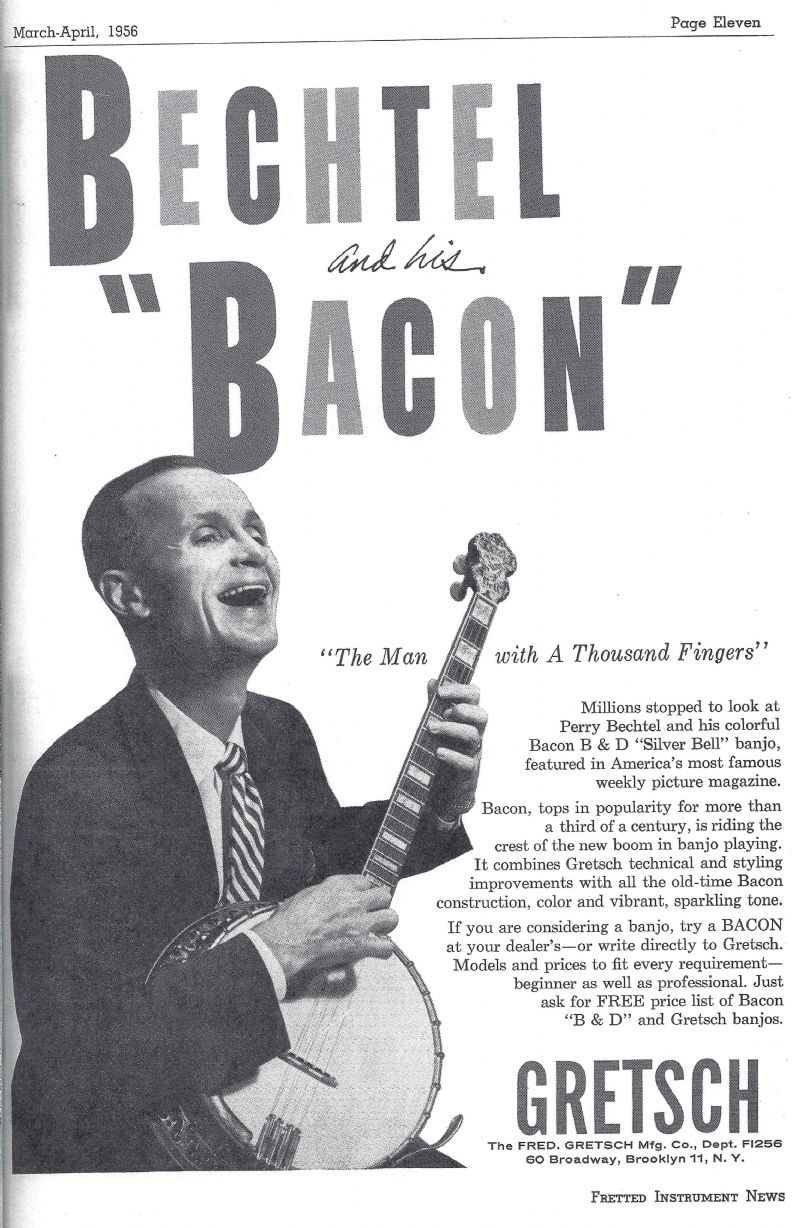 Perry Bechtel - Fretted News Mar/Apr 1956 | 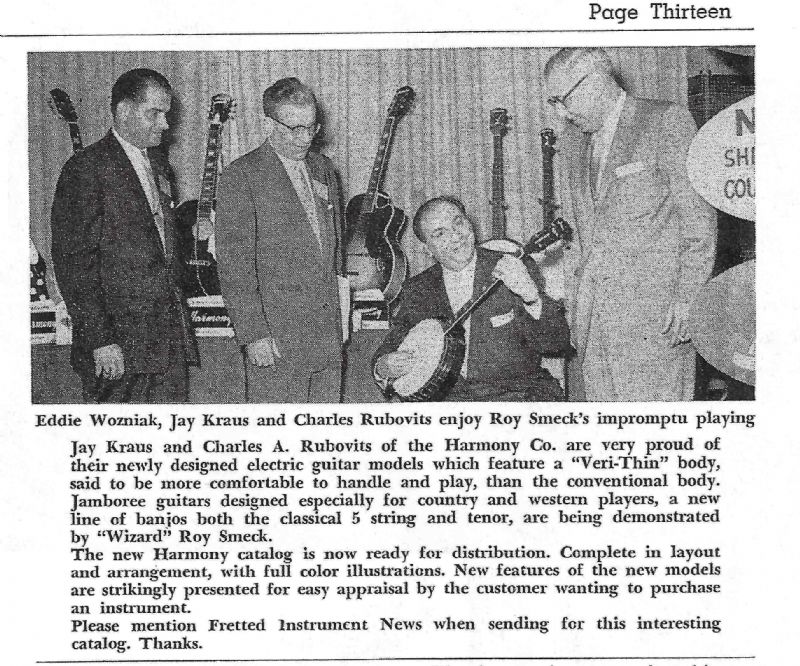 FIN Jan-Feb 1956 |
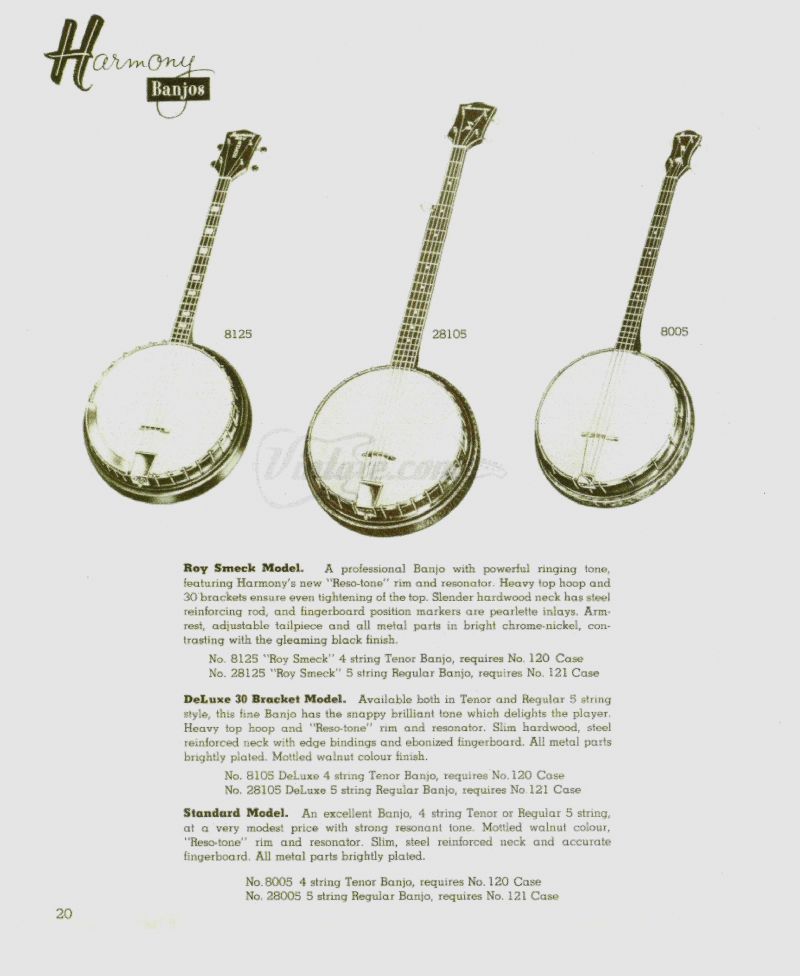 Harmony 1956 | 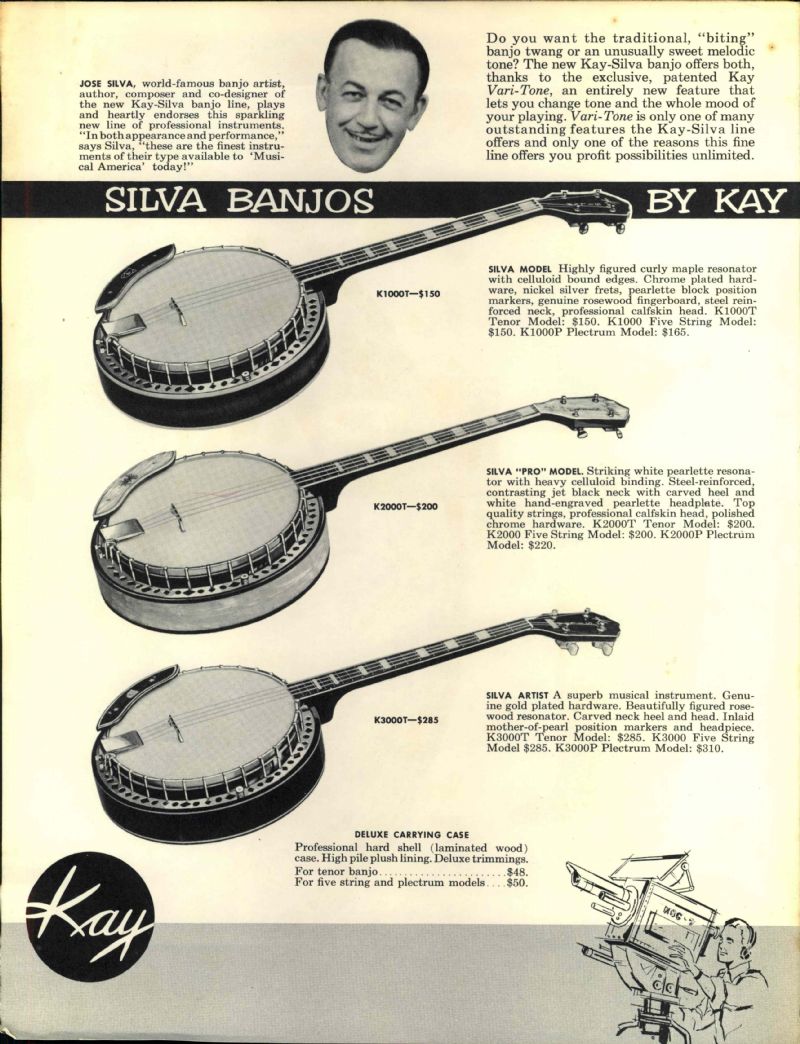 Kay Silva Banjo Brochure |
Polle Flaunoe - Posted - 05/12/2014: 00:22:00
John,
Well - that´s indeed much better - great work - my hat´s off!
I´ve tried sorting most entries in my DB - out of 129 nos. appr. 112 can fit your template - however appr. 17 nos. can absolutely not. Of the latter at least 4 nos. seem to be experimental models/versions.
BTW - from those fitting I can see, that the date-coding (4, 5 or 6-digit) would have started February 1966 - and most likely stopped April 1969.
More later.
Polle
Edited by - Polle Flaunoe on 05/12/2014 00:24:13
Polle Flaunoe - Posted - 05/12/2014: 00:53:44
PS!
Regarding date-coding - it may seem, that Gretsch ab start had decided always to use 3 digits for the monthly production (f.ex. your 26020 ~ Feb. / 1966 / # 020) - but that they by August 1968 had forgotten about this - or changed their mind - from then I have 4 entries with only 2 digits for the production number (8825, 8834, 8888 and 4976) - mixed with 3-digit numbers.
Edited by - Polle Flaunoe on 05/12/2014 01:02:08
beezaboy - Posted - 05/12/2014: 07:39:27
Polle -
Thank you for looking at your data again.
Your findings give us some encouragement.
I have no ready explanation for the date coded 2-digit 3-digit unit numbers that are inexplicably commingled.
Perhaps some new examples or information will appear in the near future to help us along.
I'll sure be on the lookout!
Thanks again for all your help on this project.
John
Polle Flaunoe - Posted - 05/13/2014: 02:41:45
John,
How does the date-coding fit Ed Ball´s research and results? Was Gretsch f.ex. at that time using the same coding for both the Bacon/B&D banjo, the Gretsch banjo and the Gretsch guitar series?
BTW - I forgot mentioning, that ALL of my relatively few infos about a present USA stamping fit the template - except for SN 893 (or maybe 0893) as mentioned above. But maybe the serial number is wrongly stamped - maybe the month in a date-coding is missing. Failures/mistakes did happen. Also - SN 942 (without a zero prefix) doesn´t have the USA stamp.
Sadly I´ve kept very few pics of the Post-Groton´s examples - for many years these weren´t within my main field of interest. But I´ll from now save all possible infos and pics - LOL!
Polle
beezaboy - Posted - 05/13/2014: 08:21:20
Polle -
Thanks. I hope that Symphonie archtop #942 has appropriate characteristics that would place it 1957/1958 - otherwise I don't know.
I believe that Ed Ball has concluded that the Gretsch date-coded serial numbering system as applied to Gretsch guitars (model 6120 at least) and Gretsch-made banjos coincided. The Gretsch 6120 serial number system suffers from the same malady as the Gretsch/Bacon "S"'s models with the difficulty in interpreting the numbers in the time gap between the inception of date-coding and the inception of the "USA" stamp.
As for Gretsch branded banjos, Ed has concluded that the Gretsch Broadkaster 75 and Gretsch New Yorker models were discontinued by 1953 (the Banner Blue and Dixie may have exited even sooner).
Gretsch Folk Model banjos then later appeared ???????. I have miniscule knowledge about the Gretsch and Gretsch/Bacon Folk Models. I don't even know what year they began. I recently purchased a Dec 1963 Sing Out magazine with a good Gretsch Folk Model advertisement so I know they existed in Dec 1963 at least (attached). The Folk models ultimately were date-coded and "USA"-ed but I don't know how they were numbered before date-coding was instituted.
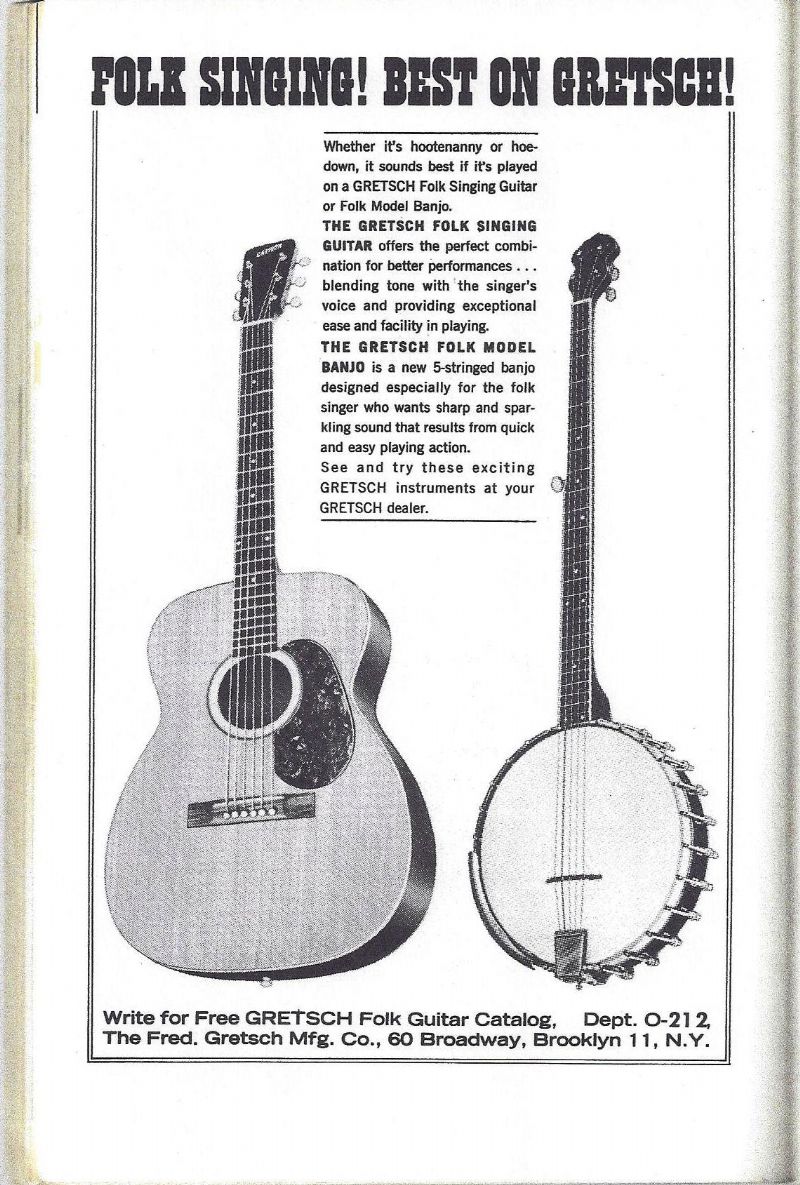 Sing Out Dec 1963 |
jims38134 - Posted - 05/13/2014: 11:09:36
A few pics of inside details added in re-listing (didn't sell in original list time). Check out the width of the neck laminations!
ebay.com/itm/Bacon-Symphonie-S...39wt_1362
Polle Flaunoe - Posted - 05/13/2014: 12:59:57
The neck laminations are identical with those of my two early 60s Symphonie´s:

Back: SN 4455 from 1961. Front: SN 6008 from appr. 1963
Polle
jims38134 - Posted - 05/13/2014: 16:28:53
Very interesting. The 68 era Symphonie did not have laminations like that. Thanks for posting.
Polle Flaunoe - Posted - 05/13/2014: 23:56:14
Jim,
Great - your observation has maybe given us yet another dating tool.
Till now I´ve used f.ex. a possible multi-layer plywood rim for dating a Symphonie to mid/late 60s - but I´ve now realized that the shift from the original 4-ply rim to this was most likely done at the same time as the change in neck construction - from a 7-piece as shown above to a 3-piece - as present on these late 60s Symphonie´s:

John´s Symphonie - SN 26020 - most likely built Feb. 1966 - has an identical neck construction.
Sadly I don´t have pics of a 50s Symphonie in my archive - I wonder how the construction was back then.
John - how is the rim on your Symphonie built - 4-ply maple or multi-layer plywood? Do you know?
Guys - we´re getting closer, I think
Polle
Polle Flaunoe - Posted - 05/14/2014: 01:26:14
PS!
Here´s a typical late 60s Symphonie - with all time correct constructions/features - as partly mentioned above:
elderly.com/vintage/items/80U-2627.htm
Multi-layer plywood rim with a possible lamination issue - 3-ply neck - locking washers on bracket screws - Oettinger copy - a back-strapping "issue" - etc. Plus a possible poor metal/wood fit.
SN 108175 - a date-coding puts this to October 1968 - monthly production number #175. And I´ll bet, that it has the USA stamp as well.
If only they all were that "easy" - LOL!
Edited by - Polle Flaunoe on 05/14/2014 01:37:53
beezaboy - Posted - 05/14/2014: 04:03:30
Polle & Jim -
Symphonie "26020" +little "26" is multiply - lock washer - 3 piece neck as shown below.
John
PS Oettinger (sic) copy too!
Edited by - beezaboy on 05/14/2014 04:06:20
Symphonie 26020 | 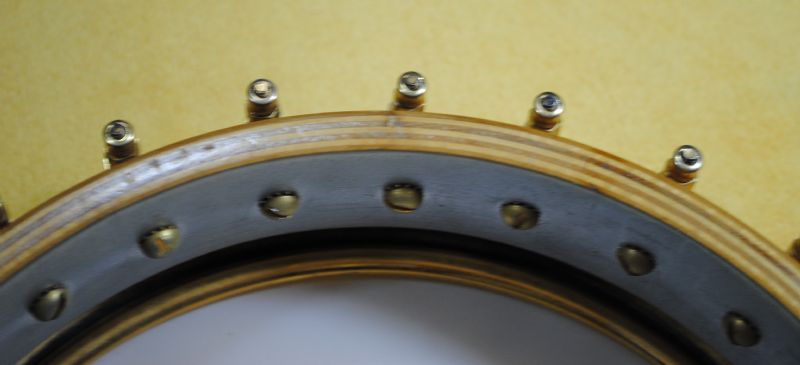 Rim Symphonie 26020 |
Polle Flaunoe - Posted - 05/14/2014: 04:08:48
Thanks John,
Exactly as expected - I have no doubt about your banjo being built Feb. 1966.
Regarding the Oettinger copies from back then - most of these are really lousy built - yet normally well functioning.
Please do keep an eye open for pics of a 50s Symphonie.
Polle
Edited by - Polle Flaunoe on 05/14/2014 04:12:09
beezaboy - Posted - 05/14/2014: 04:19:33
Polle -
I don't have enough examples but I think the "flip-top" tailpiece was earlier in 1960's and then Gretsch returned to the Oettinger style circa mid-1960's. Seems as though the "flip-top only lasted a couple of years.
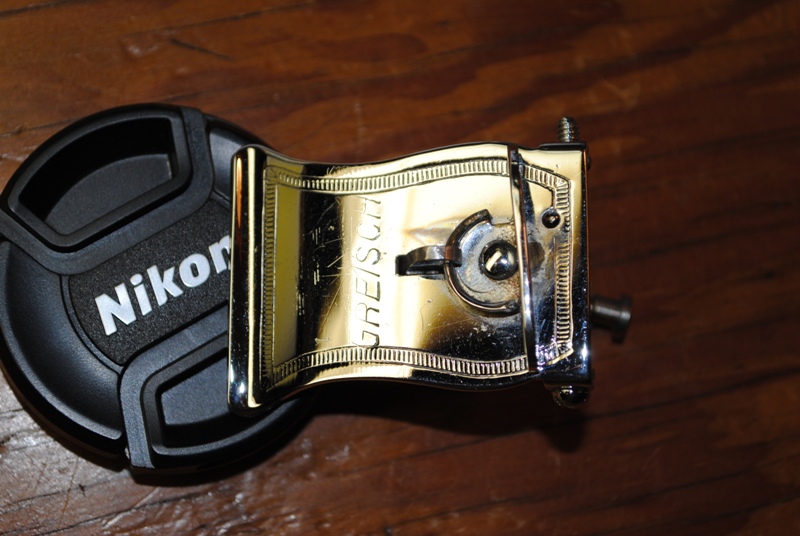 Gretsch Tailpiece |
beezaboy - Posted - 05/14/2014: 05:03:48
I neglected to write for the serial number of this ebay Gretsch/Bacon Ne Plus. Or maybe I did and didn't get an answer.
Anyway, might have been interesting!
ebay.com/itm/201062856361?_trk...BIDX%3AIT
Polle Flaunoe - Posted - 05/14/2014: 23:12:09
It´s for sure a very late example.
Do notice, that I in the DB have two Serenader´s also without a serial number. One of these belonged to a friend of mind - he told me years ago, that it dated to ´69/´70. He had this info from the original owner.
So maybe Gretsch stopped numbering the banjos mid ´69 or so.
At the very bottom of the DB I do for now have a Symphonie NPU with the odd SN 6-2079. Any thoughts?
Polle
Polle Flaunoe - Posted - 05/14/2014: 23:21:21
quote:
Originally posted by beezaboyGretsch Folk Model banjos then later appeared ???????. I have miniscule knowledge about the Gretsch and Gretsch/Bacon Folk Models. I don't even know what year they began. I recently purchased a Dec 1963 Sing Out magazine with a good Gretsch Folk Model advertisement so I know they existed in Dec 1963 at least (attached). The Folk models ultimately were date-coded and "USA"-ed but I don't know how they were numbered before date-coding was instituted.
John,
In my appr. 1960 Bacon catalog (green background opposite yours with a bluish background) the Gretsch Folk Banjo is included. It´s described being a new model. It was priced at $85 - the Bacon Folk Model was in the catalog priced at $145 - and $195 for the long neck version.
Polle
beezaboy - Posted - 05/15/2014: 05:04:42
Polle -
We discussed Symphonie NPU 6-2079 when it appeared on ebay. At the time we tabled the discussion and you placed the number at the very bottom of your database.
Now that we have been focused and studying closely I think this is a June 1972 banjo.
Baldwin/Gretsch was still advertising Bacon banjos as late as Oct 1971 as previously posted. I have the Guitar Player magazine in which the ad appeared. There may be even later advertisements.
According to Gruhn's guide and Jay Scott's book Baldwin/Gretsch began hyphenating guitar serial numbers in 1973. Well, it may have begun a mite earlier because I think this banjo bears a date-coded, hyphenated serial number.
The Guitar Player advertisement focuses on the NPU and I think Baldwin/Gretsch would build a NPU on order as I suppose it was profitable to do so with the price-tag at $900.
As for the green and shades of blue Bacon flyers they are unfortunately undated and as such I think their usefulness is limited. Although didn't you actually obtain your green flyer from a music store?? If so, you would you would have a good feel for its vintage. I have a poor photo of the interior of the green flyer and see the Gretsch folk model depicted. It has the horizontal peghead "Gretsch" and those were the earliest models. Later the "Gretsch" was placed vertical.
Edited by - beezaboy on 05/15/2014 05:06:20
Polle Flaunoe - Posted - 05/15/2014: 23:54:15
John - I can´t recall or find the 6-2079 discussion - but your remarks make sense.
The original owner of my SN 4455 got the green flyer early 1961 from the large Danish music store, where he late that year ordered the banjo (he had to raise the funds at first hand). That´s why I estimate its vintage to appr. 1960. The music store had the front page overprintet with their logo, address etc. BTW - opposite the later bluish flyer it shows all prices in USD.
Polle
Gretsch - Posted - 08/14/2014: 11:22:46
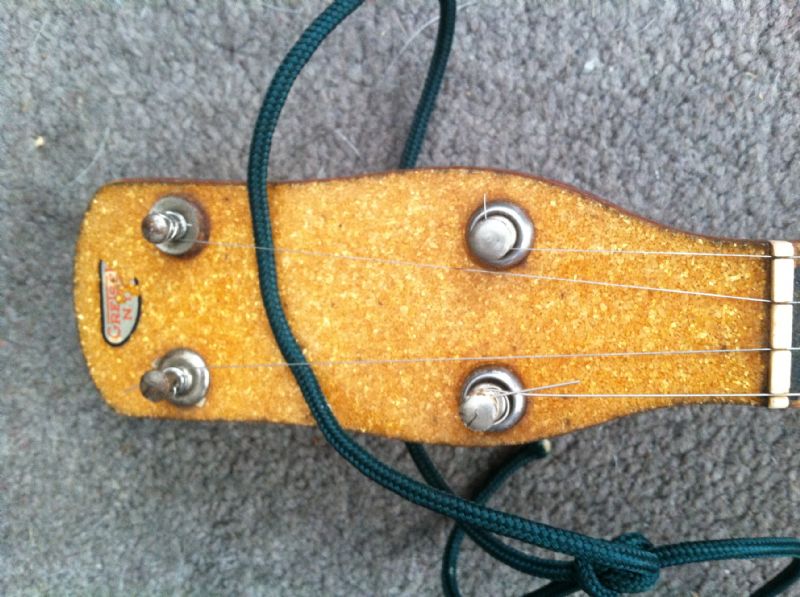
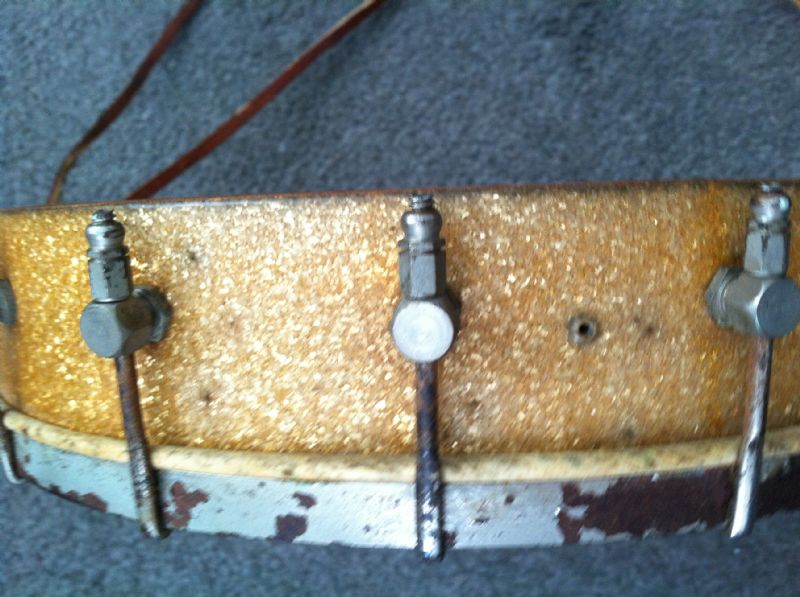
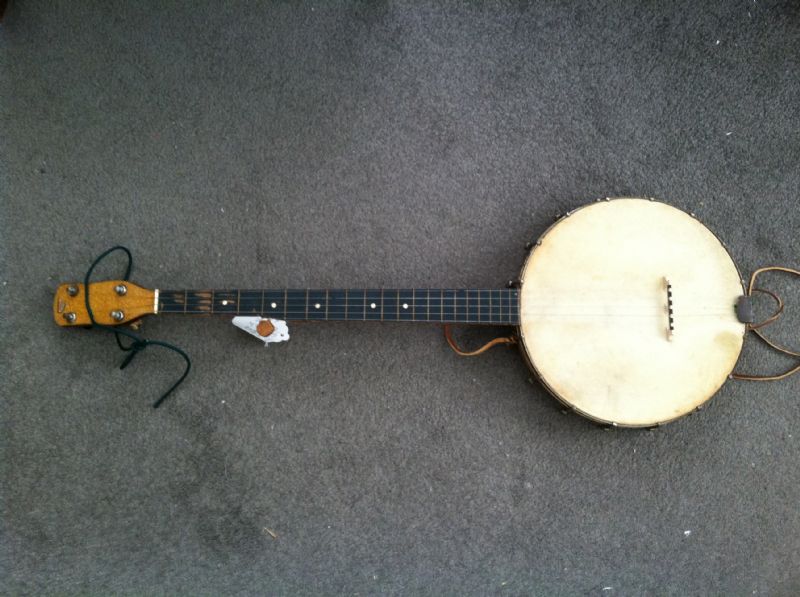
I'm trying to find out something anything about this Gretsch 5-string open-back, serial number 1334.
Anything?
 |  |  |
beezaboy - Posted - 08/14/2014: 15:08:01
I believe yours is a Dixie model.
Attached is the description from Gretsch's Catalog 50 published in 1949.
I have seen the Gretsch Dixie in the 1954 Bronson Publishing Co. Catalog.
I have not tried to date post war Gretsch banjos by serial number but I think it safe to say "early 1950's"
Hope this helps some.
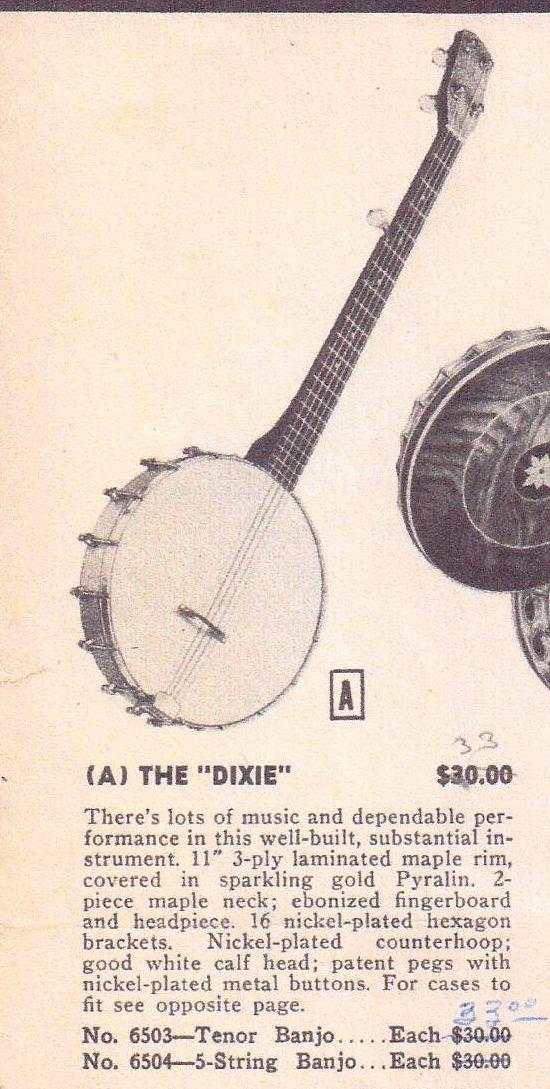 Gretsch Catalog 50 (1949) |
sdog - Posted - 11/04/2014: 19:34:39
I don't know if this thread is still being followed. I just purchased a Bacon Folk Model and was told it's a 1964. S/N is 5445. In decent condition for $500 w/original case, seems like a fair price but not sure. Any info anyone has would sure be appreciated. Also it is very bright, I'd like to get a darker old time sound from it, any suggestions? I play finger style but bought this to learn clawhammer.
Don't know why photos are not showing, but you can see the folder in my profile.
Edited by - sdog on 11/04/2014 19:37:25
Polle Flaunoe - Posted - 11/05/2014: 00:08:49
Michael,
I have a confirmed 1962 dating for SN 5126 - another Bacon Folk Model - so 1964 seems most likely correct for yours.
Polle
Gretsch NY - Posted - 11/08/2014: 11:43:14
Hello Polle,
I've been alerted to this intriguing thread by John (Beezaboy). I almost hesitate to step into it... Ha! Ha! Let me at lest begin with a simple question about the above referenced Bacon Folk model examples. Is there any way that your #5126 and sdog's #5445 could be from 1966 (based on features, aesthetics, Bacon history, etc.)? I'll admit to my novice status regarding banjos, but "if" you think it's plausible that these two specimens can be from 1966, I may have a theory that will be interesting to you. Thanks for any opinions you can share! -- Ed Ball
Polle Flaunoe - Posted - 11/09/2014: 03:35:01
Ed,
Here´s the rim of SN 5445 - a 5-ply maple construction - as used by Bacon originally and by Gretsch till mid 60s:

For comparison - the rim of John´s Symphonie SN 26020 - most likely dating to Feb. 1966 - of the multi-layer construction used by Gretsch ab mid 60s:

Nevertheless - theories are always welcome - do post yours.
Polle
Gretsch NY - Posted - 11/09/2014: 20:40:01
Ok... where to start?! Let me begin by stating up front... that I don't know very much about banjos. In one respect this is an obvious disadvantage since I can't easily recognize features are are clearly pre-war from those that are post-war. So I'll rely on all the smart people here for that stuff. However, my lack of predisposition related to the serial numbering history that is already in place is a big advantage for me (in my opinion) as it allows me to be unfettered by "what's always been believed".
I am a Gretsch guitar guy. I have spent the past 10 years decoding, translating, calibrating and discovering the many nuances of how the Brooklyn factory serialized their guitars. I have re-assembled the factory production history on a batch-by-batch basis. What I've come to realize in the past couple of years, is the many of the unidentified batches (typically 50 units) can be explained when I overlay Gretsch branded banjo serial numbers. It's uncanny how many post-war New Yorker and Folk model serial numbers fall right into the holes in my guitar database. As a result, I am absolutely convinced that 50s New Yorker banjos found in the #46xx - 90xx range are using the guitar sequential serial numbing system that Gretsch engaged just after the war (circa 1947), and carried through to mid-1966. Likewise, the Folk models of the early 60s found in the #511xx - 713xx range are attributed to '63 through the end of 65, and are also using guitar serial numbers. I have yet to find a duplicate number! About the only question I have, and it's just come up recently is "IF" the Bacon branded banjo were handled similarly? I've documented 7 Bacon Belmont banjos from this mid-60s guitar serial number range, so I'm thinking that perhaps they were.
So the info above is confirmed in my mind. But here's where you may have some opportunities to look at your Gretsch (and Bacon?) serial numbers a little differently. When the Brooklyn factory discontinued the sequential serial number system for guitars in early 1966 around #82xxx, they did NOT begin the date-coded system immediately. Instead they initiated a short term sequential system of numbers from #0001 - 105xx. These 10,000 numbers span several months in mid-1966, which I have absolutely verified on the guitar side, with both features and dated potentiometer codes. And... it's my opinion that just like the Gretsch Folk (and some Bacon?) models used the early 60s guitar sequential system, that they also reflect these "gap numbers", and I have documented Gretsch Folk banjos from the #40xx - 90xx range, which again, fall right into the unidentified numbers and batches in my guitar database. My question now is... do the Bacon "S" models with serial number like 5126 and 5445 fit into that period as well? They would have to have features consistent with 1966 for that to be true. You tell me!
The Gretsch Folk models referenced above were the "horizontal" headstock logo variety, which were supplanted by the "Vertical" logo models beginning in April of 1968, which I have determined because of the 55 banjo examples I've documented with date-coded serial numbers, none are from earlier than April 1968. They can be found as late as Nov. of 1971.
Ok... if you're still with me, here's the last piece. On the guitar side, there is a short term anomaly that exists, that we think occurred in the '72/73 timeframe, coinciding with the first fire at the Gretsch Arkansas factory which destroyed all the company records and production history. During what seems to be a couple months (maybe less) they actually used Gretsch drum labels, sequentially numbered, in Gretsch guitars. It is my theory that just like the factory applied the master guitar numbering system to Gretsch branded (and maybe Bacon?) models during the main sequential system ('47-65), and during the gap sequential system ('66), and during the date-coded system ('68-72), that they also applied these drum label numbers to banjos! Those drum serial numbers range from #230xx - 267xx. I have documented 12 Gretsch branded banjos with numbers in the #260xx - 267xx range, and it's my belief that they are early 70s banjos. The question now arises... is #26020, which I believe is a Bacon branded banjo possibly an early 70s model? If so, that would be lend even more credence to the idea that Gretsch applied BOTH the Gretsch branded and Bacon branded banjos to the main guitar system(s).
Whew... that was a mouthful! And my apologies if some of this isn't clear. Beezaboy has been an invaluable resource to me as I've developed this research over the past few years. I am by no means declaring it as 100% vetted, at least on the banjo side. I'm much more confident on the guitar side, in part because guitars have potentiometers in them with date codes, so it's easier for me to be sure what period a guitar model was made, whereas banjos, as admitted at the opening, often baffle me!
So feel free to ask questions guys. YOU all are the banjo experts! I did not set out to decode the Gretsch banjo serial numbering, but it seems clear to me the guitar approach (which I did set out to solve) may provide many answers on the banjo side. You certainly won't hurt my feelings if you don't agree with elements of the above conclusions. My Gretsch guitar database has almost 8000 documented examples in it, and several hundreds of banjo examples... but those are almost all Gretsch branded banjos. My hope is to not only assist this community in better understanding the serializing system(s) that Gretsch applied to it's Gretsch branded instruments, but to see if we can determine if the Bacon stuff might just have been handled the same way. Thanks so much for your attention, and interest in my research, and I hope my conclusions can bring some value. Regards - Ed Ball
Polle Flaunoe - Posted - 11/11/2014: 02:14:07
Ed,
Great overview - and easy understandable even for an alien like me. Only - how about the mid/late ´66 to early 1968 period?
Many Bacon´s will most likely fit some of the sequences as mentioned by you - BUT - of the relatively few examples with a confirmed dating in my DB the majority doesn´t.
I haven´t kept many pics of Gretsch era Bacon´s - as this era wasn´t of great interest for me during my first years of research. In the future I´ll keep as much as possible - in order maybe solving the puzzle over time.
Polle
Gretsch NY - Posted - 11/11/2014: 20:32:38
Hi Polle,
Yes... for the Gretsch guitars, the date-coded era begins in August of 1966, with large machine-stamped serial number located on the BACK of the headstocks in gold ink. Prior to that the sequential numbers were typically stamped in smaller digits into the TIP of the headstock of most models. Then in June of 1967 the factory added the "Made in USA" adjascent to the date-coded serial number. I didn't mention that above because the earliest date coded Gretsch branded banjos (Folk models) don't appear until April of '68 (already with the "Made in USA"). In my experience (with guitars) their date-coded numbers are always machine-stamped in gold, even prior to the Made in USA addition.
Thanks again for the invitation to share my research. Perhaps moving forward we can pay a bit more attention to the post-war Gretsch-made Bacon "S" models that surface, and determine if we think they fall into any of the Gretsch guitar serializing systems described above. If so, that could help me fill in a lot of gaps in my batch-by-batch database of Gretsch serial numbers.
If anyone on this site has a Gretsch branded banjo, and would like my impressions of it's vintage... please don't hesitate to contact me at Gretsch_Ed@yahoo.com. Cheers everyone! -- Ed Ball
gretschguy.com/
Gretsch NY - Posted - 11/29/2014: 15:49:34
Hello again Polle,
I've spent a bit more time with your amazing Bacon serial number spreadsheet, and it appears I've had a bit of a breakthrough which will be very valuable to my efforts at recreating the Gretsch guitar factory production history. As you know I too have been collecting and documenting Gretsch sequential and date-coded serial numbers, but of course my efforts have been focused on the guitar product line. As mention in my previous post, I have come to the conclusion that the Gretsch branded banjos (Folk model) of the 60s shared the same sequential system, and once I determined that I was able to fill in many of the undocumented batches in my own database with groups of Gretsch branded banjos.
After looking at your serial number list for Bacon branded (Gretsch made) banjos, I am now starting to think that they too employed the same serial numbering system(s) as the guitars and Gretsch branded banjos, first in the primary sequential period, then in the gap period (detailed in the prior post), and finally into the date-coded period.
If you refer to your list, and go towards the bottom of the Post-Groton section, you have many examples with #40xxx serial numbers, and they are apparently accurately attributed to the '40/41 period. However, it's my contention that the next 4 entries #48396, 48670, 48671, and 48693 are all date-coded serial numbers relating to April of 1968. I see that one of your contributors has already added a '68 (#48671) attribution so that further supports this supposition. Further, the next 32 entries are where I had my breakthrough... as I believe them to all belong to the primary Gretsch sequential numbering system, used by the guitars and Gretsch branded banjos. Entries #52241 (1963) thru #78494 (late'65 or early '66) when compared to my master database all fall into either a previously undocumented batch, OR into a batch that already possesses documented Gretsch branded Folk model banjos. It was very exciting as I went down the list, and each example fell into place. The #85473 is a mystery to me, since the Gretsch sequential system is only known to go as far as #82,000. But the #108xxx numbers are obviously Oct. '68 date-coded banjos.
The frustrating part now is the realization that a large percentage of the 4-digit examples that reside higher up on the list are probably from the "gap period" (1966... discussed in the previous post), but since I'm not familiar with the differences in pre-war and post war Bacon banjos, and there aren't any photos to compare anyway, I fear we will never be able to sort out which are gap period examples made in '66, and which are pre-war examples. I have some Bacon branded banjos which I have documented myself that fall into this period, but it's so tantalizing to know that you probably have more on your list... and I just can't be sure which they are. However, I'm not going to be greedy, your wonderful work in assembling the Bacon data has suddenly proven very valuable to me... so my sincere thanks for that! I will now begin to seek out and document the Bacon Belmont and "S" models on my own, to continue to support the case.
I'll check in here once in awhile as well to see what developments may surface. I'll ask John (Beezaboy) to continue to advise me on banjo-related advances, especially now that I have to be alert for post-war Bacon examples. Thanks again Polle! -- Ed Ball
Polle Flaunoe - Posted - 11/30/2014: 00:46:45
Ed,
Great - now we are getting closer. BTW - is your database published at the net - or will I have to buy the book?
Regarding 85473 - this was a mistake by someone - I did already have this banjo included as 35473. So it´s deleted now.
I´ve for now included datings as mentioned by you - do have a look.
But for the rest - it´s still a puzzle, it seems. Except for the few examples with a confirmed dating.
FYI - here are some examples, that to my knowledge do carry a "Made in USA" stamp: 893 - 4976 - 5886 - 5970 - 5976 - 8834. Something for you to think about.
Polle
Gretsch NY - Posted - 11/30/2014: 13:46:49
Hi Polle,
My database is not on-line anywhere. I have published the batch-by-batch recreation of the post-war sequential system (including the New Yorker banjo) for the decade of the 1950s in my last book "Ball's Manual of Gretsch Guitars - 1950s". I am currently working on the same approach for a 1960s focused effort, but there were twice as many batches made then, so I still have some work to do over the next year or two. The inclusion of not just the Gretsch branded Folk model banjos, but the Bacon models discussed above are a big help in that endeavor.
If you'd like to get a little more accurate with your vintage attribution on the serial numbers discussed in my last post, you can use the following rule of thumb: #522xx is around mid-1963, #550xx is the start of 1964, #650xx is the start of 1965, and #770xx is the start of 1966. These are approximate, but better than nothing.
Regards - Ed.
Polle Flaunoe - Posted - 12/01/2014: 00:16:10
Oops!
Ed - I missed the 1963 in your posting - I´ve corrected the datings now.
However I´ve put a "?" after all datings based on your infos - many of the serial numbers can indicate two different years.
As for the rest - some examples in the 0001-105XX range do most likely belong to the ´66 "gap" sequence - and some examples do most likely belong to the early 70s "drum" sequence - but there seems to be more (4-5?) sequences used.
Polle
Edited by - Polle Flaunoe on 12/01/2014 00:18:12
Gretsch NY - Posted - 12/03/2014: 16:41:28
Hi Polle... can you give me an example of what you mean when you say many serial numbers can indicate two different years? Thanks for the clarification. -- Ed.
Page: 1 2
Terms of Use | Privacy Policy | Privacy Consent (EU/GDPR Only)
Copyright 2026 Banjo Hangout. All Rights Reserved.


