
DVD-quality lessons (including tabs/sheet music) available for immediate viewing on any device.
Take your playing to the next level with the help of a local or online banjo teacher.
Weekly newsletter includes free lessons, favorite member content, banjo news and more.
Premier Sponsors


|
Please note this is an archived topic, so it is locked and unable to be replied to. You may, however, start a new topic and refer to this topic with a link: http://www.banjohangout.org/archive/280890
Mark Ralston - Posted - 03/05/2014: 13:43:09
Bollman & Gura's excellent book (America's Instrument) has some interesting information on Buckbee, including that it was:
"probably the largest banjo factory in the world" and it turned out "the best of that class of work", unlike, say, instruments from Henry Benary's operation, which "of all cheap and vile factory banjos" were "the cheapest and vilest". I like all of Chapter 2 of Bollman & Gura's book "An Expanding Market" ! ! ! !
I recently bought an under-appreciated banjo on eBay and I'm pretty sure that it's an older Buckbee. I posted pictures of it (identified as #2) along with another probable Buckbee (identified as #1) here: 2 probable Buckbees.
Probable Buckbee #2 is interesting in that the first 4 frets have been filed flush with the fingerboard, and the heights of frets 5 & 6 transition from flush to the height of fret #7, probably to avoid string buzzing. Based on oxidation, the filing appears to be old. Banjo #2 also has maker's marks that appear similar to Roman Numerals in the dowel & pot, similar to marks that I've seen on Dobson banjos. #2 also has faint, longitudinal striations on the unworn frets, which I don't recall seeing before.
Both banjos have similar, cheesy metal cladding on the pots, and the shoulders for the 5th string peg area are handled similarly.
I'm a fan of old, workhorse, Buckbee banjos. They made a lot of music in the late 1800's.
Brooklynbanjoboy - Posted - 03/05/2014: 14:03:15
One of my favorite banjos, always out and within reach, was a simple old parlour-sized Buckbee. I sold it off to a friend about 20 years ago, and it has remained his favorite, always out and within reach player for that many years.
davidwigal - Posted - 03/05/2014: 14:18:39
So just which one was "the cheapest and vilest" banjo made at the end of the 19th century? Some people may like to collect higher-end instruments, but the ones that were more common and under-rated really fascinate me.
Noah Cline - Posted - 03/05/2014: 14:25:52
I noticed that the Bollman and Gura book didn't have a lot of info or pictures of remaining banjos from Buckbee. I might have to re-read that chapter.
Don't think they were a terrible banjo for their time.
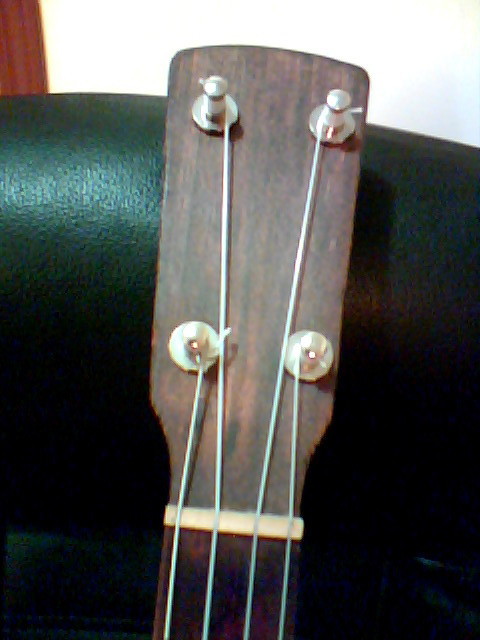
Here's mine, which is most likely a Buckbee (it has a boat tail heel that I've seen on some Buckbees, paddle peg head, and two screws holding the heel to the rim, a Buckbee feature that I've read about), possibly 1880's. I thought I found a stamp in the edge of the rim, but I'm not sure if that's what it is or not.
This one sounds good to me ;)
Edited by - Noah Cline on 03/05/2014 14:27:07
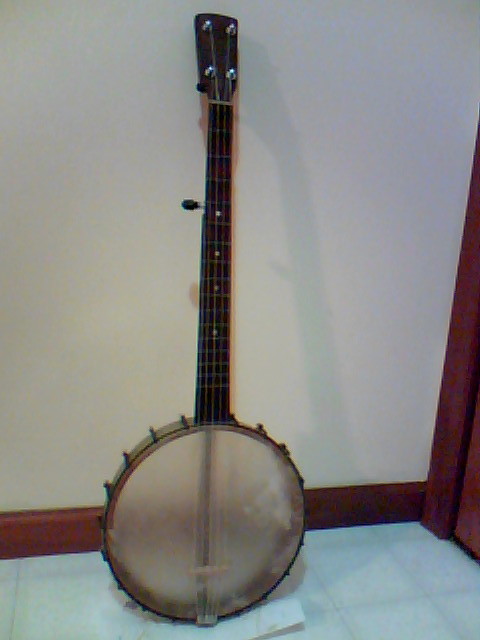 1880's Buckbee | 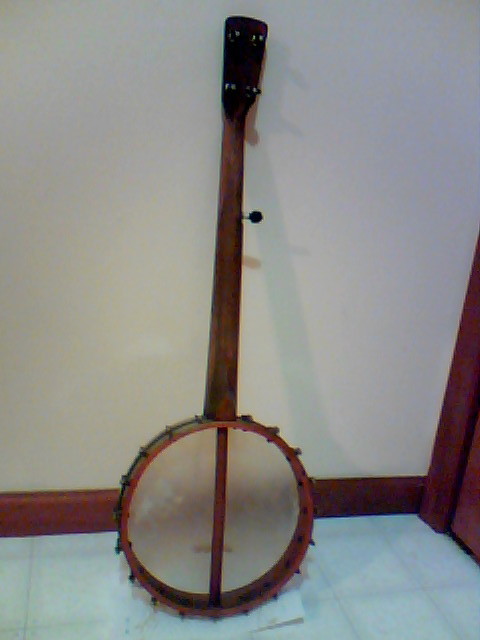 | 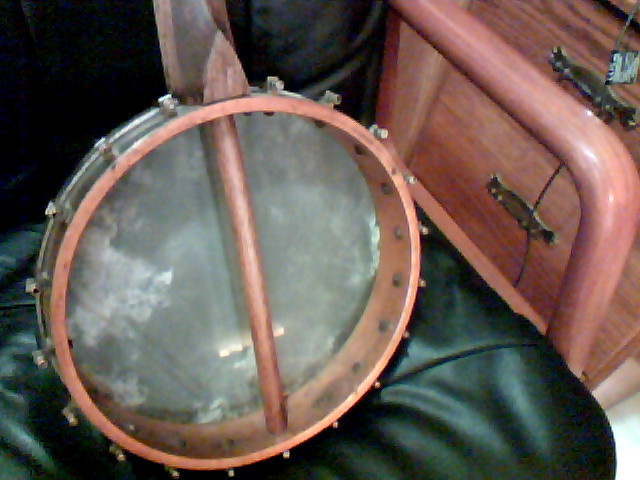 | 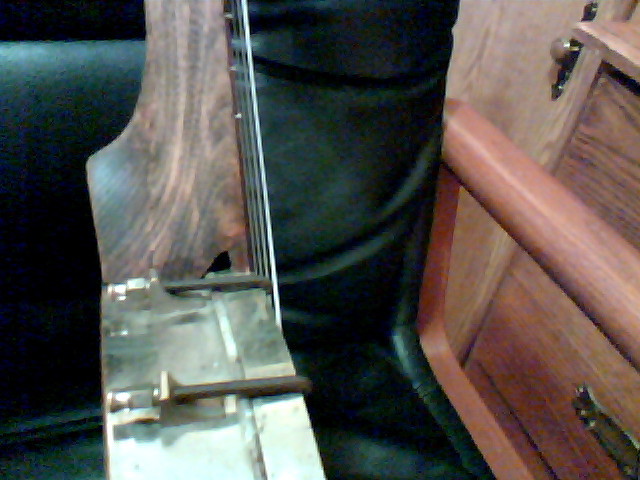 |
 |
trapdoor2 - Posted - 03/05/2014: 14:34:50
I have a rim from a 'cheap 'n' vile' factory banjo that I've stripped and gotten ready to make into something less vile and cheap. No idea what factory produced it...but some guy named "Dan Knowles" gifted it to me a couple of years ago. 
The rim is a single 1/4" thick bent and scarf-jointed circle of maple (guessing there) with the top edge relieved just a bit to look like a chamfer. It was originally painted black on the inside and wrapped externally in a very thin nickel-plated brass foil, with two carpet-tacks holding the wrap in place hidden under the heel of the neck (when it had a neck). IIRC, it had 20-something hooks (can't remember) and a razor thin brass tension hoop...lap jointed and soldered. Everything about it screams 'cheap 'n' vile'. New, it would have looked like a "spunover" banjo from 10ft away...probably sold for just a couple of bucks new.
However, when I stripped it down, I found a decent maple rim. My plan is to finish it in the white and plug the bracket-shoe holes with a contrasting color plug. I think I'll ditch the tension hoop and make it into a tackhead with a simple paddle-head fretless neck. No reason it wouldn't make a fine smaller nylon-strung banjo (the rim is just over 10" in dia).
Edited by - trapdoor2 on 03/05/2014 14:35:47
vintagegeorge - Posted - 03/05/2014: 16:09:52
I have 2 buckbee banjos. What do the Roman numerals stand for? Grading? One of mine has the Roman numeral 3 and another has a 44. Does this mean anything to anyone?
Noah Cline - Posted - 03/05/2014: 16:37:48
quote:
Originally posted by vintagegeorgeI have 2 buckbee banjos. What do the Roman numerals stand for? Grading? One of mine has the Roman numeral 3 and another has a 44. Does this mean anything to anyone?
Never new this. The only stamp I knew that some few of them have is "JHB."
Leslie R - Posted - 03/05/2014: 17:23:07
Mine has that on it.
It's structurally intact, but has no tuners, tailpiece, and is missing a couple of tension hooks.
Does anyone do this type of restoration or know of someone who does? It would make a cool banjo, but would probably cost more to restore it than it's worth. Still, I would at least like to talk to someone about it.
BlowingRockNC - Posted - 05/20/2014: 03:06:49
Most folks don't realize that Buckbee made most of the mass produced and also custom banjos back in the day (1880 to 1896ish). They also made banjos for many of the famous brand names of the day, both high and low end. In addition, they made custom banjos for many of the famous professionals of the day. I've been researching Buckbees because I just got a fully reconditioned one, with mostly new parts, although the spunover (or clad) brass rim with hard maple is original. Anyway, I've been somewhat bothered by the way so many folks refer to Buckbees as being the "trash" or "low end" banjos of the day. Some were, no doubt, but many were the best you could get, and they're still the best. Just my two cents.
mipake - Posted - 05/20/2014: 04:02:53
From what I have read Buckbee started production in 1867 and was bought out by Lange in 1897. He produced the Dobson banjos as well as thousands of others with no name attached. My collecting strategy has been to obtain banjos that could illustrate it's development. How could I be without a Buckbee. I have one that is a fretted paddle head. The tone is not as rich as a Stewart I have but the intonation is excellent. It has 38 brackets which was a huge selling point. I could have purchased a "fancy buckbee" with lots of bling. But that Banjo was not a typical Buckbee. I wanted one that was like what most Americans were playing.
gabeeg - Posted - 05/22/2014: 07:43:10
What I find odd about this quote from the book
"probably the largest banjo factory in the world" and it turned out "the best of that class of work", unlike, say, instruments from Henry Benary's operation, which "of all cheap and vile factory banjos" were "the cheapest and vilest". I like all of Chapter 2 of Bollman & Gura's book "An Expanding Market" ! ! ! !"
...is that after seeing pictures of Celebrated Benarys and owning what is supposed to be a Celebrated Benary (mine has a blank metal heel plate...so no obvious label)...I would be shocked if they were not made by Buckbee and I disagree about them being vile.
Mark Ralston - Posted - 05/22/2014: 08:22:11
That quote from Bollman & Gura's book was from Albert Baur, a banjo-player, who published this statement in S. S. Stewart's Banjo and Guitar Journal. The Mugwumps website indicates that Buckbee did indeed make (some of?) the Benary banjos.
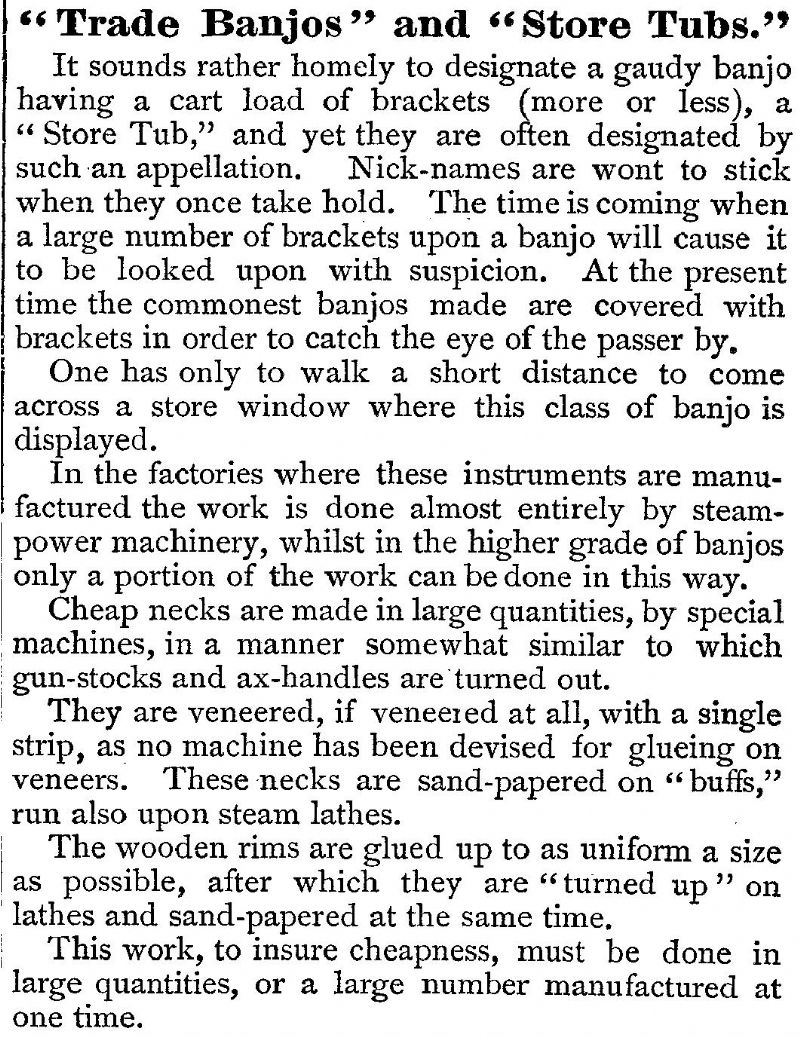
I agree w/ gabeeg...... Benary banjos are as good as any of the common banjos from the late 1800's. Stewart had a low opinion of all other banjo-makers and didn't waste any opportunity to slam his competitors. Check out The Banjo Philosophically, an 1886 lecture by Stewart (from Joel Hooks' excellent website). Here's a sample from page 3:
 |
trapdoor2 - Posted - 05/22/2014: 10:01:21
I suspect the problem here is one of perception. When you are responsible for a huge portion of the market volume for a product, the perception of your quality level is based on the largest portion of what you produce...that can be readily identified as your product. It is no wonder that they did not identify the bulk of their production (but that is simply being mean. They didn't ID their banjos because whatever contract they were building for stipulated ID or not).
Back in the day, Buckbee produced banjos for every market...but the largest percentage would always be "low end", "no name". The "cheapest and vilest" don't survive in great quantities as they simply were not capable of doing so. The fanciest ones were never a large percentage of production, so again we're left with limited numbers. What appears to have survived in the largest number are the 'middle ground' banjo, not fancy but not the worst either. These were meant to compete with the average "other" large mfg (ie, Stewart...we're talking 1880's-1890's) but to provide functionality at a lower price point.
Stewart would rant 'n' rail against them because they cut into his market (and he sold a good number of "2nd grade" banjos to cover that end of the market himself). Stewart marked them "2nd grade" and "Student" because he wanted anyone who picked it up to understand it was a lesser grade Stewart banjo...with "better", "amazing" and "holy cow!" levels being insinuated. Imagine: you make a thing but are not proud enough of it to attach your name to it...or worse, you have someone in a foreign country (New York) make them for you...cheaper than you can make them in your own factory. Stewart clearly and proudly marked his output...and reviled (loudly and often) anyone who would stoop so low.
Buckbee sold to retailers who wanted to turn product...and who usually didn't want their name associated with the cheaper banjos (or perhaps they did, these are "store tubs" because they have the store's name on them. Stewart obviously hated that type of marketing). That kind of marketing is no different today. Do you want Wal-Mart brand or the "name" brand? Do you buy Publix potato chips or Lays? Generic or Name...same thing then as now.
Nothing about all this really means anything today...other than you can still pick up an un-named Buckbee product cheaper than an equivalent Stewart. The banjo still plays and sounds like a banjo (presuming it has survived as a playable banjo). Until someone produces a definitive book which identifies all Buckbee product, they will remain "unknown, probably Buckbee" and still be cheaper than the name brands from the same period.
BlowingRockNC - Posted - 05/22/2014: 10:52:48
I would add only one additional point to the ones just made. Buckbee's largest business was manufacturing either for mass sellers (like Sears) or specialty banjo makers like Fairbanks and many others. Some of Buckbee's customers made top of the line banjos, with the customer's name on it (as in Fairbanks). Buckbee probably didn't want to put their name of banjos because that would place them in direct competition with their higher quality customer and/or their lower quality customer (depending on which end of the market), and they didn't want to lose the main portion of their business, so they didn't compete directly with either side. From what I've read, the top of the line Buckbees were custom banjos made for professional banjo players, sometimes with no name or sometimes with the professionals name on it. Bottom line: If you like it, buy it and play it. If you don't like it, then don't buy it.
Andy FitzGibbon - Posted - 05/22/2014: 12:04:13
quote:
Originally posted by BlowingRockNCI would add only one additional point to the ones just made. Buckbee's largest business was manufacturing either for mass sellers (like Sears) or specialty banjo makers like Fairbanks and many others. Some of Buckbee's customers made top of the line banjos, with the customer's name on it (as in Fairbanks). Buckbee probably didn't want to put their name of banjos because that would place them in direct competition with their higher quality customer and/or their lower quality customer (depending on which end of the market), and they didn't want to lose the main portion of their business, so they didn't compete directly with either side. From what I've read, the top of the line Buckbees were custom banjos made for professional banjo players, sometimes with no name or sometimes with the professionals name on it. Bottom line: If you like it, buy it and play it. If you don't like it, then don't buy it.
I'm confused- are you saying that Buckbee made banjos for Fairbanks? I've never seen any evidence of that, in print or in practice.
Andy
mipake - Posted - 05/22/2014: 13:20:07
I think there is a lot of assumptions being made about Buckbee's business. None of which can be supported by documentation.
what i think i know : 1. Buckbee made lot of banjos. 2. he rarely put an identifying mark on them. 3. One source i read said Dobson contracted to have banjos which Dobson designed produced by buckbee. 4. at least one retail instrument dealer sold Buckbee banjos. (Bruno). perhaps Buckbee did not mark his product because it could be sold by retailers other than him.
Without model numbers or serial number we just can’t say exactly when my Buckbee was made or how it compares with all other Buckbees produced. Maybe someone could start a data base of the surviving Buckbees. another source of information are the advertisements
BlowingRockNC - Posted - 05/22/2014: 13:30:24
quote:
Originally posted by Andy FitzGibbonquote:
Originally posted by BlowingRockNCI would add only one additional point to the ones just made. Buckbee's largest business was manufacturing either for mass sellers (like Sears) or specialty banjo makers like Fairbanks and many others. Some of Buckbee's customers made top of the line banjos, with the customer's name on it (as in Fairbanks). Buckbee probably didn't want to put their name of banjos because that would place them in direct competition with their higher quality customer and/or their lower quality customer (depending on which end of the market), and they didn't want to lose the main portion of their business, so they didn't compete directly with either side. From what I've read, the top of the line Buckbees were custom banjos made for professional banjo players, sometimes with no name or sometimes with the professionals name on it. Bottom line: If you like it, buy it and play it. If you don't like it, then don't buy it.
I'm confused- are you saying that Buckbee made banjos for Fairbanks? I've never seen any evidence of that, in print or in practice.
Andy
I'm only saying that I've read a lot about Buckbee. What's true or false I cannot say. I've read many places that Buckbee made banjos for many upper end brands, but I can't recall the names as I sit here. I also read that Buckbee made banjos for mass marketers like Sears. Again, I can't say what is and is not true, only what I've read. Please don't take any of what I've written as gospel.
Andy FitzGibbon - Posted - 05/22/2014: 16:11:24
quote:
Originally posted by BlowingRockNCI'm only saying that I've read a lot about Buckbee. What's true or false I cannot say. I've read many places that Buckbee made banjos for many upper end brands, but I can't recall the names as I sit here. I also read that Buckbee made banjos for mass marketers like Sears. Again, I can't say what is and is not true, only what I've read. Please don't take any of what I've written as gospel.
Well, just so things are clear: Buckbee did NOT make banjos for Fairbanks. I sincerely hope that the internet rumor mill doesn't latch onto that "fact".
H. C. Dobson, along with his brothers, would have been Buckbee's primary "upper end brands". Frank Converse and James Morrison also had Buckbee make them high-quality instruments for resale.
It's possible that Sears may have sold Buckbee banjos for a short time. Buckbee went out of business just a few years after the first Sears catalog that included musical instruments came out. All of the Sears "Supertone" banjos I have seen were made by Buckbee's successors, Rettburg & Lange.
Terms of Use | Privacy Policy | Privacy Consent (EU/GDPR Only)
Copyright 2026 Banjo Hangout. All Rights Reserved.


