
DVD-quality lessons (including tabs/sheet music) available for immediate viewing on any device.
Take your playing to the next level with the help of a local or online banjo teacher.
Weekly newsletter includes free lessons, favorite member content, banjo news and more.
Premier Sponsors


|
Please note this is an archived topic, so it is locked and unable to be replied to. You may, however, start a new topic and refer to this topic with a link: http://www.banjohangout.org/archive/279638
David Cunningham - Posted - 02/12/2014: 21:30:34
I was asked by a fellow I'd previously sent some bridges to come up with something for his nylon string banjo. I don't have the tools yet bought or made to do the slotting as I will in the next couple weeks but here is a photo of the initial attempt. These may work on tenors and plectrums. We'll see. Who knows until it goes? I sketched this months ago and finally used it.
The ones below are 11/16 high and have an overall width of 3.1" They are on their way to Montana for their tryout.
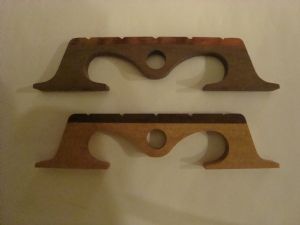
Sizes smaller than 11/16 will be 3" wide at the base.
Edited by - David Cunningham on 02/12/2014 21:39:20
Brooklynbanjoboy - Posted - 02/13/2014: 05:28:45
I'd be interested in hearing your reasoning for the design you selected, David. Thanks, Lew
Ken LeVan - Posted - 02/13/2014: 05:46:21
Like Lew, I'm curious.
I know very little about nylon strung banjos, so a couple of (maybe stupid) questions come to mind:
(1) Main question - What is the logic for two feet as opposed to the usual three? Is there a need to reduce sound transmission to the head in nylon strung instruments? is the center string too loud in nylon strings?
(2) What is the logic for the extra depth in the center? Is to provide additional stiffness because of the lack of a center foot?
(3) I notice the saddle is completely flat across the top. With only two feet, does the center sag when the strings push the bridge down against the head?
David Cunningham - Posted - 02/13/2014: 06:47:32
1. Some folks want 2 feet.
2. Yes
3. Doubt it but haven't tested it yet.
rudy - Posted - 02/13/2014: 09:23:31
quote:
Originally posted by Ken LeVanLike Lew, I'm curious.
I know very little about nylon strung banjos, so a couple of (maybe stupid) questions come to mind:
(1) Main question - What is the logic for two feet as opposed to the usual three? Is there a need to reduce sound transmission to the head in nylon strung instruments? is the center string too loud in nylon strings?
(2) What is the logic for the extra depth in the center? Is to provide additional stiffness because of the lack of a center foot?
(3) I notice the saddle is completely flat across the top. With only two feet, does the center sag when the strings push the bridge down against the head?
Ken,
Perhaps the DEFINITIVE guide to nylon strings combined with two footed bridges was written by Banjo Hangout member Joel Hooks. Here's the article:
hangoutstorage.com/banjohangou...52013.pdf
Folks would do well by reading Joel's comments and taking note. He knows what he's talking about.
Edited by - rudy on 02/13/2014 09:30:27
Ken LeVan - Posted - 02/13/2014: 10:09:34
quote:
Originally posted by rudyquote:
Originally posted by Ken LeVanLike Lew, I'm curious.
I know very little about nylon strung banjos, so a couple of (maybe stupid) questions come to mind:
(1) Main question - What is the logic for two feet as opposed to the usual three? Is there a need to reduce sound transmission to the head in nylon strung instruments? is the center string too loud in nylon strings?
(2) What is the logic for the extra depth in the center? Is to provide additional stiffness because of the lack of a center foot?
(3) I notice the saddle is completely flat across the top. With only two feet, does the center sag when the strings push the bridge down against the head?
Ken,
Perhaps the DEFINITIVE guide to nylon strings combined with two footed bridges was written by Banjo Hangout member Joel Hooks. Here's the article:
hangoutstorage.com/banjohangou...52013.pdf
Folks would do well by reading Joel's comments and taking note. He knows what he's talking about.
Thanks, Rudy!
Very interesting article. Apparently, they used low 2-footed bridges back in the day, so it's a traditional "period instruments" thing. Also, you don't need a middle foot to counteract down-pressure because nylon strings don't push down as hard.
Sounds as if the lightest possible bridge is best, but it has to be maple.
I wonder if anyone has made any investigations and comparisons with modern instruments and strings. I'm not fully convinced, but very respectful of period instruments.
I remember when my son was learning to play the cello, at the behest of his instructor and a conductor friend, we bought 6 different CDs of the Bach unaccompanied cello suites - Pierre Fournier, Mstislav Rostropovich, Janos Starker, Pablo Casals, YoYo Ma, and Anner Bylsma, and played the famous prelude to the first suite numerous times to hear different incredibly valuable instruments, the best players, and interpretations.
Of course, all these instruments were made hundreds of years ago and worth millions. The music was written around 1720 and only gut strings were used at that time. Nowadays, they don't use them in orchestras anymore, but the Anner Bylsma version was a "period instruments" version with gut strings. Mr Bylsma is a virtuoso, so I'm sure that was a good representation of what you can get from a great cello with gut strings.
I'm becoming interested in learning more about the use of the nylon strung banjo for non-period uses. There was a recent post about someone wanting to make a nylon strung longneck, and I can easily imagine 6-string ones. It has great potential, so I think.
specs - Posted - 02/13/2014: 11:29:49
quote:
Originally posted by Ken LeVanI'm becoming interested in learning more about the use of the nylon strung banjo for non-period uses.
I converted mine to nylon early last year just because I didn't want to play with picks anymore and liked the feel and sound of the nylon-- not for any specific period use. I still just play whatever I want in fingerpicking style. I put a 2-footed minstrel bridge from bho member stringbean45 just because I thought thats what I was supposed to use with nylon. i've been happy with the results.
Edited by - specs on 02/13/2014 11:30:27
mike gregory - Posted - 02/13/2014: 12:36:32
I like the idea of the hole in the middle, since you might custom design a mute that goes in there. Dunno if it would be the best way, but it's woth thinking about.
Might be too much aroundgeskrewin to get it past the strings.
ClayTech - Posted - 02/13/2014: 13:21:58
I recently switched from a 3 foot moon bridge, maple with ebony top i think, to one of stringbean's 2 foot 100 year old pine bridges on my open back, and I'm very happy with it. I'm not exactly sure which is more responsible for the change in tone- the different wood or the different feet- but I do like it better. Notes don't ring as much, the tone is less sharp/shrill with more bass, and notes are better defined. There's overall greater clarity to the sound. Because it has mellowed the tone a bit, I can also keep the head tighter than before which gives much better response and volume while maintaining a somewhat plunky sound. Switching from steel to Nylgut has made the greatest difference in the tone, but changing the bridge has definitely made improvements, too. The other benefits of nylon over steel is that my left hand fingers don't get as sore if I play for a long time, my right hand fingernail never wears out, and it's easier to fine tune the tuning since they stretch more.
David Cunningham - Posted - 02/13/2014: 15:29:14
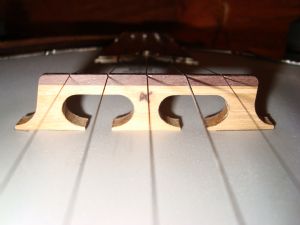
It will be interesting to hear from the gentleman who is receiving these bridges. The top one is Walnut and Padauk, 2.4g. The bottom one is American Cherry and Katalox, 1.9g. I originally came up with this design for tenor/plectrums but decided to try it out on nylons when I was requested to make one. I still need to get it drawn and programmed in other sizes, 5/8 first. I have a fellow in the UK who will be trying these out in Brazilian Cherry/Katalox and Locust/Lignum Vitae on his plectrum. I just made a 3-foot Locust/Katalox for my RK to try out and a couple of the guys really went for it at the jam at my house last Sunday. Locust has a slightly more "hollow" sound than Zebra or Maple we decided. That's the best term I can find to describe it. A friend and fellow picker from Troy, MO kindly gave me a couple seasoned Locust logs to work with. I'm going to make him one for his banjo to see if it works well on his as well as mine. I'm working 10 hour days at my day job right now so the bridge experiments will not occur at the pace they have in the last few months for a while. I also need to finish a job moving lags in a neck and making a new nut for someone before I can dig into the bridge design and testing work some more. Only so many hours in a day...
Locust and Katalox:
Edited by - David Cunningham on 02/13/2014 15:35:14
Ken LeVan - Posted - 02/13/2014: 15:41:52
quote:
Originally posted by David CunninghamIt will be interesting to hear from the gentleman who is receiving these bridges. The top one is Walnut and Padauk, 2.4g. The bottom one is American Cherry and Katalox, 1.9g. I originally came up with this design for tenor/plectrums but decided to try it out on nylons when I was requested to make one. I still need to get it drawn and programmed in other sizes, 5/8 first. I have a fellow in the UK who will be trying these out in Brazilian Cherry/Katalox and Locust/Lignum Vitae on his plectrum. I just made a 3-foot Locust/Katalox for my RK to try out and a couple of the guys really went for it at the jam at my house last Sunday. Locust has a slightly more "hollow" sound than Zebra or Maple we decided. That's the best term I can find to describe it. A friend and fellow picker from Troy, MO kindly gave me a couple seasoned Locust logs to work with. I'm going to make him one for his banjo to see if it works well on his as well as mine. I'm working 10 hour days at my day job right now so the bridge experiments will not occur at the pace they have in the last few months for a while. I also need to finish a job moving lags in a neck and making a new nut for someone before I can dig into the bridge design and testing work some more. Only so many hours in a day...
Locust and Katalox:
That's been my finding about locust, too. It has a metallic sound (hollow might be another description) and not as much complexity compared to maple, although bluegrass players may like it for the Ralph sound. It's heavy.
I am in the process of doing a comprehensive bridge wood test with 18 kinds, of which black locust is one
David Cunningham - Posted - 02/13/2014: 15:50:59
I thought that it might produce a metallic sound too Ken. We were all quite surprised to find that it didn't to our ears in this instance. See what you think... Here's how it sounds:
youtube.com/watch?v=VXt1UZPWpU...=youtu.be
Much thanks goes to the fellow testing this bridge for me in the video. His name is Brian and he is Greypicker here on BHO. He is very good musician and does a LOT for the local bluegrass banjo community by hosting the monthly banjo workshop we have around here at his home. He uses one of my Zebra/Katalox bridges on his Stelling and has really helped me along the way by testing what I make to see if I'm going in the right direction. Amazingly, he is a MUCH better piano player than banjo picker!
Edited by - David Cunningham on 02/13/2014 15:57:45
Ken LeVan - Posted - 02/13/2014: 17:03:16
David,
It sounds great unto itself.
Here are two files from the test I did a couple of years back - I did 8, and red maple is always the "control", so here's black locust and red maple:
David Cunningham - Posted - 02/13/2014: 17:08:16
Man! It's hard to decide which one I like better. It's like two different kinds of cake, both of which you like to eat! Thanks Ken.
trapdoor2 - Posted - 02/13/2014: 21:41:26
quote:
Originally posted by Ken LeVanquote:
Originally posted by rudyKen,
Perhaps the DEFINITIVE guide to nylon strings combined with two footed bridges was written by Banjo Hangout member Joel Hooks. Here's the article:hangoutstorage.com/banjohangou...52013.pdf
Folks would do well by reading Joel's comments and taking note. He knows what he's talking about.
Thanks, Rudy!
Very interesting article. Apparently, they used low 2-footed bridges back in the day, so it's a traditional "period instruments" thing. Also, you don't need a middle foot to counteract down-pressure because nylon strings don't push down as hard.
Sounds as if the lightest possible bridge is best, but it has to be maple.
I wonder if anyone has made any investigations and comparisons with modern instruments and strings. I'm not fully convinced, but very respectful of period instruments.
Yes...but as you well know, every instrument is a different animal and every ear wants to hear something different. It is no wonder that there are so many choices!
I strung my Stelling up with nylon many years ago. It just wasn't what the banjo wanted...plus, I probably wasn't really ready to listen to what nylon had to offer. I go thru a variety of bridges on all my vintage (nylon, nylgut and gut strung) banjos, selecting what sounds right to me. Some of them like maple, some like basswood, some like pine.
The only "generic" thing I can say is that I've found that very light banjos (like Stewart and early Fairbanks) appear to prefer very lightweight bridges. Two footed or five, they need to be light. Later designs like Vega get really 'sharp' with light bridges and I almost always go with a heavier maple type (I prefer the "Cole type" five-footed bridges from Elderly). That's just my experience...and my ears!
David Cunningham - Posted - 02/14/2014: 02:21:41
"Every instrument is a different animal..." Never truer words were spoken!
Terms of Use | Privacy Policy | Privacy Consent (EU/GDPR Only)
Copyright 2026 Banjo Hangout. All Rights Reserved.


