
DVD-quality lessons (including tabs/sheet music) available for immediate viewing on any device.
Take your playing to the next level with the help of a local or online banjo teacher.
Weekly newsletter includes free lessons, favorite member content, banjo news and more.
Premier Sponsors


|
Please note this is an archived topic, so it is locked and unable to be replied to. You may, however, start a new topic and refer to this topic with a link: http://www.banjohangout.org/archive/278557
mbuk06 - Posted - 01/27/2014: 06:02:45
I'm considering to try a walnut bridge on my 12" banjo with a skin head, partly out of curiosity comparing to the hard maple bridges I've always used and partly from reading reviews that claim some specific improvements in tone.
My question is has anyone tried this set-up combination and can comment? I like my head tension fairly tight and use steel strings. Obviously buying one and trying it out is a solution but at $30 a pop I don't want to waste money on a misguided exercise.
Ken LeVan - Posted - 01/27/2014: 06:49:20
You already have a 12" pot and a skin head. I'm guessing the bridge probably has a fairly central position. I personally would not put a walnut bridge on that kind of instrument, unless I was trying to soften the sound. You could get the same effect by loosening the head a hair.
Having said that, there is not a whole lot of difference - the walnut bridge will not be as expressive as a maple one.
I could post sound files of walnut vs maple, but they would be with a different kind of banjo, so maybe not that helpful.
Also, much depends on the bridge itself - wood quality, weight, design etc.
stevel - Posted - 01/27/2014: 08:10:42
I have a Fielding Walnut bridge on my Chuck Lee Ovilla (12" rim no tone ring). It has a medium thick calfskin head, NylGut strings and a Fielding Tailpiece.
I think it provides a slightly warmer sound than a maple bridge. Of course the bridge's cap material comes into play too. The Fielding has an Ironwood tip.
banjopickingman - Posted - 01/27/2014: 09:37:04
I tried a Sampson walnut bridge in that combination. It sounded like I was playing underwater--not really the sound I was after. I now use a Purcell locust bridge, which gives quite a different sound from maple. Not as bright but really brings out the character of the banjo.
mbuk06 - Posted - 01/27/2014: 09:47:15
Ebony is the only cap wood on bridges I've used. What effect does an ironwood cap have? Does it further enhance a walnut bridge's tendency to warm or soften tone or does it add some balancing brightness?
And I appreciate the huge number of variables such as head tension and tailpiece down pressure that can also come into play. These are set-up just how I like them. It's more that I'm looking for some guidance that trying a walnut bridge on this combination of rim size and skin head is not obviously bass or plunk overkill. My preference in tone is not for minimal sustain 'plunkiness'. The subtler qualities I've read about with walnut are what are sparking my interest. If it doesn't sound good on my 12" I also have the option of trying it on an 11" with calf-skin head and whyte ladye tone ring.
Should mention that the particular bridge I have my eye on is the Sampson walnut/ebony. Sound samples of the same banjo set up with walnut and maple bridges would be cool.
Edited by - mbuk06 on 01/27/2014 09:50:12
Ken LeVan - Posted - 01/27/2014: 10:01:38
I think I'm going to add a bridge comparison page to my website - I have tested and made sound files of red maple, sugar maple, "submerged" maple, walnut, yellow birch, black locust, and cherry on two different banjos.
mutantmoose - Posted - 01/27/2014: 13:20:59
Funny, I just glued up a walnut block with a slip of ebony to make some bridges from. I'll let you know what I think.
David Cunningham - Posted - 01/27/2014: 13:57:45
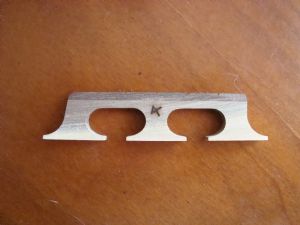
$22 free shipping to the 48 states. $27 to where you are.
Edited by - David Cunningham on 01/27/2014 14:07:44
Ken LeVan - Posted - 01/27/2014: 15:37:16
I am putting a bunch of these on my website - red maple, sugar maple submerged, yellow birch, black locust, walnut, cherry, American beech , but for this trhread, here are three - submerged maple (just for the sake of comparison), red maple and black walnut.
The submerged maple is of unknown origin, salvaged from Lake Superior. The black walnut is 250 years old, aged above water in the air and allowed to go through the seasons, from a pre-revolutionary gristmill I used to own near Bethlehem PA, and the red maple is top notch, from Northern PA, probably 30 years old.
My samples are air dried outside under roof, and represent better than you would get elsewhere. I can't vouch for the submerged, because I know nothing about it. The saddles on all are 1960s Brazilian rosewood of the kind Martin used when they could get it. You cannot get better materials than this, and the bridges are all quarter sawn in the proper orientation
It's always good to know what the actual parameters of variation are: It's not as much as you may imagine even with the very best materials:
mbuk06 - Posted - 01/27/2014: 15:40:14
quote:
Originally posted by RazrandleTry English made bridge's.??
I would if there were interesting, accessible options. There are some top quality banjo luthiers here. But I can't think of a single consistent quality English bridge maker with the experience, knowledge and subtlety of Bart Veerman, Gary Sosebee and a host of other US/Canadian makers. Just the odd garden shed experimenter and I could do that to no desired effect myself. And the bridge choices offered by the main suppliers here are minimal at best.
Maybe that's an opportunity beckoning for some enterprising, skilled and patient person? 
mbuk06 - Posted - 01/27/2014: 15:54:07
quote:
Originally posted by Ken LeVanI am putting a bunch of these on my website - red maple, sugar maple submerged, yellow birch, black locust, walnut, cherry, American beech , but for this trhread, here are three - submerged maple (just for the sake of comparison), red maple and black walnut.
The submerged maple is of unknown origin, salvaged from Lake Superior. The black walnut is 250 years old, aged above water in the air and allowed to go through the seasons, from a pre-revolutionary gristmill I used to own near Bethlehem PA, and the red maple is top notch, from Northern PA, probably 30 years old.
My samples are air dried outside under roof, and represent better than you would get elsewhere. I can't vouch for the submerged, because I know nothing about it. The saddles on all are 1960s Brazilian rosewood of the kind Martin used when they could get it. You cannot get better materials than this, and the bridges are all quarter sawn in the proper orientation
It's always good to know what the actual parameters of variation are: It's not as much as you may imagine even with the very best materials:
Thanks for posting these bridge sound files. I guess it's kind've subjective...but interestingly, given my original question, I find that I'm drawn to the black walnut. It has an unusual 'distant' quality, still bright enough with nice note separation but without some of the overtones.
tomberghan - Posted - 01/27/2014: 17:10:58
Ken, I thought the black walnut sounded nice! Smooth overtone series. Mellow . . . maybe more fundamental pitch. I liked it.
guitarman8491 - Posted - 01/27/2014: 18:24:11
Ken,
Thanks for posting the sound clips. I like the sound of the walnut.
MOUNTAIN GOAT - Posted - 01/27/2014: 19:02:10
Minimal choices? Bart makes a large variety of bridges. There are a million things that change the sound your banjo makes. The kind of wood the bridge is made of is just one variable. The design of the bridge makes a huge difference, and then the set up to optimize that bridge also makes a difference. There's a million choices out there, and it isn't so simple.
mbuk06 - Posted - 01/28/2014: 01:55:59
quote:
Originally posted by MOUNTAIN GOATMinimal choices? Bart makes a large variety of bridges. There are a million things that change the sound your banjo makes. The kind of wood the bridge is made of is just one variable. The design of the bridge makes a huge difference, and then the set up to optimize that bridge also makes a difference. There's a million choices out there, and it isn't so simple.
I think you misread my post. I was referring to bridge choices from makers/suppliers here in England.
Terms of Use | Privacy Policy | Privacy Consent (EU/GDPR Only)
Copyright 2026 Banjo Hangout. All Rights Reserved.


