DVD-quality lessons (including tabs/sheet music) available for immediate viewing on any device.
Take your playing to the next level with the help of a local or online banjo teacher.
Weekly newsletter includes free lessons, favorite member content, banjo news and more.
Premier Sponsors


|
Please note this is an archived topic, so it is locked and unable to be replied to. You may, however, start a new topic and refer to this topic with a link: http://www.banjohangout.org/archive/276369
Mr Banjolele - Posted - 12/22/2013: 13:23:36
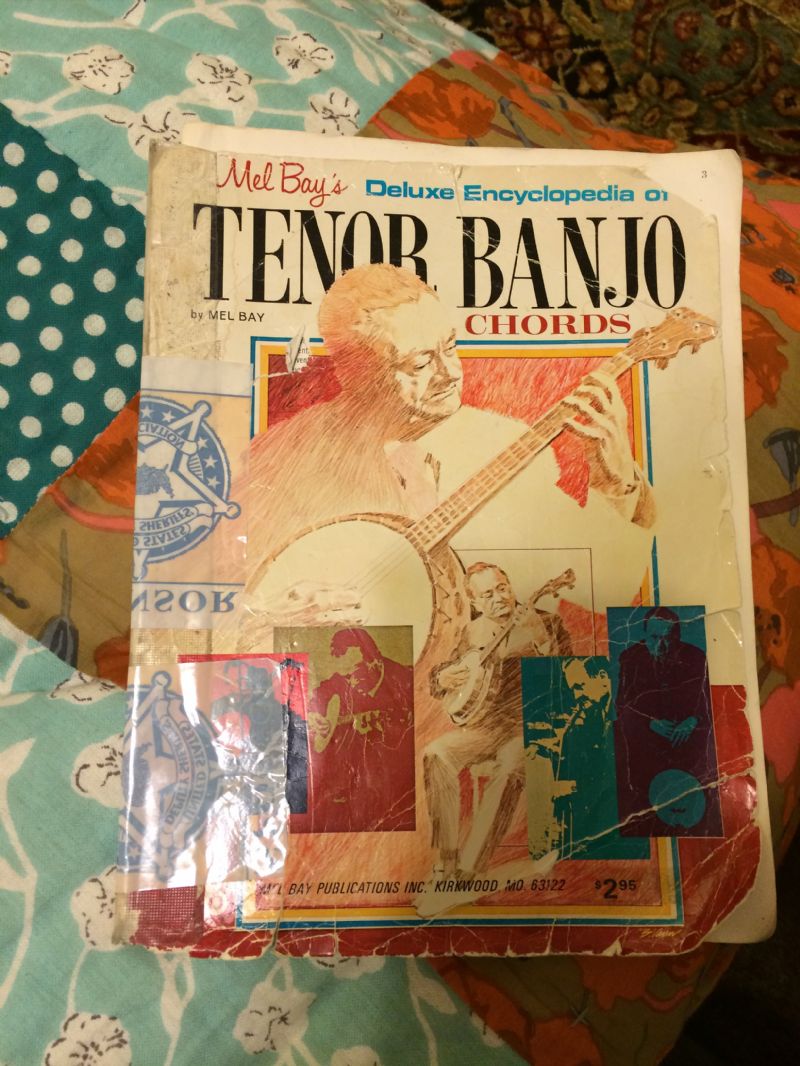
I'm an old beginner and trying to decide which of my resources are best for chord construction. I have a 1975 Mel Bay tenor chord book, Brian's huge chord list, on line and an IPad app CF Tenor chords. They don't all agree as to the various positions to play a chord. Any suggestions would be appreciated. Thanks.
Dogface - Posted - 12/22/2013: 13:31:45
They should pretty much agree if they all refer to the standard tuning... CGDA... although in some cases there can be slightly different ways of constructing the same chord at the same position. Same would of course be true for other tunings as well. For now, I'd go with the Mel Bay book as I'm not familiar with the others..
Compass56 - Posted - 12/22/2013: 13:35:01
When I started on tenor, I used that same Mel Bay book. It worked just fine for me. I still have it.
Edited by - Compass56 on 12/22/2013 13:51:14
yellowdog - Posted - 01/03/2014: 07:14:11
The Mel Bay book is fine if you play either a 17-fret or 19-fret tenor, but your handle of "Mr Banjolele" and the picture indicate that you play CGDA tuning on a banjo uke. (?) If that is true you are sure to have serious trouble fingering some standard tenor CGDA chords because the frets will be too close together for those chords.
Years ago Mel Bay published a mandolin chord book which I bought as a boy when I ordered a mandolin. The book used tenor banjo fingering diagrams throughout. I learned years later from a mandolin player at a FIGA convention why I couldn't use it to make some of the chords. He told me that I wasn't alone and that the book set back mandolin playing all over the world for years because some of the tenor banjo CGDA fingering was almost impossible on a mandolin because of the smaller fret spacing.
If you play a CGDA tuned uke you should be better off using a mandolin chord book and mandolin chord forms because of the smaller fret distances. Most of the chord forms will be the same as the tenor forms but the chords that would have given you trouble will be different to make them easier to play. All you should have to do is change the letter name of the mandolin chord to match the tenor tuning. For example, just change all of the G letters in the mandolin book to read C, all the C letters to read F, etc. (All of the letters go back the equivalent of "a musical fifth" or 5 steps.)
Frank Geiger
Mr Banjolele - Posted - 01/03/2014: 11:11:17
Frank, thank you for your comments. My ukes are tuned GCEA and TB's CGDA.
swamplunker - Posted - 01/11/2014: 17:20:12
Mr Banjolele, one of the reasons for differences in chord formations is that they are in different inversions. I just went on line to find tenor chords (having picked up and set up a Paramount Jr. today) and was reasonably satisfied, but their only A7 was at the ninth fret, I wanted something closer to the root position, so I started with the 4-2-2-4 A and just played the G string open, 4-0-2-4, to put the seventh in. The other kind of thing they might do is not give you the complete chord, maybe figuring you can't stretch. The online example was a second fret D chord with an x over the A string, as in, "don't play". Once I recognized the shape , I realized I can hit that pinkie d note on the fifth fret without any problem. What really helps is counting note names from the open string , then you can make any chord without being the victim of someone elses' limited imagination.
mmuussiiccaall - Posted - 01/11/2014: 17:52:56
I would recommend my post in regards chords which if studied will show you every chord in existence. It's a steep learning curve but if you can decipher it your need for any chord book is over.
Edited by - mmuussiiccaall on 01/11/2014 17:54:50
Polle Flaunoe - Posted - 01/12/2014: 03:02:37
George,
An easy chart of mine - with the most common chords used for jazz - based on the basic position of the root:
acoustudio.dk/4-STRING%20TENOR...HORDS.htm
Good Luck
Polle
Mr Banjolele - Posted - 01/12/2014: 04:48:16
Thank you all for your suggestions. Now it's up to me to put it together.
barchi - Posted - 01/20/2014: 13:09:35
quote:
Originally posted by Polle FlaunoeGeorge,
An easy chart of mine - with the most common chords used for jazz - based on the basic position of the root:
acoustudio.dk/4-STRING%20TENOR...HORDS.htm
Good Luck
Polle
Hello Polle,
Excuse me if this sounds silly, but what are those 0s, 5s and 10s on the left of each chord diagram? They aren't frets as usual, I suppose.
Nicolás
Polle Flaunoe - Posted - 01/21/2014: 01:37:25
Nicolás,
My chart shows various chord fingerings - no matter the key. That´s why the key is called X - as in math.
In the first column you have the basic root on 4th string. If you f.ex. will find some F chords, you´ll on a CGDA tuned banjo find F at 5th fret - do call this / think of this as a virtual Zero (0) fret.
In the next two columns you have the basic root on 3rd string - a F is here placed 5 frets higher - hence the number 5.
In the last column you have the basic root on 2nd string - a F is here placed 10 frets higher - hence the number 10.
If the actual fret number exceeds 12 - you can of course go down one octave - by subtracting 12 from the number.
I hope, that this helps you understanding the principle of the one-page chart.
Polle
PS!
BTW - do notice, that some of the chords do not contain the root - you can do without this - but the virtual root position is still the same.
In extended chords you can always throw away the root - and also the 5th note - one of my own favorite jazz chords is f.ex. "X7 add 6 add b9" - full blown this contains 6 notes - but on a 4-string banjo I´ll have to throw away both the root and the 5th note.
barchi - Posted - 01/21/2014: 05:23:21
Polle,
Thank you! Now it's all clear, the numbers are the relative fret positions of a given root in different movable chord shapes.
I find your chart very useful and well done.
Nicolás
arturo7 - Posted - 01/21/2014: 08:53:23
quote:
Originally posted by Polle FlaunoeGeorge,
An easy chart of mine - with the most common chords used for jazz - based on the basic position of the root:
acoustudio.dk/4-STRING%20TENOR...HORDS.htm
Good Luck
Polle
That is great!! Thanks.
Terms of Use | Privacy Policy | Privacy Consent (EU/GDPR Only)
Copyright 2026 Banjo Hangout. All Rights Reserved.


 This old friend is well worn, but I love it.