
DVD-quality lessons (including tabs/sheet music) available for immediate viewing on any device.
Take your playing to the next level with the help of a local or online banjo teacher.
Weekly newsletter includes free lessons, favorite member content, banjo news and more.
Premier Sponsors


|
Please note this is an archived topic, so it is locked and unable to be replied to. You may, however, start a new topic and refer to this topic with a link: http://www.banjohangout.org/archive/275954
davehicks - Posted - 12/15/2013: 10:50:01
Has anyone used or have the waverly planetary 5th string tuner? If so, how do you like it? is it the same size as a conventional tuner? Thanks
Edited by - Lynne on 12/16/2013 20:14:16
Klondike Waldo - Posted - 12/15/2013: 11:13:42
FWIW you might get more hits on this in the Banjo Building and Set-up Forum.
darwinyarwin - Posted - 12/15/2013: 11:45:25
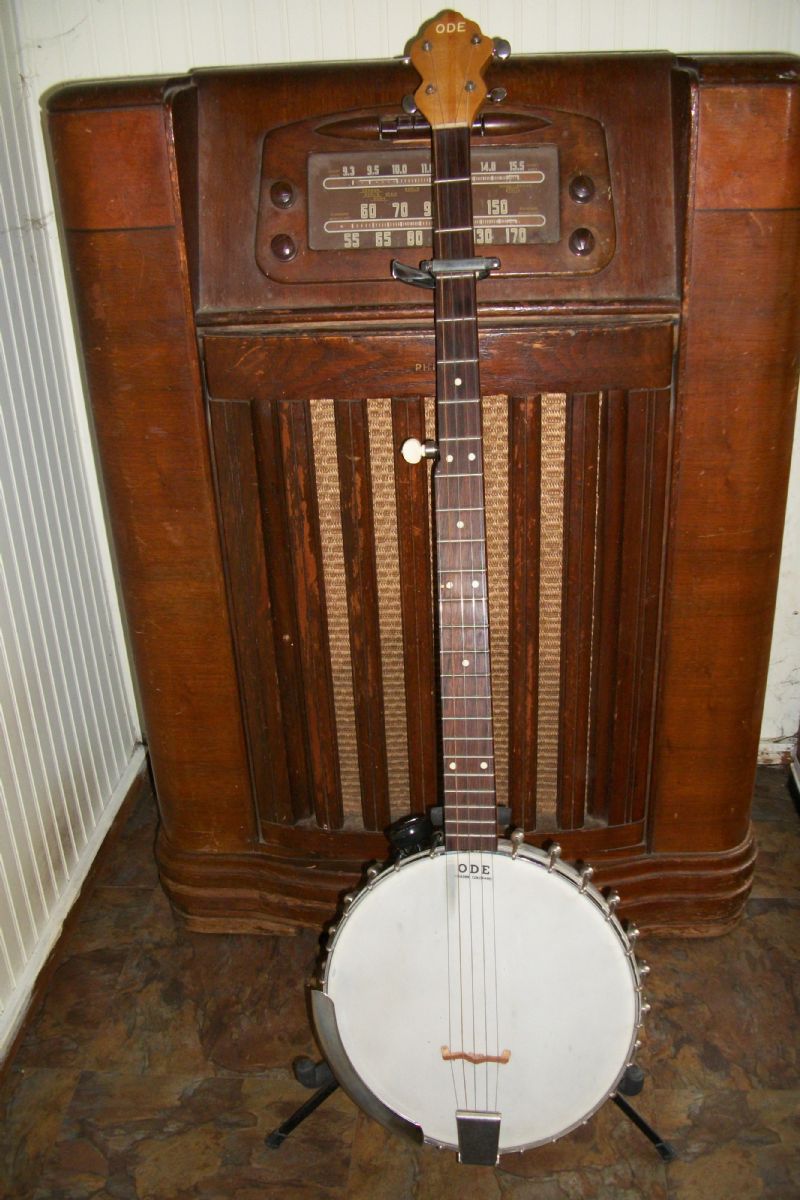
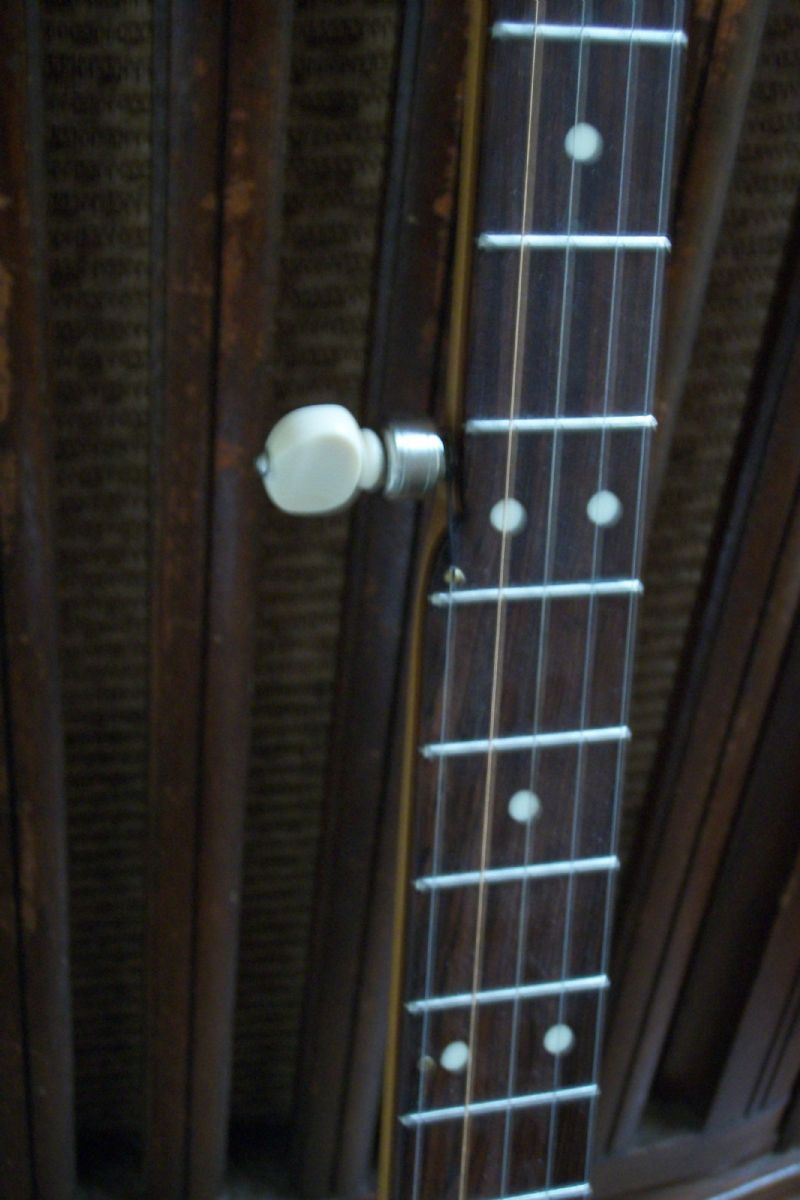
I replaced a Grover friction 5th string tuner with a Waverly planetary tuner on my Ode Model 21 long neck. (The Grover was worn and slipping after more than four decades, who'd a-thought it?.) I'm very happy with this Waverly, The retrofit was easy, the Waverly is more robust and fits into the factory-drilled opening much more solidly than the Grover did.
I like the cleaner look of the Waverly planetary over my other choice, which would have been a geared peg with that 90-degree shaft. This Waverly is much better than any other peg I've used on banjos at fine-tuning and holding the string at the proper intonation. I like it a lot.
As for size, you can judge from the attached pics. The Waverly is just a hair longer, all other dimensions about the same.
Edited by - darwinyarwin on 12/15/2013 11:47:22
 |  |
rudy - Posted - 12/15/2013: 14:04:11
Many who have these installed have said it is a royal pain to deal with a broken string, as the remaining piece is very difficult to extract. Never used one myself, so it's only what I've heard others comment.
Edited by - rudy on 12/15/2013 14:05:00
PeterJ - Posted - 12/15/2013: 17:29:52
I've had one for years (it's the 5-Star brand version, before Stew-Mac started using the Waverly name). It works great -- holds it tune and loses the post that sticks up. The downside, as Randy mentioned, is that it can be a bit of a pain to get a string off. Putting a new string on is no problem though, and it really only adds a minute or so of playing around with it. I've enver had a broken 5th string, so it hasn't been an issue on a gig.
RB-1 - Posted - 12/15/2013: 18:22:26
Like Peter I have the old version on my RB-1. It was already on the banjo when I got it in 1994.
So far still going strong, it doesn't feel any different from when I first got it.
Putting on the string in a way it comes off easy in a few easy steps:
Pull the string through the hole in the shaft towards the back of the neck, until no slack remains (no tension either).
While pulling on the string, tune up. Within half a turn of the shaft, you will feel the string 'catch'
Cut off the loose end as close to the shaft as possible. (use a small wire cutter that goes that far into the tuner housing).
Tune up to pitch. Done.
Removing: take the tension off the string while pulling it towards the tailpiece. When you're done, you'll pull it out of the hole in the shaft.

Edited by - RB-1 on 12/15/2013 18:25:06
rexhunt - Posted - 12/16/2013: 06:22:07
I had one years ago and I'll confirm the need for a pair of needle nose pliers in case you happen to break the string at that end.
Rex
RB-1 - Posted - 12/17/2013: 00:46:52
Important is to de burr the holes in the shaft (any new tuner needs to be checked and, if need be, have sharp edges removed).
I'm doing this free hand with a 2 mm (~ 3/32) drill.
Ever since I never break strings at my tuners.
lightgauge - Posted - 12/17/2013: 04:38:18
I switched back to geared with post. I got tired of poking my finger dealing with broken pieces of string as mentioned above. String changes should not require blood. It seemed a small piece continually would break off down inside. Tuning was fine.
JohnJ - Posted - 12/17/2013: 05:08:31
Personally I think the Waverly tuner is the best thing since sliced bread.... Never had any problem with broken strings, but I don't break many strings.... JJ
Ks_5-picker - Posted - 12/17/2013: 05:21:41
There is a learning curve to changing the string on these tuners.It is possible to thread the string through a side hole,you just have to look closely when you thread it through.A little pair of needle nose is imperative,as mentioned. As for poking fingers,the end should be inside the tuner if it's installed correctly.
arnie fleischer - Posted - 12/17/2013: 08:43:16
This tuner is standard on Paul Hopkins' banjos. Here's another way of putting on the string that makes it easy to remove (I've never broken a fifth string so my experience is limited to changing strings). This method is similar to what the instructions say.
The hole in the central shaft is slightly larger on one side than the other. Turn the peg until the larger hole is facing up, and then put the string through the hole. Pull the string through the hole until there is no slack. Cut off the end of the string, leaving about an inch or inch and a half extending past the hole. Push that end of the string back toward the hole until it's almost flush with the hole, and then start tightening. The string will catch immediately.
To remove the string, loosen it until the it's no longer wrapped around the central shaft and you can see it going through the larger side of the hole. Unhook the string from the tailpiece, grasp the string as close to the tuner as possible, and gently push the string downward, causing it to back off from the bottom of the shaft.
Sounds complicated and slow but it isn't.
ejimb0 - Posted - 12/17/2013: 10:25:21
To add to all this; ...the tuner works great and it looks nice. Changing the string in a stage situation is problematic. I have small needle nose pliers in my case all the time. I always need to keep the case nearby, ....and when it is a dark stage it can take a few stressful minutes to get the banjo going again. ....Read pair of reading glasses and a pen sized flashlight (in your mouth). Have the band ready with a 2 minute long joke. In a pinch the hole in the shaft is big enough for two strings, you can usually stuff another string end in there with the broken one. Remember to clean up the mess before you start another show.
Turnabout945 - Posted - 12/17/2013: 10:42:38
I have one and love it except for the broken string problem. I've gotten a lot better at dealing with it with some of the tricks described here and elsewhere on the hangout, but I've only had issues with strings breaking from age. If I was performing, I would change strings more often to eliminate that problem. If you're not breaking strings, I can't see any downside to the planetary tuner. Even with a broken string, it shouldn't be too bad if you keep the windings on the peg to a minimum.
Kevin B - Posted - 12/17/2013: 14:10:52
I have one on a Stew Mac banjo and like it. On some banjo it changes the break angle to the peg and causes the string to rub the binding above the nut.
Dan Drabek - Posted - 12/17/2013: 16:06:18
I liked mine enough to order a second one. I like the quality and the fact that it's made in the U.S. To my eye, it's hands-down better looking than the clunky right-angle models. And it seems to function fine. I've yet to break a string on it, but I rarely if ever break my fifth string. But I don't re-tune my fifth like some do when they change keys.
I think the biggest design flaw is what Kevin noted--the string makes contact with the edge of the fretboard, where I suppose it might eventually wear a groove. Hasn't been a problem for me yet, but it's something to consider.
DD
RB-1 - Posted - 12/17/2013: 16:15:31
If you're breaking strings while performing, there's something very wrong...
Check all contact areas where the strings touch. Remove every sharp bit.
Make sure all tuners have smooth holes in the shafts. De-burr with a small drill.
Fix those items first, then complain about the tuner....
ken61 - Posted - 12/25/2013: 16:04:38
These waverley fifth string tuners are just fine, but they do require a different sized hole in the neck. I believe, they say this up front in the package slip. I made a reamer to ream out the hole.
Yes , I agree, they can be a pain to get that little bit of wound string out. But they work well and I like them.
Since the hole is a little bigger, once you go there it is not easy to go back to other tuner with standard sized hole.
ken
Quickstep192 - Posted - 12/25/2013: 18:47:16
I have the Waverly planetary 5th string tuner on my banjo. It's the first banjo I ever built and it's the first banjo I've ever owned, so factor in my experience when considering my opinion. Extracting a broken string is a pain, but I use a dentel pick to reach in and get the fragment. Installing a string is a bit of a pain too, but you get used to it. On my banjo, the break angle of the string required me to saw a slot in the fingerboard between the tuner and the pip. Not a big deal, but it was unplanned and a little anxiety producing. The tuner itself is very accurate and operates really smoothly.
rudy - Posted - 12/25/2013: 20:16:44
quote:
Originally posted by Quickstep192I have the Waverly planetary 5th string tuner on my banjo. It's the first banjo I ever built and it's the first banjo I've ever owned, so factor in my experience when considering my opinion. Extracting a broken string is a pain, but I use a dentel pick to reach in and get the fragment. Installing a string is a bit of a pain too, but you get used to it. On my banjo, the break angle of the string required me to saw a slot in the fingerboard between the tuner and the pip. Not a big deal, but it was unplanned and a little anxiety producing. The tuner itself is very accurate and operates really smoothly.
I've noticed several folks who retrofitted the Waverly fifth tuner to have that problem; some even stating that the string cut through the fret board binding after being installed and used for a few years. The photos I've seen where there wasn't a problem are where the tuner has been purposefully installed further toward the 4th fret. It seems like the major problem is when they are fitted to a hole where a worm and capstan type of tuner was installed. Normally the capstan sits farther back and the string is attached at a much higher point. The string for the Waverly angles down at a much greater angle, pulling over the fret board and/or binding edge in the process.
mikehalloran - Posted - 12/26/2013: 10:51:53
quote:
Originally posted by rudyMany who have these installed have said it is a royal pain to deal with a broken string, as the remaining piece is very difficult to extract. Never used one myself, so it's only what I've heard others comment.
I used the 5-Star version. Hated it for the string change issues.
I sold it to another member of this forum who is quite happy with it.
Never again for me.
Ken LeVan - Posted - 12/26/2013: 12:34:21
I used to like them, but I don't any more.
The primary reason I was attracted to them was an aesthetic one, because I didn't like the post that sticks up on the worm-and-gear type. After the price shot up, I stopped buying them, and I am now "at peace with the post" - I'm so used to it it looks normal, and I don't even see it anymore, and I think the worm-and-gear ones work better. There's more to something "working" than gear tooth tolerances.
What I don't like about the planetary ones is string changing difficulty, and the angle the string goes at compared to the worm-and-gear type.
On the top picture, you can see the string angle with the worm-and-gear type, which is pretty straight. The bottom picture shows the planetary type, which goes at an angle and makes or requires a groove in the binding. The old friction pegs did that and I do not mourn their passing.

Also, the planetary ones are at least twice as expensive as the worm-and-gear kind, and I don't see the extra value in something that doesn't work (in terms of design) as well. Supposedly, they "match vintage banjos", but they don't look like old friction pegs to me because of the big gear housing - no better than the post IMO.
mikehalloran - Posted - 12/27/2013: 10:02:07
If someone really wanted to build a vintage substitute, a celluloid 5th Pegheads copy.
Not holding my breath...
Ken LeVan - Posted - 12/27/2013: 10:33:13
quote:
Originally posted by mikehalloranIf someone really wanted to build a vintage substitute, a celluloid 5th Pegheads copy.
Not holding my breath...
Mike,
I have suggested that before - it would be the best thing. It would have to stick out the same distance as a regular banjo 5th peg - the ones they sell now are too long.
If you could get those with a banjo style button that would only stick out 1 1/2" from the 4th fret side of the neck, I'd go for it - it could even have a slide-on metal ferrule to match the look of old friction pegs.
I put the Wittner ones on my wife's violin 2 years ago and it was life changing for her. This Christmas I got a set for her viola. I love them. Next will be 2 cellos I know about and another violin.
Not holding my breath either.
Ken
rudy - Posted - 12/27/2013: 11:01:54
quote:
Originally posted by mikehalloranIf someone really wanted to build a vintage substitute, a celluloid 5th Pegheads copy.
Not holding my breath...
The ones that Bob Smakula has available are pretty close:
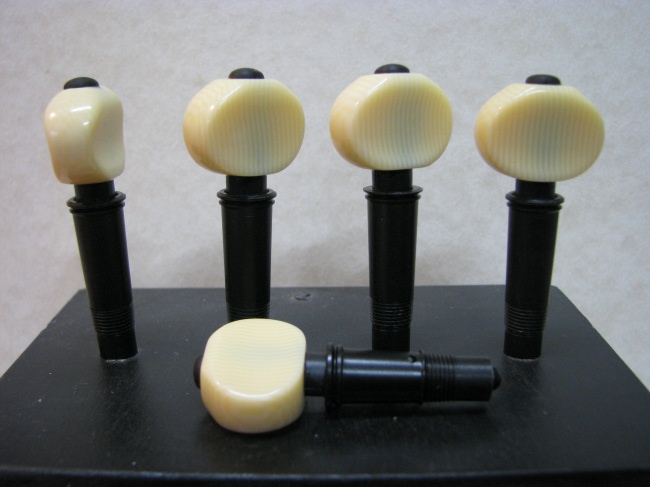
The amber-buttoned ones are quite attractive, too.
Edited by - rudy on 12/27/2013 11:03:00
Ken LeVan - Posted - 12/27/2013: 11:26:32
Those amber button ones are very nice looking Rudy. You must have used them. How far do they stick out? Also how deep does the hole in the neck have to be?
Ken
Deaf Lester Crawdad - Posted - 12/27/2013: 11:35:10
quote:
Originally posted by davehicksHas anyone used or have the waverly planetary 5th string tuner? If so, how do you like it?
There was a big craze for 'em out here on the west coast when they first came out, but you rarely see one these days.
Pros hated the fact that it took a couple of minutes to change a string if you broke one on stage, and other players did things like leaving the old broken string ends wrapped around the shaft inside the tuner because it was difficult or impossible to remove them without using tools. (Yes, there are lots of people out there who don't own a pair of needle-nosed pliers -or who even know what they are.)
I once had to fix a "broken" Waverly that turned out to have four or five broken string ends all wrapped around each other down inside the housing. Took about ten minutes to tease one end loose so I could untangle the whole mess, and it took two pairs of fine-tipped Kelly forceps to do the job.
If you're bothered by the esthetics of a Kroll-style 5th string tuner -and are willing to put up with the problems inherent to the Waverly design- they're well-built and seemingly reliable. (Which means you can count on having the same problems for many years.)
~Pete
Smurf2dope - Posted - 12/27/2013: 13:23:53
Not a fan of the Waverly fifth string tuner because of the aforementioned binding cutting and string change issues.
Ken LeVan - Posted - 12/27/2013: 13:30:07
I agree with you, Pete.
I had one that someone gave me and it had pieces of broken strings wrapped around. I wound up using small wire cutters and needle-nosed pliers. It took me a while to figure out the trick of not wrapping the string when you put a new one on.
I also agree that they worked just fine for tuning the string.
I have a banjo in the shop right now where the customer wants me to replace the planetary 5th with a post type. His reason is that he doesn't like the groove in the binding.
I don't see why a nice looking brass one or one with a brass ferrule couldn't be made. Someone's going to do it sooner or later. The "Pegheds®" have the gearing in the shaft and the Wittner® (German) ones have the gearing in the button:

What I like about that design is that the shaft can be any length - they could put the string hole 1/4" from the button if they wanted to. They make them violin viola and cello" lengths because they are selling them to orchestra players, but the shaft could be made much shorter. I've installed two sets of Wittners so far (on a violin and viola) and you cut them down to final length.
This is what we would have called a "market opportunity" when I was at Corning - what the people who already make these and have the technology would call an "upper-right-hand opportunity".
rudy - Posted - 12/27/2013: 14:43:22
quote:
Originally posted by Ken LeVanThis is what we would have called a "market opportunity" when I was at Corning - what the people who already make these and have the technology would call an "upper-right-hand opportunity".
True, but from how my communications with an established manufacturer went, what we perceive as a marketing opportunity can be greeted with a lukewarm reception. Sometimes folks just aren't interested in something that could easily expand their product line.
The nice thing about the Pegheds tuners are the buttons can be easily modified,as the examples at Bob Smakula's website show. I've even seen the Pegheds tuners fitted with real ebony buttons, although the stock tuner buttons look so much like the real thing (only better...) that I'd be hard-pressed to spend more for real wood.
Wittner may have a more detailed specification as to what they can get away with for button material, given that the gears are integral to the button.
Ken, I have not used the amber buttons myself, they are the stock sales photo at Bob's website. I believe the dimensions and mounting hole depth is identical to the stock tuner configuration.
I'd be happy to use them, though I don't have a burning desire as I have a few sets of Pegheds lying in my parts area but I'm really concentrating on slot head designs which I've grown very fond of for a number of reasons.
Edited by - rudy on 12/27/2013 14:46:40
Terms of Use | Privacy Policy | Privacy Consent (EU/GDPR Only)
Copyright 2026 Banjo Hangout. All Rights Reserved.


