
DVD-quality lessons (including tabs/sheet music) available for immediate viewing on any device.
Take your playing to the next level with the help of a local or online banjo teacher.
Weekly newsletter includes free lessons, favorite member content, banjo news and more.
Premier Sponsors


|
Please note this is an archived topic, so it is locked and unable to be replied to. You may, however, start a new topic and refer to this topic with a link: http://www.banjohangout.org/archive/272079
hking - Posted - 10/11/2013: 23:12:18
Ok, so I'm very new to this. And at risk of asking a stupid question. But, what are the changes that have to be made in terms of playing a long neck v short neck. I.e Chord shapes and positions. I realise the tuning is different, but am not sure what that means in terms of playing, in particular, playing chords. Any help/ advice would be greatly appreciated!!
Bill Rogers - Posted - 10/11/2013: 23:50:46
They're the same, except that with the banjo tuned 3 frets lower, the keys are different. Capoing at the third fret is G, just like on a standard neck. The chord reaches are, of course, longer. Not a banjo for one with small hands. IMO, there's zero reason to have one unless you want it primarily to accompany singing--and not bluegrass singing.
Banjelo - Posted - 10/11/2013: 23:58:29
You basically are playing in E instead of G. Capo it at the 3rd fret, and you have the standard neck and tuning. Pete Seeger did this all the time. Tuning and chord patterns are all the same, just 3 half-steps lower. I found a tab here on BHO recently for a song (Folsom) that was in the key of G and a lot of people responded that they always play it in E. Whollah, long neck banjo. Same tab and in the key of E.
You just have to get used to reaching out a little farther. The long neck is just a banjo that you can UN-capo. The 5th string is tuned to E in standard (e-b-e-g#-b) tuning but if you capo it to G, E still works on the G scale (or you can use a spike to make the fifth string a G).
Having the lower range is really nice and opens up many possibilities.
Banjelo - Posted - 10/12/2013: 00:03:12
quote:
Originally posted by Bill Rogers IMO, there's zero reason to have one unless you want it primarily to accompany singing--and not bluegrass singing.
I couldn't disagree more.
hking - Posted - 10/12/2013: 00:26:21
Alright thanks! I was given one, and just needed a few questions answered, and you did!
Also, do you know of any chord charts for playing in open E that I could have a look at? I.e. fingerings for certain chords
Cheers
Banjelo - Posted - 10/12/2013: 01:18:04
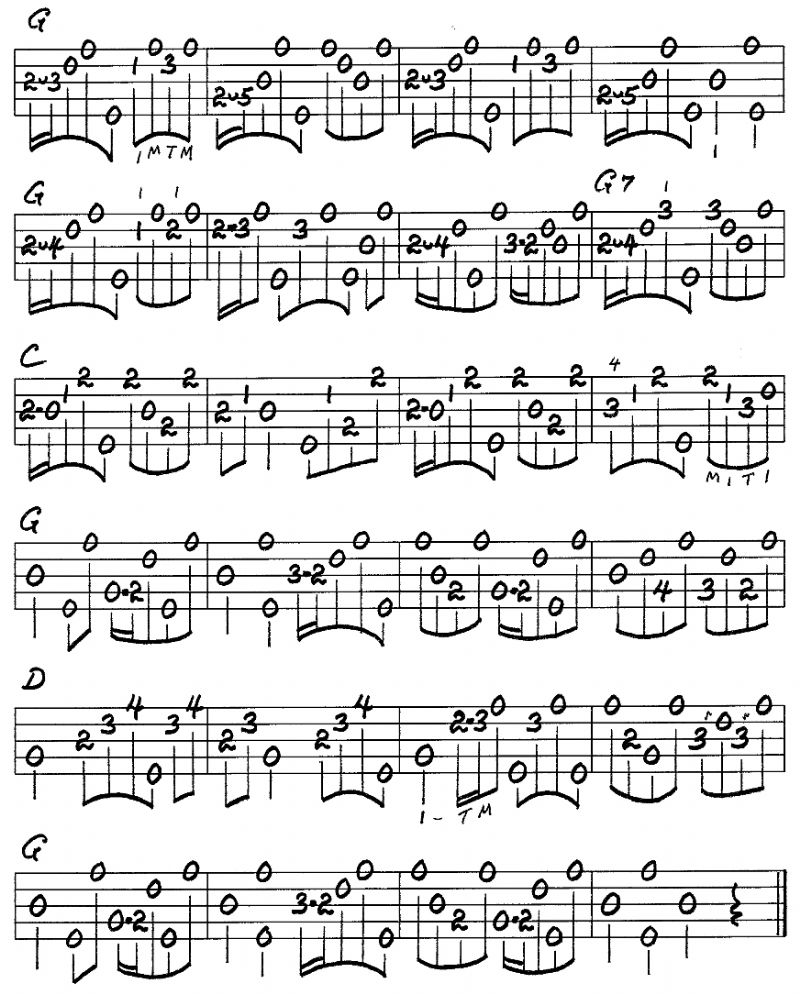
Take any chord you know in G and lower it 3 half steps. The C pattern for example is C-B-A#-A. F becomes F-E-D#-D.
Hope you can read this. I found it here. It's a song that was moved to the key of G for easier playing on the banjo in G tuning even though most would play it in E proper.
Figuring out the chords is about the same as if you were figuring out the chords if you are capoing your G banjo up the neck.
There are songs you are going to want to continue to play on your standard banjo for now like Cripple Creek or something. You can do bluegrass on it if you want. I don't know why anyone would say you can't. The first song that came to me when I strummed the long neck was Norweigan Wood so I came up with a rendition of that. The next one was Amazing Grace so I quickly threw that out as a cheesy religious tune.
Just play banjo any way you want. You'll find ways to make it sound good. There are no rules.
 |
hking - Posted - 10/12/2013: 01:24:12
Alright, thanks for that!! I'll have a muck around and see what happens!
Cheers
Helix - Posted - 10/12/2013: 04:34:59
Banjelo has done a great job explaining and trying to help.
There is also a longneck users group to discuss things with other longnecketeers.
the first time you play G fingering with the capo off , it'll become clear. The first time you do it when everybody capos up 2 and plays in D fingering, that'll show which notes the guitars are not playing.
Longnecks make things possible, opinions don't.
darwinyarwin - Posted - 10/12/2013: 04:55:39
quote:
Originally posted by Helix
longnecks make things possible, opinions don't.
I hereby steal this quote. 
dbrooks - Posted - 10/12/2013: 05:50:16
I've had a fine longneck banjo since 1969. Lots of folk songs and other sing-along tunes were in the key of E, and the longneck was perfect for that. I kept a capo in the 3rd fret most of the time and played in G. With the capo or on a standard banjo in open G tuning, common chords might be G - C - D7. With the longneck, these same chord shapes produce E - A - B7. So the same chords and left-hand fingering work in several keys.
My 5th string is at the 8th fret, not the 5th fret, so I did not have to tune that string up when I use the capo. I tuned it down to E from G when I played without a capo.
Do you know what style you want to play? I played some bluegrass and folk picking (like the KIngston Trio, Chard Mitchell Trio, Pete Seeger, etc.) with finger picks. More recently when I began playing again, I switched to clawhammer (at the banjo's quiet, insistent urging). I never could get the hang of clawhammer when I was younger, but it came more easily this time around.
Today, I don't play the longneck as much. I actually have several short-scale (or A-scale) banjos that I play. They are easier on my small hands. Interestingly, I tune them to open G rather than to A because I like the sound better. I use a capo to play in the key of A.
David
Cryo - Posted - 10/12/2013: 06:18:48
I have a regular neck and a long neck. My long neck gets played three times more than the regular neck. Much more versatile. I keep a capo handy and it is much easier to switch keys with the rest of the band.
Crusty - Posted - 10/12/2013: 06:20:01
Pete Seeger installed a screw eye in the neck of his to attach the strap to so that the neck wouldn't droop when he was playing.
Fathand - Posted - 10/12/2013: 06:49:55
That would be one good reason I could see to owning one
quote:
Originally posted by hking
Alright thanks! I was given one,
Lew H - Posted - 10/12/2013: 07:59:48
In response to Bill Rogers and Banjelo (and irrelevantly, since the longneck is in already in the hands of hking): I've always heard the main reason for a longneck is to find keys that fit one's voice better than having the base chord three frets up. It won't hurt to keep a capo on the third fret and never fret (LOL, or groaning anyway) about those extra frets below. Recently, however, I have found that some tunes work better from the open position. For example, a fiddle tune in A minor could be played in Sawmill, capoed up two frets. But double C tuning, with capo off, becomes double A tuning, and can make some wonderful dark tones, and makes picking some tunes easier. So I think the longneck offers more flexibility for playing tunes as well!
darwinyarwin - Posted - 10/12/2013: 08:30:10
quote:
Originally posted by Crusty
Pete Seeger installed a screw eye in the neck of his to attach the strap to so that the neck wouldn't droop when he was playing.
I was gonna post a viagra joke in response, but ... well ... never mind. 
Mike Casey - Posted - 10/12/2013: 09:29:17
I enjoy the different tones, sounds and keys available to me using a longneck. It does require a little longer reach with the capo off, but they sound great and have an awesome look. And you can capo down neck just like you would with a standard necked banjo. I play primarily Bluegrass style, but I'm getting to where I enjoy the clawhammer style of playing. Now if I could just figure out how to break many years of the playing in a open G tuned banjo habit...
mikehalloran - Posted - 10/12/2013: 16:33:17
In my day, I owned three long necks (2 are in my avatar) and still own two along with many other banjos. I recently remastered the only album I made with the third one and regret letting it get away. And I can't play anymore. Go figure.
Like Alex Hassilev of The Limelighters, one of my favorite tricks was to play in F. Sometimes he capo'd one up and played in G; other times he capo'd up 9 and played in C. This was the days before Shubb capos so he copied one of Erik Darling's early Vega conversions and this was the first Exel with the 5th peg moved up to 9 instead of 8. Vega also spelled it Excell and Xcell - possibly other ways, too?
At least one SS-5 Folklore was made this way.
Shubb will make a custom length 5th capo if you're feeling really creative, there's no extra charge. My Pete Seeger is also a blondie but not an Excel - I had Shubb make a 5th capo that allows me to capo to a high F (they matched holes already in the neck when I bought it from Marc Silber).
These Excel pictures and more are from Frank Ford's Frets.com museum pages.
frets.com/FretsPages/Museum/Ba...xcel.html


Edited by - mikehalloran on 10/12/2013 16:35:36
mikehalloran - Posted - 10/12/2013: 16:42:04
My blondie, non Excel with the custom Shubb. To the right is my ODE/Muse with its original Vega Pitmann capo.


Terms of Use | Privacy Policy | Privacy Consent (EU/GDPR Only)
Copyright 2026 Banjo Hangout. All Rights Reserved.


