
DVD-quality lessons (including tabs/sheet music) available for immediate viewing on any device.
Take your playing to the next level with the help of a local or online banjo teacher.
Weekly newsletter includes free lessons, favorite member content, banjo news and more.
Premier Sponsors


|
Please note this is an archived topic, so it is locked and unable to be replied to. You may, however, start a new topic and refer to this topic with a link: http://www.banjohangout.org/archive/271374
slc - Posted - 09/30/2013: 00:18:57
Last weekend at the 2013 Berkeley Old Time Music Convention, I had the great privilege of playing with the "real thing" fiddler, Franklin George. After playing Over the Waterfall he asked "did you know there's a third part?" I was able to record it, and think I got the melody pretty close - at least as much as my banjoing can reasonably get. Have you guys heard of or played this part before?
Anyway, here's Over the Waterfall, with the third part, as played by Franklin George :-)
I'd think that part is of "intermediate" difficulty, and can definitely be simplified some. Certainly doable if you can play the other parts already. Maybe I'll work up some tab....
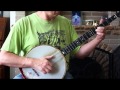 VIDEO: Over the Waterfall - with the third part (click to view) |
BrendanD - Posted - 09/30/2013: 01:30:06
That's great, Stefan! Nice playing. I regret that I didn't get to spend nearly as much time as I'd have liked to with Frank at the BOTMC, though I did have several tunes and a few conversations with him. I dimly remember (I think) his playing a third part to that tune way back when he was at Fiddle Tunes in 1978 or 1980, but I didn't remember the part. You were probably there in 1980, weren't you? Come to think of it, I probably have him playing that on some cassette that sits mouldering on my wall!
muzzlehatch - Posted - 09/30/2013: 04:39:05
I did not know that a third part existed, so its great to hear it.
If you do manage to tab it out I'd be delighted if you would let me know.
Brooklynbanjoboy - Posted - 09/30/2013: 07:24:13
Stefan,
That is some real nice, spirited playing.
And that’s an intriguing third part that adds to this tune. THANKS for sharing it.
I learned the tune from a young fiddler, probably in the early 1990s, and this morning tried to get my brain to recall where it might have been tabbed out for the banjo, because I recalled taking some hints from a tab when trying to develop a credible backup for the fiddler. The fiddler got most of her repertoire in the northeast; I have no clear memory of where she acquired this tune, but she played it with such energy that I had to learn it.
I found the tab reference a few minutes ago in Miles Krassen’s book, Clawhammer Banjo, (Oak, 1974, page 73).
However, Krassen plays it differently from the way I reach for the tune, so I suspect I learned it from another banjo player, or derived it from the fiddler – who played only two parts.
Anyway, Krassen identifies it as a Henry Reed tune.
I thought that either Alan Jabbour or Stephen Wade might be able to offer some insight as to whether this third part ever existed in Henry Reed’s musical vocabulary.
Stephen is traveling now, but sent off a quick “interim” email response noting that he and Alan recorded the tune on Stephen’s "Dancing in the Parlor" album. He recalled: “We only had two parts, though I remember going up an octave to create variation.”
Haven’t heard from Alan yet.
More later.
Just to make sure my intention is clear: I’m not one to look for musical, or regional, orthodoxies in the playing of these tunes. I welcome the diversity of forms, and embrace the mystery regarding possible origins of these variations. Nice to have this third part, especially directly from George (via Stefan).
Play hard,
Lew
slc - Posted - 09/30/2013: 07:37:43
Phil yeah I think I'll work something out.
btw there's one phrase I found nearly impossible to play cleanly here; it's the ending string of the second part that drops to the low D. Frank plays it as a run, like this: ...AB|AGF#ED_ (I'm making up symbols here - | is a measure marker, n_ means a longer note). Maybe Ken Perlman can do it but I can't! So I do something easier that hopefully works with the fiddle.
Brendan I've seen those tapes! Just think how much gold might be in them thar cassettes! Now if only you had a couple hundred years to go through them and pull out all the gems for us :-)
slc - Posted - 09/30/2013: 07:59:53
Lew - great digging! I'd appreciate hearing what you find out! I'm similar I think. While I get excited about histories and nuances (especially since working on fiddle lately), my own style is rather 'urban' and not directly "informed" by the old players. This was never a decision, just how it worked out.
i checked a couple old recordings from Henry Reed but only heard the two parts. Since both Henry Reed and Franklin George (who were friends) got the tune from John Summers it's possible Reed just didn't play it for some reason. I think if it was ever played much once, it may have been dropped for dances. I wish I had asked more about it but it was pretty noisy there!
About the name: sources I found said that Henry Reed learned and named it from the sound of a steam powered jalopy. But Frank said John Summers named it: He had heard it recently but didn't know the name. It was in his head as he was navigating his steam powered jalopy over a bad road (I think Franklin said "driving over the mountain") in a heavy rain storm. It was so bad it was like going over a waterfall...
That's what I love about these old stories - such interesting variations and in a way they are ALL true :-)
Edited by - slc on 09/30/2013 08:13:16
carlb - Posted - 09/30/2013: 08:29:50
There appear to be only two parts to the song from which "Over the Waterfall" was derived, "The Fellow That Looks Like Me" (published in 1866).
levysheetmusic.mse.jhu.edu/cat...y:052.001
I'll have to ask Frank about the 3rd part the next time I see him, maybe in June, 2014.
carlb - Posted - 09/30/2013: 09:06:13
The third part reminds me of one of the parts for "Granny Will Your Dog Bite".
whyteman - Posted - 09/30/2013: 09:15:16
Wow, that was great, Stefan. I'll bet there's a whole bunch of us getting right to work on this!
Franklin once said he believed that Henry Reed made this up based on a tune he heard from a calliope at a fair. That it's not some fiddle tune from the mists of time. In light of Stephan's story, maybe Franklin was just having a joke on the interviewer.
Don
slc - Posted - 09/30/2013: 10:46:02
It's possible Franklin is gettin' fuzzy on the details. Definitely it'd good to do a follow-up - perhaps Carl will be able to do that.
He was also rather hard-of-hearing and we had to speak loudly for him to hear us in the noisy room. He did tell a funny hard-of-hearing story: a friend in her 90's recently said, "I'm so deaf I couldn't hear myself fart in a tin can".
slc - Posted - 09/30/2013: 21:57:16
I'm starting to doubt my memory now - or at least my hearing, since it was quite noisy in that room. He could have said "callipe" and I heard "jalopy" - lol! But I'm pretty sure he said it was from John Summers. I've asked my friend who was there what he remembers...
carlb - Posted - 10/01/2013: 07:00:36
quote:
Originally posted by slc
I'm starting to doubt my memory now - or at least my hearing, since it was quite noisy in that room. He could have said "callipe" and I heard "jalopy" - lol! But I'm pretty sure he said it was from John Summers. I've asked my friend who was there what he remembers...
I haven't found any recordings of Summers playing this. However, in checking <ibiblio.org/fiddlers/>, "Over the Waterfall" has some interesting cross-referenced tunes that might be checked.
Rm - Job of Journeywork ; Waterfall #2 ; Waltzing Over The Waterfall
Mf - Don't Ask What a River Is For
Bill Rogers - Posted - 10/01/2013: 11:06:27
Let me pile on with the thanks for the post and the skillful playing. Your effort means the third part will stay alive and spread among players. Well done!
slc - Posted - 10/01/2013: 11:56:41
Thanks, Bill :-) When we heard him ask "do you know there's a third part?" It was a strangely transformative moment. OtW is such a standard and something that everybody plays or has at least learned at one time if they've been playing for a while. Even though I rarely play it these days, hearing that it has three parts was sort of like hearing the earth was round, or there's life on Mars. We went "Whoa! Really?" It was a small thing but somehow big, too.
I reached out a little and might have a contact that might result in being able to call him (lots of "mights" there). I want to clarify my memory of some of his stories.
slc - Posted - 10/10/2013: 23:33:05
Hi - I worked up some banjo tab for this tune. It's roughly how I play it on the video, minus a bunch of extraneous "stefanisms".
Note that this is a WORK IN PROGRESS, and would love some feedback or corrections. Also, I didn't see an easy way to link to the .tef file - I'll figure that out later - so the pdf will have to do for now. The .tef is handy because of the MIDI playback.
The second page consists of some rather verbose Notes clarifying various TablEdit workarounds, plus some comments on banjo tab/playing in general and this tune in particular. Let me know if that's way too wordy (it probably is - I can't help myself!) and I'll trim.
 Over the Waterfall tab, includes third part |
Brooklynbanjoboy - Posted - 10/11/2013: 11:41:39
Interestingly, Wayne Shrubsall reports, in his review of "Milestones: Legends of the Doc Watson Clan," in the October 2013 issue of Banjo Newsletter, that this CD set contains a recording of Gaither Carlton frailing a version of Shady Grove "with a second part I've never heard of..." If Wayne hasn't heard it, then this, too, is a discovery, driving home the point, as Stefan's adventure shows, that there's enough new stuff buried in these Old Time traditions to keep us all busy.
slc - Posted - 10/11/2013: 13:19:56
In way it's a very little thing - yes this tune might have had a different part played by that person, but so what? On the other hand, each of these stories is like a door to a living history. Why that part? Who played it back then? How did it get lost? Every answer to those questions involves a story and relationships and how people moved around and who they knew and learned from - stuff that's happening today by the way. We're not inheriting a static tradition with a stack of tunes played by these great musicians - we're actually IN the flow of these traditions. WE are adding and subtracting parts, learning versions or making any number of other changes. In a hundred years people may get excited to learn about a different chord in Cripple Creek, say, or why are there so many versions of Road to Malvern (there aren't - yet)
slc - Posted - 10/11/2013: 15:39:08
I want to make a correction on the story: I must have hallucinated the entire John Summers angle! Perhaps it was too loud there, I don't know, but somehow I completely misunderstood him. John Summers was not involved at all, and Henry Reed did indeed learn it from the music of a steam-powered calliope and might have gotten the name from there too. Where I got the other narrative I have NO idea, and I apologize if I confused anyone!
I wish I could go back and edit the original post, but BHO doesn't seem to allow that.
Terms of Use | Privacy Policy | Privacy Consent (EU/GDPR Only)
Copyright 2026 Banjo Hangout. All Rights Reserved.


