
DVD-quality lessons (including tabs/sheet music) available for immediate viewing on any device.
Take your playing to the next level with the help of a local or online banjo teacher.
Weekly newsletter includes free lessons, favorite member content, banjo news and more.
Premier Sponsors


|
Please note this is an archived topic, so it is locked and unable to be replied to. You may, however, start a new topic and refer to this topic with a link: http://www.banjohangout.org/archive/264337
C Nyal de Kaye - Posted - 06/07/2013: 21:26:02
I read here somewhere on the Forum of someone having problems with string pressure distorting the gourd inwards and wrinkling the skin head. In some cases the gourd was broken simply by the constant pressure of the strings. The following information may well be "old hat" to many but I have not seen it before so here it is.
To overcome the problem I installed some wooden supports to give the gourd strength against the pull of the strings. The following pics shows the supports in place and hopeful this explanation with be helpful and not confusing.
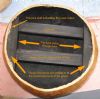
The wood is just softwood about 3/8 inch thick. The two end pieces have been shaped to fit the compound curve of the gourd. The gourd is curving, or tapering, in two directions at the same time and the end pieces need to fit snugly against the inside edges of the gourd.
Creating the compound curve is a bit of a slow process. I traced the basic shape onto the wood as shown by the dotted line on the pic. Both ends have to be done as they are different. Cut the wood roughly to shape with a fret saw.
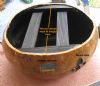
As you can see in the pic the inside of the gourd is painted with flat black paint. This is helpful when cutting the end pieces to their final shape as will be explained.
Once the basic shape of the end pieces are cut you need to grind away the "high" bits. By gently rubbing the end pieces against the gourd the "high" bits pick up the black paint and thus reveal themselves. Using a Dremel with a sanding bit I then, little by little, ground off the "high" bits. You just grind a bit of, try it again, grind way the next bit etc. It takes a while and you will never get it perfect nor do you need to do so.
Once you have both end pieces more or less in the right shape you fit the two "strainers" so that they the hold the end pieces snugly against both ends of the gourd. At the risk of being boringly obvious the end pieces must be placed where the neck enters and leaves the gourd.
They are then glued into place with "Builders Bog." That's what it is called in Australia - who knows what it is called where you live? "Builders Bog" is a two part filler and is described as "Unsaturated polyester based filler compound." Here is the advertsing blurb that should help you know what I am talking about.
"Builders Bog is a trade quality timber repair filler designed for use by builders and painters. Depending on mixing method, this high grade product mimics the behaviour of wood and can be made to set quickly or slowly, depending on the job. Builders Bog spreads smoothly, filling gaps, holes and dents. It can also be sanded, drilled and painted - just like real wood!"
The "bog" fills in all the gaps and glues the whole thing in place. It dries in just a few minutes. I just held it in place until it dried. Once you string the banjo up the tension will hold it in place as well.
I have done this on three gourd banjo's now without any problems. They may be tuned to normal tunings without fear as the strainers are taking the strain rather than the gourd.
Maybe this will be helpful to someone.
C Nyal de Kaye - Posted - 06/07/2013: 21:29:06
I am replying to my own post. How do I enlarge the pics above?
Someone help please!
mike gregory - Posted - 06/08/2013: 17:28:26
I copied the properties and clicked on the image after placing it on the page, then used the mouse to stretch it.
Another way to do it is for YOU to click to enlarge off your home page, and post that intead of the small one.
C Nyal de Kaye - Posted - 06/08/2013: 18:26:46
Thanks for your efforts Mike, I appreciate them.
I tried to follow your instructions but as you can see, I failed miserably.
My post is rather useless without the pics. I tried to upload them from Photobucket, again without success.
I don't know what else to do.
Noah Cline - Posted - 06/08/2013: 18:37:59
I've never heard of gourds caving in from the pressure of the strings. Usually since they are tuned low, I wouldn't think it would affect the gourd that much. I've heard of them being supported with, I believe, fiberglass on the inside. A cigar box banjo is one kind of banjo that I've made supports for to keep it from caving in, an improvement over the first one. I set two boards that were the same size as the dowel parallel to it.
JIm Widess - Posted - 06/08/2013: 20:29:34
I asked the question early this year or earlier. Thank you very much for your input. I'm getting ready to install a new gourd finally and now I'll try your method as I do the reconstruction. Another musician suggested installing an eyebolt through the neck extension between my leather tail piece and the gourd so that the tailpiece would be against the eyebolt instead of the gourd. The eyebolt is just south of the locking pin in the neck extension. (He makes the Ngoni (an instrument family from West Africa which can have 2-15 strings.) I'll send in a photo once I complete this installation . I'm thinking that a "T" bolted through the extension might be a visual improvement over the eyebolt but I don't have a machine shop to make one - but the leather tailpiece would look better draped over a "T" than over or through the eyebolt. Actually I'm working on a ukelele rather than a banjo.
Love this site.
Jim
C Nyal de Kaye - Posted - 06/08/2013: 21:13:39
Thanks Noah and Jim for your comments.
Noah is right in that many are tuned low to avoid the problem. Frankly, I refer the lower tuning also. However there have been times for me where it was necessary to tune up to standard tuning and thus I have set mine up to bear this without a problem.
Jim, I am no expert in these matters, but this idea does work well and gives strength that otherwise may not be there. I will be interested to see your pics and I hope that you have more success loading them than I have had.
C Nyal de Kaye - Posted - 06/08/2013: 21:18:39
Here is my latest attempt to get some viewable pics up.
This is the link to the first one.
http://i956.photobucket.com/
And the second ...
i956.photobucket.com/albums/ae...rdEnd.jpg
If it does not link directly just paste it into the browser and it should be OK.
BNJOMAKR - Posted - 06/09/2013: 10:19:12
Here are the pictures. I hope this helps!
p.s. Click on picture to enlarge!
Edited by - BNJOMAKR on 06/09/2013 10:20:09
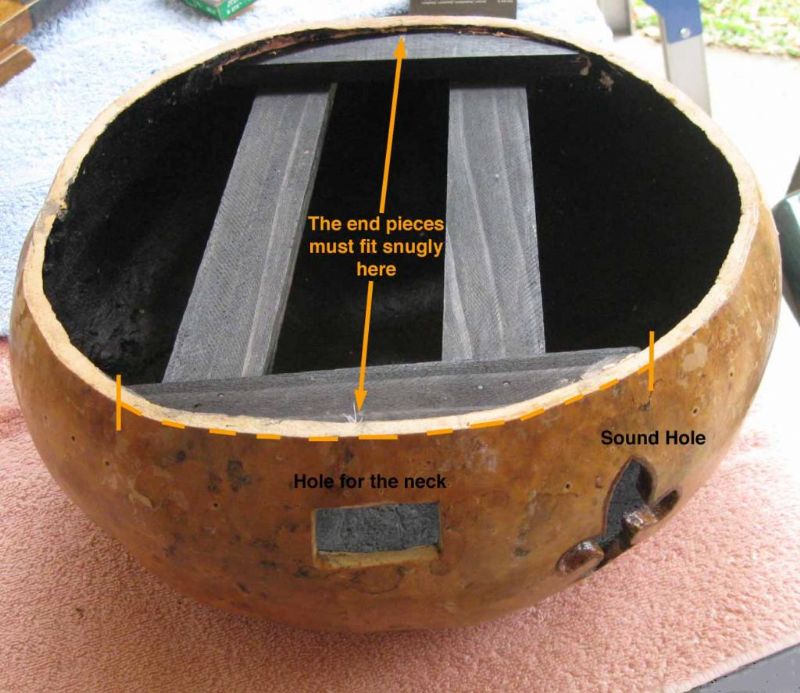 Gourd End | 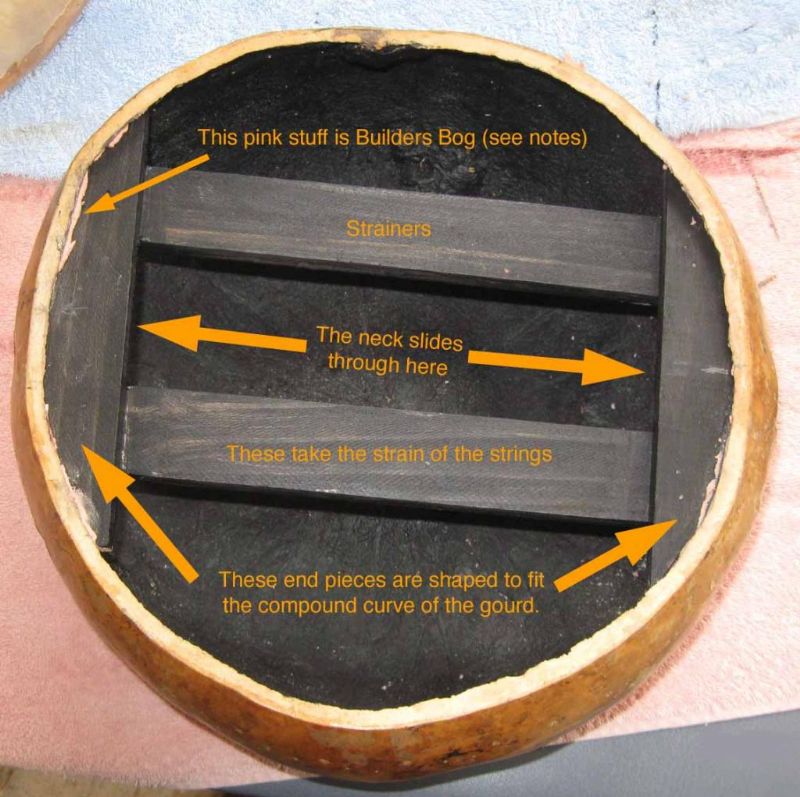 Gourd Inside |
smellyoldfatguy - Posted - 06/09/2013: 13:43:11
My son bought a gourd a couple of years ago, and the gourd collapsed where the tailpiece rested on the gourd. Since then I have gotten into banjo building and came up with a design that keeps all but the pressure of the bridge on the skin off of the gourd. Here are a couple of photos of my latest one. I basically just use a build up piece attached to the dowel, then run a violin tailpiece cord though the dowel and up and over the build up piece and over to a tailpiece. This has worked really well for me.
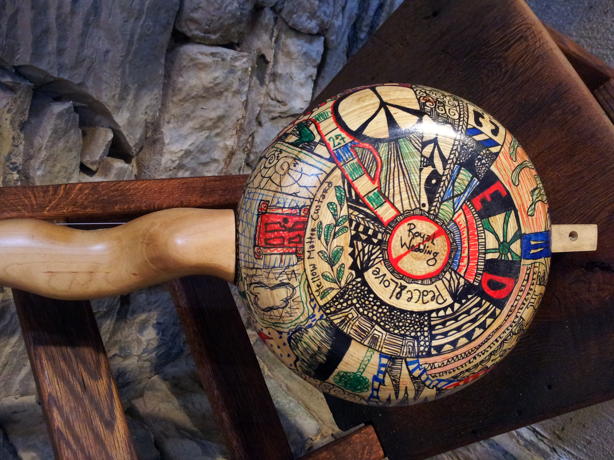 bamboo pot banjo | 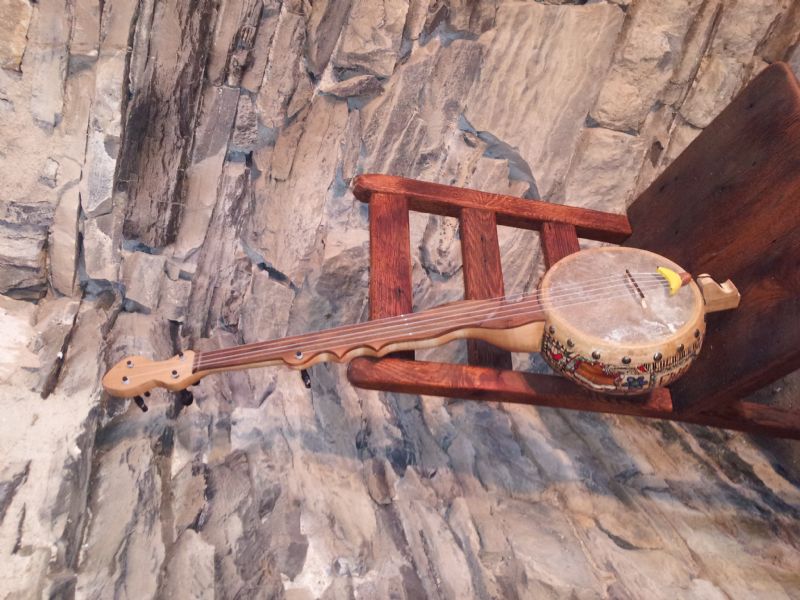 | 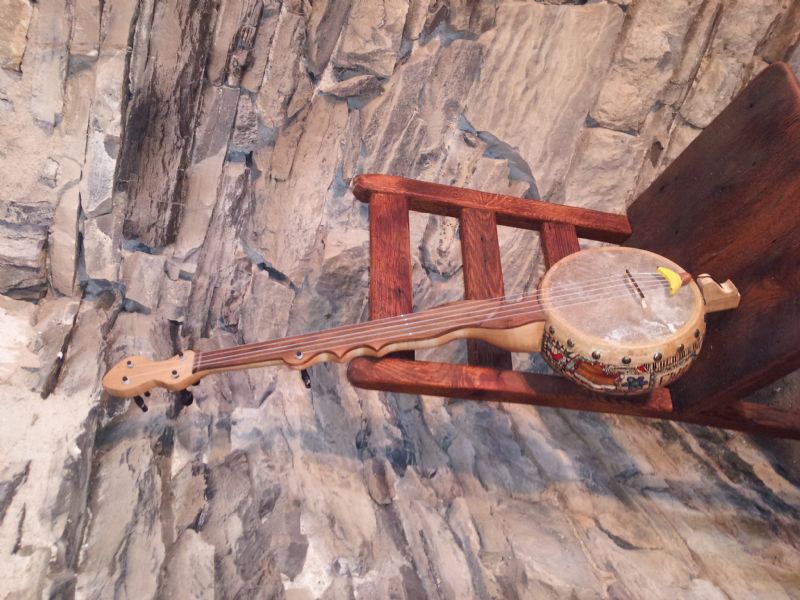 |
C Nyal de Kaye - Posted - 06/09/2013: 14:49:56
BNJOMAKER - thank you mate for sorting that out for me. I do appreciate your help.
Smelly, thanks for your input also. I love the look of your work and what a great idea is that tailpiece! It is a very nice looking neck.
Terms of Use | Privacy Policy | Privacy Consent (EU/GDPR Only)
Copyright 2026 Banjo Hangout. All Rights Reserved.


