
DVD-quality lessons (including tabs/sheet music) available for immediate viewing on any device.
Take your playing to the next level with the help of a local or online banjo teacher.
Weekly newsletter includes free lessons, favorite member content, banjo news and more.
Premier Sponsors


|
Please note this is an archived topic, so it is locked and unable to be replied to. You may, however, start a new topic and refer to this topic with a link: http://www.banjohangout.org/archive/261113
wizofos - Posted - 04/19/2013: 14:52:53
I am building a 12 sided unturned wooden head banjo to play with. Going to have fish line strings and baltic birch head. Building it from some maple flooring that has been in my shop for over 12 years. I have measured several instruments and the rim depth seems to be about 2 1/2 inches.
My question: Is there a reason that the rims are all about that depth? Would a deeper rim sound different? What about a thinner rim?
If you want to see one of the inspirations for this project look at the link below.
thebanjohut.com/childs_banjo_t...en_5.html
MOUNTAIN GOAT - Posted - 04/19/2013: 17:04:02
I would think a deeper rim would change the sound, and so will a thinner rim. I would think about making the rim taller, since you won't have a tone ring on top of it. Make the top part from really hard wood. I would keep it 3/4 thick. Nobody knows if a better rim, is better because it is stiffer, or because it weighs more, or because it is made from denser wood. They know X rim was better or worst, and assume why. The banjo is an extremely complicated instrument, which means there are a million unexplored options. Have at it. No one knows what sound you will come up with.
wizofos - Posted - 04/19/2013: 17:22:19
Thanks for your reply Bill, I reread my post and my real question was not about the thickness of the rim wall but thinner in terms of the depth. I am going to use 3/4" stock and glue them with vertical grain then cut a groove for the baltic birch plywood so it sets down inside the rim.
If this works out one of my grandsons is going to get something to play and annoy my daughter.
My thought was to start with a 3" deep rim.
Tanbark - Posted - 04/19/2013: 17:27:17
Tony Pass Lost Timber birch rim: a bit more than 2 and 1/8th inches.
First Quality Cox rim: 2 and 1/8th inches.
Stock Gibson rim from my RB-3: 2 and 1/8th inches.
Custom maple rim (a goood rim) from Janet Davis: 2 and 1/8th inches.
What it amounts to is that every contemporary bluegrass rim I've seen is within a 1/16 of an inch of 2 and 1/8th inches deep.
SoundsGoodToMe - Posted - 04/19/2013: 18:00:22
I haven't played one myself, but I've heard reports that 3" deep rims are bassier, but also considerably more uncomfortable to play because they force your arm into an odd angle.
SamCy - Posted - 04/19/2013: 19:04:24
Didn't Trujo banjos have exceptionally deep rims? How did they sound compared to the more typical shallower designs?
 |
gmo - Posted - 04/19/2013: 19:20:04
Lest we forget, the total depth of the tone chamber includes the tone ring (if there is one) and is overall 2 7/8" +/_. Rims are usually in the neighborhood of 2 to 2 1/8" and the tone ring makes up the rest. In the case of a "woody" or tone hoop banjo, the rim is overall 2 5/8" to 2 7/8" or thereabouts. I would say 3" would be a reasonable depth to shoot for.
George
Helix - Posted - 04/19/2013: 19:41:10
Yeah that was my next question, what sounds like a woody with a wooden top, nice sound.
3" total from the bottom of the head to the bottom of the rim. My rims are 2-3/4" tONY pAss and I discussed this with some humour, it's the depth of the cases available that limits, too deep and things get tubby and loose clarity.
The inside chamber gets maniuplated frequently, a thinner wall gives a bigger sound chamber with the same hardware, an old-timer's trick. Cool. So for a thinner wall, use a shallower rim, like 2-1/2"
mrussell - Posted - 04/20/2013: 03:38:55
Any shorter than about 2" and the hook and nut combinations most banjos use would extend past the bottom edge of the pot. Of course this may not be a problem unless yours is an open back. Any deeper than about 3" and you are really changing the overall depth of the finished banjo, especially with a resonator. This would place the players picke'n hand at an unfamiliar angle, that may be uncomfortable. My last few open back rims average 3" including the wooden tone ring.
Mike
Ken LeVan - Posted - 04/20/2013: 05:51:25
With an all wooden banjo, I'd think you would want a fairly thin rim. The thicker you make it, the more muffled it's going to sound. With a wooden top, the major part of the sound is going to come from the sounding board, which is the top. I would make the top from spruce instead of Baltic birch
I would be thinking along the lines of a guitar or bouzouki more than a heavy bluegrass banjo. If it was me making it, I would make the depth of the rim deep enough so that the tension nuts did not extend below the bottom of the rim. I might even taper the rim on the inside.
Apropos of an earlier post, the reason all bluegrass rims are within 1/8" of each other is because they are all copies of the same design, use standard parts, the resonator flange is also the bracket band, and the resonator has to be in the same relative position to the bottom of the rim, so there is not very much if any leeway for depth experimentation.
Ken
wizofos - Posted - 04/20/2013: 07:23:07
Thanks for all the input, sounds like I am on the right track with 3" or so from the bottom of the head to the bottom of the rim. One of my purposes in this is to get my 6 year old grandson into the shop to pass on some feel for the wood. My Dad was a Master Carpenter and I grew up working with him off and on and wanted to see if I can pass on the love of the smell of sawdust.
Probably going to start with 3 1/2" blocks then if it seems too deep dig out the belt sander.
Ken, thanks for the idea on the spruce, I will see if I can find some. Bruce Petros has a nice discussion about woods to use and how to pair them for guitars. Not sure if this applies but sometimes you connect information from different sources and a light goes on.
mbanza - Posted - 04/20/2013: 08:23:17
I've seen Pass all wood rims 3 inches deep and 1/2 inch thick. Consider gourd banjos and you will realize that many have depths of five inches and more. Bowl backed mandolins are rather deep, and the list continues the more you think about it. If you put it together with the heel cut at what you consider the least depth you want, you have the option of reducing pot height from the bottom later if you so desire.
Since you are planning to have a wooden top, you needn't worry about hooks and nuts, therefor, you have the option of making it thinner than average, though I'm not recommending this.
Helix - Posted - 04/20/2013: 16:51:18
There are those here who know a thing or two about wooden tops, not just conjecture, we'll see if we can't get somebody with experience to ring in. How thick a piece?
In Scrugg's book they show the fancy rim they built out of blocks of different color, and there in the photo, it's only about 2" deep, the hooks can stick over the bottom all they want, they were counting on the resonator to pickup the slack.
Depth and thickness go together.
mrussell - Posted - 04/21/2013: 06:12:34
quote:
Originally posted by Helix
There are those here who know a thing or two about wooden tops, not just conjecture, we'll see if we can't get somebody with experience to ring in. How thick a piece?
In Scrugg's book they show the fancy rim they built out of blocks of different color, and there in the photo, it's only about 2" deep, the hooks can stick over the bottom all they want, they were counting on the resonator to pickup the slack.
Depth and thickness go together.
The wooden top banjos I've built range in depth from 2.5 to 3.5 inches, 1/2 to 5/8 rim and a 1/4 top. Normally use spruce or cherry for the tops.
Mike
Helix - Posted - 04/21/2013: 06:27:20
Thanks Mike, I'm always curious about nylon and post earthquake building techniques. Not kidding, I like it when people keep this simple tradition alive.
Since the poster mentioned Baltic Birch, he had a reason, the Balalaikas seem to be all Birch.
But there is a little difference between Cherry and Spruce, would you be kind enough to explain possible other choices? 1/4" top? Very cool,easy to produce, does thinner make it better?
I suggest a thinner and deeper rim because you can always remove depth, but it's hard to add later.
MOUNTAIN GOAT - Posted - 04/21/2013: 09:40:15
Wooden rim and tone ring bonded as one piece. Hard wood for tone ring section. 2.69 high and .72 thick. You can't tell it doesn't have a metal tone ring. Very balanced and loud sound.
wizofos - Posted - 04/21/2013: 10:47:13
Actually the reason I mentioned Baltic Birch was because that is what they used on the one sold by Banjohut and I found a small piece Music Makers when I was over in St. Paul, Minn. They are in Stillwater just down the road. While I was there talking to the guys I mentioned looking for some birch and they said they had some and I got a piece for a buck. The main idea of this was to build this as an experiment out of what I have in the shop or what I can pick up locally.
I might look around Green Bay area to see if I can pick up some spruce.
Edited by - wizofos on 04/21/2013 10:54:28
MOUNTAIN GOAT - Posted - 04/21/2013: 10:57:05
Just for your information, maple is harder, stiffer and heavier than Spruce by a significant amount. Birch is slightly stiffer, heavier and stronger than maple.
mrussell - Posted - 04/21/2013: 18:34:42
quote:
Originally posted by Helix
Thanks Mike, I'm always curious about nylon and post earthquake building techniques. Not kidding, I like it when people keep this simple tradition alive.
Since the poster mentioned Baltic Birch, he had a reason, the Balalaikas seem to be all Birch.
But there is a little difference between Cherry and Spruce, would you be kind enough to explain possible other choices? 1/4" top? Very cool,easy to produce, does thinner make it better?
I suggest a thinner and deeper rim because you can always remove depth, but it's hard to add later.
Hey Helix,
I made a jig a few years ago to try out different woods for a wood top banjo. I tried cypress, birch, spruce, different cedars, different maples, walnut, two types of cherry, sycamore, and sassafras. Some braced with spruce, others with the primary wood, others unbraced. I settled on cherry braced with spruce as my favorite sound, but others, like the sassafras sounded good as well. If I remember right, I didn't think either the walnut or sycamore sounded very good. 1/4 inch with bracing seems to work well, providing a good soundboard. Any thicker, and the sound seemed to deaden.
The jig is no longer around, but basically it was a maple pot fixed to some plywood with a straight piece of maple and some wooden pegs. I tried the wooden top both sitting directly on the pot and raised up off of the pot with 6 maple pegs. The more dense woods tended to sound louder with the pegs.
Mike
Dan Drabek - Posted - 04/21/2013: 18:40:07
quote:
Originally posted by SamCy
Didn't Trujo banjos have exceptionally deep rims? How did they sound compared to the more typical shallower designs?
I had a Trujo plectrum. (ugliest banjo I've ever owned). It did indeed have a very deep pot. If I recall correctly, it had a bright but "throaty" sound.
DD
Dan Drabek - Posted - 04/21/2013: 20:17:20
quote:
Originally posted by MOUNTAIN GOAT
What are you guys talking about when you say braced?
Fitted with wooden braces. Like the top of a guitar.
DD
Helix - Posted - 04/22/2013: 06:09:07
This is a great thread.
One hangout member, country frank has installed an insert in the bottom of his resonator, a flat piece of wood that is flexing, no braces, it kind of shoots sound. Coolest idea, passive and simple.
Then this other builder innovator comes along and uses an ossicle inside the banjo just like a fiddle, a little fiddle stick.
Now this discussion of a wooden top and types of materials and bracing. I suggest bracing was added after somebody cracked a head with music, real vibes.
The transfer from a 2mm thick diaphragm is enhanced greatly by braces, I'm sure. It's logical, then a person can pick a sound they want. Pennington uses tacks to raise the tone ring, totally logical to raise the head. 1/4" thick still kicks, got to.
Badfoof here on the hangout has the best mountain dulcimers I've seen, the builder installs a false bottom using blocks of wood and gravity and time, no holes in the back of the dulcimer, just another back with a space, about an inch in there. They boom, he can play them at an outdoor festival with his group and be heard quite clearly and far away, just wood.
I went to Kentucky in 2011 to pick up some necks I ordered and came back with a truckload of wood, necks, rims as compensation from a strong person and friend who had a string of failures. BUT.................
I came back with Sassafras, Catalpa, Osage Orange, and Cherry, all cut by the Amish, you can tell when you're looking at a 2'radius of sawteeth, they've got an old 4' buzzsaw. Not a bandsaw.
No one on the hangout has mentioned Sassafras or Catalpa, I got busy, so I'm always curious and I always seek out those who know. As it is, the consumer has enjoyed a full wheelbarrow of Cherry Helix.
 Mahogany, Grapefruit, Cherry, Cherry, Hickory, Red Oak, Chestnut |
RBuddy - Posted - 04/22/2013: 06:23:46
AK Goat
Here is a pic of typical guitar top braces. The pic was taken through the sound hole inside an old Martin I was restoring last year. Should give you the idea. Basically braces support the thin wood on wood body instruments.
 Martin Guitar Braces |
wizofos - Posted - 04/22/2013: 07:45:23
This conversation is great, what I thought would be a relatively simple project is turning into a great learning experience for me.
I had thought that the head should be free to resonate and that braces would deaden the sound. I looked at my cheap guitar after looking at the picture above. I guess that the braces do not affect the resonance of the head that much.
Looks like I am going to be rethinking my plan here. That is not a bad thing at all.
By the way most of these wooden banjo's I have seen all appear to have 8" rims or so. My plan was to go with an 10-12" rim. 12x3" long blocks make a 10 1/2" rim.
Hmmm lots to consider and think about but glad to get all this knowledge and skill on here.
Thanks
Helix - Posted - 04/22/2013: 08:13:57
I suggest there's a pattern or center point close to the bridge, ovalized, that's why people shave braces, it enhances the sound of a wooden top guitar, little ones in a fan shape should R O C K in a tasteful way of course. Notice they are assymetrical.
I like the 12-sided, unturned, whatever depth, 12" , I haven't read about one like that here, aren't you going to build the case, too?
Ogsbury backed up in the snow over his banjo in a case he had built in his shop, no harm to neither three, the banjo, case, nor car. Makes me feel better about taking off to the hardware store with a resonator on my tailgate.
Also some of us exchange pieces of wood in our old age. I've received Lilac, Crabapple, Chestnut, Rosewood, Ebony, Tiger, I've shared Lemon, Grapefruit (braces) Orange, Tangerine, Tangelo, can't find any Peach or Apple. Up North, try to find some old furniture to cut up, that's local. I just got a free CHERRY chest of drawers, American, I use every splinter, bridges and all. Jatoba and Ipe are Western Hemisphere. I bought a box of Jatoba flooring for $8.97 reject. I use it for strength and color, here's an example of bamboo flooring with Jatoba stripes. (I use bamboo for all kinds of things like jigs, bridges, race car models, banjos. Jatoba won't steam bend even at 1/8", but I can cut bamboo so thin you can see the light through it, just sayin'
Please publish pictures as you go, very nice project.
 |  |
Dan Drabek - Posted - 04/22/2013: 08:32:06
quote:
Originally posted by MOUNTAIN GOAT
Never heard of that. Can you post pictures?
Braces not only strengthen the top against the pull of the strings, they help distribute sound vibrations, and control them.
I would assume braces might perform in the same fashion on a wooden topped banjo. However a banjo uses a tailpiece, so the vibration of the strings transmits sound differently than it does to an instrument where the bridge is glued to the top like a flat top guitar.
Archtop guitars, on the other hand, do use a tailpiece, and are braced differently than flat top guitars.
An interesting experiment might be to use a flat, braced wooden top on a banjo and glue the bridge to the top like a flat-top guitar.
DD
Ken LeVan - Posted - 04/22/2013: 08:38:30
Here is a picture of the braced spruce top of a "Celtic or Irish Bouzouki".
This would be my approach when building one - notice the reinforcement under the bridge:

This particular type of instrument is very "banjo like" in shape, but uses guitar construction methods.
Jonnycake White - Posted - 04/22/2013: 08:59:40
When you say baltic birch, are you talking about solid wood or plywood? I have a piece of balic birch plywood that is about 1/32" thick which I've been saving for a wood topped banjo.
Ken LeVan - Posted - 04/22/2013: 09:15:27
quote:
Originally posted by Jonnycake White
When you say baltic birch, are you talking about solid wood or plywood? I have a piece of balic birch plywood that is about 1/32" thick which I've been saving for a wood topped banjo.
Baltic Birch is the trade name for high quality birch plywood made in Finland and Russia. The difference between it and most other plywood is that all the layers are made of birch. In ordinary birch plywood, the inner plies are some other wood, such as poplar.
Baltic Birch comes in a number of thicknesses and until recently has been metric, with sheets being 150cm ( roughly 5' x 5'), which doesn't fit into a pickup truck.
google.com/search?q=baltic+bir...p;bih=776
rudy - Posted - 04/22/2013: 10:09:17
quote:
Originally posted by MOUNTAIN GOAT
Never heard of that. Can you post pictures?
Plenty of photos of braced wood top banjos at Jason Romero's website if you're interested in seeing how Jason makes them.
For anyone interested, Baltic birch (aircraft plywood) is commonly available at craft outlets such as Michael's in banjo-suitable sizes. I purchase it to make jigs and patterns out of, the local paper (and sales fliers arriving in the mail) often run a 40% off one item coupon which makes it pretty economical to pick up a 12" by 24" piece. It is sold in many thicknesses from 1.5mm up to about 1/2" thick.
I'm going to do a wood-bodied banjo (rim constructed like a guitar body with bent sides and kerfed lining), but it won't be til later this year before I can work it in.
bluestemstrings.com/pageWTBanjo.html
Edited by - rudy on 04/22/2013 10:12:43
Ken LeVan - Posted - 04/22/2013: 10:17:59
quote:
Originally posted by MOUNTAIN GOAT
I was asking about bracing on a banjo rim.
I don't know that you would need any bracing on the rim, inasmuch as the rim is going to be hugely thick compared to the rim of a guitar.
It's not clear how the grain runs on the 12-sided rim, but that would have a bearing on the stiffness of the rim.
If you were going to make the rim thinner than banjo rims usually are, you would probably need some kind of heel block, like they do on guitars, mandolins, etc.
The top will keep it round on the top, but there will have to be some longitudinal brace, like a dowel stick, to keep the rim from going oval on the bottom. On regular wooden stringed instruments, the bottom does this, but I believe the instrument being contemplated here is going to have an open back, like a banjo.
wizofos - Posted - 04/22/2013: 10:18:29
I am not familiar with the Baltic Birch that instrument makers use but it is popular in high end yachts. The advantage is that there are no voids in the inner layers and it is laminated with marine grade glues. When you cut it there are no edge voids.
I understand that there is a B grade that does have patches but never seen or used it.
A sheet of 3/4" A grade Baltic Birch plywood can coast over $100
Ken LeVan - Posted - 04/22/2013: 10:25:55
quote:
Originally posted by rudy
I'm going to do a wood-bodied banjo (rim constructed like a guitar body with bent sides and kerfed lining), but it won't be til later this year before I can work it in.
That's the way I would do it. I am planning to make one after the summer projects are over, but I will use the more "Bouzouki - shaped" body on it and a bolted-on neck.
wizofos - Posted - 04/22/2013: 10:44:40
Ken, not sure what others might do but my idea was the use a similar design to the one on banjohut.com. They did turn the top of the rim round but I was going to leave it 12 sided (Dodecagon. yes had to look that up). Cut the head to that shape about a 1/4 inch larger than the inside of the rim, rabbit a ledge on the top of the rim to rest the head on.
Rim is going to be made from from some tongue and groove 1x6 maple flooring that has been in the shop from another project about 12 years ago. I was going to run the flooring through the table saw to cut the 15 degree angles I need, then cut off 3 1/5" pieces so that the grain will run vertically and the blocks will be edge glued not end grain glued. A lot of this design has to do with the tools available, no lathe available that is large enough to turn a rim.
One problem that I read about from someone that made something similar is how to adjust the neck angle but I have a few ideas there. There will be something similar to a dowel stick. Still doing some research and thinking out the design.
If I use the Baltic Birch for the head and fishline strings I don't think I am going to need any extra bracing under the head.
Edited by - wizofos on 04/22/2013 10:49:11
MOUNTAIN GOAT - Posted - 04/22/2013: 11:28:04
OK I see now your were talking about a wood top banjo being braced.
championofnorthhuron - Posted - 04/22/2013: 18:41:46
quote:
Originally posted by MOUNTAIN GOAT
OK I see now your were talking about a wood top banjo being braced.
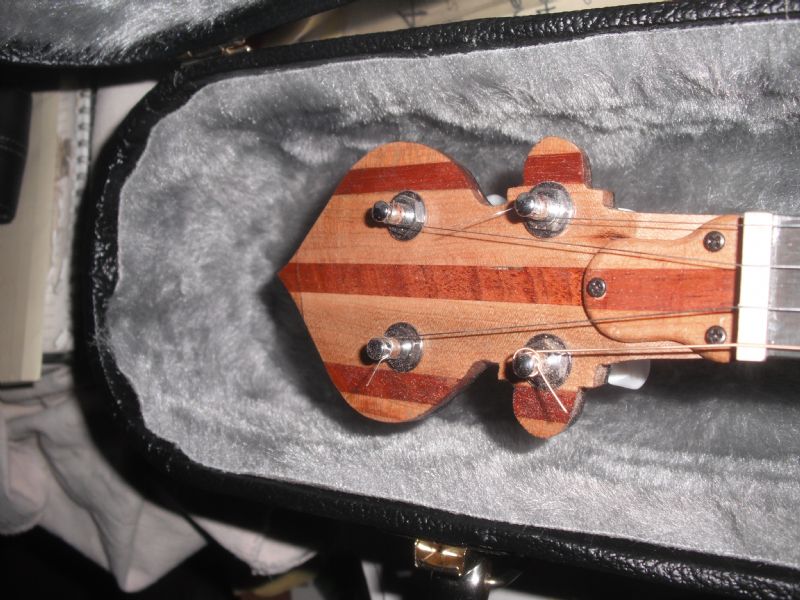
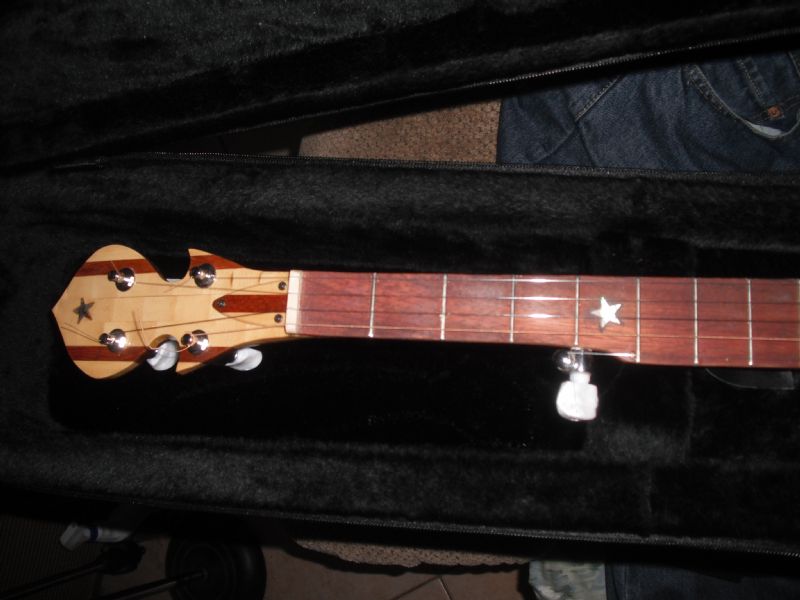
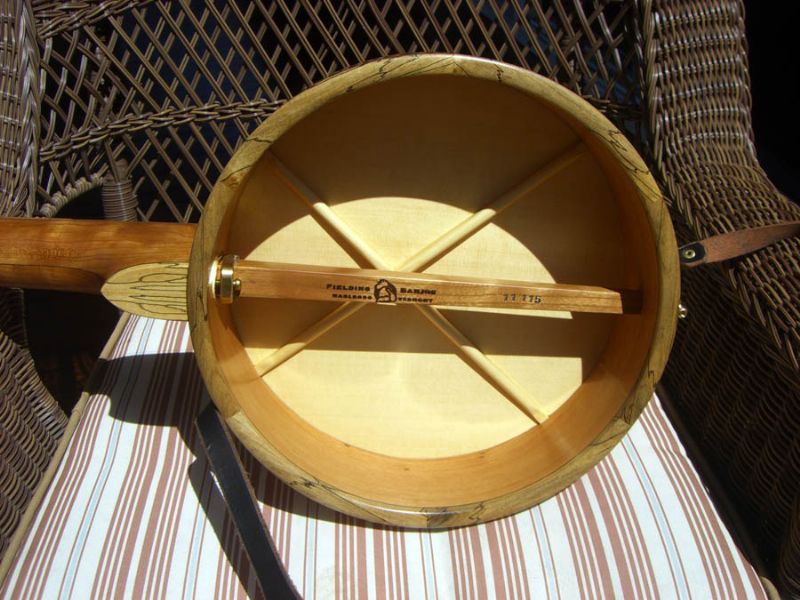
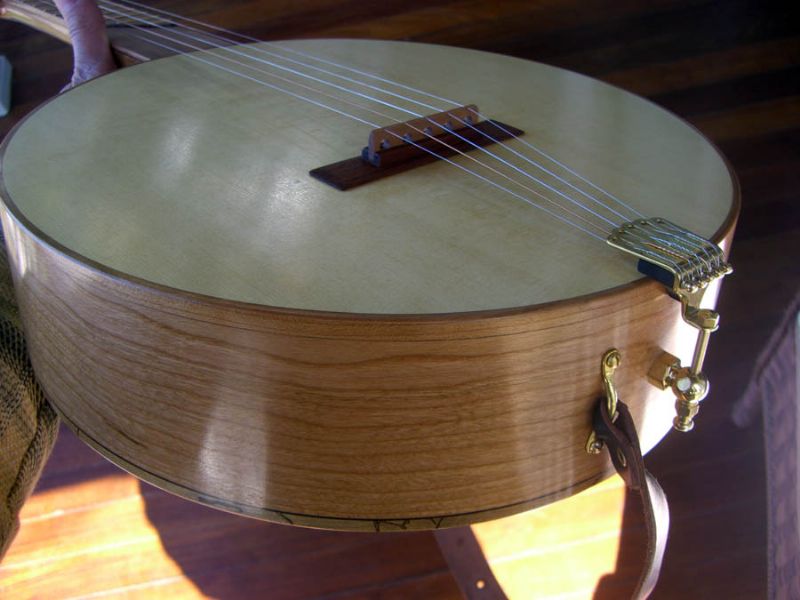
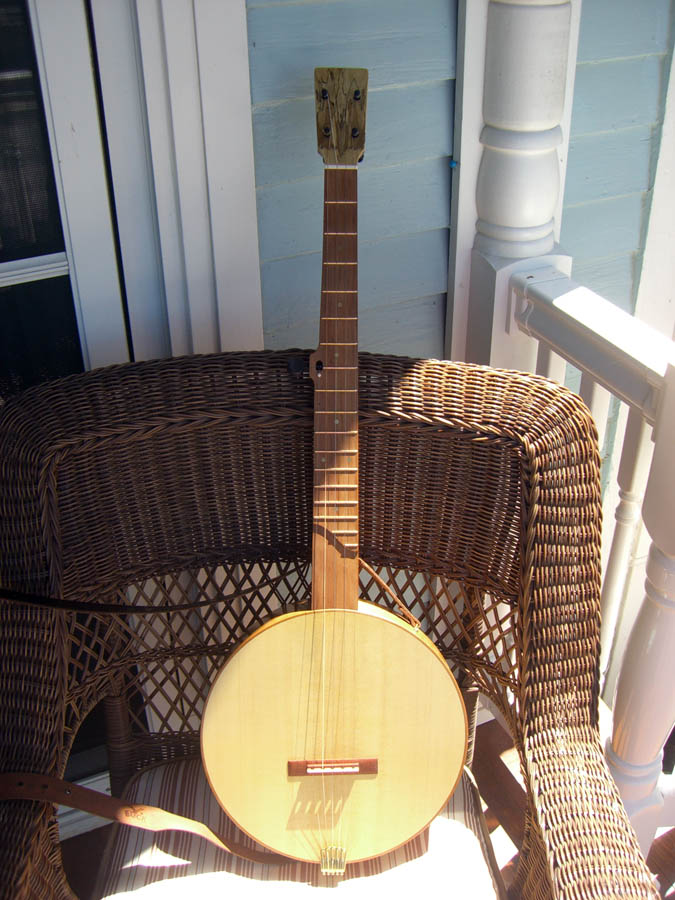
Here's a few photos... the first showing the bracing. This one's mine. The bracing is taper/scalloped down on the ends. There are additional photos of this banjo on my home page... in the folder titled 'Fielding Wood Top'.
Edited by - championofnorthhuron on 04/22/2013 18:46:19
 |  |  |
Helix - Posted - 04/22/2013: 19:58:42
Vertical grain should be sufficient to not need a heelblock, other builders of this type get along fine A round dowelstick gives a round hole, a dowelstick is not necessary and can be done from the outside of the banjo on the bottom, I'm not very fond of punching big holes in nice rims. I'm cvurious what method you choose.
There's no hardware, thus the top is glued on. the bridge needs to stay loose to adjust the intonation.
Champion, what wood is your top?? Mountain biking season is approaching, we had 97 degrees today, shoosh.
championofnorthhuron - Posted - 04/23/2013: 07:05:31
quote:
Originally posted by Helix
Champion, what wood is your top?? Mountain biking season is approaching, we had 97 degrees today, shoosh.
My top is Adirondack Spruce.
97 degrees? That's hot. Looks like you'll just have to stay in the air conditioning and pick banjos! Here in the North East... we've been struggling to get past 60 degrees yet. Not excessively wet though.
wizofos - Posted - 04/23/2013: 09:21:32
Champion, that is a beautiful instrument. I love that spalted wood trim. I have a maple in my back yard that is going to be cut down this spring and might get some spalted wood from that but would not be good to use for a year or so.
You did give me a few ideas. I have some teak that would look nice as trim, will have to see what I can do.
mrussell - Posted - 04/23/2013: 18:46:39
Back on bracing for a second, another benefit is helping deal with wood movement and cracking. One of my wood tops that became firewood, cracked because I solidly attached the top to the pot, and didn't allow for wood movement. Bracing will help with, but not eliminate the movement. I did try one version with a loose top, similar to how a cabinet door is made, thinking the pressure from the strings would make a good enough connection between top and pot to transfer the vibrations. That didn't work as well as I wanted. Guitar style bracing with a soft wood top seems to be the best compromise. I guess generations of guitar builders got a few things right, but I still like to experiment.
Mike
davidppp - Posted - 04/23/2013: 23:27:37
About 30 years ago, I assembled an all wood kit from the Hughes Dulcimer Co (defunct?) of Denver, CO. The head is 1/8" ply, pieced together from three pieces. The pot interior photo shows one of the two thin strips that reinforce the head butt joints. I cut down the original 3 1/4" depth to 2 1/2" and thinned the neck to give it more of a regular banjo feel, but I couldn't tell any difference in sound. Fishing line recently replaced extra-light steel. I've always loved it, and it has a louder, richer sound than an elegant all-wood banjo I bought that has a 1/4" solid cedar head.
DOES ANYONE HAVE A CLUE ABOUT RIM DEPTH ON AN OPEN BACK??? On virtually every other design decision, I have a sense of the sound of various materials and dimensions (and theory to go with it).
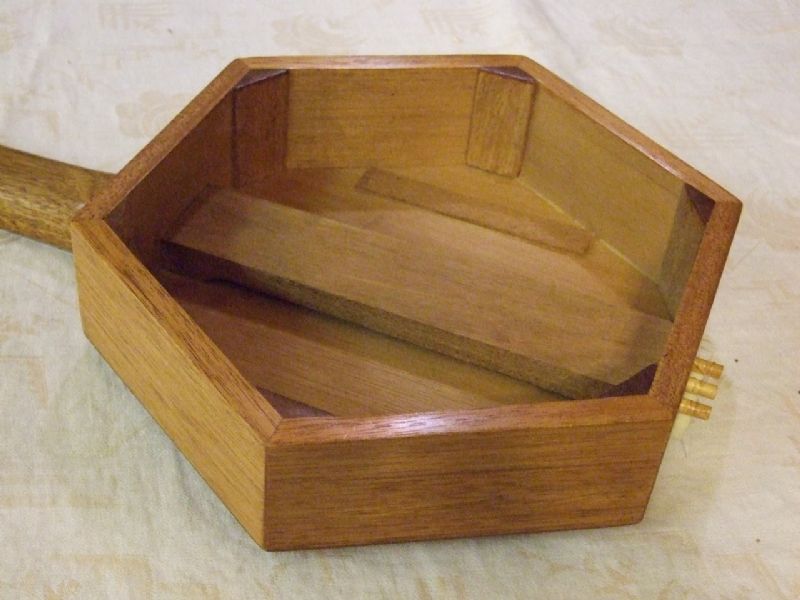 all wood banjo pot interior |  all wood banjo head |  all wood banjo |
wizofos - Posted - 04/24/2013: 05:31:20
Thank you for the photos and comments David. I am encouraged by this project and will start making sawdust this weekend after getting a few Honey Do's done. This design is pretty much what I have in mind and what I have sketched out. The one thing I am planning is to put in a 'dowel stick' similar to what you have in yours but put it lower down in the rim then slide the neck in and work out a way to include and adjusting screw to adjust the neck angle. I am glad to hear that so many of these woodies sound good which encourages me.
The plan is to use zither pins for tuning but that might change. Right now everything is negotiable in my mind.
There is so much good info in this thread, I think I am going to print it out for future reference.
Mike thanks for the comment about the 'floating' head. I was thinking of doing this but not sure if the vibrations would be transferred to the rim, sounds like that is not a good idea. I agree we need to heed the lessons of those who have gone before, but is it fun to play around with a few ideas.
rudy - Posted - 04/24/2013: 07:11:09
quote:
Originally posted by mrussell
Back on bracing for a second, another benefit is helping deal with wood movement and cracking. One of my wood tops that became firewood, cracked because I solidly attached the top to the pot, and didn't allow for wood movement. Bracing will help with, but not eliminate the movement. I did try one version with a loose top, similar to how a cabinet door is made, thinking the pressure from the strings would make a good enough connection between top and pot to transfer the vibrations. That didn't work as well as I wanted. Guitar style bracing with a soft wood top seems to be the best compromise. I guess generations of guitar builders got a few things right, but I still like to experiment.
Mike
Wood top banjos need careful consideration to deal with wood movement where the top is concerned. The design I'm going to use will have a solid sitka top, so wood movement will be addressed by building the top with an appropriate arch. Top arching is an effective measure to deal with expansion and contraction of the wood across the grain. Arching has the added benefit of ensuring the top doesn't take on the concave appearance that it characteristic of flat topped instruments with string tension exerted upon them.
Baltic Birch ply is another option if you're going for a dimensionally stable top.
davidppp - Posted - 04/24/2013: 08:18:03
In that hexagonal Hughes Dulcimer banjo, the neck and "dowel" are a single piece. A 1/4" fingerboard is glued on, and that gets the fingerboard height above the head (by 1/8"). Under the head, the neck wood is cut away about 1/8" except for lengths of about 3/4" at the neck joint end and 1/2" at the tail end, each glued to the head, leaving the middle of the head to vibrate. The neck angle isn't adjustable, but you could construct it with a fixed angle, e.g., 2 or 3 degrees, by removing wood from the top of the tailpiece end of the dowel/neck. (I didn't think of it then). That angle gives you more down pressure of the strings on the bridge (and, hence, more volume) and a bit more clearance under the strings over the head.
Terms of Use | Privacy Policy | Privacy Consent (EU/GDPR Only)
Copyright 2026 Banjo Hangout. All Rights Reserved.


