
DVD-quality lessons (including tabs/sheet music) available for immediate viewing on any device.
Take your playing to the next level with the help of a local or online banjo teacher.
Weekly newsletter includes free lessons, favorite member content, banjo news and more.
Premier Sponsors


|
Please note this is an archived topic, so it is locked and unable to be replied to. You may, however, start a new topic and refer to this topic with a link: http://www.banjohangout.org/archive/258027
steve davis - Posted - 03/10/2013: 05:33:52
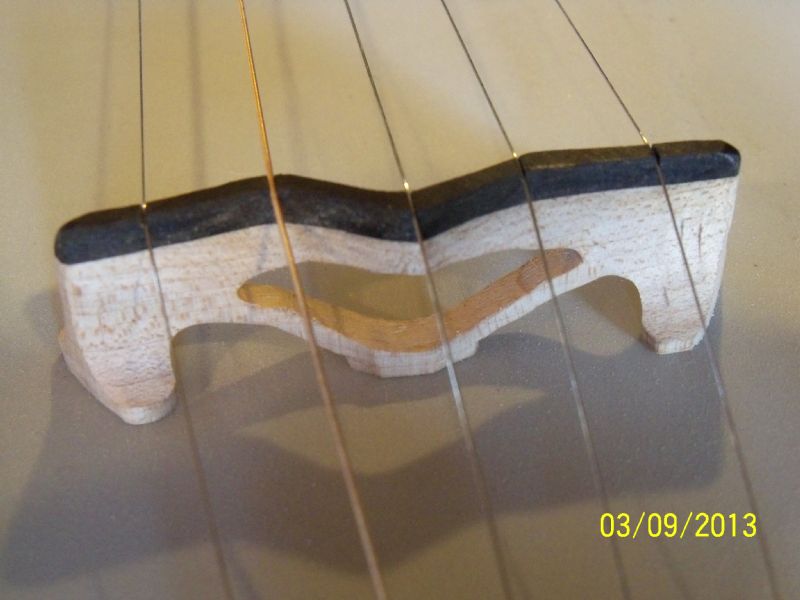
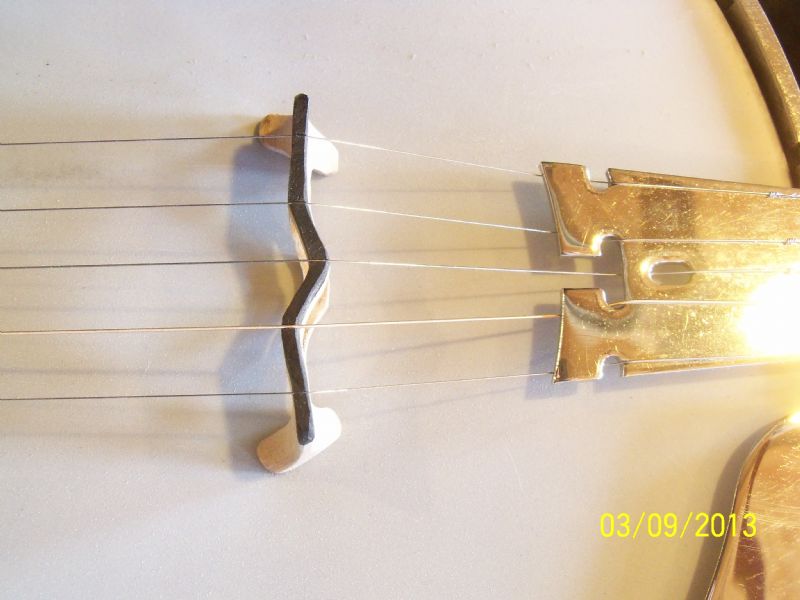
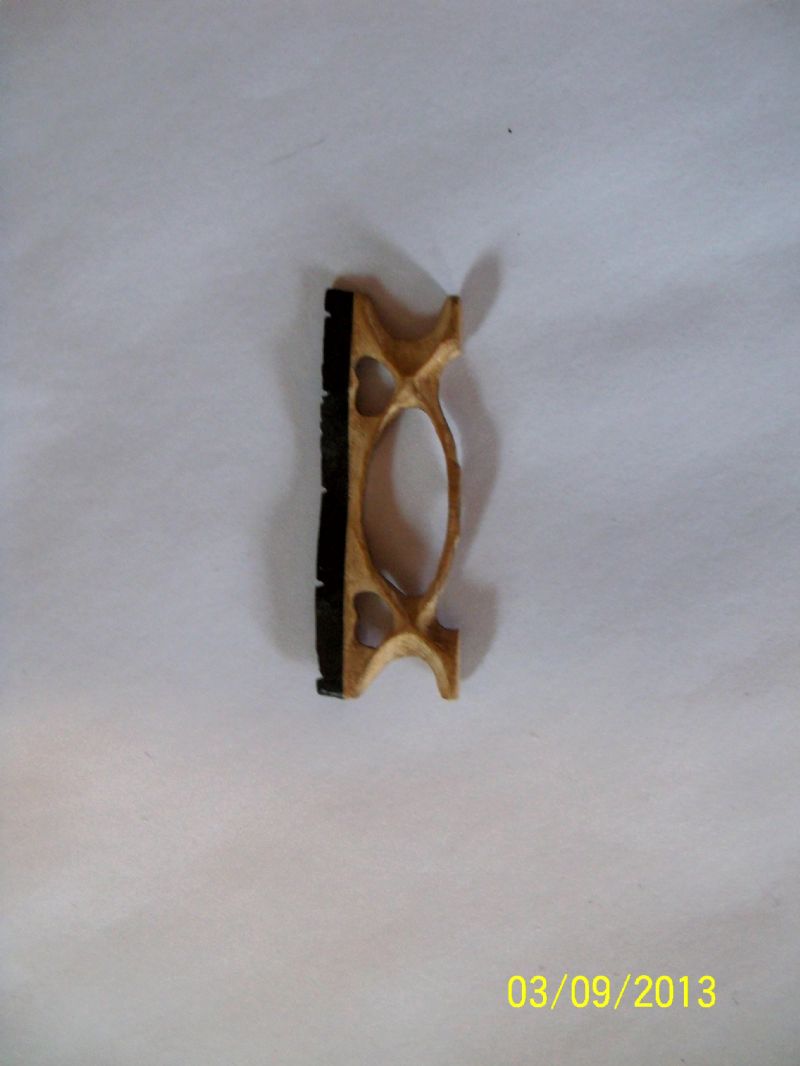
I've been playing it since yesterday and all tonal characteristics are favorable.
 |  |  |
jeremyg - Posted - 03/10/2013: 05:58:03
Looks good steve. Im still playing the one you made for me, still lovin it. What are the advantages to the new design? Keep us posted, maybe ill have to try a new one out!
kmwaters - Posted - 03/10/2013: 07:39:24
Steve you are a great bridge builder. I hope the BHO crowd supports you. I like the looks of this one. So now for the universal question:
If compensation is totally logical - which it seems to be - why are so many bridges not compensated???
steve davis - Posted - 03/10/2013: 08:05:20
A straight bridge has its own set of temperament in the distance of each note from 0 on a tuner or your ear.
Acceptable as the way a banjo has always sounded.A little sharp here and there.
I found it easy to remove that sharpness to a very high degree and sweeten the notes.
I like the closer accuracy of the notes to 0 when I navigate melodically up the neck.
I like the closer harmonies I hear and feel in the compensated chords.
Edited by - steve davis on 03/10/2013 08:12:53
 |  |
kmwaters - Posted - 03/10/2013: 08:09:27
I have to agree with all of that. So some day we will see the action committee to stamp out straight bridges. They may call it the musical purist political action committee. What the heck - there are movements everywhere to make things illegal, right? Why not straight bridges?
steve davis - Posted - 03/12/2013: 08:26:50
My bridge design lets you capo without retuning.
Great intonation on all strings all over the neck.
"All the Gs are in tune",said Jimmy Cox.
Aradobanjo - Posted - 05/16/2013: 06:00:05
Hello Steve,
Nice design you have there. A trend seems to be happening with bridge design. Before, the most deviation from the straight line was the Shubb (German design) compensated bridges. Today, the surface area of the pads is wider. While the move is to thinner bridges, does this lead to instability? Vibrations are transmitted through the bridge. The bridge of a guitar is fixed. The bridge of a banjo is movable. Hence, those vibrations will cause the bridge to "move". Wider feet would 1) distribute the load better instead of a knife edge 2) stabilize the bridge making it less likely to bow or teeter. Assuring a straight line is perpendicular to the surface of the head is problematic. Once inside the case, a secured banjo would be required to not have the bridge tilled forward or backwards.
How is the compensation calculated? Seems that the Shubbs were just something different. They sounded muffled and up the neck was off. Compensation seems to be less used to solve tonal issues and more for asthetic appeal, a.k.a. The cool factor.
steve davis - Posted - 05/16/2013: 18:13:34
I came up with this top wave by plotting the location of each string when the 12th fret fretted notes and 12th fret harmonics agreed on an electronic tuner.
I was curious what the effect on the overall playing of the banjo would be.
I found a much higher percentage of fretted notes all over the neck at or near 0 on the tuner when compared to straight bridges.
Sweeter,closer harmonies in the notes of a chord,less if any retuning after capoing and a general strength of in tuneness.
I prefer a bridge's tone at a weight between 2 and 2.15 grams,but my customers sometimes have other preferences.
I base my decisions on what I've heard in the past 53 years.
Shubb stairstep bridges are very inaccurate concerning intonation and they are too heavy.
Edited by - steve davis on 05/16/2013 18:14:29
Bart Veerman - Posted - 05/17/2013: 06:27:49
Aradobanjo: "How is the compensation calculated?"
Steve: "I came up with this top wave by plotting the location of each string when the 12th fret fretted notes and 12th fret harmonics agreed on an electronic tuner."
I've seen you post the weight of your compensated bridges quite frequently but never the most important specification about a compensated bridge: the intonation correction values for each one of the strings...
So do you use the exact same locations/values for all your compensated bridges Steve and, specifically, what are these values?
steve davis - Posted - 05/17/2013: 10:04:57
I figured the pattern on my Cox conversion because I have faith that it is as close to correctly built as any existing banjo.
I wanted to make sure that I started with a blueprint accurate neck.
I wanted to make sure that I was only dealing with the compromises of a straight top bridge.
Moveable slide (paper clip) on a fixed 5/8" block in place of a normal bridge.
Paper clip under each string in line with where 1 11/16 string spacing would line up(5 measured lines on the block).
Slide clip back and forth under each string to find each string's 0/0 at the 12th.
The pattern of my bridges will emerge on any banjo that this test is done on unless the 12th fret is somehow not located correctly.(rare).
I took a cheap,clear plastic protractor,laid it on the 5/8 block and traced the 5 dots on the protractor.
I then drilled the 5 dots and I always use that little drilled protractor/template to mark my bridge tops.
Nothing to do with unique intonation problems,simply straight top bridge correction.
Edited by - steve davis on 05/17/2013 10:07:20
steve davis - Posted - 05/17/2013: 10:51:56
The 5th string position is figured from the 5th string resting on the 5th fret...not on a pip.
We all know where the 5th fret is...the pip could be anywhere.
Bart Veerman - Posted - 05/17/2013: 14:44:24
quote:
Originally posted by steve davis
I figured the pattern on my Cox conversion because I have faith that it is as close to correctly built as any existing banjo.
I wanted to make sure that I started with a blueprint accurate neck.
I wanted to make sure that I was only dealing with the compromises of a straight top bridge.
Moveable slide (paper clip) on a fixed 5/8" block in place of a normal bridge.
Paper clip under each string in line with where 1 11/16 string spacing would line up(5 measured lines on the block).
Slide clip back and forth under each string to find each string's 0/0 at the 12th.
The pattern of my bridges will emerge on any banjo that this test is done on unless the 12th fret is somehow not located correctly.(rare).
I took a cheap,clear plastic protractor,laid it on the 5/8 block and traced the 5 dots on the protractor.
I then drilled the 5 dots and I always use that little drilled protractor/template to mark my bridge tops.
Nothing to do with unique intonation problems,simply straight top bridge correction.
Hmmm, if you're getting the same $40 for a one-fits-all generic as I do for my completely custom prescription ones maybe I should raise my prices... 
steve davis - Posted - 05/17/2013: 14:47:54
Generic?It's just the pattern that increases the accuracy and in-tuneness when compared to a straight bridge.
It takes me from 1 to 2 hours to make one of my bridges.
Seems a fair price for all the work and care I put in each one.
My carving friends say I put $75 worth of work in each one.
Edited by - steve davis on 05/17/2013 14:49:56
HarleyQ - Posted - 05/17/2013: 22:08:57
Out of 25 or 30 banjos, I finally needed a comp bridge on one. So I built one like Arthur's, it took about 45 min too an hour. About $15-20 worth of work. I sure wouldn't put one on every banjo I have.
Roll Player - Posted - 05/17/2013: 22:36:31
I found the compensation on Steve's bridge worked well on every banjo I put in on, even with longer scales like 27.5". I've tried it on 5 of mine and a couple of xnavyguy's banjos. As long as you put it in the right place it gives very good intonation, better than a straight bridge and sounds really good too.
xnavyguy - Posted - 05/18/2013: 03:36:03
Art's right about Steve's bridges, at least the one we put through our "rigorous laboratory testing procedures ". If you have a light fretting touch, with low action and low strings at the nut, a straight bridge can be "close". If you're like me and fret notes with a "death grip", particularly up the neck, your banjo can sound like hammered horse dung without some sort of compensation. If I ever get to the point where I can really play one of these infernal machines, I'm going to borrow some money and buy one of Steve's bridges.
steve davis - Posted - 05/18/2013: 03:37:53
My bridge design corrects the differences in the comparison of fretted and harmonic or open notes at the 12th fret.A straight bridge gets close enough for our ears and we don't mind tweaking certain strings when we capo.
The benefits of matching these 12th fret comparisons is more accuracy in all fretted notes and a great reduction/elimination of retuning after capoing.
I like not having to touch my tuners for hours at a time and just think about what to play,instead and
I find the sweeter,balanced harmonies in the chords very pleasing to my ears .
My design assumes that your banjo has its frets in the right locations.
If they are out of spec that's some kind of construction problem.
As always,Davis bridges are sent first and only paid for after the customer is happy.
Edited by - steve davis on 05/18/2013 03:53:23
Roll Player - Posted - 05/18/2013: 10:46:33
Steve is right about capo-ing with his bridge. You won't have to re-tune at all.
Well maybe the 5th string, since capo spikes always pull it a bit sharp. My Fender Artist has a Shubb 5th string capo installed, and that doesn't require re-tuning, but all my mastertone-style banjos have spikes and the 5th goes a little sharper when spiked than it would just fretting it.
I had Steve's bridge on my newly-acquired (used) RK85 last week at a jam and I kept wondering why I was having to re-tune so much. Turned out the tuners were slipping a bit and needed tightening, like pretty much every thing else on that banjo (head, truss rod,) but it had nothing to do with Steve's bridge.
steve davis - Posted - 05/18/2013: 13:59:29
When the fifth string is allowed to rest directly on the 5th fret instead of in the pip,the 5th string intonation gets very good.
Other parameters need to be heeded for maximum intonation accuracy with my bridge.
Another big one is not letting the clearance between the strings and the top of the first fret be greater than .015".
Terms of Use | Privacy Policy | Privacy Consent (EU/GDPR Only)
Copyright 2026 Banjo Hangout. All Rights Reserved.


