
DVD-quality lessons (including tabs/sheet music) available for immediate viewing on any device.
Take your playing to the next level with the help of a local or online banjo teacher.
Weekly newsletter includes free lessons, favorite member content, banjo news and more.
Premier Sponsors


|
Please note this is an archived topic, so it is locked and unable to be replied to. You may, however, start a new topic and refer to this topic with a link: http://www.banjohangout.org/archive/257280
cackalacky - Posted - 02/28/2013: 05:34:17
Hi all
I can find lots of info and chord charts for moveable chords in the bluegrass world of open G tuning. I play OT and jamming in CC or DD I would sometimes like to be up the neck with chords and not single strings. Anyone have some simple charts of CC/DD moveable chords or chord positions up the neck,,,,I prefer 12th fret or lower?
Thnaks
pbarge - Posted - 02/28/2013: 05:38:28
I have asked the same question in the theory section....all I heard were crickets! Seems to me there must be movable chords for all the tunings.
Gus Bloch - Posted - 02/28/2013: 06:16:29
Yes. most chords are movable and easily to figured out on your own. However, some chords are harder to finger if your hands are small or not
very limber and some may require leaving the fifth and other strings out of the mix.
For example take the C major chord pattern, place index finger as a bar on the second fret and the pinkie on first string/fourth fret = D major.
Now move pattern up one fret = Eb major, up one more = E, up one more = F, up two more frets = G and so on.
This all takes some hard thinking at times, but is well worth the effort. Any book in "The _____ Chord Genius" Series from northernmusician.com explains this and much more in a fairly understandable manner.
chip arnold - Posted - 02/28/2013: 06:47:52
Check out the picture section on Carl Baron's Hangout homepage. Chord charts enough to keep you busy for a long time.
Or see this archived thread: banjohangout.org/archive/105811
Chords in C/C are easy. Up the neck, I usually use chords on the 1st two or three strings depending on the demands of the melody.
carlb - Posted - 02/28/2013: 07:15:58
quote:
Originally posted by cackalacky
Anyone have some simple charts of CC/DD moveable chords or chord positions up the neck,,,,I prefer 12th fret or lower?
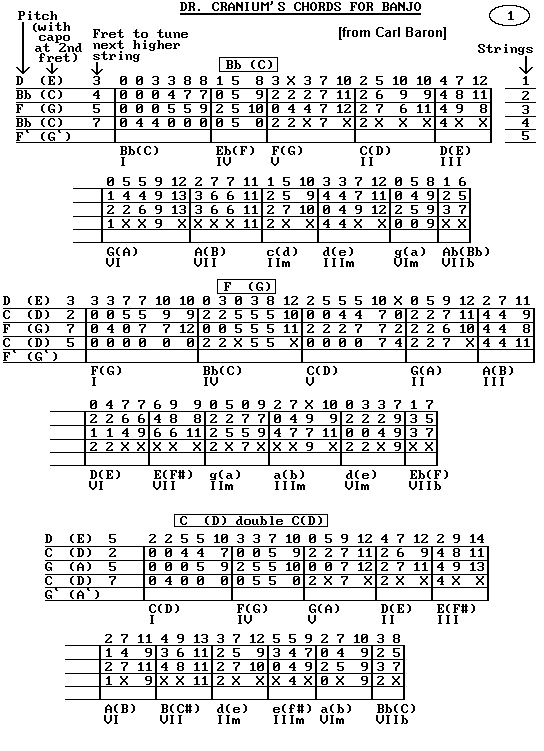
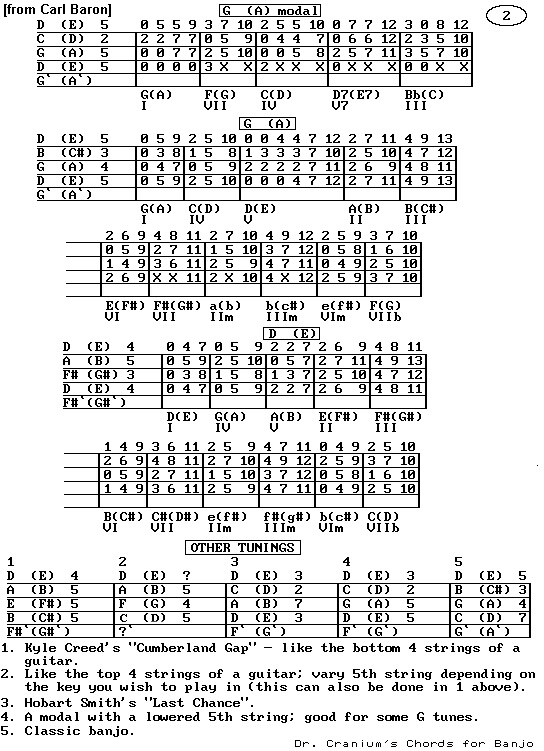
Yes, you'll find a chart for CC/DD among the ones shown.
 |  |
kmwaters - Posted - 02/28/2013: 08:03:41
Here's another short one with the 3 you use most of the time
 Major Inversions |
kmwaters - Posted - 02/28/2013: 08:05:22
Think about a backup book like Janet Davis Banjo Backup - then you see the great variety of picking patterns used by all the pros as they play backup and move up and down the neck.
The other good backup book is Jack Hatfield's Backup Book 3.
chip arnold - Posted - 02/28/2013: 08:36:25
kmwaters, the OP is looking for chord charts (provided) for C/C tuning, not G tuning.
Do you have any?
The g tuning charts you posted are nice and easy to read.
MileStretch - Posted - 02/28/2013: 12:56:08
Out of necessity, I sometimes make an F by barring the top three strings on the fifth fret and fretting the first string, seventh fret with my ring finger.
g C G C D
x x 5 5 7
I've never done it, but one could move that shape around. Down one fret is an E. Down three is a D. Up two from the fifth, a G. Up four to the ninth fret is an A.
Then you have the usual G in double C tuning:
g C G C D
0 2 0 2 0
One could move that up like so for A:
g C G C D
x 4 2 4 x
Up two frets is a B. Up four to the eighth fret is a C#.
Now let's think about minor chords. C minor:
g C G C D
0 0 0 0 1
Move that shape up two frets, you have a Dm:
g C G C D
x 2 2 2 3
Up two more, Em. Up one more to the fifth, Fm. To the seventh fret, Gm.
Am:
g C G C D
x x 2 0 2
Moving that shape up two frets gives us Bm:
g C G C D
x x 4 2 4
Up 2 more, C#m.
Hope this helps.
chip arnold - Posted - 02/28/2013: 13:21:19
The shapes I use most often in c/c or d/d tuning are on the 1st, 2nd and 3rd strings. They are in order of strings 1, 2, and 3 ... F - 755, C - 545, G - 524. These move up and down the neck easily and give you the 1, 4 & 5 of the key. 022 is the 6 minor which can be moved up as well. for instance 424 is the B minor.
Using 2 or 3 string chords leaves a finger or two free to catch notes which are in the melody but not in the chord.
Remember that a major scale is step, step, 1/2 step, step, step, step, 1/2 step.
C scale has no sharps or flats. c, d, e, f, g, a, b, c
You can figure which fret to move your chords to by remembering the scale.
Edited by - chip arnold on 02/28/2013 13:28:28
eddielee - Posted - 06/03/2013: 19:12:14
bump for the sake of it... Good Thread, more need to see...
griffinwisc - Posted - 06/05/2013: 20:50:24
Theo's Banjo Chord Generator ===> link I've not really used this website. I think I heard of it from another post on the BHO. It looks to cover about any chord you want.
Regards,
Scott
chip arnold - Posted - 06/06/2013: 10:37:04
My suggestion is to learn how a chord is constructed and then you'll be able to figure them out in any tuning all over the neck.
ringtailman - Posted - 06/06/2013: 12:38:07
quote:
Originally posted by chip arnold
My suggestion is to learn how a chord is constructed and then you'll be able to figure them out in any tuning all over the neck.
Good answer ,best way to do it .Knowing the banjo neck is all thats needed.
carlb - Posted - 06/07/2013: 05:26:49
quote:
Originally posted by chip arnold
My suggestion is to learn how a chord is constructed and then you'll be able to figure them out in any tuning all over the neck.
Exactly how my chord chart came into being.
Cottonmouth - Posted - 06/07/2013: 07:22:56
Please pardon me if I am mistaken here, but I think I have located a C7 chord:
g C G C D
x x 3 4 5
I don't see a C7 anywhere in the offered charts.
Edited by - Cottonmouth on 06/07/2013 07:24:59
Terms of Use | Privacy Policy | Privacy Consent (EU/GDPR Only)
Copyright 2026 Banjo Hangout. All Rights Reserved.


