
DVD-quality lessons (including tabs/sheet music) available for immediate viewing on any device.
Take your playing to the next level with the help of a local or online banjo teacher.
Weekly newsletter includes free lessons, favorite member content, banjo news and more.
Premier Sponsors


|
Please note this is an archived topic, so it is locked and unable to be replied to. You may, however, start a new topic and refer to this topic with a link: http://www.banjohangout.org/archive/241661
Mirek Patek - Posted - 07/27/2012: 00:21:32
While in the single string style (played by TITI) it is common to cross the T and I, i. e. to play Thumb on thinner string than previous or following Index finger, like this
-|---------------|-
-|--------T-I----|-
-|----T-I-----T-I|-
-|T-I------------|-
-|---------------|-
my question is whether this is used sometimes also in the three-finger rolling style. I understand that it was/is used in two-finger [thumb+index] picking style to get the arpeggiated sound, but what about three-finger style?
Imagine the following roll played on some chord where the 5th string does not fit (so it is not used in that moment). Melody is marked in red.
-|--------M-----M|--------M-----M|-
-|--I---I-----I--|I---I-------I--|-
-|T---T-----T----|--T---T---T----|-
-|---------------|---------------|-
-|---------------|---------------|-
Would somebody play it this way to keep the "thumb-lead" approach?
-|--------M-----M|--------M-----M|-
-|--I---I-----I--|T---T-------I--|-
-|T---T-----T----|--I---I---T----|-
-|---------------|---------------|-
-|---------------|---------------|-
Mirek
Edit: Subject changed to Thumb-lead rolls with T-I or T-M crossover
Edited by - Mirek Patek on 01/05/2013 04:19:47
kmwaters - Posted - 07/27/2012: 07:25:24
I am doubtful. Using the index on the third following the thumb on the second is difficult in terms of smoothness.
Jim Yates - Posted - 07/27/2012: 07:51:33
Apart from single string, this is the only situation where I would play the T on a higher string than the previous I:

-|--------M-----
-|-----T--------
-|---I----------
-|-T------------
-|--------------
I tried your suggested "thumb lead" approach and feel it would take me a lot of practice to get it very smooth.
RyanHerr - Posted - 07/27/2012: 17:36:26
I sometimes do crossovers / crossunders, because in the quirky style I play, I usually stick to a strict thumb lead, similar to this: archive.banjosessions.com/jun0...tlin.html
However, I will only do a crossover / crossunder to get a melody note. I would never ever do it for a fill note or to stick to a certain roll pattern.
For example, here is how I would personally play your example a little differently.
-|--------------M|--M---M-------M|-
-|--I---I--------|T---T----------|-
-|T---T-----I----|----------I----|-
-|--------T---T--|--------T---T--|-
-|---------------|---------------|-
bjango53 - Posted - 07/28/2012: 00:57:55
David Cava ( Musicmoose ) did a lesson, which I unfortunately cannot remember, which included a crossover on the 2/3 string. I do remember it giving a very nice
upbeat sound. Hope he sees this and can enlighten us.
boyratchet - Posted - 07/28/2012: 04:17:34
I do the cros over with 3 finger "rolls" all the time, playing the higher string with thumb and lower strings with index or middle. I can cross from 3rd to forth with my index but not my middle if I have anchored my ring finger. I found it slighly ackward at first, but it comes rather naturally now.
There was a BHO member a while back (TrashMan, GarbageCan...something like that) who had the interesting habit of picking multiple different strings in succession using a single finger. As ackward as it looked, the guy's playing was smooth with good tone and incredible speed. When asked, he said something about the rolls being a starting place and the the goal was independence of the fingers. He said that he didn't think in terms of rolls. It left quite an impression on me and since then I spend NO time on rolls, and let my fingers do what they want (more or less). Of course I don't play much Scruggs so...
boyratchet - Posted - 07/28/2012: 04:19:11
Hey Ryan, Haven't seen you here in a long while. Welcome back. It's nice to have you contributing again.
pearcemusic - Posted - 07/28/2012: 09:16:41
I do use M and I crossed under my thumb ... Both with roll patterns and SS styles. I practice it every day .... Feels normal now, but it took a while to get it comfortable.
Thor - Posted - 07/30/2012: 01:46:12
Why not?
I use this in a couple of tunes:
|--------------0--------0--|--------------0--------0--|
|-----------0-----0--------|-----------0-----0--------|
|--0-----0-----------0-----|--0-----0-----------0-----|
|-----0--------------------|-----0--------------------|
|--------------------------|--------------------------|
.  T  I  T  I  M  I  T  M     T  I  T  I  M  I  T  M
Use whatever you want to get the notes.
Mirek Patek - Posted - 07/30/2012: 03:41:12
Thanks for your replies, I just wanted to know how much I am "inventing the wheel" when my fingers started to do this. Yes, it was not pre-planned in my head - it came spontaneously probably due to my practice of Irish traditional tunes (played fingerstyle on my DGdg tenor banjo) which often use low drone and thus call for crossunder with index or even middle finger.
Here is the first measure of Drowsy Maggie:
g-|---------------|--
d-|--------0------|--
G-|----4-------4--|--
D-|2-----2---2---2|2-
   |   |_| |_|_|_| |
   T   T I M I T I T
And here is the 3rd-4th measure of Cooley's:
g-|---------------|---------------|--
d-|---------------|--------0------|--
G-|----2---4---2-0|------2---2----|--
D-|4-0---0---0----|4-0-4-------4-0|2-
   |_|_|_| |_|_|_| |_|_|_| |_|_|_| |
   T I T I T I T M T I T M T M T I T
Anyway, in the bluegrass rolling, I am weak in the index-lead patterns and I have played everything in thumb-lead (definitely due to the fact that my thumb does not give its share to high drone g string, which is played by middle finger on my DGdg tenor banjo). Well - everything except the melody on the 2nd string, where I tried to play the index-lead [Stanley] patterns or thumb+index-lead [Scruggs] patterns. But now my right hand said that the thumb-lead is preferred also for the 2nd-string melody even if that would mean the crossunder with index finger on the third string.
Therefore, here is kind of update of my article about [my] bluegrass rolls at banjosessions.com/?p=60 . The formerly index-lead patterns in the Examples 21-24 are now changed to thumb-lead ones.

Edited by - Mirek Patek on 07/30/2012 03:44:05
Mirek Patek - Posted - 10/30/2012: 09:26:02
Here are some practice routines I use to teach my right hand the "strictly-thumb-lead" approach with T-I crossovers.
Standard forward roll, melody on the 3rd string

g|----M-----M----|----M-----M----|-
d|--I-----I-----I|--I-----I-----I|-
G|T-----T-----T--|T-----T-----T--|-
D|---------------|---------------|-

"Forward roll" right-hand motion, thumb-lead melody on the 2nd string

g|----M-----M----|----M-----M----|-
d|T-----T-----T--|T-----T-----T--|-
G|--I-----I-----I|--I-----I-----I|-
D|---------------|---------------|-

Switch via M on [open] 1st string

g|----M-----M---M|----M-----M---M|----M-----M---M|----M-----M---M|-
d|--I-----I------|T-----T-----T--|--I-----I------|T-----T-----T--|-etc.
G|T-----T-----T--|--I-----I------|T-----T-----T--|--I-----I------|-
D|---------------|---------------|---------------|---------------|-


FMB roll

g|--------M-----M|--------M-----M|-
d|--I---I-----I--|--I---I-----I--|-
G|T---T-----T----|T---T-----T----|-
D|---------------|---------------|-

"FMB roll" right-hand motion, thumb-lead melody on the 2nd string

g|--------M-----M|--------M-----M|-
d|T---T-----T----|T---T-----T----|-
G|--I---I-----I--|--I---I-----I--|-
D|---------------|---------------|-

Switch via M on [open] 1st string

g|--------M-----M|--------M-----M|--------M-----M|--------M-----M|-
d|--I---I-----I--|T---T-----T----|--I---I-----I--|T---T-----T----|-etc.
G|T---T-----T----|--I---I-----I--|T---T-----T----|--I---I-----I--|-
D|---------------|---------------|---------------|---------------|-


Half-note melody on the 3rd string

g|----M-------M--|----M-------M--|-
d|--I---I---I---I|--I---I---I---I|-
G|T-------T------|T-------T------|-
D|---------------|---------------|-

Half-note thumb-lead melody on the 2nd string

g|----M-------M--|----M-------M--|-
d|T-------T------|T-------T------|-
D|--I---I---I---I|--I---I---I---I|-
G|---------------|---------------|-

Switch "with preparation" of the note preceding the melody

g|----M-------M--|----M-------M--|----M-------M--|----M-------M--|-
d|--I---I---I----|T-------T-----I|--I---I---I----|T-------T-----I|-etc.
G|T-------T-----I|--I---I---I----|T-------T-----I|--I---I---I----|-
D|---------------|---------------|---------------|---------------|-
Mike Moss - Posted - 10/30/2012: 15:10:26
This doesn't strictly correspond to rolling/melodic playing, but I think it's still interesting in this context; this is from Parke Hunter's studies on cases where it might be convenient to cross the thumb and index:

In N. 15 Hunter also proposes using thumb and index glides as a possibility to finger these passages; thumb glides are commonly used but index finger glides are unusual in Classic Banjo. I know Farland also used them; Hunter has several exercises on them.
(NB: . is the index finger, : the middle finger, and + is the thumb)
Edited by - Mike Moss on 10/30/2012 15:11:06
mikey5string - Posted - 11/01/2012: 11:30:21
I think it is beneficial to be comfortable using any finger and when I play single string I use all 3 fingers. I try to always think in terms of rolls, that is, I dont want to have to make a mental shift and think "OK here comes a measure of singles string, then a scruggs measure and then a melodic lick"
The thumb lead is more about playing the melody note in bluegrass style. Scruggs favored his thumb for melody, Ralph Stanley favord his middle. When playing ss style, you are usually playing fiddle tunes or other pieces where the melody is moving along faster (in 8th notes) So it would be nearly impossible to try to just your thumb for all melody.
Mirek Patek - Posted - 11/01/2012: 13:21:33
quote:
Originally posted by Mirek Patek
While in the single string style (played by TITI) it is common to cross the T and I, i. e. to play Thumb on thinner string than previous or following Index finger ...
my question is whether this is used sometimes also in the three-finger rolling style.
Thanks for your replies. I thought that I have clearly indicated in my original post that the subject is NOT the T-I crossover in single string style (or whatever name is used for all-melody-lines), but the T-I crossover in the three-finger rolling [bluegrass] style.
I somehow agree with the argumentation that any finger should be able to pick the melody, however there are reasons why I prefer to pick the melody with my thumb.
- the tone is different as the thumb strikes the string further from the bridge than the index finger
- the plastic thumbpick sounds different from metal fingerpick
- the thumb IS stronger than the index finger (at least in my case)
[- I do not need to pick g string by my thumb as it is on middle finger side of my DGdg tenor banjo]
That's why I practice the "strictly thumb-lead" approach in my bluegrass picking (with the drone 1st string).
In case of the melody on 4th or 3rd string there is no problem (my thumb picks the melody and nothing else).
In case of the melody on the 2nd string the thumb-lead approach requires the rolls with T-I crossovers.
mikey5string - Posted - 11/01/2012: 14:46:16
Well, if youre not talking about single string than I cant think of a reason you would choose to cross under. Rather than use awkward moves to enable you to use your thumb for melody notes, you might be better off learning to get the same tone from all your fingers.
Is there another use for crossing under in roll based playing?
I do appreciate your posts as they always provide me with some good technical exercises.
Banjophobic - Posted - 11/02/2012: 06:31:33
From the tabs of your examples, it would seem that using your thumb that much on adjacent strings ,via "cross-overs", would put you more in the rhythmic groove and style context of two finger style playing. Thats not to say you can't use the thumb when and where you like, but the syncopation and pulse of 3 finger style will be changed.
The thumb does not have to lead everything, even though that's the dictum of Scruggs style. But it is a dominant characteristic of it and using all three fingers in succession. in the context of 'rolls', gives those classic syncopations. Using these 'cross-over' ideas is cool and anything that helps be more versatile is a good thing, in my view. I doubt I'll be shifting my thumb that much since the 3 finger patterns serve to do that and do it extremely well. But I do cross-overs where it feels right and makes sense to do so.
Overall though, trying to get 2 fingers to do all the work ,when I have 3 available, is too much trouble-haha. I'll just do what my instincts tell me, which is just roll dummy, 
Edited by - Banjophobic on 11/02/2012 06:31:51
androo - Posted - 11/02/2012: 10:37:30
I use this crossover technique in several Irish/Celtic tunes. I learned this from Tony Furtado's arrangement of The Collier's Reel. The Monaghan Twig, Rakish Paddy & Jenny's Wedding. I use it in my own arrangements quite often as well.
Mirek Patek - Posted - 11/02/2012: 16:56:25
As I receive my Banjo Newsletter with some delay due to foreign surface delivery, I have opened the October 2012 issue just two days ago. But incidentally, the article+tab in Tom Adams' High Five column on pages 32-33 is very relevant to my DGdg tenor banjo and to this topic.
Tom shows the sixths fretted on the 1st and 3rd strings, without playing the 2nd string. This makes his tab of Home Sweet Home ideal for my banjo, which does not have the B string. So what I need to do with Tom's tab is just to put the bottom line to the top (my g string is the 1st one) and adjust the picking patterns accordingly.
And here comes the most relevant point to this thread. Tom's arrangement uses almost exclusively just two rolls - the backward roll with three melody notes on the high d string, and the backward-forward (as he calls it) roll with just two half-note melody notes. In the past, I would transcribe and play them on my DGdg tenor banjo with the index-lead rolls - but recently (apparently under the influence of the T-I crossovers and importance of thumb-based drive in Irish tunes) I have started to play them with the thumb-lead rolls using the T-I crossovers.
Backward roll with 3 melody notes per measure

d|M---M-----M----|M---M-----M----|-
B|---------------|---------------|-
G|--I---I-----I--|--I---I-----I--|-
D|---------------|---------------|-
g|--------T-----T|--------T-----T|-

Variant with drop thumb to avoid M-I-M picking sequence

d|M---M-----M----|M---M-----M----|-
B|---------------|---------------|-
G|--T---I-----I--|--T---I-----I--|-
D|---------------|---------------|-
g|--------T-----T|--------T-----T|-

Conventional transcription to DGdg tenor banjo = index lead

g|--------M-----M|--------M-----M|-
d|I---I-----I----|I---I-----I----|-
G|--T---T-----T--|--T---T-----T--|-
D|---------------|---------------|-

Thumb-lead transcription to DGdg tenor banjo - with T-I crossovers

g|--------M-----M|--------M-----M|-
d|T---T-----T----|T---T-----T----|-
G|--I---I-----I--|--I---I-----I--|-
D|---------------|---------------|-


Roll with two half-note melody notes per measure

d|M-------M------|M-------M------|-
B|---------------|---------------|-
D|--I---I---I---I|--I---I---I---I|-
D|---------------|---------------|-
D|----T-------T--|----T-------T--|-

Conventional transcription to DGdg tenor banjo = index lead

g|----M-------M--|----M-------M--|-
d|I-------I------|I-------I------|-
G|--T---T---T---T|--T---T---T---T|-
D|---------------|---------------|-

Thumb-lead transcription to DGdg tenor banjo - with T-I crossovers

g|----M-------M--|----M-------M--|-
d|T-------T------|T-------T------|-
G|--I---I---I---I|--I---I---I---I|-
D|---------------|---------------|-
You can find both these thumb-lead DGdg tenor banjo rolls in my post from 30th October - what a coincidence. While the second one (with two half-notes per measure) has definitely two-finger feel, the first one (with three melody notes per measure) keeps firmly the three-finger essence.
Speaking about T-I crossovers - I would even cross my fingers in the opening pinches of Tom's tab (I have them on neighbor strings) to stress the upper [melody] note of the sixth with my thumb.
Mirek
P.S. I think there is the typo in measure 9 of Tom's tab - instead of 5-5-7-7 the second half should contain 5-4-7-5 (analogically to the measure 1).
Edited by - Mirek Patek on 11/02/2012 17:10:19
Dingoman25 - Posted - 11/03/2012: 00:13:02
Hello Mirek,
totally unrelated to your original question, but how do you write the tablature as you do in your posting above?
Is it written in Tabledit, or a similar program, and then just exported to text, and then pasted into BHO?
thanks for any advice,
Chris.
Mirek Patek - Posted - 11/03/2012: 00:23:11
quote:
Originally posted by Dingoman25
Hello Mirek,
totally unrelated to your original question, but how do you write the tablature as you do in your posting above?
Is it written in Tabledit, or a similar program, and then just exported to text, and then pasted into BHO?
thanks for any advice,
Chris.
I use Notepad, then copy-paste to BHO, then (and this is crucial) the tab has to be highlighted and in the first box of editing tools above the post there should be chosen formatted (or something like this, I have it in Czech) to get the
unproportional Courier font.
tomadams - Posted - 11/03/2012: 16:10:11
originally posted by Mirek Patek:
P.S. I think there is the typo in measure 9 of Tom's tab - instead of 5-5-7-7 the second half should contain 5-4-7-5 (analogically to the measure 1).
Hi Mirek,
I don't believe there's a typo in Measure #9 of the tab. I chose to play it the way it is shown in the Banjo Newsletter by walking up from frets 4/5 to 5/7 to 7/9. The melody is on the first string and I move into each new left-hand position during the walk-up one note ahead of the downbeat where the melody note lands. So, playing Measure 9 with the last four notes being 5 5 7 7 matches the pattern I play in the rest of the tab, where substituting 5 4 7 5 would not.
Here are measures 8, 9 and 10 from the tab for Home Sweet Home: An Exercise for Playing on the 1st and 3rd Strings:

Measure 9 is different from all other measures in the tab in that it is the only full measure where you'll find just one 5th string note, rather than the two 5th string notes you see in all other full measures.
Very interesting discussion on Thumb-Index crossing over!
—Tom
Mirek Patek - Posted - 11/03/2012: 16:23:32
quote:
Originally posted by tomadams
The melody is on the first string and I move into each new left-hand position during the walk-up one note ahead of the downbeat where the melody note lands.
Now I see the logic behind, thanks, you are right.
I got the principle of moving to the next position in the measures with the two half-note melody notes (where you actually use the open string for the left hand shift), but I mistakenly did not decode the consistency with this approach in that second part of the measure 9.
Thanks again for your input in both in BNL and BHO.
Mirek
Mirek Patek - Posted - 11/04/2012: 03:09:24
This post is off-topic concerning the T-I crossover in the roll, however it may show you how I transcribe the rolls from 5-string to my DGdg tenor banjo.
At the end of his High Five column in BNL Oct. 2012, Tom Adams assigns a homework - to move the Home Sweet Home song from the key of G to the key of C by moving the entire tab 7 frets lower. This is possible as the drone g string fits the key of C too.
But what about moving the song to the key of D? One option is to retune (or spike) the 5th string from g to a and move the original tab 5 frets lower with most part staying on the 1st and 3rd strings.
The other option is to move the fretted notes to the 2nd and 4th strings, and to have the 1st d string as the drone. Now you are in my Banjo Universe with the drone string picked with the middle finger. You will use the index-lead backward roll ITITMITM (with the FMB rhythm) and index-lead ITMT roll. Here are first four full measures, used by Tom's permission:

Hint: For the Banjo Newsletter [tab] readers this homework would be easy as the lower notes (shifted from the 3rd to the 4th string) do not change the fret, and the upper notes (shifted from the 1st string to the 2nd string) just move by two frets to the nut.
Back to the topic of the T-I crossover: On my DGdg tenor banjo where is no B string I play this tune [when transposed to D] on the neighbor 3rd (G) and 4th (D) strings - OK, some sixths are quite stretchy - so I do the T-I crossover and play it in thumb-lead fashion.
Mirek Patek - Posted - 12/08/2012: 08:08:26
I am going maybe to far, but I try to cross the thumb all the way to the 1st string, while keeping the middle on the 2nd and index on the 3rd string.
In other words, I am trying to play Thumb-lead roll with the melody on the 1st string.
Starting from Jim's tab shown in the third post in this thread; this would be the version in 3/4 rhythm:
-|------M----|------M----|-
-|----T---T--|----T---T--|-
-|--I-------I|--I-------I|-
-|T----------|T----------|-
-|-----------|-----------|-
  |_| |_| |_| |_| |_| |_|
However in the 6/8 rhythm the different emphasis calls for different placement of thumbstrokes:
-|------T----|------T----|-
-|----M---M--|----M---M--|-
-|--I-------I|--I-------I|-
-|T----------|T----------|-
-|-----------|-----------|-
  |_|_| |_|_| |_|_| |_|_|
Or - to stick with the TIM forward rolls:
-|------T----|------T----|-
-|----M-----M|----M-----M|-
-|--I-----I--|--I-----I--|-
-|T----------|T----------|-
-|-----------|-----------|-
  |_|_| |_|_| |_|_| |_|_|
Who knows where this may lead...
Mirek Patek - Posted - 12/23/2012: 07:48:47
Here is another bunch of practice routines that includes the 1st-string-lead rolls. All rolls keep the syncopation of the melody as in standard forward roll (3+3+2) and the sound of forward roll is sought after - that's why the 2nd-string-lead rolls are technically backward (TMI) but sonically forward ones. Melody is played by thumb (marked by red). Last notes of the roll (marked by blue) differ depending on the location of the melody in the next measure. First there are shown the two (or three in case of 1st-string-lead) options for each string-lead, then these options are used during the switches of the melody between the strings as shown in the last three rows.
3rd-string-lead, TIM forward roll

g|----M-----M----|----M-----M----|-
d|--I-----I-----I|--I-----I-----I|-
G|T-----T-----T--|T-----T-----T--|-
D|---------------|---------------|-

or

g|----M-----M---M|----M-----M---M|-
d|--I-----I------|--I-----I------|-
G|T-----T-----T--|T-----T-----T--|-
D|---------------|---------------|-


2nd-string-lead, TMI backward roll motion (sounds like forward roll)

g|--M-----M------|--M-----M------|-
d|T-----T-----T--|T-----T-----T--|-
G|----I-----I---I|----I-----I---I|-
D|---------------|---------------|-

or

g|--M-----M-----M|--M-----M-----M|-
d|T-----T-----T--|T-----T-----T--|-
G|----I-----I----|----I-----I----|-
D|---------------|---------------|-


1st-string-lead, TIM forward roll

g|T-----T-----T--|T-----T-----T--|-
d|----M-----M----|----M-----M----|-
G|--I-----I-----I|--I-----I-----I|-
D|---------------|---------------|-

or

g|T-----T-----T--|T-----T-----T--|-
d|----M-----M---M|----M-----M---M|-
G|--I-----I------|--I-----I------|-
D|---------------|---------------|-

or

g|T-----T-----T--|T-----T-----T--|-
d|----M-----M---I|----M-----M---I|-
G|--I-----I------|--I-----I------|-
D|---------------|---------------|-


Switch between 3rd-string-lead and 2nd-string-lead via M on 1st string

g|----M-----M---M|--M-----M-----M|----M-----M---M|--M-----M-----M|-
d|--I-----I------|T-----T-----T--|--I-----I------|T-----T-----T--|-etc.
G|T-----T-----T--|----I-----I----|T-----T-----T--|----I-----I----|-
D|---------------|---------------|---------------|---------------|-


Switch between 2nd-string-lead and 1st-string-lead via I on 3rd string

g|--M-----M------|T-----T-----T--|--M-----M------|T-----T-----T--|-
d|T-----T-----T--|----M-----M----|T-----T-----T--|----M-----M----|-etc.
G|----I-----I---I|--I-----I-----I|----I-----I---I|--I-----I-----I|-
D|---------------|---------------|---------------|---------------|-


Jump between 3rd-string-lead and 1st-string-lead via I (or M) on 2nd string

g|----M-----M----|T-----T-----T--|----M-----M----|T-----T-----T--|-
d|--I-----I-----I|----M-----M---I|--I-----I-----I|----M-----M---I|-etc.
G|T-----T-----T--|--I-----I------|T-----T-----T--|--I-----I------|-
D|---------------|---------------|---------------|---------------|-
Edited by - Mirek Patek on 12/23/2012 07:58:33
mikey5string - Posted - 12/23/2012: 20:00:44
I think it will be good for your picking hand from a technical perpective but crossing under while rolling seems unnecessarily difficult to me. I have been playing some of your tab examples and they are good for dexterity but not something I would do in a scruggs style setting.
IMO it would be better to practice control of each picking finger so that you can get the same tone and volume from T I or M.
The 3 against 8 (3 fingers, 8 notes to a measure) thing gives you the ability to roll across measures and get a syncopated feel. Starting measures or landing on beats at different points in a roll add interest IMO.
songs, with word, have melody notes that are longer and there is more space between. You are free to fill the space around the melody how youd like. It is rare to have eighth notes in a row in a bluegrass song melody.
Fiddle tunes and Irish trad are a different story. You are more bound to a form and you have to adapt. I cross under a lot when playing ITM.
Mirek Patek - Posted - 12/23/2012: 23:01:57
Mike, thanks for your comments. I explained my reasons for "strict thumb-lead" in my former post from 11/1/2012 10:21 PM.
quote:
Originally posted by mikey5string
The 3 against 8 (3 fingers, 8 notes to a measure) thing gives you the ability to roll across measures and get a syncopated feel. Starting measures or landing on beats at different points in a roll add interest IMO.
Agree, and for sure I will come to that later. I want to cover (read: teach my right hand) first the basic rolls and most frequent kind of syncopation of the melody, that's why I presented the 3+3+2 roll. The next one will be the 2+3+3 roll (FMB, or the one with quarter note at the beginning). In that case, I see that I would sometimes need to utilize backward sounding roll for the last 3 notes for some switches of "melody strings" to avoid the repetitive picking on the same string.
Mirek Patek - Posted - 01/05/2013: 04:07:32
Banjo Newsletter is always good source of 5-string material to be transcribed to my
DGdg tenor banjo fingerpicking or frailing. In the November 2012 issue (which I have
got just recently due to overseas delivery and Christmas holiday) there is Tom Adams'
tab of Skip To My Lou in his High Five column (page 33). For the most part of the tune,
where the melody consists of two half notes per measure, there is used this roll:

|M-------M------|M-------M------|
|--I---I---I---I|--I---I---I---I|
|----T-------T--|----T-------T--|
|---------------|---------------|
|---------------|---------------|

I have tried my thumb-lead approach with thumb crossed over the index and middle
fingers, but due to the avoidance of M-I-M sequence I do not play it this way:

|T-------T------|T-------T------|
|--M---M---M---M|--M---M---M---M|
|----I-------I--|----I-------I--|
|---------------|---------------|
(---------------|---------------)

Instead, I use the TIMI roll this way:

|T-------T------|T-------T------|
|----M-------M--|----M-------M--|
|--I---I---I---I|--I---I---I---I|
|---------------|---------------|
(---------------|---------------)

It may seem difficult at first, but as always the practice makes it easy.

What is more difficult is the switch of melody notes between the 1st and 2nd string.
One can either to shift the same roll to the thicker set of strings:

|T-------T------|---------------|T-------T------|---------------|
|----M-------M--|T-------T------|----M-------M--|T-------T------|
|--I---I---I---I|----M-------M--|--I---I---I---I|----M-------M--|
|---------------|--I---I---I---I|---------------|--I---I---I---I|
(---------------|---------------|---------------|---------------)

Or, there can be used the other TIMI roll for playing the melody on the middle string.
It has been shown in my previous post (10/30/2012 6:26 PM).

|T-------T------|----M-------M--|T-------T------|----M-------M--|
|----M-------M--|T-------T------|----M-------M--|T-------T------|
|--I---I---I---I|--I---I---I---I|--I---I---I---I|--I---I---I---I|
|---------------|---------------|---------------|---------------|
(---------------|---------------|---------------|---------------)

The emphasis on thumb and its position further from the bridge (in comparison
with the index and middle fingers) shall distinguish the melody sufficiently.
Of course it works when the melody is moving (either because the chord voicings
change over the neck, or because some non-chordal notes are used). It does not
work so much when the chords are static for the long time.
pearcemusic - Posted - 01/05/2013: 23:28:22
some examples of crossunder exercises
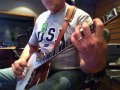 VIDEO: IM crossunder exercises 1 (click to view) | 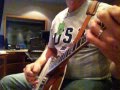 VIDEO: IM crossunder exercises 2 (click to view) |
Mirek Patek - Posted - 01/06/2013: 02:14:47
Doub, thanks for your immediate response to my PM I have sent you yesterday.
(I referred to Doub's post from 7/28/2012 and I asked for some more information
about roll patterns with thumb crossed over I and/or M).

I tried to play your examples on my 5-string instrument (well, one of my guitars
is changed to the 5-string tuning with thin g in the A slot). Being inspired by
this tuning :-) and by your videos, here is the exercise that I've made.
It is the G, C, D progression with F-shape, barre and D-shape chord voicings and
with added 6th degree of each chord. The melody (in fact arpeggiated chord)
is played solely by thumb, which causes some T crossovers (or I crossunders in Doub's
terminology).

 G               r
|----5-----5----|----5-----5----|-
|--3-----3---3--|5-----3-------3|-
|------4-------4|--4-----4---4--|-
|5--------------|---------------|-
|---------------|---------------|-
 |_|_|_| |_|_|_| |_|_|_| |_|_|_|
 T I M T I M T I T I M T I M T I

 C     r                     r
|----5-----5---5|----5-----5----|-
|--5-----5------|5-------5-----5|-
|------------5--|--5---5--------|-
|5-----7--------|------------7--|-
|---------------|---------------|-
 |_|_|_| |_|_|_| |_|_|_| |_|_|_|
 T I M T I M T M T I M T I M T I

 D           r         r
|----4-----4---4|----4-----4----|-
|--3-----3------|3-------3-----3|-
|------2-----4--|--2---4-----2--|-
|4--------------|---------------|-
|---------------|---------------|-
 |_|_|_| |_|_|_| |_|_|_| |_|_|_|
 T I M T I M T M T I M T I M T I

These patterns do not use the 5th string so they can be used on whatever chord.
Edited by - Mirek Patek on 01/06/2013 02:21:27
pearcemusic - Posted - 01/10/2013: 13:38:53
here's another Single String crossunder exercise for jazzers.
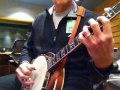 VIDEO: SS crossunders and jazz patterns (click to view) |
Mirek Patek - Posted - 01/20/2013: 03:07:36
Good practice for the thumb-lead rolls with T-I or T-IM crossover is to play the thumb + IM pinch with that kind of crossover. Here is the part A of the Old Joe Clark on the first three strings of 5-string banjo with the melody played always by thumb (even if it is on the 1st string!) and followed by the IM pinch on the other strings.
Old Joe Clark, part A

  G                                               D7
d|0---2---3---2--|0-----0---0---0|0---2---3---2--|0---0---0---0--|
B|--0---0---0---0|--0-1---0---0--|--0---0---0---0|--1---1---1---1|
G|--0---0---0---0|--0---2---0---0|--0---0---0---0|--2---2---2---2|
D|---------------|---------------|---------------|---------------|
g|---------------|---------------|---------------|---------------|
  |_|_|_| |_|_|_| |_|_|_| |_|_|_| etc.
  T M T M T M T M T M T M T M T M
    I   I   I   I   I   I   I   I

  G                                       D7      G
d|0---2---3---2--|0-----0---0---0|--0---0---0---0|--0---0---0---0|
B|--0---0---0---0|--0-1---0---0--|0---0-----1---1|--0---0---0---0|
G|--0---0---0---0|--0---2---0---0|--0---0-2---2--|0---0---0---0--|
D|---------------|---------------|---------------|---------------|
g|---------------|---------------|---------------|---------------|
Mirek Patek - Posted - 02/06/2013: 00:11:17
The following exercises use the thumb drop and thumb crossover as the substitution of the chain of IMIMIM. Classical guitar players have to master it, but for three-finger-picking banjo player the use of thumb may be preferred. Instead of two-finger approach (when applicable, e.g. TMTM or TITI), the three finger rolls TIM or TMI are used exclusively.
Here is the guitar-like fingering in 6/8 rhythm, with the single melody note per measure, as the point of departure for the crossover exercises. The melody is on the 3rd string, but it may be also on the 4th one.
  |----M---M--|----M---M--|
 6|--I---I---I|--I---I---I|
 8|T----------|T----------|
  |-----------|-----------|
   |_|_| |_|_| |_|_| |_|_|


Here is the fingering with thumb dropping to the 2nd string.

  |----M---M--|----M---M--|
 6|--I---T---I|--I---T---I|
 8|T----------|T----------|
  |-----------|-----------|
   |_|_| |_|_| |_|_| |_|_|

In 9/8 or 12/8 rhythm the thumb crosses all the way to the 1st string,
instead of some two-finger picking approach (e.g. TIMTMTMTM).

  |----M---M---T---M|----M---M---T---M|
 9|--I---T---I---I--|--I---T---I---I--|
 8|T----------------|T----------------|
  |-----------------|-----------------|
   |_|_| |_|_| |_|_| |_|_| |_|_| |_|_|

  |----M---M---T---M---M--|----M---M---T---M---M--|
12|--I---T---I---I---T---I|--I---T---I---I---T---I|
 8|T----------------------|T----------------------|
  |-----------------------|-----------------------|
   |_|_| |_|_| |_|_| |_|_| |_|_| |_|_| |_|_| |_|_|


Here is the other version, which can be intuitively picked in two-finger fashion,
however for the practice purposes the TIM roll with thumb crossover to the 1st string
(and TMI roll with thumb drop to the 2nd string) is used.

  |--M---T---M|--M---T---M|
 6|----I---I--|----I---I--|
 8|T----------|T----------|
  |-----------|-----------|
   |_|_| |_|_| |_|_| |_|_|

  |--M---T---M---M--|--M---T---M---M--|
 9|----I---I---T---I|----I---I---T---I|
 8|T----------------|T----------------|
  |-----------------|-----------------|
   |_|_| |_|_| |_|_| |_|_| |_|_| |_|_|

  |--M---T---M---M---T---M|--M---T---M---M---T---M|
12|----I---I---T---I---I--|----I---I---T---I---I--|
 8|T----------------------|T----------------------|
  |-----------------------|-----------------------|
   |_|_| |_|_| |_|_| |_|_| |_|_| |_|_| |_|_| |_|_|
Edited by - Mirek Patek on 02/06/2013 00:22:33
Mirek Patek - Posted - 02/08/2013: 00:15:56
In search for good roll pattern for some Mumford and Sons songs (I Will Wait etc.) where the banjo
intentionally uses just single roll to support the uniform groove of the song) for my DGdg tenor banjo
with no thin thumb string I identified the following ones:

(original roll pattern for 5-string banjo - look at banjohangout.org/topic/210390 )

|----M---M-----M|----M---M-----M|
|--I---------I--|--I---------I--|
|T---------T----|T---------T----|
|---------------|---------------|
|------T--------|------T--------|

Roll pattern suitable for up-the-neck left-hand voicings, where the highest notes are on the 1st string.
The right-hand picking pattern is the same, my thumb just drops down to the 2nd string.
The 1st-string strokes are rhythmically on the same place as in 5-string banjo.

|----M---M-----M|----M---M-----M|
|--I---T-----I--|--I---T-----I--|
|T---------T----|T---------T----|
|---------------|---------------|

Roll pattern suitable for down-the-neck left hand voicings, where the highest note
is on the 5th string of 5-string banjo. I play that peak on the 1st string.

|------M-------M|------M-------M|
|--I-----I---I--|--I-----I---I--|
|T---T-----T----|T---T-----T----|
|---------------|---------------|

And here comes the part relevant to this thread - the same strings could be picked
by TITM TITM roll with the crossover in the second part of the measure.

|------M-------M|------M-------M|
|--I-----T---T--|--I-----T---T--|
|T---T-----I----|T---T-----I----|
|---------------|---------------|

Try these different right-hand fingerings (TI TMI TIM versus TITM TITM) on your banjo
and listen to the difference. Would you see any use of the latter pattern?
Mirek Patek - Posted - 02/09/2013: 07:35:01
And if we combine the second halves of the above described rolls, here is perfect roll for practicing the crossover of thumb and index finger. The sound should be as regular as possible, or you may put the emphasis on thumb notes. Compare this TITM ITIM roll with the index-lead ITIM ITIM fingering.
 |------M-------M|------M-------M|
 |T---T---I---I--|T---T---I---I--|
 |--I-------T----|--I-------T----| etc.
 |---------------|---------------|
  |_|_|_| |_|_|_| |_|_|_| |_|_|_|
From the thumb-lead perspective, this roll is good for playing two melody notes on the 2nd string followed by one melody note on the 3rd string, with the "FMB syncopation". On my DGdg tenor banjo it looks like this:
g|------0-------0|------0-------0|
d|0---0---0---0--|0---0---0---0--|
G|--0-------4----|--0-------4----| etc.
D|---------------|---------------|
  |_|_|_| |_|_|_| |_|_|_| |_|_|_|
  T I T M I T I M T I T M I T I M
Edited by - Mirek Patek on 02/09/2013 07:38:27
Mirek Patek - Posted - 02/10/2013: 05:49:27
quote:
Originally posted by Mirek Patek (color added)
 |------M-------M|------M-------M|
 |T---T---I---I--|T---T---I---I--|
 |--I-------T----|--I-------T----| etc.
 |---------------|---------------|
  |_|_|_| |_|_|_| |_|_|_| |_|_|_|
OK, the same melody with FMB syncopation can be played with the following roll without any crossover:
|--M---M-------M|--M---M-------M|
|T---T---I---I--|T---T---I---I--|
|----------T----|----------T----|
|---------------|---------------|
But I do not like the long chain of alternated 2nd-1st-2nd-1st-2nd-1st-2nd strings.
On the other hand, the same roll with the first note on the 3rd string sounds good to me for some Mumford and Sons grooves.
|--M---M-------M|--M---M-------M|
|----T---I---I--|----T---I---I--|
|T---------T----|T---------T----|
|---------------|---------------|
I know it is off-topic (no crossover included) but it is my thread :-)
Mirek Patek - Posted - 02/21/2013: 10:42:52
Let's explore the famous C7 lick in Earl Scruggs' Buggle Call Rag (Foggy Mountain Banjo).
All tabs below are for 5-string banjo in standard open G tuning.

Here is the tab of the original lick with the left hand holding doublestop of tritone
(third and seventh of the C7 chord) on 1st and 2nd string, plus the drone on the 5th string.
The emphasized Bb note (1st string, 8th fret) is picked by middle finger.

 C7
|8-----8-------8|--8-----8-----0|-
|--5-----5---5--|----5-----5----|-
|---------------|------------5s0|0
|---------------|---------------|-
|----0-----0----|0-----0--------|-
 |_|_|_| |_|_|_| |_|_|_| |_|_|_| |
 M I T M I T I M T M I T M I T M T

What if the drone is on the 1st string and the tritone is held on the 2nd and 3rd string?
Here is the transposition of this lick to the G7 chord. Note that I've changed last two notes
of the 2nd measure in order to get kind of two-measure loop.

The topic of this thread is the right hand fingering. So - the conventional fingering would be
kind of index-lead, as the emphasized F notes (seventh of the G7 chord, 2nd string, 6th fret)
are picked by index finger.

 G7
|----0-----0----|0-----0-------0|
|6-----6-------6|--6-----6---6--|
|--4-----4---4--|----4-----4----|
|---------------|---------------|
|---------------|---------------|
 |_|_|_| |_|_|_| |_|_|_| |_|_|_|
 I T M I T M T I M I T M I T I M

Here is the thumb-lead approach with T-I crossovers. Emphasized notes are picked by thumb:

 G7
|----0-----0----|0-----0-------0|
|6-----6-------6|--6-----6---6--|
|--4-----4---4--|----4-----4----|
|---------------|---------------|
|---------------|---------------|
 |_|_|_| |_|_|_| |_|_|_| |_|_|_|
 T I M T I M I T M T I M T I T M

By shifting the 4-6 doublestop up one fret to 5-7 you play the D7 lick. I keep the thumb-lead
picking approach here. Note that the emphasized note on the 2nd string is not the seventh,
but the third of the D7 chord (F# note).

 D7
|----0-----0----|0-----0-------0|
|7-----7-------7|--7-----7---7--|
|--5-----5---5--|----5-----5----|
|---------------|---------------|
|---------------|---------------|
 |_|_|_| |_|_|_| |_|_|_| |_|_|_|
 T I M T I M I T M T I M T I T M

What if one intends to emphasize again the seventh of the D7 chord (C note, 3rd string, 5th fret)
with the same syncopation? This would be the tab, at the first sight with completely different rolls:

 D7
|----0-----0----|0-----0-------0|
|--7-----7---7--|----7-----7----|
|5-----5-------5|--5-----5---5--|
|---------------|---------------|
|---------------|---------------|
 |_|_|_| |_|_|_| |_|_|_| |_|_|_|
 T I M T I M I T M T I M T I T M

But note that the right-hand picking pattern is the same as the thumb-lead approach for G7 above.
In other words - the strictly thumb-lead approach enables you to keep the same picking pattern
for emphasizing the notes on the 3rd string or on the 2nd string.

You may try the same exercises with the C7 (actually C9) doublestop 3-5, or with the higher
versions (10-12 for G7, 11-13 for D7, 9-11 for C9).
Mirek Patek - Posted - 03/18/2013: 05:54:29
Below is the brainstorming about using the T-I crossover
to emphasize different notes (i.e. to pick them by thumb).

Let's start with 5-string banjo "tag roll" with quarter notes.

d|--------0------|
B|---------------|
G|0-----0---0----|
D|------------0--|
g|----0----------|
  |   |_| |_| |
  T   T I M I T

This roll is used in THE tag lick (if played with quarter notes).
I have highlighted the notes that I hear as emphasized in this lick.

d|--------0------|
B|---------------|
G|0-----2s3-0----|
D|------------2--|
g|----0----------|
  |   |_| |_| |
  T   T I M I T

On different strings, it is used in Ground Speed (12th full measure - C chord).
Maybe I am wrong, but here I hear different emphasis.

d|--------2------|
B|1-----1---1----|
G|------------0--|
D|---------------|
g|----0----------|
  |   |_| |_| |
  T   T I M I T

Here is the transcription of this roll to my DGdg tenor banjo,
with conventional right-hand fingering (no crossing).
Three out of four emphasized notes are picked by thumb.

g|----0----------|
d|--------0------|
G|0-----0---0----|
D|------------0--|
  |   |_| |_| |
  T   M T M I T

Tag lick with highlighted syncopated emphasis.

g|----0----------|
d|--------0------|
G|0-----2s3-0----|
D|------------2--|
  |   |_| |_| |
  T   M T M I T

In C chord (Ground Speed) with different emphasis.
Here, one of emphasized notes is picked by middle finger...

g|----0----------|
d|--------2------|
G|5-----5---5----|
D|------------5--|
  |   |_| |_| |
  T   M T M I T

This halfnote plus two quarter notes could be played
with crossed right-hand fingering to pick all the emphasized notes with thumb.

g|----0----------|
d|--------2------|
G|5-----5---5----|
D|------------5--|
  |   |_| |_| |
  T   M I T I T

g|----0----------|
d|--------0------|
G|0-----0---0----|
D|------------0--|
  |   |_| |_| |
  T   M I T I T

------------------------------------------------------------------------------
Of course there is also no-crossing approach for such
halfnote + two quarter notes, which uses different filler notes
(this example sounds like two-finger picking and can be played that way too).

g|------0---0----|
d|----0---0------|
G|0--------------|
D|------------0--|
  |   |_| |_| |
  T   I M T M T
 (T   T I T I T)
Mirek Patek - Posted - 03/31/2013: 07:54:41
One of the cliches used in the Irish traditional music is the arpeggio of some chord with the low drone (one may say "pedal point") on the off-beats. I suppose this cliche was born in the pipes who have their low drone(s) in separate pipe(s). Fiddle players can play it by the bow alternating between the strings (the lower being the drone). Flatpicking tenor banjo players would pick down on the arpeggiated note and up on the drone note (as it is off-beat). For me it seems logic to play the arpeggiated notes by thumbpick and the off-beat drone notes by index (and middle) finger, which requires the crossover. Here is my tab for the D6 (or Bm7) arpeggios all over my DGdg tenor banjo neck.

Mirek Patek - Posted - 04/28/2013: 03:48:49
My other thread ( banjohangout.org/topic/256977 ) on banjo montunos (used in Afro-Cuban music) forced me to search good banjo rolls for immitating the merengue piano (from Dominican Republic). The roll which works best for me is this one:
|0-----0-0-----0|0-----0-0-----0|
|----0-------0--|----0-------0--|
|--0-------0----|--0-------0----|
 |_|_|_| |_|_|_| |_|_|_| |_|_|_|
In his book The Complete 5-string banjo player (p. 202-204) Tony Trischka calls it Shelton roll after Allen Shelton. The common right hand picking pattern is kind of index-lead (with middle finger instead of index at the very beginning - not shown here).
|0-----0-0-----0|0-----0-0-----0|
|----0-------0--|----0-------0--|
|--0-------0----|--0-------0----|
 |_|_|_| |_|_|_| |_|_|_| |_|_|_|
 I T I M I T I M I T I M I T I M
However I found that for me the thumb-lead picking pattern with T-I crossover works better:
|0-----0-0-----0|0-----0-0-----0|
|----0-------0--|----0-------0--|
|--0-------0----|--0-------0----|
 |_|_|_| |_|_|_| |_|_|_| |_|_|_|
 T I T M T I T M T I T M T I T M
Below are some banjo rolls based on Shelton roll useful in merengue music (of course you may stick with the common index-lead picking pattern). The examples are on C and G7 chord only - the left hand voicings (alternating 6ths or 7ths or other passing tones) are not subject here.
I have been inspired by this tutorial in Spanish (examples start at 2:40) youtube.com/watch?v=HseD3WsahgY

Edited by - Mirek Patek on 04/28/2013 04:01:14
Mirek Patek - Posted - 04/28/2013: 04:46:54
Ha - I've found that in 2010 I preferred yet another picking pattern.
banjohangout.org/archive/185219
|0-----0-0-----0|0-----0-0-----0|
|----0-------0--|----0-------0--|
|--0-------0----|--0-------0----|
 |_|_|_| |_|_|_| |_|_|_| |_|_|_|
 M T I T M T I T M T I T M T I T
Not anymore.
Edited by - Mirek Patek on 04/28/2013 04:50:12
Terms of Use | Privacy Policy | Privacy Consent (EU/GDPR Only)
Copyright 2026 Banjo Hangout. All Rights Reserved.


