
DVD-quality lessons (including tabs/sheet music) available for immediate viewing on any device.
Take your playing to the next level with the help of a local or online banjo teacher.
Weekly newsletter includes free lessons, favorite member content, banjo news and more.
Premier Sponsors


|
Please note this is an archived topic, so it is locked and unable to be replied to. You may, however, start a new topic and refer to this topic with a link: http://www.banjohangout.org/archive/226556
hduke - Posted - 01/25/2012: 14:26:53
I may be directing this question to the wrong group. Can someone please tell me why a half-fret less banjo will sometimes have a metal covering over the lower fretboard and why fretless banjos rarely/never sport a protective metal plate? I was told that playing a fretless banjo with metal strings will eventually damage/hollow out/gouge the fretboard and it will need replacing. Is this true? Is the absence of the protective plate on a fret- less just esthetics? How are the metal plates attached?? Thanks.
Edited by - hduke on 01/25/2012 19:33:37
majikgator - Posted - 01/25/2012: 15:14:45
People claim there fretboards will get damaged with a lot of slides, i hvae no rason to doubt them although i have never seen it my experience is very limited. There are as you noted some all fretless banjos with a brass plate onder the first fivr positions and the half fretless you think has more although the first ones i saw were fromn Kevin Enoch and his don't. Half fretless banjos are a newer idea (as far as manufactoring as such) and i guess they like the look and sound of the brass plate. The material you use for a ffretbaord will effect the sound of the banjo especially for slides so i guess it isn't purely esthetic.
i imagine plates were intially used to cover the grooves left when the frets were pulled off and then they said gee that sounds cool. Personally it ain't my thing, i like frets and can get nice enough slides and semi tones with them there..
oldwoodchuckb - Posted - 01/25/2012: 15:43:00
The plates do help the string "sustain" longer in a slide. I've seen full fretless with full covering of the wood, but usually something lighter than brass (like formica) is used.
I like the feel and sustain of formica even though I originally fooled around with pure fretless banjos like a friend's Frank Proffitt mountain style banjo. From him I learned to hold my fingers so the nail provided a hard surface for sustain.
Paul R - Posted - 01/25/2012: 16:00:30
The metal covering creates more sustain, but I think there may also be (speculating here) another practical reason for the plate. A thick enough section of metal comes closer to matching the height of the frets. Otherwise, the fretboard has to be planed at two heights for the unfretted portion to match the height of the frets.
the-fish - Posted - 01/25/2012: 16:17:39
the metal plate is there because a lot of fretless players use their fingernails when "fretting" this digs into the boards pretty quickly, so the plate is there to protect it..
Don Borchelt - Posted - 01/25/2012: 19:38:24
I built my first semi-fretless neck myself, about 15 years ago. I first used rosewood veneers for the fretless part, but the notes were not quite clear enough for my ear and way of picking. I replaced the rosewood with brass, which gave me a much crisper note for the same effort, and I have stuck with that. I just glued the plate on with Titebond.
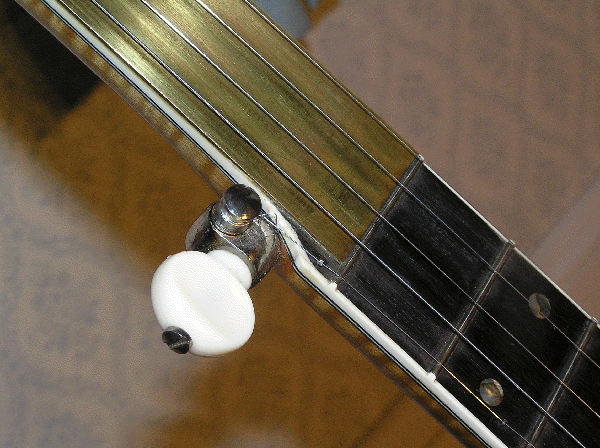
Edited by - Don Borchelt on 01/25/2012 19:40:01
Hunter Robertson - Posted - 01/26/2012: 07:04:35
The reason mine has a metal plate is that I was doing it myself from a fretted banjo, like Don, and I didn't want to tear out all the frets and have to cover the whole fingerboard - so the plate brings that section of the fingerboard up to the level of the frets. I've since simply filed all the frets off another banjo and I think there is a slight difference in sound between wooden and metal fingerboards. For wear, metal strings may wear the board, and your fingernails certainly do.
I've seen some older English banjos with metal fingerboards (totally fretless), usually screwed on. My impression, without much to back it up, is that their current prevalence goes back to the worn fingerboards on some fiddles and banjos being repaired with sheets of copper, aluminum siding etc. and then Kyle Creed's use of formica. I could be wrong.
Hunter
Hunter Robertson - Posted - 01/26/2012: 07:07:30
Oh, and I used a spray contact cement made for cabinetry to attach it. It's been something like 4 years now and it's fine.
Hunter
erikforgod - Posted - 01/26/2012: 07:31:47
Guys...I assume the brass/metal fingerboards are glued on? The formica is the same? I always wondered how they got it to glued onto the neck like that.
staronjeff - Posted - 01/26/2012: 08:02:10
side note mettle strings will boar divots in a fret board over time, it has happen me with a fretless bass i used to have
neillconnor - Posted - 01/26/2012: 09:02:27
Edited by - neillconnor on 01/26/2012 09:05:58
 |  |  |
hduke - Posted - 01/26/2012: 14:20:54
I was under the impression that MOP was soft and if used over large areas, wears quickly.
Since I posted this topic the other day I'v been thinking (menttally ruminating really) about the comments made by the owner of the banjo that brought forth my questions. In addition to the banjo, this fellow plays the fiddle. To be precise, a metal strung fiddle with an ebony fretboard. He says he covered his banjo's fretboard to protect it, why wouldn't the fiddle's ebony fretboard need covering too. I think that comments concerning sustain and ease of sliding notes are the true use of a coverplate.
neillconnor - Posted - 01/26/2012: 14:44:07
Far from it, mop is very hard but also very brittle. It's made up of calcium which by itself is soft but also a secretion from the mollusc, rather like silk weave which binds it all together.
Violin players don't use their nails to sound a note, and keep their fretting hand fingernails trimmed, whereas to gain clarity, banjo players do use nails when sliding. I've seen a ebony fretboard of a banjo where someone had long fingernails and it was seriously gouged after only 4 years use.
Don Borchelt - Posted - 01/27/2012: 02:25:22
That's quite a banjo, Neil. Very elegantly done. How do you like it?
hoverflytheo - Posted - 01/27/2012: 03:05:40
Is there much difference in sound using a brass plat v.s. filed down frets when using nylgut or nylon strings?
I have a banjo which I may eventually free from frets, and I'm wondering which approach to take (it's currently strung with nylgut.)
tomberghan - Posted - 01/27/2012: 05:26:54
My opinion: The primary reason for a plate is to achieve some specific tone the banjoist seeks. Yes, it matters what the plate is made of. You can demonstrate this for yourself. Take a glass and lightly place it on a string and try a few slides (don't press so hard you fret the string on the metal fret - this is like playing "bottleneck style"). Now try the same thing with steel, brass, or even plastic or hardwood. They all sound different right?
As for wearing out the fretboard - well, modern violinists use steel strings (some use gut) and they slide all over the fretboard and they DON'T wear throught fretboards every 10 years. So, there is such a thing as pressing down too hard on the strings. If you press only as hard as you need to, the fretboard will last many years. Ask a violinist!
Hunter Robertson - Posted - 01/27/2012: 05:29:54
quote:
Originally posted by hoverflytheo
Is there much difference in sound using a brass plat v.s. filed down frets when using nylgut or nylon strings?
I have a banjo which I may eventually free from frets, and I'm wondering which approach to take (it's currently strung with nylgut.)
I don't think it would make as much difference as with metal strings, nylon/gut seems to be a lot more forgiving. But I've never used them on a banjo with a metal fingerboard. My fretless banjos with wooden fingerboards work just fine with them, though they do have some fingernail wear.
Hunter
neillconnor - Posted - 01/27/2012: 10:42:49
quote:
Originally posted by Don Borchelt
That's quite a banjo, Neil. Very elegantly done. How do you like it?
stever1422 - Posted - 01/27/2012: 20:23:46
Here is a picture of my original 5 string Tuba-phone #3 with brass between the frets up to #7. On the left is my Grandfather's Tuba-phone #3 Plectrum which I recently brought back to life. I did not want to alter the 5 string by ripping out the frets, so they are still there but the banjo plays like a fretless.
The brass is slightly "higher" than the frets and is held on with small dots of 5 minute epoxy. So there are no "speed bumps", just smooth sliding. The brass has been on the banjo for about 35 years and every few years I need to reglue one or two of the brass pieces. There has been no damage to the ebony fingerboard from the glue so after I join the great stingband in the sky the next owner can remove the brass and the banjo will be back in its original condition. As a bonus, the frets have not received any playing wear since the mid 1970s.
The sound of the metal strings sliding on the metal fingerboard sounds great to my ears. Perfect for playing with a fiddler. And with frets above #7 I can chord up the neck. To my admittedly warped mind this is the perfect set-up for a banjo.

Edited by - stever1422 on 01/27/2012 20:31:57
stever1422 - Posted - 01/27/2012: 20:29:26
As a PS to the above post- years ago I bought a banjo from Kyle Creed which had copper on the fingerboard up to the 7th fret for the 1st string. Trying to slide on the copper was like driving through mud, the copper was so soft. So I took it off and replaced it with brass. Sounds and plays great. Still have the original copper which I will pass along to the next owner of the banjo someday.
g3zdm - Posted - 01/28/2012: 03:17:46
After an evening at Don Borchelt's, I was hooked on the idea of a semi fretless. When I returned to UK I had a local luthier friend (and fiddle player) put a brass plate on my Ibanez Artist for the 1st 5 frets.
It's great for producing a different take on well known (some would say overplayed) favourites; even breathes new life into Cripple Creek.
Chris Muriel, Manchester, UK
Bart McNeil - Posted - 01/29/2012: 05:02:31
While I don't doubt that semi-fretless is "easier" than fretless, just like a full-fretted instrument is easier than fretless there is a loss of tonality when frets are applied. Perhaps a "change of tonality" would be putting it better.
I think a semi fretless is like riding a tricycle. It is kinda like playing a fretless but much much safer when playng up the neck.
There must have been attempts to build fretted violins and violas to achieve proper intonation but you would lose as much as you gain with them.
On the other hand I have never played a semi-fretless instrument, so what do I know?
Bart McNeil - Posted - 01/29/2012: 05:12:32
Whoops!!!! i just looked them up and, yep, there are fretted violins for sale, at least for beginning level players. I don't know whether there are "professional" level fretted violins, etc. I suspect not.
plunknplinkntwang - Posted - 01/29/2012: 09:37:43
The history of the old time era leads me to believe that the usual Appalachian players either made their own banjo's or if they were better off, bought catalog banjo's. Some of the old mass produced banjo's didn't have a fingerboard and those that did were often "ebonised", i.e. lower cost fine grained timbers dyed black
Apart from the inherent beauty of the contrasting black colour against other woods, ebony is very hard, only surpassed by woods such as lignum vitae. As such, "back in the day" fingerboard wear would be quite rapid; it seems sensible to rejuvenate or to prevent the wear by placing a thin hard surface over the most used part of the wood. Materials like brass & copper were common articles, as were used a lot for other repair applications such as bearing surfaces, shims for aligning machinery couplings etc etc. As these would be readily available and relatively easy to work someone somewhere had the clever idea to use them on a banjo.
Kyle Creed then followed this but applied his innovative spirit and started using a wonder material of that age, Formica. Nice and hard, low friction and even easier to work and fix to timber - if he were around today I wonder what material he'd use nowadays?
None the less he also made fretless banjo's with fingerboards entirely plated with Formica, Fred Cockerham's banjo was one such as these and you can see pictures of it on the Smithsonion web pages.
rgds
Chris
Bart McNeil - Posted - 01/30/2012: 12:07:55
I am building a few minstrel banjos and thought i would experiment with brass on one of them out of curiousity... These minstrel banjos are not built for steel strings. Nylon or gut strings are required. There will be virtually no wear with these strings on a white maple neck (even without separate fretboard). I do suspect though that the metal will have some effect tone-wise.
Terms of Use | Privacy Policy | Privacy Consent (EU/GDPR Only)
Copyright 2026 Banjo Hangout. All Rights Reserved.


