
DVD-quality lessons (including tabs/sheet music) available for immediate viewing on any device.
Take your playing to the next level with the help of a local or online banjo teacher.
Weekly newsletter includes free lessons, favorite member content, banjo news and more.
Premier Sponsors


|
Please note this is an archived topic, so it is locked and unable to be replied to. You may, however, start a new topic and refer to this topic with a link: http://www.banjohangout.org/archive/205533
championofnorthhuron - Posted - 04/28/2011: 07:09:52
I'm curious on the differences in skin heads I have and have seen; not just tonally but also as to what part of the animal they may have come from, how they are processed, and how they perform from a stability standpoint.
On my Romero (the banjo on the left in first photo), I have a very 'unprocessed'/organic looking head; color variations, smooth areas, and rough areas. Although the 'mottled' appearance can be seen from either side, one side has a very soft feel and different areas that are either smooth or more rough/fuzzy to the touch; and which I assume to be that which was on the inside/'guts' side of the animal. The other side is more uniformly smooth and more 'hard' to the touch and that which I have assumed to have been where the hair once was. This head seems quite elastic and stretchy... like a trampoline, and changes tension readily with small changes in humidity and temperature. It also seems to have a 'warmer' tone. I also understand that this head had some wood stain applied... adding to the mottled appearance. It seems that the wood stain is absorbed by the rougher/fuzzy areas of the skin and not so much by the smooth areas.
My SS Stewart has a very glassine looking head... like looking through ice or thin mica, with much less mottling than the Romero. When held at an angle to the light it almost has a silver appearance. It has a hard, smooth surface on both sides and seems less giving or stretchy. It is clearly an organic/skin head, but just does not have that 'soft' or leathery feel. Even on close examination I really can't even see the little 'pores' I would expect to see where the hair once was. This head has a brighter tone, and while it seems to be more tolerant of humidity changes I have had it react sharply to large changes in temperature (which I know obviously has to do with other components reacting to the temperature as well... neck, pot, etc.). This head seems quite thin, but very tough. Has more of a sharp 'crack' to it when you tap it (which again I know is also affected by tension and the other components such as the spun over pot).
The third general type of skin head I've seen, though I don't own one is more uniform in appearance. Typically bright-white or off-white, kind of matte, very opaque, and the 'pores' or follicles where the hair once was are readily seen. The direction that the hair laid is also evident as the holes all kind of angle in a common direction. Uniformly 'soft' to the touch on both sides. Like the head on my Romero, this head seems perhaps a bit more stretchy, and my impression is that they may also be thicker relative to the one on my Stewart. I can't speak to the tonal qualities as again, I don't own one and haven't much heard them played.
To the best of my knowledge these are all calf skins, but I'm not 100% certain of that. What gives them their different appearances, stretchiness, hardness/softness, etc? All of these banjos are quite different of course and I know that the tone is affected by the sum of all parts, but of that part that I at least perceive to be contributed by the head I have to say that I like the head I have on the SS Stewart. I also like its appearance quite well and it seems more resistant to soiling than the other skin types I mentioned.
Edited by - championofnorthhuron on 04/28/2011 11:31:16
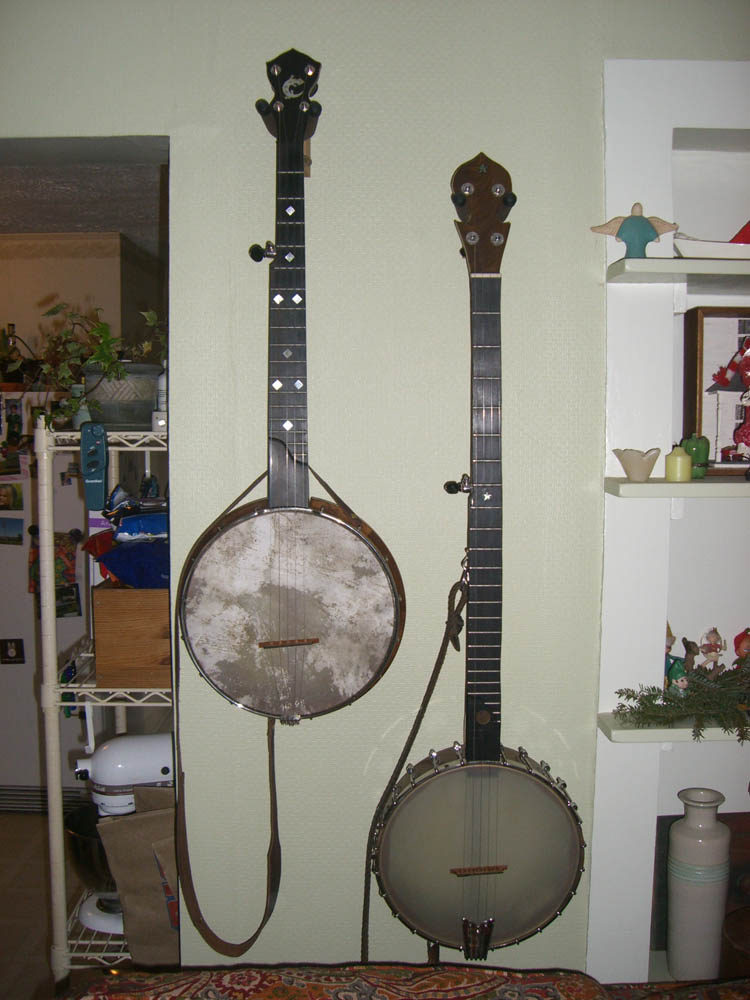 | 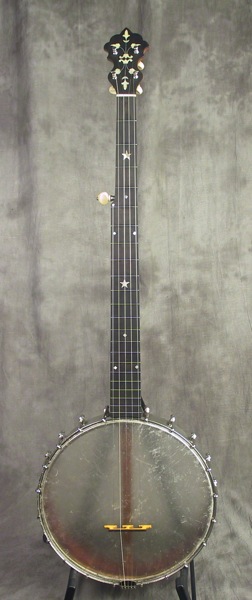 S.S. Stewart UF |
Voyageur - Posted - 04/28/2011: 07:25:56
I hope someone provides this information, because all of your observations and questions are very interesting and well-put. I recently put a goatskin head on a vintage Whyte Laydie pot (replaced a FiberSkyn head) and like it a lot. I have considered replacing the Ren head on my OME with skin, but don't want to tone down the brightness too much, so have been hesitant.
championofnorthhuron - Posted - 04/28/2011: 08:00:53
I'll tell ya' Voyageur... I have a Ren head on my Helix, and I think that skin head you see on my Stewart is equal or brighter. They're both fairly tight and close in tension. If you can find this type, I don't think you'd be toning down your OME by using one. That head on my Stewart is the one that was put on it by Bernunzio's in Rochester NY, where I bought it. I've seen these heads on a few of the banjos they have there. If I don't end up with information here that helps me identify it I have been thinking of calling or stopping back into Bernunzio's and asking what they know about the differences and where I may be able to buy these skins. Because of the absence of noticeable hair pores, I've wondered if they could come from some part of the animal that doesn't have much hair such as the belly.
tomrice - Posted - 04/28/2011: 09:43:14
I can tell that around here, and this is the land of Joel Walker Sweeney, that house cats were heavily used for banjo heads. And the portion used was the cats stomach. In other words the cat had to be removed from his hide by slitting him down the backbone. If the poor creature had interesting t!t$, they'd be lined up parallel with the strings for additional shock/artistic value. These hides were not processed or tanned, they were scraped very clean, stretched, and allowed to dry in the way rawhide is made. From a stability standpoint, they last for decades. As tradition holds it around here, a young Joel Walker constantly ran afoul with his mother and the disappearance of her favorite pets with a noted under population of house cats in the Appomattox area in general.
Mumble Peg - Posted - 04/28/2011: 10:28:46
How big of a cat would it take to cover an 11" rim? Which makes the best skin: p**** cat or tom cat?
jbalch - Posted - 04/28/2011: 11:10:07
I don't know the answers to your questions. But having mounted a few dozen heads myself, I've made similar observations.
On thing is for sure, each piece of hide is unique. I don't know that you can predict exactly how any piece of animal skin will perform...until it is stretched. But, I tend to like the skins that have a "harder" or "stiffer" feel before mounting.
Some of the best heads I've gotten appear to come from the animal's spine. You can sometimes see a line across the hide where the spine was. Some of those may have translucent spots that can be quite hard. I've been told that drummers used to look for those type skins for kick-drums heads. The would place the very-hard translucent spots where the pedal would strike.
I'd be interested to hear what other folks know about the topic. I linked this thread to the Hide Heads group banjohangout.org/group/hideheads
The fellow who could answer is Jeff Stern of the Stern Tanning Co. Unlike most of the retail sources that sell calfskin, Jeff actually processes the hides. I have spoken with him a couple of times and found him to be very knowledgeable and helpful.
sterntanning.com/percussion.htm
You can see a little bit of the line I was talking about on this head from Stern tanning:

Edited by - jbalch on 04/28/2011 11:11:11
tomrice - Posted - 04/28/2011: 12:10:39
Hey Mumble Peg, wouldn't take too big a cat. If"'n you felt the need for those artistic qualities I was a- speakin' of, then it'd have to be a P**** cat.
fuzzyacg - Posted - 04/28/2011: 13:33:50
Bill Miller has the clearish skin heads. they're listed as "natural" skins. I'm thinking about putting one on my goodtime but I dont like looking at the co-rod.
Terms of Use | Privacy Policy | Privacy Consent (EU/GDPR Only)
Copyright 2026 Banjo Hangout. All Rights Reserved.


