
DVD-quality lessons (including tabs/sheet music) available for immediate viewing on any device.
Take your playing to the next level with the help of a local or online banjo teacher.
Weekly newsletter includes free lessons, favorite member content, banjo news and more.
Premier Sponsors


|
Please note this is an archived topic, so it is locked and unable to be replied to. You may, however, start a new topic and refer to this topic with a link: http://www.banjohangout.org/archive/202453/2
Page: 1 2
From Greylock to Bean Blossom - Posted - 03/23/2011: 21:17:24
quote:"Not from me he hasn't"? This sounds like a personal problem to me.
Originally posted by RedDragonquote:
Originally posted by From Greylock to Bean Blossom
You should care who he is. He has EARNED respect.
Not from me, he hasn't. He's lost any respect he might have earned from me with that bizarre response. I'm sure he'll lose about as much sleep over it as I will.
I won't be entertaining any more off-topic meta-discussion in this thread.
From Greylock to Bean Blossom - Posted - 03/24/2011: 04:11:41
quote:No one said that you didn't have "the right" to post here.
Originally posted by From Greylock to Bean Blossomquote:
Originally posted by RedDragon
[quote]Originally posted by pearcemusic
I couldn't care less how you see things ... you are only one opinion.
Yes - with as much right to post it here as anyone else, "experts" included.
 What should have been learned long ago that is just because you have the right to do something does not make what you do right. Rights come with responsibilities. You have hurt the community by creating a hostile environment for a REAL player.
 Edited by - From Greylock to Bean Blossom on 03/24/2011 04:16:38
JoeDownes - Posted - 03/24/2011: 04:57:17
RedDragon,
I don't see anything coincidental in the cof. Diatonic music is based on scales, that incorporate as many perfect fifth as theoretically possible to divide the octave. This is not coincidental, but by design. It's the perfect fifth that defines diatonic music.
The perfect fifth, with its ratio of 3/2 (let's forget about temperament for the moment) is the simplest ratio (and thus the most harmonious sounding interval), that creates a different note. You can't build scales with the intervals of unison (1/1) or octaves (2/1). So the perfect fifth is the driving force behind (not only western) harmony.
If you stack perfect fifth to divide the octave, you inevitably end up with the pentatonic scale, that is pretty universal in all kind of music from all over the world. Of course this is not by coincidence, but because it sounds harmonious.
If you continue dividing the octave beyond the pentatonic scale, you inevitably end up with one diminished fifth, between the 4th and 7th interval. This creates the tension in a V7 chord, that is the basic of diatonic harmony.
So I conclude that the fifth is the driving force in all diatonic music. The fact that a perfect fifth creates harmony and a diminished fifth creates tension lies at the heart of the diatonic scales and western harmony. It's not coincidental at all, it's by design.
The diagram of the circle of fifth illustrates those relationships.
The pentatonic scales notes are the root plus the four notes next to it in the cof's. The diatonic scale adds the notes to the left and right in the cof's. Those are exactly opposite each other on the circle of fifth.
So notes that are close to each other in the cof are also closely related harmonically, they combine well into consonant intervals, while notes that are opposite each other create the dissonant interval of the diminished fifth.
Look at a diminished scale or a whole tone scale on a cof's and you'll see that more notes are opposite each other and combine into a tritone interval, adding more dissonance to the harmonies created with the scale. Also notice that the notes of the dissonant interval of the minor second are almost opposite each other in the circle.
So notes that are close to each other on the cof combine into consonant intervals, while notes that are opposite each other in the circle combine into dissonant intervals
Now back to keys: The cof's shows how closely related two keys are. Keys that are right next to each other share all but one note. Keys opposite each other share just one note. Coincidence? No, it's caused by the design of the diatonic scales, that divide the scale in as many perfect fifth as possible.
It's no coincidence that the major chord that are predominant in bluegrass, the I, IV, V, II and bVII are right next to each other in the circle, with the tonic chord right in the middle of them. The progressions 'borrow' the II and bVII major chords from the most closely related keys.
Pat, I'm intrigued by your idea of analyzing jazz progressions as tonic, subdominant and dominant chords. I enjoyed reading your posts and I'd appreciate if you'd continue to share your views, even though you don't like to discuss them. Maybe you can just post your insights and leave the discussion to us.
Edited by - JoeDownes on 03/24/2011 05:12:57
From Greylock to Bean Blossom - Posted - 03/24/2011: 06:15:52
quote:Joe,
Originally posted by JoeDownes
Pat, I'm intrigued by your idea of analyzing jazz progressions as tonic, subdominant and dominant chords. I enjoyed reading your posts and I'd appreciate if you'd continue to share your views, even though you don't like to discuss them. Maybe you can just post your insights and leave the discussion to us.
Edited by - From Greylock to Bean Blossom on 03/24/2011 06:18:26
pearcemusic - Posted - 03/24/2011: 06:18:31
quote:
Originally posted by stringbreaker
red dragon is the real deal
JoeDownes - Posted - 03/24/2011: 06:32:33
Ken, Pat might continue posting out of the same reasons that he posted in the first place. He can either stop posting or ignore some comments. I'd appreciate if he'd choose the latter. I think most folks here like to read his comments, so that might be another reason for him to continue to participate on this forum.
I think those discussions about treating the experts with respect should be moved to and continued in a separate thread. It's well worth discussing, but I don't like to see this discussion in interesting and informative topics. It's distracting from the original topic.
Edited by - JoeDownes on 03/24/2011 06:41:03
RedDragon - Posted - 03/24/2011: 08:10:27
quote:
Originally posted by From Greylock to Bean Blossom
If you had phrased your opinion as a respectful question and asked him his opinion to your thought process there are good chances he would have taken the time to reply. You and the community would have gained more insight to the thinking process of a PROVEN GREAT PLAYER. Instead you called his view MYOPIC. That is still hard for me to fathom the attitude behind that statement.
RedDragon - Posted - 03/24/2011: 08:19:36
quote:
Originally posted by JoeDownes
RedDragon,
I don't see anything coincidental in the cof. Diatonic music is based on scales, that incorporate as many perfect fifth as theoretically possible to divide the octave. This is not coincidental, but by design. It's the perfect fifth that defines diatonic music.
minstrelmike - Posted - 03/24/2011: 09:27:34
The musical beauty of the circle of fifths:
For regular 1,4,5 chord songs, the other two chords are to each side of the root chord.
For 2-5 jazz or 3-6-2-5 ragtime tunes, you leap forward 2 or 4 'hours' and walk your way back.
For notes of a scale, the 5 notes clockwise form the pentatonic.
Grab the 6th note and the one counterclockwise and you've got the full major scale.
For reading music, it maps the numbers of sharps and flats in written music.
Richard Dress - Posted - 03/24/2011: 10:49:38
I am plenty upset that I can't find any flaws in RedDragon's long uncomfortable rant. I hate it when people are right. My only consolation is that his opinion will be lost in the chaff.
Personally, some time after I noticed that there was a similarity in I, IV, V songs, I began to see similarity in songs like 'Salty Dog' and 'I Know What It Means To be Lonesome' (Circle of 5ths), and other interesting tricks. I was happy to know that because it made jamming a little easier. I wish it hadn't taken so long to pick up on it but mostly for ego reasons rather than musical reasons. A lot of pickers got their little bit of theory that way.
But it's not earth-shattering news. How many BG songs have a circle? Maybe 2%? What would happen to someone who never heard of the circle of 5ths?
JoeDownes - Posted - 03/24/2011: 10:50:46
quote:
Originally posted by RedDragonquote:
Originally posted by JoeDownes
RedDragon,
I don't see anything coincidental in the cof. Diatonic music is based on scales, that incorporate as many perfect fifth as theoretically possible to divide the octave. This is not coincidental, but by design. It's the perfect fifth that defines diatonic music.
I'm obviously having some difficulty communicating this particular point. What the circle of fifths was designed to do was to show the relationships between key signatures. Even if it were true that "the perfect fifth...defines diatonic music", this doesn't change the fact that that's what the circle does.
quote:
Originally posted by RedDragon
People seem to place a lot of weight on the fact that the circle "illustrates" common cadential progressions such as ii-V-I. Like I said, all you need to do to demonstrate that the circle of fifths does not illustrate these progressions at all is to try the same exercise with the full progression of fifths, and you'll see that it doesn't match up with the circle at all, because the circle is not designed to illustrate this type of thing. It's just an arrangement of notes into perfect fifths.
quote:
Originally posted by RedDragon
As an illustration, you could probably order the notes purely chromatically, and come up with a whole bunch of interesting things you can hang on such a circle.
As some people have said here, they look at it as a "circle of fourths", and they can still hang just as many things on it, so the link with "the perfect fifth...defines diatonic music" seem tenuous. You could read things into all kinds of random arrangements, and that's fine, but those things are not in those arrangements by design, which is my point.
Edited by - JoeDownes on 03/24/2011 11:00:56
RedDragon - Posted - 03/24/2011: 19:39:41
quote:
Originally posted by JoeDownes
Where did you get the information that is was designed only to show the relationship between key signatures?
quote:
Originally posted by JoeDownes
According to wikipedia it 'is a geometrical representation of relationships among the 12 pitch classes of the chromatic scale in pitch class space. ' This implies to me that the intention of the cof is more fundamental than you want to admit.
quote:
Originally posted by JoeDownes
It does match perfectly.
quote:
Originally posted by JoeDownes
If you'd continue to move down a perfect fifth from F, you'd play around the circle through all keys and you end up where you started. That's what the cof illustrates...What the cof really shows is that after going up a (tempered) perfect fifth (ratio 3/2) twelve times you end up on the same (or rather an enharmonic equivalent) note that you started with. Those notes devide the octave into the 12 notes we know as the chromatic scale. It's the most basic insight into the nature of western music.
banjoak - Posted - 03/25/2011: 04:03:11
quote:
Originally posted by Mirek Patek
Where is the comma in the circle of fifths?
JoeDownes - Posted - 03/25/2011: 05:50:17
I also prefer other resources above wikipedia. Here are some excerpts from The Harvard Dictionary of Music:
On Chinese music, p. 154
"From the principal note hwangjong eleven additional pitches were derived by the Pythagorean (circle-of-fifth) method."
The circle of fifth, p. 171:
"The circular, clockwise arrangement of the twelve keys in an order of ascending fifths, showing that after twelve such steps the initial key is reached again. "
Pythagorean scale, p. 709:
"A scale, said to have been invented by Pythagoras (c. 550 B.C.) that derives all the tones from the interval of the pure fifth, 3/2. The tones of the diatonic scale are obtained as a series of five successive upper fifth and one lower fifth. (...) The succession of Pythagorean fifths can be continued beyond the tone b, leading to chromatic tones f#, c#, etc., and finally to b#, which is slightly higher than c, the interval between the two pitches again being the Pythagorean comma. "
For a description of how the circle can be applied to harmony read R. F. Goldman's "Harmony in Western music" (1965). Here's an excerpt from wikipedia:
"Another theory regarding harmonic functionality is that "functional succession is explained by the circle of fifths (in which, therefore, scale degree II is closer to the dominant than scale degree IV)." According to Goldman's Harmony in Western Music,[13] "the IV chord is actually, in the simplest mechanisms of diatonic relationships, at the greatest distance from I. In terms of the circle of fifths, it leads away from I, rather than toward it." Thus the progression I-ii-V-I would comply more with tonal logic. However, Goldman,[13] as well as Jean-Jacques Nattiez, points out that "the chord on the fourth degree appears long before the chord on II, and the subsequent final I, in the progression I-IV-viio-iii-vi-ii-V-I." [14] Goldman also points out that, "historically the use of the IV chord in harmonic design, and especially in cadences, exhibits some curious features. By and large, one can say that the use of IV in final cadences becomes more common in the nineteenth century than it was in the eighteenth, but that it may also be understood as a substitute for the ii chord when it precedes V. It may also be quite logically construed as an incomplete ii7 chord (lacking root)." [13] However, Nattiez calls this, "a narrow escape: only the theory of a ii chord without a root allows Goldman to maintain that the circle of fifths is completely valid from Bach to Wagner." [14] en.wikipedia.org/wiki/Diatonic_function
Edited by - JoeDownes on 03/25/2011 05:58:33
steve davis - Posted - 03/27/2011: 05:24:04
I like using the circle as a refernce aid for someone learning the rag and partial rag progression,especially in learning to play w/o a capo and for transposing.
After figuring it out on the wheel,the ear starts to take over.
RedDragon - Posted - 03/27/2011: 17:57:37
quote:
Originally posted by JoeDownes
I also prefer other resources above wikipedia.
Edited by - RedDragon on 03/27/2011 18:06:05
JoeDownes - Posted - 03/28/2011: 03:59:36
Pythagoras used the circle of fifth to construct the chromatic scale and the diatonic scale, centuries before key signatures were 'invented'. Coincidental or meaningful?
Analyzing harmony by distinguishing between tonic, subdominant (a fifth below the tonic) and dominant (a perfect fifth above the tonic) function is the basis of Riemann's 'functional harmony'. These relationship can be shown on the circle of fifth. Coincidental or meaningful?
Just because Heinichen designed a circle of fifth, that shows the relationships between key signatures, it doesn't follow that the other implications of the cof (scales, functional harmony, temperament, ect) are not valid, interesting and meaningful.
That there's a diminished fifth in the circle progression, lies in the nature of the diatonic scales. You simply cannot have a 7 tone collection without including at least one diminished fifth. Again, the circle can be used to illustrate this.
Thor - Posted - 03/29/2011: 04:14:23
quote:
For instance, the full progression of fifths - which is the proper name for the actual chord progression - goes:
I - IV - vii(dim) - iii - vi - ii - V - I
It's pretty easy to see that the circle of fifths isn't linked to this progression at all. For instance, to take it in the key of C, I is obviously C itself, and IV is F. If you start at C on the circle, and back up to the left then you will indeed go straight to F, and they'll match. If you go one step further and try to hit vii(dim), this is Bdim in the key of C, but if you back up another place on the circle you'll hit Bb, and not B at all. This is because the descending interval from the subdominant to the leading note is a diminished fifth, not a perfect fifth, and the circle deals only with perfect fifths. So if we're using it to look at the actual full progression of fifths, we can see that the circle fails us before we even get to the third chord.

Edited by - Thor on 03/29/2011 04:18:17
tom elder - Posted - 03/29/2011: 05:20:49
I use a banjo finger board for my theory diagrams,if i want to know whats going on in Bb i simply bar it and look at the memorized scale or chord to see the correct name for the notation at that particular pitch.I can see the scales ,modes, relative minor ,and chords i want pretty much instantaneous,if i wanted to hop a 5th ,i would bar the f and get a readout.
Banjophobic - Posted - 03/29/2011: 06:59:29
quote:
Originally posted by Thor
Not recognizing this and assuming singular intent might be considered myopic. ;)

Edited by - Banjophobic on 03/29/2011 07:02:09
250gibson - Posted - 03/29/2011: 08:48:23
I learned the "circle of fifths" as the circle of fouths. In other words, I was taught to construct the circle going clockwise from C: C, F, Bb, Eb, Ab, Db, Gb - F#, B, E, A, D, G and back to C.
And the reason I was taught it was to learn the key signatures. I was taught it in music theory class taught by a jazz bassist, so maybe that is why.
Going clockwise from C at 12 o'clock was the flats, and Going counter-clockwise was the sharps, How many steps in each direction was the corresponding number of flats and or sharps in the key signature.
I believe inferences made otherwise regarding chord progressions, etc. were derived to make bluegrass, folk, music, and the like, that rely heavy on I, IV, V progressions, eaiser to understand and know the chord relationships. If you stare at anything long enough, you can realize many different patterns.
grumpy7 - Posted - 03/29/2011: 09:28:34
red dragon is the new banjophobic. LOL. I love the BHO it is so dam funny. I'm convinced if you went to Hollywood and got 10 of the best comedy writers in the world, they couldn't come up with the funny stuff here.
First you have banjophobic, who got kicked out of the main board for bossing everyone around and telling them all off, and he is here telling red dragon to quit bossing everyone else around and telling them off.
Then you have red dragon who probably didn't even know that banjola was a famous banjo player, but then that makes you ask why didn't you name yourself your real name????? hilarious
Then you got the guy from Holland explaining about the d sharp and the f sharp and how it resolves on the circle, and how Newton's laws of physics predict the placement of the sharp on the b flat chord, yada yada yada. We are playing a BANJO here okay. Note a classical Bach symposium. A BANJO. (lol) As in wearing overalls, missing a few teeth, deer hunting. You get the picture!
(I don't mean any disrespect by the way, you are a super cool guy)
Then you got all the grumpy old guys coming out of the woodwork saying "yeah, I agree"
and it's all over an argument about the circle of fifths (something I have never once, ever, considered using or understanding in all my yrs of playing!)
I love the banjo hangout. that's all i can say. You could never invent comedy this good.
Edited by - grumpy7 on 03/29/2011 09:41:18
Banjophobic - Posted - 03/29/2011: 09:44:48
quote:
Originally posted by grumpy7
red dragon is the new banjophobic. LOL. I love the BHO it is so dam funny. I'm convinced if you went to Hollywood and got 10 of the best comedy writers in the world, they couldn't come up with the funny stuff here.
First you have banjophobic, who got kicked out of the main board for bossing everyone around and telling them all off, and he is here telling red dragon to quit bossing everyone else around and telling them off.
Then you have red dragon who probably didn't even know that banjola was a famous banjo player, but then that makes you ask why didn't you name yourself your real name????? hilarious
Then you got the guy from Holland explaining about the d sharp and the f sharp and how it resolves on the circle, and how Newton's laws of physics predict the placement of the sharp on the b flat chord, yada yada yada. We are playing a BANJO here okay. Note a classical Bach symposium. A BANJO. (lol) As in wearing overalls, missing a few teeth, deer hunting. You get the picture!
(I don't mean any disrespect by the way, you are a super cool guy)
Then you got all the grumpy old guys coming out of the woodwork saying "yeah, I agree"
and it's all over an argument about the circle of fifths (something I have never once, ever, considered using or understanding in all my yrs of playing!)
I love the banjo hangout. that's all i can say. You could never invent comedy this good.

Edited by - Banjophobic on 03/29/2011 09:57:48
Mirek Patek - Posted - 03/29/2011: 10:24:41
Is there any way to mix the circle of fifths with the duoprism, which relates the notes which are THIRD apart?
See my message at the end of archived thread banjohangout.org/archive/169589
I am reposting here the links which do not work in the archived message:
Triangular-square duoprism:
(taken from upload.wikimedia.org/wikipedia...prism.png )
Note that all horizontal edges have length 3, all vertical and slant edges have length 4.
If we switch the polygons, the result is Square-triangular duoprism:
(taken from upload.wikimedia.org/wikipedia...prism.png )
Note that all horizontal edges have length 4, all vertical and slant edges have length 3.
These duoprisms contain all 12 chromatic notes (as the 12 vertices) and those ones which are major or minor third apart are connected by the edge (line). Rectangle faces (3x4) contain the notes of major and minor triad from the same root, e.g. C-Eb-G-E. The square faces (3x3) contain the notes of diminished seventh chord and the triangle faces contain the notes of augmented triad.
So - can this duoprism be combined with the circle of fifths?
Mirek
Banjophobic - Posted - 03/29/2011: 10:30:22
quote:
Originally posted by Mirek Patek
Is there any way to mix the circle of fifths with the duoprism, which relates the notes which are THIRD apart?
See my message at the end of archived thread banjohangout.org/archive/169589
I am reposting here the links which do not work in the archived message:
Triangular-square duoprism:
(taken from upload.wikimedia.org/wikipedia...prism.png )
Note that all horizontal edges have length 3, all vertical and slant edges have length 4.
If we switch the polygons, the result is Square-triangular duoprism:
(taken from upload.wikimedia.org/wikipedia...prism.png )
Note that all horizontal edges have length 4, all vertical and slant edges have length 3.
These duoprisms contain all 12 chromatic notes (as the 12 vertices) and those ones which are major or minor third apart are connected by the edge (line). Rectangle faces (3x4) contain the notes of major and minor triad from the same root, e.g. C-Eb-G-E. The square faces (3x3) contain the notes of diminished seventh chord and the triangle faces contain the notes of augmented triad.
So - can this duoprism be combined with the circle of fifths?
Mirek
stringbreaker - Posted - 03/29/2011: 13:58:41
john, immature and troll are name calling. red dragon took you and pat to town. grumpy knows what he is talking bout.
Banjophobic - Posted - 03/29/2011: 14:16:23
quote:
Originally posted by 250gibson
I learned the "circle of fifths" as the circle of fouths. In other words, I was taught to construct the circle going clockwise from C: C, F, Bb, Eb, Ab, Db, Gb - F#, B, E, A, D, G and back to C.
And the reason I was taught it was to learn the key signatures. I was taught it in music theory class taught by a jazz bassist, so maybe that is why.
Going clockwise from C at 12 o'clock was the flats, and Going counter-clockwise was the sharps, How many steps in each direction was the corresponding number of flats and or sharps in the key signature.
I believe inferences made otherwise regarding chord progressions, etc. were derived to make bluegrass, folk, music, and the like, that rely heavy on I, IV, V progressions, eaiser to understand and know the chord relationships. If you stare at anything long enough, you can realize many different patterns.

Jody Hughes - Posted - 03/29/2011: 20:04:14
Anyone have an example of a song that uses the full progression of fifths
I - IV - vii(dim) - iii - vi - ii - V - I
I've seen bVmin7b5-VII-III-etc before.
banjoak - Posted - 03/29/2011: 23:07:18
quote:
Originally posted by Jody Hughes
Anyone have an example of a song that uses the full progression of fifths
I - IV - vii(dim) - iii - vi - ii - V - I
I've seen bVmin7b5-VII-III-etc before.


Thor - Posted - 03/30/2011: 03:00:17
quote:
Originally posted by Jody Hughes
Anyone have an example of a song that uses the full progression of fifths
I - IV - vii(dim) - iii - vi - ii - V - I
I've seen bVmin7b5-VII-III-etc before.
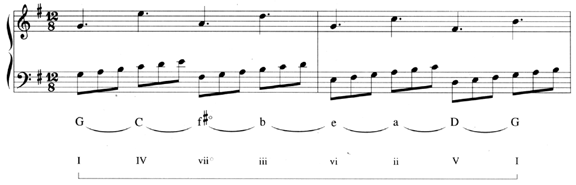
JoeDownes - Posted - 03/30/2011: 03:18:36
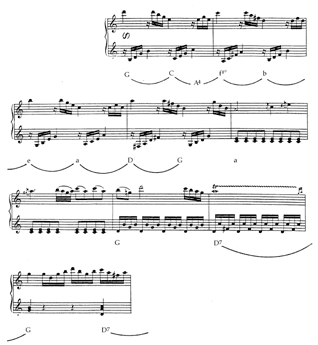
Mozart's piano sonata in C major measures 18-26
macromusic.org/journal/volume1/Gerber.html
youtube.com/watch?v=JcUh-ggBfzI
mikey5string - Posted - 03/30/2011: 07:57:55
quote:
Originally posted by JoeDownes
Mozart's piano sonata in C major measures 18-26
macromusic.org/journal/volume1/Gerber.html
youtube.com/watch?v=JcUh-ggBfzI
TopCat - Posted - 03/31/2011: 06:19:47
quote:
Originally posted by From Greylock to Bean Blossom
You have hurt the community by creating a hostile environment for a REAL player.
If you had phrased your opinion as a respectful question and asked him his opinion to your thought process there are good chances he would have taken the time to reply. You and the community would have gained more insight to the thinking process of a PROVEN GREAT PLAYER. Instead you called his view MYOPIC. That is still hard for me to fathom the attitude behind that statement.
TopCat - Posted - 03/31/2011: 06:23:55
quote:
Originally posted by RedDragon
All else being equal, a person posting to these forums who picked up the banjo for the first time just this morning deserves exactly as much "respect" as someone who's been playing for 70 years does.
grumpy7 - Posted - 03/31/2011: 06:54:01
youtube.com/watch?v=Nw01ImG07aE
Edited by - grumpy7 on 03/31/2011 07:07:16
tom elder - Posted - 04/01/2011: 07:28:31
Kemo Sabe asked me about my audio take on this,by the way i think i was introduced to this theory by the red Pete Seeger book.
Any way Phil as luck has it, it is changing chords about right on the second,it goes thru the circle 4 times,starting at 20 seconds completing at around 30 resting 2 measures taking off again at 36,this rest occurs again at roughly 49-52 seconds,then at 1 minute 05 till 1 minute 08.The chords i use are G-D-A-E- B-Fsharp-Db-Ab-Eb-Bb-F-C-
I may have practiced it years ago,it is basicly changing the main 3 closed chord positions,an important thing to get going but easy as pie afterwards.One thing i do is fret the high G string with the same finger i fret the low d with to keep it in tune at all times.I am amazed that books don't show this.
banjojnab - Posted - 04/24/2011: 06:38:23
I've read this topic with interest as one with next to no music theory experience and learning banjo. I just share my insight into the Cof5ths. That would be that the Circle of 5ths is to music similarly to what the periodic table is to chemistry or geometry is to math. A good diagram is the key to understanding a problem and gaining further knowledge.
Here's a simple example: At one time, before the periodic table was portrayed, chemists (alchemists) had knowledge of a number of elements and the main part of their occupation was describing everything they could about each element. Over time, chemists began to notice that certain groups of elements behaved similarly under similar conditions. At some point a chemist named Mendeleev laid out all the elements known at the time into the diagrammatical representation known now as the periodic table. To make a long story short, seeing the list of elements portrayed in this fashion led to a number of key insights into why certain elements behaved as they did, and why some combined with others in a certain fashion, why some were solids, liquids, or gases, why some didn't react at all, based on valence electrons. Perhaps more importantly, the (representation of elements into the) periodic table also explained why these phenomena must be so. Chemists were now able to predict the behavior of various combinations of elements (chemical reactions) and eventually led to synthetic chemistry...
In math, a good geometric representation of a problem leads to key insights, and explains why it must be so. A circle is understood when one realizes that every point on the circumference is an equal distance from the centre. Similar diagram representations show why the sum of angles inside a triangle must equal 180 degrees, a square 360 degrees, in general 180 x (number of sides minus 2)... Pages of formulas and mathematical proofs could explain the same thing, but the diagram makes it readily apparent. From a good diagram representation, one can understand statics, dynamics, architecture, clock making, space travel, gears, banjo strings, etc., and get an explanation as to why things must be so.
The circle of fifths is a diagram someone conceived as a way of representing relationships between key signatures, in the experiential sense. If you look at it, that's all it really is. However, having the key signatures arranged in this diagrammatic fashion, instead of being written down as a series of scales with successive sharps and flats, or counting to 5 on your fingers. As I learned here, one can easily figure out key relationships, scale relationships, more complex musical passages,...ultimately take the banjo to places it's never been before. It's not apt to say that the uses made of Cof5ths is analogous to using a toaster as a doorstop. It would be more apt to say that a diagrammatic representation of thermodynamics and electromagnetism led to the toaster, and many other objects we now have to make life more convenient.
banjojnab - Posted - 04/25/2011: 05:56:53
I was thinking about how the circle of fifths may apply to other modes (dorian, myxolydian, etc) and came across this handy DIAL that shows the circle of fifths and chord progressions for any mode and key of your choosing. Very practical:
all-guitar-chords.com/circle-of-fifths.php
Is there a similar resource for banjo out there?
Edited by - banjojnab on 04/25/2011 06:03:31
OT Banjo - Posted - 04/27/2011: 19:11:13
quote:
Originally posted by banjojnab
I was thinking about how the circle of fifths may apply to other modes (dorian, myxolydian, etc) and came across this handy DIAL that shows the circle of fifths and chord progressions for any mode and key of your choosing. Very practical:
all-guitar-chords.com/circle-of-fifths.php
Is there a similar resource for banjo out there?
This appears to be universal (not guitar or banjo-specific).
Edited by - OT Banjo on 04/27/2011 19:12:04
Page: 1 2
Terms of Use | Privacy Policy | Privacy Consent (EU/GDPR Only)
Copyright 2026 Banjo Hangout. All Rights Reserved.


