
DVD-quality lessons (including tabs/sheet music) available for immediate viewing on any device.
Take your playing to the next level with the help of a local or online banjo teacher.
Weekly newsletter includes free lessons, favorite member content, banjo news and more.
Premier Sponsors


|
Please note this is an archived topic, so it is locked and unable to be replied to. You may, however, start a new topic and refer to this topic with a link: http://www.banjohangout.org/archive/152453/2
tubeandplate - Posted - 04/30/2010: 08:28:51
Bob Trober called me to re-inlay a neck for him, and as we talked, we both realized he might just as well buy new banjo for what he really wanted. I suggested a Hatfield to him given his overall considerations, and he said he'd drive down to Arthur's sometime if I met him there. He didn't know who Arthur was until I recommeded his banjos. I was overdue to visit Arthur in his shop with ole' Ed Pipefitter, so we all convoyed it up there last Friday.
Pictures of the visit are at Bob's homepage:
banjohangout.org/myhangout/pho...umid=4446
I had a great time with these guys, but I really enjoyed finally hanging out with Arthur Hatfield on his home turf, and talking shop and comparing notes with him.
Arthur has to not only be one of my favorite craftsman, but one of my favorite human beings as well.
Thanks for the visit, coffee, and code drinks, Arthur (Bev was out gettin' her hair "did" so we didn't get any of the famous popcorn...maybe next time, which won't be too long from now)!!!!!
Chris
Arthur Hatfield - Posted - 05/01/2010: 07:27:27
Chris I really enjoyed your visit and thanks for the nice compliments, means a lot coming from a luthier of your caliber. I really enjoyed our conversation about so many different ways luthiers do things to accomplish the same thing, such as fretting and binding at different stages of the neck. Don't let it take you as long to get back up to my shop as it took you to get here the first time.
vtyankee5 - Posted - 05/01/2010: 08:31:05
Chris the luthier extraordinaire for sure. Chris' roots are from the New England area. A fact we are proud of up north.
tubeandplate - Posted - 05/01/2010: 09:40:03
Arthur...I think I have some dealin's to take care of with you in the not too distant future, so I'll be up again soon enough. One of my customers may want me to deliver sumpin' up deah to ya, and I told him I'd be glad to do that since any day I get to come up there and visit you is a good day, no matter what else happens that day before my head hits the pillow.
As far as a "luthier of my caliber", my BHO rating under my avatar picture just says I'm "average"....

Does you and Bev like banana bread Nuts or no nuts
Huber, who IS nuts, doesn't like nuts in his banana bread....
Being that my inlaws live just the other side of the dam from you, and now that I know how to get there, you might have to keep a fire poker handy to keep me away!
"Dang it, Pete, don't poke me so hard wit dat deah thang!!!" 
Joe, I tried to email you a while back while you were in ME, but the email got returned???
I did respond, and I have been trying to hear from David Pericone about the archived Banjo Talk episode, but no word yet....David just got married, so he may be "pre-occuppied" with "other things" these days.....now that he and his honey have a license to fight.
I'll keep you posted on that for sure.
Yup, Yankee at heart....not much difference in topography or folks from where I grew up between the White and Green Mountains of NH/VT around Providence and Ossippee Lakes than from VA where I went to school for a while in the Blue Ridge near Smith Mountain Lake. I liked Newton/Boston/Cambridge/"Wisthta" better than Nashville. I ran my first powered woodorking tools and did my first lathe work when I was a wee youngin' in an old 1890's lineshaft wood shop my Uncle had in Holden, MA....tried to make a banjo resonator out of Ash in that shop...I hope I've learned a lot about making banjos since then...... Wish I had that old shop down here with me now!!!
Mountain and Country folk are the same all over the world.....I played a banjo gig in Greece once on the mountainous island of Crete, and the country/mountain folks over there that played music in the tavernas were the same as the folks here...just different accents....even the traditional lyre music there was SO SO similar to fiddle banjo stuff here, it was amazing.
Born up "nauth" and raised by GA crackers.....that's me.
Chris
Edited by - tubeandplate on 05/01/2010 09:56:14
Mopick - Posted - 05/03/2010: 10:59:02
The perfect way to set up your banjo is to have Chris do it. His attention to detail and meticulous craftsmanship insures a quality outcome. I just got home with my Gibson RB-3 that Chris worked on. I have been talking to Chris since last Summer. I knew my Gibson was sick. I first contacted Charlie Cushman and talked to him about my banjo. Charlie gave me Robin Smith's phone number so I could talk to Robin about doing some fret work before I sent it to him. Charlie said that Robin was the "go to" guy for fret work. I think Chris is the go to guy for all your banjo work, and here's why.
I talked to Robin and I asked him if he knew Chris. Robin said "Yes I know him. He is a perfectionist when it comes to banjo work." It was tempting to want to send it to Charlie for the sake of having my banjo worked on by Charlie Cushman, but the more I talked to Chris about my banjo, and he logically talked about the root cause of these problems and the experience he has had working on banjos like mine when he worked with Steve Huber at Huber Banjos, the more I realized he was going to be the one to do my work. Also, this was about the time Charlie had his surgery.
I dropped my banjo off with Chris on a trip through Nashville on my way to Illinois, Missouri and Arkansas.
Chris did all the work on my banjo and he had it ready for me when we came back through on the way home to Florida. He went way above and beyond the call. He worked long hours and had late nights on this project. He said he would never do it again, I think it's called biting off more than you can chew. He did it as a special favor to me and I appreciate it.
Chris. It's like I have a new banjo! I'm serious, this thing sounds better with each passing day like we talked about. It's better than it ever was when it was new.
Ok. Let's talk banjo. My banjo is a Gibson RB-3 re-issue. It's a 1993 model from the Greg Rich era. It has a Kulesh tone ring. I bought it in 1994 new from Port's Music in Tampa.
Over the years, the banjo has gone through what I call SSOD, or Slow Spiral Of Death. The frets were worn, especially the second and third. There was a worn out spot in the fretboard at the second fret. I had tried to tighten my head and broke it. Since then, things just went down hill. The banjo had no growl on the low end and sounded crappy up high on the neck. I took it to two different "luthiers" here in Central Florida. I has the first guy put a new head on for me, but he left it too loose. The second guy tightened up the head, but he tweaked my truss rods so that I had bad buzz and couldn't even use a capo at the second fret.
Other issues were from the factory. If you love Gibson banjos....I do to. I'm not trying to knock Gibson or any other mass produced banjo. But the difference between a mass produced banjo like mine and say a Hatfield or a custom made banjo is that the person building the banjo takes all the time he needs to make sure the neck is mated to the pot for optimal transmission of vibration. Also, the way the neck is fit to the pot defines the sting break angle over the bridge.
My banjo had about 1/8 inch of end grain showing if you looked across the head at the end of the fretboard, look, it's level with the top of the tension band. Chris did a neck set and put a .656 bridge with Crowe spacing. While he was working on the neck, he filled the old holes where the lag screws were, and re drilled them to properly match the neck and pot.
My banjo before the work. You can see about 1/8 inch of end grain above the tension hoop/tone ring. Notice the binding. It covers up the ends of the frets. In the photos below you can see a white line were the binding meets the frets. Chis had to sand the binding a little to take the sharp edge off. It used to be white like that, but like a good Gibson, the binding is yellowing with age.
In this picture you can see the fret board is level with the tone ring. You can't see any end grain. Also in the photo you can see a new Mastertone block that Chris put in, and you can see some of the new frets. Chris did a complete fret job. See the white where Chris sanded the binding?
This is a view of the pot assembly. Chris did a neck set and put a .656 Huber bridge with Crowe spacing. I had a .656 Kateyz with Crowe spacing but I sent it back to Mike Smith and traded it for a 5/8 because my banjo was set up for a 5/8 from Gibson. But now that Chris set it up for the .656 it's great. I'll have to see if Mike will trade me again. Also, my old Presto tailpiece was bent up so Chris found me another one.
A brand new bone nut slotted for the gauge strings I use. Chris did a complete fret job.
There was a worn spot in the fretboard at the second fret under the G string. Chris matched the grain perfectly in the repair. I can't even see a sign of it. See the new frets?
I had railroad spikes at A, B and C. But they were too close to the frets and I had trouble getting the string under the spikes. Chris moved them and added a spike at B Flat. I can't see the old holes, they were about half the distance to the fret to were they are now. 
Chris put a new pip for the 5th string, and a felt washer on the 5th string peg. He also serviced all my tuning gears. They are smooth as silk. Better than they ever were.
Chris put steel co-ordinator rods in. These are Huber steel co-rods. The old Gibsons had steel co-rods not brass plated with chrome. Every part of the system interacts to produce tone and volume. Chris also showed me how the co-rods work to raise and lower the action. It only takes a minute amount of change on the nuts on the lower rod to change the action height at the 21 fret. Chris also showed me the minute amount you have to turn your truss rod to flatten out or add relief to the neck.
My tone ring and flange were stuck on the rim due to swelling of the wood. Chris used a lathe to turn the rim and hand fitted the tone ring to the rim. He also trued up the top of the rim so the tone ring would contact all surfaces of the top of the rim.
No detail escapes Chris. He put new screws in my resonator brackets, the old ones were stripped out. And he wire brushed the threads on the hooks. The Florida humidity caused rust and corrosion.
Before you could see a gap between the neck and the flange.
When Chris got through with the neck set there is no gap between the neck and flange. The neck is married to the pot assembly.
The neck and the rim look like one piece it fits together so well. The growl of the 4th (and 3rd) string makes the whole banjo vibrate. I never felt that before.
Chis put a thinner piece of felt in the resonator notch. He lowered the neck and thought he may have to rout out the notch a little, but there was room with a thinner felt pad.
Another view of the new Matertone block and the fit of the fret board to the pot assembly. 
The Huber .656 bridge with Crowe spacing and Presto tailpiece.
Chris was worried because he normally keeps these banjos for a couple of weeks to allow the new components to settle in. I'm in contact with him to tell me what to do, but so far it just sounds better and better.
Here is Chris playing my banjo in his shop the day I picked it up.
This is a Gibson banjo any pro would be proud to use on stage. It has the classic Mahogany growl of the 4th string. It pops in the high positions up the neck. It's the Gibson I always wanted. Chris said he was actually amazed at how good it sounds. He said it was one of the best Kulesh tone ring Gibsons he ever heard. In the past, Chris always kind of suggested a Huber tone ring up-grade. I told him I wanted to keep my Gibson original as far as the tone ring goes, and Chris said this is good sounding one.....now.
And the best part of the whole thing is that we got to meet Chris and Christy. Debbie got to walk barefoot in the pastures and enjoy the beautiful Tennessee countryside.
Thanks so much Chris. Thank you for everything.
Randy
Edited by - Mopick on 05/05/2010 06:11:52
tubeandplate - Posted - 05/03/2010: 12:12:29
YIKES, Randy, you act like I'm some sort of pro.....
The only thing that I'm never doing again, is cram 3-4 weeks worth of work into one week during a lot of other projects that are on the workbench....that's what I meant about that....oh, and driving to OH to buy another big metal lathe....all in the same couple of weeks.
I told Randy 6 months ago I would block out time during his vacation so he could drop it off and pick it back up in person. We ended up deciding to do much more work on the banjo than when I agreed to the original timing....AND my waiting list and activity grew during the meantime, which I didn't anticipate it doing to the extent that it has......
....SO I just learned that to do the quality work that I want and am able to do with the workload I have, I can't commit to doing something in a week....or even a month sometimes....depends on the job, of course.
That's all I meant by that Randy. I was HAPPY to work with you and to follow through on my commitment to you....my young shop is still in the learning curve portion of it's development as I try to figure out how to handle the ways and time that work flows through here...that part of having my own shop is new to me.
Yes.....
"....hi, my name is Chris, and I'm a perfectionist......"
....problematic if you work for someone else, but advantageous and gets reactions and results with customers who want the best and are prepared to wait and pay for it if you call your own shots.
This is one reason I started my own shop....now I'm free to do the kind of work I am able to do and want to do for customers who want that kind of work.
Thank you for all the time and attention it took to make that post, Randy. I really appreciate you showing your banjo off like that. This sort of showing of my work is something I just don't have much time to do for myself these days.
Randy, I buffed all your metal and wood parts and got them all shiny again....I noticed in one of your pictures above, that your armrest already has arm wear on it.....you must be playing it a LOT....you haven't even been gone from here picking it up for 4 days!!!!!!!!
Keep me posted on how she settles in, Randy. I fully expect that by the end of May, she will not be the banjo she is today.
Randy, your banjo is now going through the SSOA (Slow Spiral of AWESOME)!!!
"Pick it hard, pick it often...."
Chris
Edited by - tubeandplate on 05/03/2010 13:11:58
Rian Adams - Posted - 05/03/2010: 13:19:54
Hey all just want to inform you on some work Chris recently did on my banjo and how everything turned out. First things first, the banjo is a FEB 98 Gibson style 3 with a 99 Huber ring. The ring is stamped 12-12-98-4. The frets were worn out and the banjo just needed an overhaul. I asked Chris is he’d consider changing some frets, doing a complete set-up, doing a neckset, repositioning the lag bolts, put a new bone nut, and gave it a speed neck.
I’ve always loved this banjo because my grandfather purchased it for me when I was a banjo baby but it had never really lived up to its potential. I often read of new tone rings and new bridges and special strings and picks; all of which designed to make your banjo sound better. Nothing could make this 3 live up to its potential. Even had some local “banjo gurus” (one thing I’ve learned is that most everyone who plays a banjo THINKS they are set-up Zen Masters) tinker with it usually making it worse. Well finally I said the heck with it, this things needs to see a doctor.
I learned of Chris from the hangout, by reading his posts and following the thread about his work. The thing that amazed me is that he ALWAYS spoke highly of other people who were in the same line of work. Most people think they/their product is the best and everyone else’s is sub-par, not Chris. He was always quick to recommend other craftsmen. So I called him up and told him the problem and he said “yeah, I’ve worked on over a hundred Gibson’s updated with Huber rings.” Outside of being a fantastic guy to talk with, Chris has competitive prices and does fantastic work.
When I got my banjo back I didn’t think it was mine. I looked at it and it didn’t look like my banjo (Chris threw in a cleaning for free =) and then I took it out of the case to play it and it didn’t sound or play like my banjo… I was about to get on the phone and tell him he sent me the wrong banjo when I saw the small holes in the neck where Chris repaired shubb capo holes. I was in shock! The banjo that was mediocre before came out of its cocoon and was an absolute beast! It’s as loud as my prewar 33 style 2 with a HR-30 ring. I don’t know what kind of wand Chris has in his Tennessee shop but there is something awesome going on there. This has convinced me that you don’t need prewar nationals and a 2K tone ring, you just need someone to give your banjo the proper set up. Folks, no hype here what so ever, this is one of the best sounding, loudest new Gibson’s I’ve ever heard. The only sad part was I had the banjo for just a few days then had to go “play Army” in the field for a month before I could play it again, but now I’m home and loving every min of it. Trust Chris, I’m so glad I did. If you are on the fence about getting some work done, hop off and give Chris a call, he will treat you right and you’ll be blown away by the results! Thanks Chris for breathing new life into my 3.
banjodr - Posted - 05/03/2010: 13:32:31
Rian, sssshhhh his head is growing as you write tone it down. Papa Bear can't take too much of that bragging.
banjodr - Posted - 05/03/2010: 13:51:48
yep but I swapped a guy a car for a style 3 that's pretty good.
Rian Adams - Posted - 05/03/2010: 14:07:55
Here are some pics of my new and improved 3. The speed neck was awesome Chris, Thanks again!
Rian+
 |  |  |  |
 |
tubeandplate - Posted - 05/03/2010: 14:17:57
Hey Rian-I figured you must have been in a foxhole somewhere "pleasant" lately.....glad you could get some home time now....
Capt. Adams, THANK YOU for your kind words!
I see no reason to speak badly about someone else's work, or to put down another shop to get a job (which it usually doesn't work that way, anyway). That being said, I've worked on just about every other "famous" luthier's banjo work at one time or another on my workbench, so I have a pretty good idea of who does what and how they do it....so sometimes, I do call 'em as I see 'em, but that's the extent of it.
If someone wants to engage someone else to work on their banjo besides me, that's not my choice, NOR my place to argue with or try to convince them otherwise...it's a free country......in part, thanks to you!
I think that decision is as much about the customer's ideology and goals for any given banjo matching the potential luthier's MO, as well as it is about how the client gets along with or likes to talk to/deal with the luthier. After all, your instrument is a pretty pesonal thing....I think the musician/luthier relationship should be the same way.
There's 8 strong opinions about all things banjo for every banjo player there is....no one wants/needs to hear mine......
There have been lots of other banjo luthiers who have influenced me over the years (Rual Yarborough especially has been a Saint to me....add him to your list, Rian!), been kind towards me, and also even referred work to me. I am extremely grateful to these folks...some of whom are my great friends now.
Like Robin Smith says...there is cut throat competition, and there is healthy competition....
So, competition that I respect, makes me strive to be my best, and competition I can learn from, and also help when I can, AND go eat a taco or popcorn with (double hint) with sometimes is a GOOD thing...to me.
All that being said, every different shop/set up guy/whatever has their own talents, approach, focus, specialty, etc......some have more time constraints and production oriented orders and flows of work than others....all of this means there is a wide variety of folks out there doing a wide variety of different stuff with different ideologies about how to approach all things banjo.
.....and I have my own ideology.....which basically is that I don't look at myself as a set up "guru"....I look at myself as a diagnostician with the ability and critical judgement to make decisions about a banjos' given condition in order to make it into it's best.
So, set up to me involves (a lot of the time, and depending on the banjo, of course) looking at how it was built to start with, the fit and working relationships of the parts, etc...
In my opinion, some things HAVE to be addressed if a banjo is going to "pump air" efficiently, as well as play well. "Set up", when I grew up, was always looked at like witchcraft...something mystical. It does take some experience, but a LARGE head start in setting one up well can be had by making sure the banjo was built correctly to start with...and if not, I feel I do pretty well at "re-aligning" things and "re-fitting" things so that they do just that....fit and work together so the banjo is greater than the sum of it's parts as a "tuned assembly".....physicists use fancy two dollar words like that, but that's basically what a banjo is....not tuned to Bb, but tuned as far as properly fit together with all the parts having the right spatial alignment, which yes, should be "special" and "spatial"...... Sort of like a suspension bridge.
So, Dave, no big head here. I'm just getting more and more at peace with my place in the world as a new small shop proprietor, and relishing every cleint that honors me with the chance to work on their banjo....
I have to say, I've had THE BEST HUMAN BEINGS to work with since I opened up last summer.....every client I've had so far is someone I would be proud to call my friend, and again, I've been humbled and amazed at this whole first year on my own because of this activity.
Big head? Not yet anyway....Amazed, mystified. and gobsmacked? Yeah, pretty much
Dave, I think I need a long, deep, time consuming, and inconvenient root canal real soon.....
Sorry, more blah, blah, blah......
Papa Bear aka Chris
Edited by - tubeandplate on 05/03/2010 14:31:53
banjodr - Posted - 05/03/2010: 18:22:02
Chris, a root canal may just be the thing you need to send you into the "next level". There's nothing like em! I know the "big head syndrome" and you don't have the big head syndrome! Just couldn't resist raggin you. You did a great job on Rian's banjo and deserve all the positive props. Give me a shout and get down here there's a root canal with your name on it! along with a cuppa joe
tubeandplate - Posted - 05/03/2010: 18:50:34
Aw, Doc, I know you wuz just razzin' me...datz cooo...I need razzin'......
(did I detect a Meta message in there somewhere, or was that just wishful thinking on my part? )
(.."don't get above your razzin'....stay down to earth..." with....well, you know how it goes, though I did hear it as " don't get a buggy raisin" once...that's another story....)
So, how does hot or iced coffee affect a fresh root canal? I'm not chicken, I just want to be mentally prepared.....
Thanks, and I'm happy everyone ('specially YOU and that other David heppin' me) stepped up to help Rian, who is using his banjo to help others who really need it.....REALLY glad it suits Rian, too.....
Rian's one of my new heros......
Off to OH tomorrow AM to look at a big metal lathe....seems it was custom made in 1916 JUST FOR ME TO MAKE/FIX BANJOS with....
If I get it, I'll post some pics here......stay tuned....
Keep it real, bay-beeeesss
Papa Bear
Edited by - tubeandplate on 05/03/2010 18:54:03
Mopick - Posted - 05/04/2010: 13:24:46
quote:
Originally posted by tubeandplate
Randy, I buffed all your metal and wood parts and got them all shiny again....I noticed in one of your pictures above, that your armrest already has arm wear on it.....you must be playing it a LOT....you haven't even been gone from here picking it up for 4 days!!!!!!!!
Chris
humphammer - Posted - 05/08/2010: 17:24:57
A few months ago I posted to this thread about Chris and his work. The old Vega he did for me has done nothing but improve--to the point I have a hard time keeping it at home! (I have TWO banjo-picking sons). The work was just marvelous.
I have dropped a couple more jobs on Chris, the latest being an old Fairbanks number 4 for my son the drop-thumb guy. I see Chris from time to time, and watching him do his thing on this old basket case is just amazing. I am SO PROUD that Robin sent me to him and I have gotten to know him. I have been fooling with old instruments for many years and what I see from Chris is the BEST work I have had done, anywhere by anybody.
He told me not long ago he tried to measure his work in quality instead of how many came in and went out the door, and the quality you will find here is unsurpassed, in my opinion. He has my strongest recommendation!
Chris, do you think you need to tell them about the two boxes and two bags of scrap I carried you a few weeks ago?
Ken Riddle
tubeandplate - Posted - 05/17/2010: 15:18:56
Ken-You're too kind...SORRY to hear about your guitars being flooded in the Nashville flood that your guitar repairman's shop was in...that is a really scary concept to me......I was blessed at my shop with only muddy feet.
Well, all, Friar Adams hath posted a video on yon youtube that ya'll might like:
youtube.com/watch?v=P9jXpHYnrKI
It's Rian playing his '33 TB-2 w/HR-30 tonering that Huber's shop converted for Doc Foster before Friar Rian got it; then, the Good Friar plays his '98 RB-3 w/Huber Vintage tonering that I just got finished refretting, reconfiguring, going over, and setting up for his impending Iraqi deployment.
Likely not a professional/studio mic, and of course, through a computer on 'puter speakers....BUT a neat comparison none the less.
Thanks, Capt. Adams!!! You're the Stevie Wonder of the banjo!!
Just thought you'ns might like an update.......
And for another update....
Leaving in the morning for out of state to pick up a WW1 era Monarch lathe for banjo work in the shop to add to my other big Monarch from WW2 (delivered in March '42 to GM in Lansing, MI....scary close to Gibson). Monarch's logo up until about 1950 was a Lion's head with the bannered words "The King of Lathes" in his mouth...ANY machinist that has used one will testify to the truth in this slogan. Either of these machines COULD have built prewar banjos for Golden Age makers as they were high end machines at the time the banjos were made. 
I take a lot of pride in equipping my shop with old American Iron that was responsible for our American Industrial Revolution and winning 2 WW's for us, and that none of my "heavy iron" tools are from China...far as I know, I'm one of the few if not the only banjo shop with this outlook on the heavy tools necessary for banjo work.
I also take pride in the fact that instead of these wonderful old American iconic tools that I bought being sold for scrap to China to be melted down into soda cans and banjo strings and sold back to us at a profit, that I am using them for their intended purpose (physically, spiritually, and "commercially") on their native soil.
I can't stomach the thought of an iconic American instrument (especially a Golden Age/historically significant banjo) being repaired/restored on Chinese machines that aren't as good, and would have come from a country that is melting down our heritage at our willing expense (shameful of US), only to return inferior copies (of our technology to begin with) of the aforementioned melted down machines that were the same machines that made the stuff that made this country great. 
This is NOT a racial commentary (nationalist? Maybe....but when I was a kid in school, Nationalism was taught as a virtuous trait of character for any US citizen)....only my outlook regarding world economics and the continued exportation and devaluation of our culture, the iconic tools that MADE that culture AND our vintage banjos, and our dollar.
If some of the banjos I've been honored to be engaged to repair and restore are worth that trouble, why are not the tools that made them?
No apologies this time for this soapbox......
Chris
Edited by - tubeandplate on 05/17/2010 17:09:51
Mopick - Posted - 05/17/2010: 16:14:15
Good Chris. Be careful on the road. Are you going to pull a trailer? Man, I can't wait until the next time I see your shop. I hope there is one or two big lathes running.
By the way, my banjo continues to astound and amaze people by it's tone and volume. You really did it right. I talked to Mike Smith at Kateyz and he swapped my 5/8 bridge for a .656 Crowe spacing like you set my banjo up for. This bridge is made of old maple from the floor of the McCormick Spice factory. It has an Ebony top held on with an ultra thin layer of glue and pegs. It weighs 2 grams. It looks a little lighter than the Huber bridge that is on there now.
Be careful,
Randy
tubeandplate - Posted - 05/17/2010: 17:03:25
Hi Randy!
Yup, trailer...lots of rigging work, too. Careful and conservative is how I'm going to drive.....
Thanks for the well wishes....
And, Randy, thanks for keeping me posted on your banjo and showing it to folks! I bet it's settling in nicely....it was changing while I had it here for only a day or so after I finished it and before you picked it up....
That's nice he's worked with you on the bridges....
Chris
PS-there might be 3 or 4 running next time you come up....I've got lathe fever like I used to have banjo fever when I was younger (and you thought a banjo was heavy....)!
Edited by - tubeandplate on 05/17/2010 17:05:59
Mopick - Posted - 05/18/2010: 02:27:48
quote:
Originally posted by tubeandplate
PS-there might be 3 or 4 running next time you come up....I've got lathe fever like I used to have banjo fever when I was younger (and you thought a banjo was heavy....)!
tubeandplate - Posted - 05/19/2010: 07:17:24
Hey Randy-I'm back.....lathe move went really smoothly (I think my constant praying before, DURING driving, and after was heard)...now I have to upack it all and unload the "great iron beast"....
I was thinking, like I told you when you were here, that I might build my own rotary phase converters to save some money....I'm still researching all the options.
Ed (pipefitter61) used to work in the oilfield machineshops of TX and OK way back...I think he had his own shop down there for a while...he volunteered to come pick up my feet and limbs when I blow them off my body fooling with 220V 3 phase power myself when I try to build these things....
It's nice to know my BHO friends are here to look after me like that!!!!
Chris
Edited by - tubeandplate on 05/19/2010 07:18:45
Tom Robison - Posted - 05/19/2010: 16:12:26
Yowza!!! The postal service delivered my banjo and all I can say is Yowza!!! Man! it sounds great.
A little background on my 'jo and the work I had Chris do. I purchased a wreath neck from Melvin Cumbee last August. Melvin said it was an Arthur Hatfield neck and I was impressed with the workmanship. It feels great and plays great too. But one thing that bugged me was the Mastertone tone block was at the 21st fret rather than the 15th, which when my band plays in darkened places it was tough to play up the neck. I asked Chris if he'd be able to inlay the block at the 15th fret and, I guess he likes a challenge because, he said sure. I shipped it to him in April and he went to work. He discovered a number of other issues which keep a banjo from sounding it's best. To Chris all parts must not only fit together tightly but also correctly. Seems my banjo's fretboard was over an 1/8" proud of the tonering. To Chris, the fit for the "golden age'" of banjos is the fretboard being even with the tension hoop, so he did a neckset. He moved the lag bolts to accomodate the proper fit. Chris made matching rim plugs to fill some ovalized holes from work done previously. He then set the neck perfectly. I am really pleased with the neckset.
Moving the block was more of a challenge. Inlaying the block is cake, but to fill the old block space required Chris finding matching rosewood and making several small pieces to match the existing grain. His work was unbelievable! From the attached pictures you cannot see the work he did. To me, that's the work of an artist and a craftsman.
To say I am pleased with the work is an understatement. Chris' work is impeccably good. You can do no better than have him work on your banjo. There are luthiers and then there are banjo luthiers. Chris is the latter.
Tom
Edited by - Tom Robison on 06/01/2010 06:24:11
 Wreath before picture | 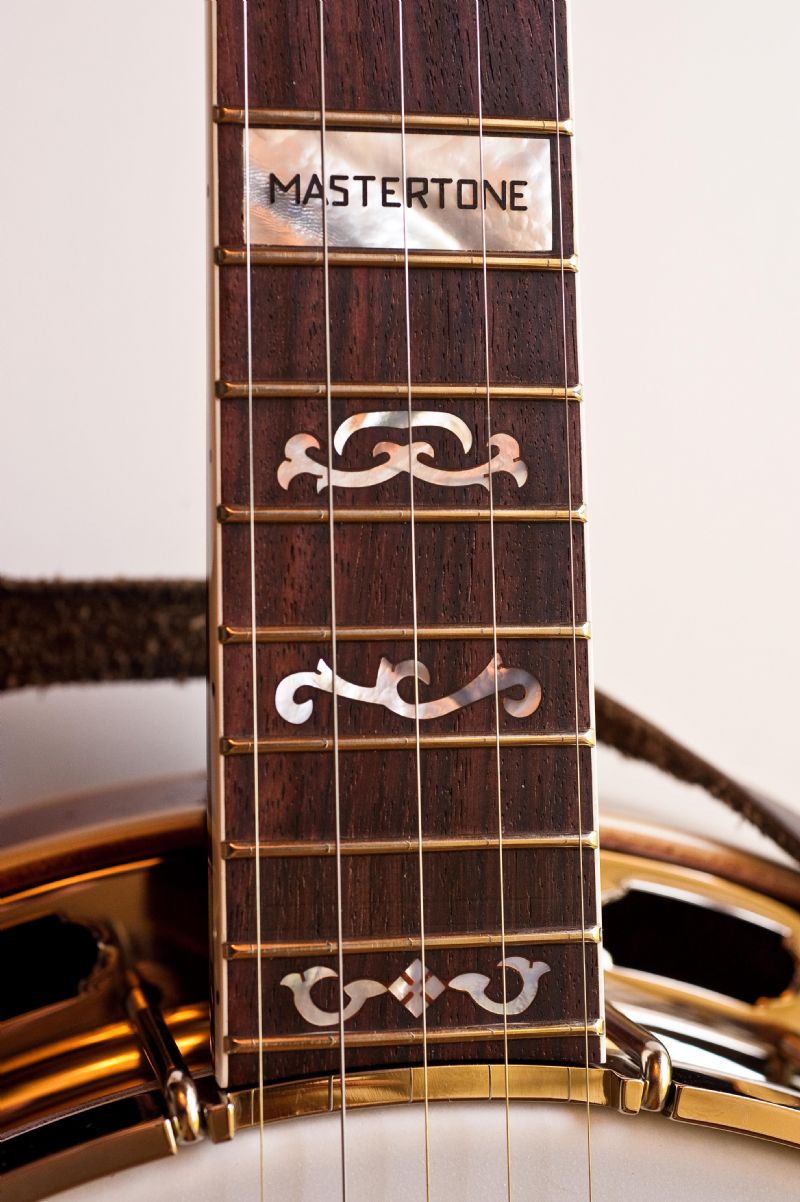 |  Wreath after picture |  |
tubeandplate - Posted - 05/19/2010: 17:33:56
Here are some detail pics of Tom's 21st fret area that had a Mastertone block in it when I received it, and after I pieced in some matching rosewood.
I chose the rosewood stock from several pieces, and the color was slightly off in shade, but it's the best I could find.
Then, I made 5 well fit pieces in order to try to match the black grain lines and color variations along the grain down the fingerboard and across the frets so that it would look like nothing had ever been there but wood from the same tree that had been made into Tom's fingerboard to start with and nothing else ever having been done to it:


He got a new fret job, too (shown in process), showing the 21st fret with frets in place:
If I did my job right, no one should ever know I worked on it (other than it better sound & play better now with all the other work I did, too.....hopefully!!!!!).
Chris
Edited by - tubeandplate on 05/19/2010 18:00:25
Mopick - Posted - 05/20/2010: 05:23:52
quote:
Originally posted by Tom Robison
Yowza!!! The postal service delivered my banjo and all I can say is Yowza!!! Man! it sounds great.
A little background on my 'jo and the work I had Chris do. I purchased a wreath neck from Melvin Cumbee last August. Melvin said it was an Arthur Hatfield neck and I was impressed with the workmanship. It feels great and plays great too. But one thing that bugged me was the Mastertone tone block was at the 21st fret rather than the 15th, which when my band plays in darkened places it was tough to play up the neck. I asked Chris if he'd be able to inlay the block at the 15th fret and, I guess he likes a challenge because, he said sure. I shipped it to him in April and he went to work. He discovered a number of other issues which keep a banjo from sounding it's best. To Chris all parts must not only fit together tightly but also correctly. Seems my banjo's fretboard was over an 1/8" proud of the tension hoop. To Chris, the fit for the "golden age'" of banjos is the fretboard being even with the tension hoop, so he did a neckset. He moved the lag bolts to accomodate the proper fit. Chris made matching rim plugs to fill some ovalized holes from work done previously. He then set the neck perfectly. I am really pleased with the neckset.
Moving the block was more of a challenge. Inlaying the block is cake, but to fill the old block space required Chris finding matching rosewood and making several small pieces to match the existing grain. His work was unbelievable! From the attached pictures you cannot see the work he did. To me, that's the work of an artist and a craftsman.
To say I am pleased with the work is an understatement. Chris' work is impeccably good. You can do no better than have him work on your banjo. There are luthiers and then there are banjo luthiers. Chris is the latter.
Tom
Edited by - Mopick on 05/20/2010 05:30:13
Mopick - Posted - 05/20/2010: 05:49:54
quote:
Originally posted by tubeandplate
Here are some detail pics of Tom's 21st fret area that had a Mastertone block in it when I received it, and after I pieced in some matching rosewood.
I chose the rosewood stock from several pieces, and the color was slightly off in shade, but it's the best I could find.
Then, I made 5 well fit pieces in order to try to match the black grain lines and color variations along the grain down the fingerboard and across the frets so that it would look like nothing had ever been there but wood from the same tree that had been made into Tom's fingerboard to start with and nothing else ever having been done to it:
He got a new fret job, too (shown in process), showing the 21st fret with frets in place:
If I did my job right, no one should ever know I worked on it
Chris
Edited by - Mopick on 05/20/2010 05:54:33
dgoodnight - Posted - 05/23/2010: 15:37:49
Two weeks ago, I picked up my TB6 from Chris. I posted the following comments:
"I flew to Nashville Friday night to pick up my '29 Checkerboard TB6 from Chris Cioffi. Actually Chris thinks it might be later than '29 based on the rim, but that is yet to be determined.
I sent the banjo to Chris for A LOT of work. I've had the banjo since 1981 and it was in need of repair. Basically, a total restoration. He reshaped the conversion neck and heal closer to pre-war specs, planed the fingerboard, fret job, new spikes, repaired the neck binding, fit the original tone ring, cleaned and restored all the original gold (under years of buildup), refit the neck, new tuning pegs, restoration of original buttons, on and on. He convinced me to set it up with the original archtop ring. I've always had a flathead conversion ring in it. Well, his advice was good. It sounds great and I will leave it an archtop. It's beautiful and plays like a dream. I can't wait to play it in a jam.
If anyone is considering repair work, I can't recommend Chris any higher. When I picked it up, I dropped off my TB11 for some work and I have another one to send him when that one is returned. I'll send all my instruments to him from now on.
I've decided to name her "The Grand Old Lady". She is truly a classic from the Golden Age of banjos.
You can see pictures at:
banjohangout.org/myhango...&albumid=496"
Now that I have had a couple of weeks with the instrument and time to reflect on the project, I want to add to my post. I mentioned above that there was a lot of work, but I didn't do justice in describing the quality of the work.
First, Chris has a deep respect of pre-war banjos and he went to great lengths to do "non-invasive" things to restore it's originality and maintain its value.
He had to do many things to restore it.
For instance, he had to plug/re-drill the original rim. Over the years the holes had become oval in shape. He actually hand fit plugs to existing holes instead of just drilling them out.
He also asked me to send him the original tenor neck so he could make sure it still fit well as it was intended to when he re-set the 5 string neck.
He had to re-carve the neck to trim mass and position of neck on pot for best sound, feel, etc... He also had to relocate the flange cutout and flesh hoop relief, cut the heel shorter to prewar dimension and he had to rebuild/reisntall the heelcap.
And a very important thing to me, he was able to bring back the original plating when it looked so bad that we were both resigned to replating it. It turned out beautiful. He suggested I replace the original tailpiece and he replated it to try to make it all look right.
And best of all, he convinced me to put it back as an original raised head. I am really glad I did.
It's a great banjo thanks to Chris!
tubeandplate - Posted - 06/04/2010: 12:08:04
HEREWITH I PRESENT AN EXPOSE' ON dgoodnight's TB-6 RESTORATION FOR YOUR VIEWING PLEASURE AND CURIOSITY
When things got heated in Steve Huber’s HR-30 tone ring thread last winter, I sent my Gibson Tractor with it’s 20 hole Titanic Bronze Huber HR-30 PTO clutch conversion mounting flange in to save Cliff Fitch, but I was too late.
Following all that activity last winter, Cliff quit doing banjo repair and restoration, and as Providence would have it, I was ramping my shop up just for that sort of work, and I had some email correspondence with Cliff concerning both of our activities.
In the middle of this time, David Goodnight wanted to have his TB-6 conversion restored as he was entertaining selling it or keeping it, depending on how the restoration went and how the banjo turned out.
(David has posted just above on his thoughts about my work on his banjo).
David called Cliff, and Cliff graciously recommended me; David had also posted a thread here on BHO soliciting recommendations for qualified luthiers for the job, and Danny McKnight, another Texan and friend/client of mine, chimed in there to recommend me as well for the job.
David got in touch with me, and we discussed the project. After the banjo arrived, I evaluated it, and we spoke some more, and I got to work.
David was pretty free in trusting my experience and judgement, and I always love projects like that since I have confidence in my critical judgement and abilities to act on such, and this give me the freedom and confidence to move into a project feeling like I’ll be at my best and able to make a banjo the best it can be.
It’s been said here on this thread by some of my gracious clients as well as my Champion and Friend, Robin Smith, that I am a perfectionist when it comes to banjo work. This is a two edged sword….the banjo likely will turn out better for this concept, but isn’t a “drive through” delivery date sort of thing, either.
David was fine with this. He had owned this banjo, an early 30’s TB-6 for nigh on 30 years, and never played it much, as he told me, because “it never sounded very good or did much for”…him. He also told me he was a “flathead guy”…..but had read my posts of my favorable opinion of old raised head Gibsons, and asked me if we should put it back to original (it had a Steve Ryan conversion ring in it since he bought it with the original engraved raised head ring in storage)….and those who know me at all will know how I responded…..
I took this as a challenge to convince or prove to David that raised heads are viable banjos, and it was a sobering approach for me to the project…I thought the stakes were high, and David might be somewhat skeptical, or at least, not know quite what to expect with a raised had…good, bad, or otherwise.
As a service to this classic instrument of high grade (only the Florentine, Bella Voce, and All American would be considered higher grade instruments, and then, only in extent of ornamentation), I approached this project in a way that would mean I would do appropriate things with it in the spirit of how the maker built it in the least invasive way possible, while at the same time, trying to “undo” some wear/damage that it had sustained in it’s long life as an actively used tenor banjo by a player who was overenthusiastic about wiping it down frequently with a dirty, coarse towel, which took it’s toll on the original gold plating, working years of grunge into the surface of the metal and rendering it dull and very, very worn looking.
The conversion neck, though well made, was a little massive, and the heel itself was much taller than the overall tonering and rim, making not only the heelcap be even with or slightly below the rim when installed, but the fingerboard was a little too high in relation to the plane of the top of the tone ring.....remember that this neck was made while the banjo had a different tonering in it than the original raised head ring we were putting back in it. The tonering can change the neck angle and other relationships slightly....depending on the rings/situation.
[EDIT: Jim Yarboro, maker of the neck, just told me that the neck was made to a large contour on purpose....the preference/style at the time; the height of the neck was done on purpose for the reason/edit below about the warped resonator...THANK YOU for setting me straight, Jim]
All these things can negatively impact the sound of an old (or new) Gibson style banjo, from a bluegrass tone perspective, and also from the intention of the maker for the dimension and fit of the neck to the pot. Fortuitiously, the maker’s intent OF THE TIME and what we usually like to hear tonally in a bluegrass banjo both coincide in these aspects of neck construction and fitting.
There were other problems along the way, too….the neck, being so tall at the heel, had made the resonator not seat all the way up, paralell to the flange and L-brackets, and when the thumbscrews were tightened to hold the resonator on, the neck was pushing against the neck notch in the resonator. This warped the resonator slightly over the years, and also disfigured the heelcap, causing it to delaminate and come unglued from the neck.
[EDIT: Jim Yarboro, maker of the neck, just told me that the neck was made to a tall height on purpose a the resonator was warped already BEFORE Jim made the neck, and Jim was trying to fill the open gap between the neck notch and the heel so it would look right.....this is what's tough and risky in repair...you don't know who/what came before or what was first/later in damage, repair, and so forth, so trying to suppose what happened and why/when can be difficult to guess. Jim...thank you and please forgive my wrong suppositions]
The frets were in bad shape…not necessarily from wear, but from a concept similar to “frost heave”….as the unfinished fingerboard wood moves with humidity over the years, frets can move in their slots as the board expands and contracts, and the frets had all worked slightly up in their slots 30 years hence….meaning they didn’t play right, and they did not have the vibrational solidity in their mounting in the board….leading to mushy and indistinct tone.
I had my work cut out for me. I got David’s banjo here around Halloween of ‘09, and he just flew up to my shop and picked up the finished banjo, apparently a happy camper who now will NEVER sell this banjo (as a raised head to boot), on May 8, 2010.
David had told me he was in no hurry, and this was good, as it gave me the peace of mind to work on his banjo when I was in the right frame of mind to concentrate and savor this project, which I did to the full. It also gave me time to make and upgrade some of my fixtures for some of this work, some of which are in this photo essay, so that I felt good about my approach and potential results with this classic and historically significant banjo.
I have had some requests for some pictures of this project, and some folks have wandered into my picture hosting albums on the net and seen some of the pictures of this banjo that I posted during the time I had it for David and Greg Earnest, who became interested in this banjo because of the rare, but sometimes seen, black “taint” (taint the tonering, and taint the flange) on the rim and peghead reverse…..completely original Gibson 1930’s.
These people and others who have known I was working on this wanted to see more about what I did, and I thought, this being my thread and my only web presence, and a place intended for good company and scintillating conversation, have decided to use up some bandwidth on BHO to share some of my work on a project I am extremely proud of, and that also might provide some of you with some enjoyment from a voyeuristic standpoint.
So….here we go. That’s enough talking from me….I will post the appropriate, but short comments with some of the picture groups as we go…….
Fasten your seatbelts, the bus is leaving on the field trip, now……out your front window you will now see the rebirth of what David now calls……
“The Grand Old Lady”
Chris
Edited by - tubeandplate on 06/11/2010 20:37:30
tubeandplate - Posted - 06/04/2010: 12:12:32
SOME OF WHAT I STARTED WITH
I didn’t take too many before pictures of the banjo…only some closeups of what Greg Earnest wanted to see (he had recently aquired a 30‘s flathead with the same factory black colored appointments as David‘s TB-6). It’s hard to get a good idea of just how the plating looked when I started, but David and I were basically resigned to replating it….a bitter cup for sure; the pics make it look much better than it was.
That being said, here are whatever before pictures I had taken.
Notice the fingerboard being high over the plane of the head, the heelcap warp and coming unglued, the neck heel cutout for the flange tube, the neck heel being almost as tall as the bottom of the rim [to take up the space due to the already warped resonator as Jim Yarboro has told me], and the ovalled rim holes (likely from the factory).


Edited by - tubeandplate on 06/11/2010 20:39:40
tubeandplate - Posted - 06/04/2010: 12:36:30
I started with the neck, and recarving/reshaping it’s contour to remove mass (a tone and volume/projection sucker, usually in my experience) as well as to make the neck more comfortable to play. The neck was a D shaped contour…..David likes more of a V shaped neck.
The original finish of the neck looked like it was checked pretty badly….as I started removing finish and got to the wood surface, I noticed the neck had some slight irregularities in the curly maple, and the finish had checked above it. The lacquer was checking over the wood/grain irregularities underneath.
Curly maple is very hard to carve or plane…the curls you see in the grain are actually minute and violent changes in the grain direction…meaning “cutting with the grain” is almost impossible… getting a good smooth finish surface on curly maple is very difficult and requires careful work. When I was done, it was “baby’s butt” smooth.
I was careful to not remove any material from the “spine” under the truss rod on the back of the neck, and used this “line” as my reference for the bottom of the V, before the final sanding.
I have seen many fancy necks with purfling and fancy bindings ruined during amateurly done speed necks and recarving in this situation. The goal was to reshape the neck nicely, but obviously to maintain the beautiful binding work and structural integrity of the neck. The maker had done a great job of installing the board and truss rod in the neckshaft, and the truss rod worked beautifully...not all necks are this carefully thought out and assembled with this in mind.
Cabinet scrapers, razor blades, files, sandpaper and LOTS of critical judgement, a bright light that casts shadows (the effect of which can be seen in the 4rth picture), and EVEN MORE elbow grease was applied to the neck……..
SOME OF THE PICS ARE NOT IN ORDER SINCE I HAD NOT PLANNED ON POSTING THESE AT THE TIME I TOOK THEM
I would shape a little, assemble and play the banjo to judge the feel, then repeat ad nauseum.
I did NOT work with patterns or neck templates, but with a strong light casting shadows, and my hands for feel as a banjo player having been told what David wanted.


Edited by - tubeandplate on 06/11/2010 20:45:24
tubeandplate - Posted - 06/04/2010: 12:51:13
Heelcap was munched up pretty bad as I explained/showed before, and had to come off anyway to facilitate cutting the neck heel height to it’s proper dimension.
After cutting the heelcap off, I had to steam it apart as a previous repair had ruined the upper black/white/black laminations above the heelcap; then, I had to heat straighten/flatten the heelcap because years of the resonator pushing on it had warped it, which is also what had caused it to start to come unglued from the neck.
I made new wood black/white/black laminations for the heelcap, and glued them up with the striped and bound heelcap proper, and was ready to proceed.
Notice in the pictures that after I cut the heel to it’s proper height, interpolating the thickness of the heelcap, that when I glued the heelcap on, you will see lots of heel wood now proud around the heelcap outline…..this is how much bigger/taller the neck was when I started, and as you see in the pictures, I recarved the neck heel to the outline of the heelcap AFTER I glued the heelcap on….VERY tedious, and EASY PEASY to mess up the heelcap this way, but, when reconstruction/restoring something, frequently you must work backwards to save original details and parts as opposed to in “new construction” where you can build things in place to dimension easier to start with.
This is the same concept as to why it’s easier to built a new house than restore a Grand Old Victorian, and why restoration is more challenging and time consuming than building new….whether it be banjos or houses or cars.
This is why I personally love restoration and repair....I love the challenge within the parameters of the original maker's intent. Most luthiers will shy away from or hem and haw about this if you push them on a proper restoration because of this.
Also included in this group of pictures you will see my fixture for “plowing through” the old flange cutout (which as the neck was placed on the pot, was in the wrong place for the "future" location). I also had to raise the “flesh hoop floor” of the neck since, given the previously explained dimensions of this neck, it would now be too deep/low if I didn't add some maple.
So, you will see now pictures as well of cutting out, filling with appropriate maple, and recutting of the flesh hoop floor and tube cutout in the neck for the tube and plate flange…now, all re-located and dimensioned to "original spec", with as clean and tight glue joints as possible.


Edited by - tubeandplate on 06/11/2010 20:49:55
tubeandplate - Posted - 06/04/2010: 12:54:50
Newly reconfigured neck heel with properly restored heelcap installed, and all new cuts made. Can you see how nice the plugs for the heelcap glueing locator pins turned out (you can barely see them in the last pic, and you CANNOT see them now since the finish is on)?
Also, I spent quite a bit of time cipherin’ to place my cuts for the flange bead cutout in the neck heel for proper placement for the fingerboard and head planes’ relative positions….a mistakenly placed cut would mean doing all the plowing, filling, and recutting over again. There is no way to trial fit the placement of this on the pot physically BEFORE you make the cut.
Also, like the original prewar necks, the heel cutout for the flange tube is a clean, close fitting cut….no slop, no room for wiggle….it’s just as big as necessary and placed perfectly. This was one “flaw” the conversion neck came to me with, and that I wanted to restore aesthetically to the overall banjo.
I got it right first time out.


Edited by - tubeandplate on 06/04/2010 14:41:36
tubeandplate - Posted - 06/04/2010: 13:06:10
I have seen many banjos from the prewar Gibson factory with ovalled rim holes for the neck lag bolts…..likely because coordinating the flange tube cutout in the neck and the lag location for a good neckset can be challenging if you are in too much of a hurry, have too many banjos to make by lunchtime, or just don’t care to burn calories thinking about such things at work.
I believe these ovalled holes to be factory original as they were pictured in the first post of this EXPOSE'.
The easy “lazy” way out is to get the drill bit out that is the smallest one to fit the largest dimension of the oval, drill new holes so you can plug the rim with dowels, and go for it…..
I don’t work that way. Doing that is what I think is invasive, and also “damaging”. You also run the rather large risk of splintering and chewing up the holes around the drill bit….certainly considerd damage to an old instrument, not easy to touch up, and also, this would mean the nuts and washers around the lag bolts would certainly not have any of the “real rim” to bear against when reassembled….PLUS the fact that you might see the dowel plugs and other nastiness around the perimeter of the washers…..
So, more calories and elbow grease….all enjoyable when spent on an instrument like this owned by a nice fellow like David.
I hand fit maple plugs to the existing holes…..hand shaping, trial fitting, over, and over again until they fit perfectly…..glued them in, and redrilled the holes in their proper place.
This is why I had David send me the original tenor neck…to MAKE SURE that when I was done doing this, that the original tenor neck would slip right back on the banjo as it was meant to, and now, even have a better mated fit with no slop…..
And all this time, I removed NO original wood from the rim…..NONE. And, what I added was consistent with the original maker’s INTENT, and “fixed” the factory’s shortcut. Now the neck can’t move around in the large holes and will locate itself properly……IF IF IF the lag bolts are installed CAREFULLY and STRAIGHT……how many times have you pulled a neck off a banjo and seen lag bolts that aren’t parallel or had been bent into shape after they were installed??? There has never been, nor will there ever be, shinanigans like that on my workbench…..ever. Filling the rim holes properly was somewhat tedious….but I knew, after doing well over 1,000 banjos done by “feel” myself and with no fixture, that I could confidently install the lags perfectly, first time out, when the time came (and indeed, I did, yet again).


Edited by - tubeandplate on 06/04/2010 14:11:43
tubeandplate - Posted - 06/04/2010: 13:11:56
RIM HOLES DONE
They look a little sloppy from the inside, but that is the reflection from the flash on the touch up color I applied...they are baby's butt smooth to the feel, no gaps on the glue joints.
New holes in originally intended locations do not go outside of the plugs...no original Gibson wood was removed from this rim during any of this work....
Nice, eh?

tubeandplate - Posted - 06/04/2010: 13:18:19
The original raised head ring had not touched this old rim for 30 years. The rim had swelled a bit, and I needed to refit the two back perfectly for best sound/volume. BUT I had to be VERY CAREFUL to NOT ERASE any of the wonderful original Gibson factory details on the rim where the tonering sits-some original sloppy finish and the original factory floor (the REAL one in Kalamazoo, not some cotton mill in storyland) workman‘s serial number penciled on under the lacquer….. Again, mo’ tedious than building a new one, but I eat this sort of thing for breakfast…….
This is tedious experienced hand fitting….no machine can do this properly…the ultimate tone and volume and voice of the banjo depends largely on this fitting...... as well as…fitting the flange in largely the same way.
So, I also refit the flange tube with the same concept in mind that you would refit a OPF…..the flange should fit like a tonering…it can be a LITTLE tighter than a tone ring, but if it’s too tight, it will have the same effect as a ring that’s too tight on the rim….mutes the voice of the banjo….significantly.
BUT….on the old original prewar tube and plate Gibsons, which are INCREDIBLY well designed and constructed instruments, the flange tube will actually “snap” or “pop” into place on the machined radius for the flange bearing on the side of the rim….if no one has monkeyed with it over the years.
The trick in getting the tube to fit right for best sound AND still “pop” into place as per OEM is…..well….you guessed it…more experience, time, tedious attention, and expenditures of calories in trial fitting and knowing when enough is enough….and….
A little touch up color, and….
Success…..
Oh, and notice the hole on the “taint” that is where “The Grand Old Lady’s” original and extant armrest mute linkage passes through the rim in the third picture….


tubeandplate - Posted - 06/04/2010: 13:23:33
“The Grand Old Lady” had prewar Ludwig Planet tuners originally….THE BEST vintage tuners EVER made…PERIOD. Unfortunately, this is one of the few sets I have run across over the years that didn’t still work perfectly….they were trashed….worn beyond further use.
I replated a new nickle set at my Au Ma Mater, Huber Banjos, myself, to try to match the tone of the Gold on the pot well.
She had her original solid Mother of Pearl tuner buttons, but one had cracked, and like the tuners and Gold plating, the original tenor player/owner had used them hard….they were dull and dirty.
Pearl, like ebony or some metals and stones, will take an incredibly high and fine polish, and is how they likely would have left the factory originally on the banjo...so...again, with more calories and tedium...the fun kind for me
I repaired the cracked button, and buffed all the buttons up to their original, shiny, pearlescent beauty….and they looked wonderful on the new tuners with Huber’s Cioffi applied gold plate. These were hard to capture “on film”, but I tried……
BTW-much care is involved in buffing these original pearl buttons....one slip on the buffing wheel and the wheel will grab your nice, rare prewar hunk of mother of pearl, sling it across the room if not into your face, and break it into a thousand little pearl flakes.....
I made and fitted some leather washers as cushions for the buttons when under screw tension to help keep them from cracking from now on. I also added some small, appropriately sized washers, gold plated too, under the screw heads to help distribute the pressure on the button around the screw hole....some prewar tuners had the screw heads with molded on "washers" for this purpose, so I thought it would not only help protect the buttons from cracking, but also have an appropriate vintage look, as well.
Also, not wanting to alter original vintage parts, I hand filed/fit each new tuning machine shaft to it's own button's original square hole for a good fit that would not stress the button to crack it over time in use, and also maintained the buttons' originality...these original buttons are REALLY hard to find on the open market now, and would cost between $75 and $125 EACH depending on condition IF you could find any for sale.....and good like finding 4 that would match well.....
Oh, and here’s a couple of pics of the new replica tailpiece we installed after I “antiqued” and “age plated” it at my Au Ma Mater’s plating room to try to split the difference between the original armrest wear and the original plating of the rest of the banjo, and tried to make it look as much like the original as I could (the original was useable, but had bent so badly over the years, it could not be adjusted for set up anymore, so we put a new accurate replica on).


Edited by - tubeandplate on 06/04/2010 21:03:52
tubeandplate - Posted - 06/04/2010: 13:34:39
Here’s a couple of shots of the fret job in process….should have taken more pics.
All the purflings and bindings, not only on the side of the neck, but on the fingerboard PROPER really make fretting a style 6 challenging….it’s only too easy to mess all that up pulling/installing frets ON it, then you’ve made a MESS.....
....and I didn't want no mess out of this beautifully done binding and purfling job.
I was careful, and filled and reglued some opening binding glue seams and then leveled the board paying close attention as I did so to how the truss rod worked and WHERE it wanted to impart it’s bow and flatness….I kept this in mind as I fit the new fret tangs to their slots to keep this fret/fret slot/truss rod system working well in harmony with each other…..something that high end guitar restorers think about during their daily Devotions, but besides me, I have yet to hear a banjo luthier or shop even bring up this concept….also, and along with……
…..how the frets actually fit their slots and the glue used to fill these slots to:
1-solidify and fill any airspace in the fret slots
2-increase the mechanical/physical bond of the fret to the board
….both of which HUGELY affect tone and volume and vibration transfer throughout the instrument…..again….I’ve never heard any other banjo “repairmen” ever talk about this concept, but I know it’s there, I know how to make it enhance the banjo overall, and I do all my fret jobs with all this in mind. Don’t believe me (....."how could frets possibly affect tone????"....")? Reread this thread by some of my happy clients. 

Edited by - tubeandplate on 06/11/2010 20:52:48
tubeandplate - Posted - 06/04/2010: 13:53:56
LAST POST OF TB-6 RESTORATION
After Andy Todd (the best finish man in the world, world class guitar maker/restorer, and my friend of a decade and more previous to our working together at Huber banjos) matched the neck to the resonator and rim, spruced up the peghead (there was some lacquer separation around the tuner holes) and added antique binding coloring and peghead overlay tones to the neck, he then applied his perfect lacquer work to the neck until it looked like a cough drop in February that had been in your mouth for about 5 minutes….slick, smooth, and beautiful.
Think I’m bragging too much on Andy? Ask Arthur Hatfield about Andy’s work. Then, go see The Nashville Bluegerass Band play….that’s Andy playing the doghouse bass…..
Oh, and Andy was the electrician’s apprentice who helped wire Uncle Dave Macon’s house for electric service…..Andy and Dave (Macon) are from the same county…one town over……it don’t get much more authentic than that.
Andy is NOT Barney Fife, he only plays Barney on TV
That being said, any color mismatch in the photos is just that....in the photos. I have a 10 year old cheap digital camera and it's flash and color eye aren't so good...in person, the banjo matches PERFECTLY....THANKS, ANDY!!!!
This post will be the last of my wind bagging for a bit….and you thought it would never end .
All the original parts (tailpiece, armrest mute, tuners, tenor neck, etc…) have been kept safe and sound in the Grand Old Lady’s Hope Chest that she keeps around for her memories.... "Close By" (as THE MAN says/sings).
Here is the final product, ready for David to pick up after I spent quite a while assembling, doing a nice neckset, tweaking, setting it up, and letting her settle in.
Turned out to be quite a banjo, was a lot of fun for me, and I have a new friend in David Goodnight.
Thank you for entrusting the Grand Old Lady’s work to me, David!!!!!
I enjoyed this project greatly!!!
I hope someone here gets some enjoyment out of seeing a nice old banjo being brought back to life, and possibly there is someone here curious enough about what I do to enjoy seeing some of it being done and the care I take while doing it.


Edited by - tubeandplate on 06/04/2010 21:10:54
tubeandplate - Posted - 06/04/2010: 14:57:41
Hi Randy-Well, the fellow who made the neck is retired, and is a legendary neck maker of many years....
I guess my posts could be misconstrued to sound like the neck was substandard in some ways....remember, neck "preferences" and styles, like music/banjo styles were slightly different 30 years ago than they are now....as were restoration approaches and choices.
But I didn't picture Jim's last name because I didn't want to draw any negative attention to his work.
[Edit: It's Jim Yarboro....we just spoke by phone]
I will say that Jim CUT EVERY SINGLE BLACK AND WHITE PIECE YOU SEE IN THE BINDINGS AND PURFLINGS.....
BY HAND
...AND FIT THEM INDIVIDUALLY TOGETHER HIMSELF.
THAT is a feat I DO NOT want to have to ever do...
...and I can tell you from micro inspecting this neck EVERY SINGLE PIECE of these black/white purflings was PERFECTLY joined....absolutely incredible.
This was before you could buy this style 6 purfling ready made.
This is a good time to say that I chose to restore Jim's neck instead of make a new one (and that possibility did come up between David and I), since the cosmetic work was ABSOLUTELY PERFECTLY DONE, the truss rod worked very well, the inlays and fingerboard were well done and not worn too bad at all, and a style 6 neck would be VERY EXPENSIVE to make....even with pre-made purfling.
So, actually, I don't look at me pointing out my work and therefore what could be considered by some to be flaws in the neck....
....rather, I would choose to focus on the fact that I thought this neck was MORE THAN WORTHY to restore nicely, and deserved that effort and tribute....to Jim and his legacy.
Jim, C.E. Ward, Rual Yarborough, and many other folks like this were making necks for these banjos when these banjos would most likely be thrown away as tenor banjos if someone didn't make conversion necks for them....these guys are legends, part of Bluegrass History, and have done a great service to all the prewar Gibson (and other brand) banjos they have touched over the years.
Actually, Jim is one of my banjo luthier heros...though he doesn't know me [Edit: He does now since we just spoke by phone...]. He was making master grade necks like this years before I ever even picked up a banjo.
PLUS....kind of hard to find a 30 year old fancy piece of curly maple that nice these days.
Chris
Edited by - tubeandplate on 06/11/2010 21:05:14
tubeandplate - Posted - 06/04/2010: 15:38:28
Golly, Gee, Greg....
THANK YOU!!!!
(I didn't do any of the engraving......)
Chris
Edited by - tubeandplate on 06/04/2010 15:46:47
tubeandplate - Posted - 06/04/2010: 16:39:14
Thanks, Tommy! It's a privelege every time I get to work on an "Old Master" banjo!
Thanks, Ken!
Ken, I haven't forgotten about you suggesting I share what you dropped off here for me to restore in a brown paper grocery sack a few weeks ago.....I'm trying to cycle through them in some sort of logical (yeah, right) order...I'll be sharing your project soon enough!!! Or should I say, all of them.....
Joshua Rose and old Arn fo-rever!!!
Chris
Edited by - tubeandplate on 06/04/2010 16:42:19
drottman300 - Posted - 06/04/2010: 20:32:23
Wow !! Great job Chris! Thats a Beautiful Banjo! Never seen anything like it!
tubeandplate - Posted - 06/04/2010: 20:40:44
Ken-YES! THE BEST cutting lube for some metals, and THE BEST smell while doing so...course, it's only fitting to partake of such olefactory pleasures if you are doing so on a pre-August of 1944 "prewar" lathe...preferably with a swing capacity of 16" or larger.....
Oh, and depending on the sulpur content, makes a pretty good cornbread "lube" for your skillet....
Hi Bob!!!!
Bob-THANKS!!!!!
I got your message and then we had some bad storms up here and the phones are out in my little community.....still....
....so I haven't been able to call you back, and your BHO homepage has the sending you emails feature blocked so I can't contact you....check that out for me so I can email you.....
Chris
Edited by - tubeandplate on 06/04/2010 20:41:59
tubeandplate - Posted - 06/07/2010: 19:11:09
quote:
Originally posted by vtyankee5
Any chance of getting your show up on the archives? I'd like to listen to your show on Banjo Talk.
Edited by - tubeandplate on 06/07/2010 20:49:06
tubeandplate - Posted - 06/08/2010: 11:52:09
For all readers of this, my shop thread:
Oddly enough, after communicating with David Pericone the last few days regarding the post above, I just found out today that David, and his new wife, Jessica, who is David's engineer and producer on the Banjo Talk web radio show have just lost their expected baby, who apparently was into a relatively advanced development in the pregnancy.
David has been so supportive of me, and David and Jessica have not been married a year, so I am burdened for them and this situation, and request that anyone who reads this and is similarly affected will offer their prayers and support to David and Jessica in this time of sadness.
David has posted his announcement of this situation on the thread link below, and I think that's a great place for folks to drop in and offer their support and communicate more directly with David:
banjohangout.org/topic/180077
David and Jessica: again, I am so sorry for your loss, and you are in Christy and my prayers.
Chris
Terms of Use | Privacy Policy | Privacy Consent (EU/GDPR Only)
Copyright 2026 Banjo Hangout. All Rights Reserved.


