Monday, May 12, 2008
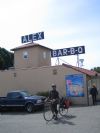
Saturday, after I fed our chickens and finished planting the chard, I took my bike and headed down old highway one into Santa Cruz to write at a cafe for the day. My hear was glad. The wind was at my back and the sun was out. To the west, surfers caught their breaks, a hawk hoovered over an arroyo in search of mice. To the east a school of road bikers zoomed by in a flourescent blur. Through all of this, I belted out the lyrics to Blue Ridge Cabin Home. I didn't care who heard me, I sang them as loud as I could.
I sang and I rode. The cadence of my pedals kept time. The trucks roaring kept time. The crash of the waves kept time. I sang and I rode and I remembered.
Aboriginals walked and sang. Druids danced and sang. Old Norsemen sailed and sang. Music swells up from motion.
The primal rhythms of our steps, the cadence of a horse trot, the locomotion of trains. These are the very basis of music. Juxtaposed onto these cadences are the howl of wolves, the chromatic melodies of birds, the screech of a trains breaks. From these we found melody. And for the very reasons the animals sang, we too learned to sing.
For hundreds of thousands of years, we sang. We sang for practical purpose; warning, courtship, to remember routes or locations. Most possibly we sang too, for reasons unknown to us. This is the way it was for hundreds of thousands of years.
Then, Somewhere in our deep primal past our larynx descended. Speech swelled up. It's initial use to convey important information, to plan, to warn, to a more complex logic. The most important things were said; and if it needed to be said, it most likely needed to be remembered. To remember we needed music.
We are made to remember music; melody and rhythm. It is genetic. Learning theory suggests that the multiple patterns (cadence, rhythm, rhyme, tone, repetition is the most effective way of remembering longs lists of information. It is a way of including every learning modality into one simple activity; an activity we are designed to do. (Funny how it's kept out of most schools now days when its so efficient, perhaps I'll touch on that later.)
We have examples of this. Druids created epic songs to remember their history. The ancient Greeks did not delineate verse from song. In their time, the great epics of Homer were sung. Aboriginals keep their maps in song/stories. So did some Native Americans. Nearly every culture uses music in such a way.
But it wasn't only because music helped us remember that we sang. Logos is only part of what needs to be conveyed in a truly meaningful message. Music (and perhaps dance) is the most direct path we have for tapping into our deepest, often most hidden emotions. The subtle nuances of a persons feeling could be expressed in a way that mere words themselves cannot convey.
In addition, music, for every culture I can think of holds a special place in religious life. It is considered by numerous cultures a primary form of praying/connecting to the spirit world/communicating with God. So by singing a person could convey meaning on all three levels; logos, emotion, and spiritual. And at the same time express it in a way that our memories are best geared to remember.
I've never been a good singer, like many people my age I grew up in a culture where 'real' music was done by 'professionals'. Music classes and lessons were something to be suffered through. It was done as an exercise to make me "well rounded',. I played the few songs I knew in both social and cultural isolation. I never got to play with others, and the songs I learned (Vivaldi, Bach, 19th century fiddle tunes) were not the ones I knew from the radio. The instruments and songs I heard on the radio were inhibiting. The technology necessary to reproduce them distant and expensive. The voices, as synthetically alte
3 comments