
DVD-quality lessons (including tabs/sheet music) available for immediate viewing on any device.
Take your playing to the next level with the help of a local or online banjo teacher.
Weekly newsletter includes free lessons, favorite member content, banjo news and more.
Premier Sponsors


|
Please note this is an archived topic, so it is locked and unable to be replied to. You may, however, start a new topic and refer to this topic with a link: http://www.banjohangout.org/archive/286504
pgroff - Posted - 06/14/2014: 19:14:40
Here's an interesting banjo. Not for the purist collector . . . and I would question the use of the term "fully restored" in the description.
Anyway, if any of the tenor players stop in to check it out, I'm curious how it sounds and plays. I wouldn't be surprised to hear that this makes a wonderful instrument.
gryphonstrings.com/instpix/43729/index.php
Edited by - pgroff on 06/14/2014 19:49:07
davidcava - Posted - 06/14/2014: 19:45:36
What are your thoughts on this banjo Polle? Thank You Sir.
Dc
Bill Rogers - Posted - 06/14/2014: 20:24:24
I'd hate to be the one who had to keep the silver plating from tarnishing.
Polle Flaunoe - Posted - 06/15/2014: 01:14:07
Bill - it´s now chrome plated.
David - maybe this sentence in the ad tells it all: "Although the work was done decades ago, everything is bright and clean because it has not been used or handled since then."
I´ve over the years worked on 1000+ nos. tenors - vintage and newer - of most brands and models - I still have to experience a Mastertone style example having a response in the bass and low mid range even close to that of an original B&D Silver Bell. Some pro jazz banjoists do prefer a new/newer banjo - most will purchase an OME - with a Silver Bell tone ring - for the same reason.
A CGDA tenor is very different from f.ex. a 5-stringer - its heavy strings with extremely high tensions call for a light weight construction.
Just my two cents 
Polle
pgroff - Posted - 06/15/2014: 02:30:46
quote:
Originally posted by Polle FlaunoeBill - it´s now chrome plated.
David - maybe this sentence in the ad tells it all: "Although the work was done decades ago, everything is bright and clean because it has not been used or handled since then."
I´ve over the years worked on 1000+ nos. tenors - vintage and newer - of most brands and models - I still have to experience a Mastertone style example having a response in the bass and low mid range even close to that of an original B&D Silver Bell. Some pro jazz banjoists do prefer a new/newer banjo - most will purchase an OME - with a Silver Bell tone ring - for the same reason.
A CGDA tenor is very different from f.ex. a 5-stringer - its heavy strings with extremely high tensions call for a light weight construction.
Just my two cents
Polle
Hi Polle,
Many thanks for your insights!
Am I understanding you correctly, that in your opinion by switching *only* the tone ring in a Silver Bell banjo, from the standard Silver Bell ring to a "Mastertone style" [flathead] ring, you would expect less bass and midrange response for the usual CGDA tenor set up?
Have you seen a few examples of this kind of tone ring swap in a Silver Bell tenor?
Do you have an opinion about how this modified banjo might work in a lower tuning such as GDAE?
Thanks,
PG
Polle Flaunoe - Posted - 06/15/2014: 04:10:16
quote:
Originally posted by pgroff
Hi Polle,
Many thanks for your insights!
Am I understanding you correctly, that in your opinion by switching *only* the tone ring in a Silver Bell banjo, from the standard Silver Bell ring to a "Mastertone style" [flathead] ring, you would expect less bass and midrange response for the usual CGDA tenor set up?
Have you seen a few examples of this kind of tone ring swap in a Silver Bell tenor?
Do you have an opinion about how this modified banjo might work in a lower tuning such as GDAE?
Thanks,
PG
Paul - yes, you´re understanding me correctly - I´ll any day consider an installment of a heavy Mastertone style casted flattop tone ring in a CGDA tuned Silver Bell tenor a "down-grading". The banjo in question is sadly the 5th "converted" example for me to see or meet - 3 of these did btw. sell at a price significantly lower than that of an original SB in the same condition. The one above will maybe become the 4th.
And yes - I do have an opinion about various tone ring types more or less suited for Irish GDAE tenor tuning - however the playing style, the scale and the string gauges etc. does also play an important role - too complicated to summarize here.
My general advices for Silver Bell tenor owners / potential buyers - based on my experiences - will be - do never replace the tone ring - do never replace the dowel with coordinator rods - do never install an adjustable truss rod in the neck!
Just my now 3 cents
Polle
pgroff - Posted - 06/15/2014: 08:04:23
quote:
Originally posted by rudykizutyGorgeous restoration though. Another beauty by Renee'.
Well, I think it's a very attractive banjo, considered as a customization, a rebuild, a modification, a conversion (to mastertone ring), a hot-rod . . .
That instrument may be exactly what the previous owner wanted, and may be what the next owner wants in a banjo. And the work to achieve that goal looks to be very high quality.
I'm not faulting the instrument here, but would dispute calling it "restored." My point is that, to me and to many interested in historical musical instruments, an instrument described as a "restoration" or "fully restored" should show respect for the original specifications. It can be debatable sometimes to decide if the best approach to restoration is to make an instrument look like it did when it was new (e.g. replating, refinishing etc to original specs) or to leave all the original finish that shows wear and age . . . but in any case, true "restoration" would not include a different type of metal plating, or replacement of essential components with a type that was not originally present and that would be expected to sound different.
IMO a modified, customized, "hot-rodded" instrument can sometimes suit the owner more than a restoration -- might play, sound, or look better than the original -- and can also be of interest to collectors in some cases. Hot-rod cars are collected.
But to me, such an instrument should not be described as "restored."
Just my opinion (but supported by the comparable usage in describing many other kinds of musical instruments).
PG
Edited by - pgroff on 06/15/2014 08:06:44
NYCJazz - Posted - 06/16/2014: 11:06:36
E... Chrome instead of silver?
I love the look of my #2/3 SB. It gives it a very organic look ranging from the natural tarnish to a bright warm shine. It gets better every day.

jims38134 - Posted - 06/16/2014: 11:11:03
The #2 silver Silver Bell is definitely a beautiful look (pictures don't really do one justice). Much more elegant than the nickel plated No1's.
I agree that chrome sounds "ewww" 
jim
pgroff - Posted - 06/16/2014: 12:41:40
Hi Jim and Nathan,
Agreed. I would never request chrome re-plating for a banjo that was originally nickel- or silver-plated. I prefer silver and nickel to chrome, and I also prefer finishes and platings that respect the original specifications of an instrument (in most cases, when it's a good instrument to begin with). That's just my preference.
In acknowledging that the banjo is attractive, I was trying to give the benefit of the doubt to this banjo, its current seller, the owner who commissioned the re-plating, and the luthier who did that work. The current shiny and durable chrome finish seems very well done, for that type of finish. It obviously was desired by someone, and I expect a new owner will also want it that way. Probably cost a lot too.
But even for someone who wants that kind of finish, my point is that it's misleading to describe the banjo as "restored."
It will be interesting going forward to see if the many tenor banjos out there that have been modified, rather than restored (in my terms), suffer a loss of market value compared to more original examples, as Polle suggested above for Silver Bells converted to a mastertone ring. If so this would vindicate my argument, since my earliest days on this forum: it's false to claim, as some five-string banjoists do, that "the tenor banjo market doesn't care about originality." *
PG
* banjohangout.org/archive/125689
Edited by - pgroff on 06/16/2014 12:53:35
stanger - Posted - 06/16/2014: 12:47:29
Some serious lathe milling must have gone on to make a Mastertone ring fit the rim!
Personally, I wouldn't want the banjo- the Silver Bell is a full tone system, not just the tone ring alone. The bell shaped flange, the depth of the resonator, and the flat back are all equally vital parts of the Sliver Bell sound, and were designed to all work together. Dropping a completely different tone ring into the system had to make the banjo sound much different than it was intended to sound, just as dropping a Tubaphone tone ring onto a Gibson would change the sound radically.
But tone is tone. Someone wanted it that way. I'm not sure the guy who ordered the work was happy with the results, though- failed experiments often get no playing afterwards.
Chrome is nice. I like the way it doesn't tarnish, and I like it's cool whiteness vs. nickel's brownish color cast, but it ain't silver. Silver looks like sliver, period. Chrome is a good working players' finish though, and possibly it was also a failed change?
Given those 2 huge changes, I really think this banjo is overpriced. It may be a high quality hot rod, but it's still a hot rod, and lots of money that is never returned in a sale goes in to hot rods. Not everyone wants a Ford with a Chevrolet engine that's painted in a Chrysler color, after all. I like my Gibsons to be Gibsons and my Bacons to be Bacons.
regards,
stanger
Polle Flaunoe - Posted - 06/17/2014: 02:07:57
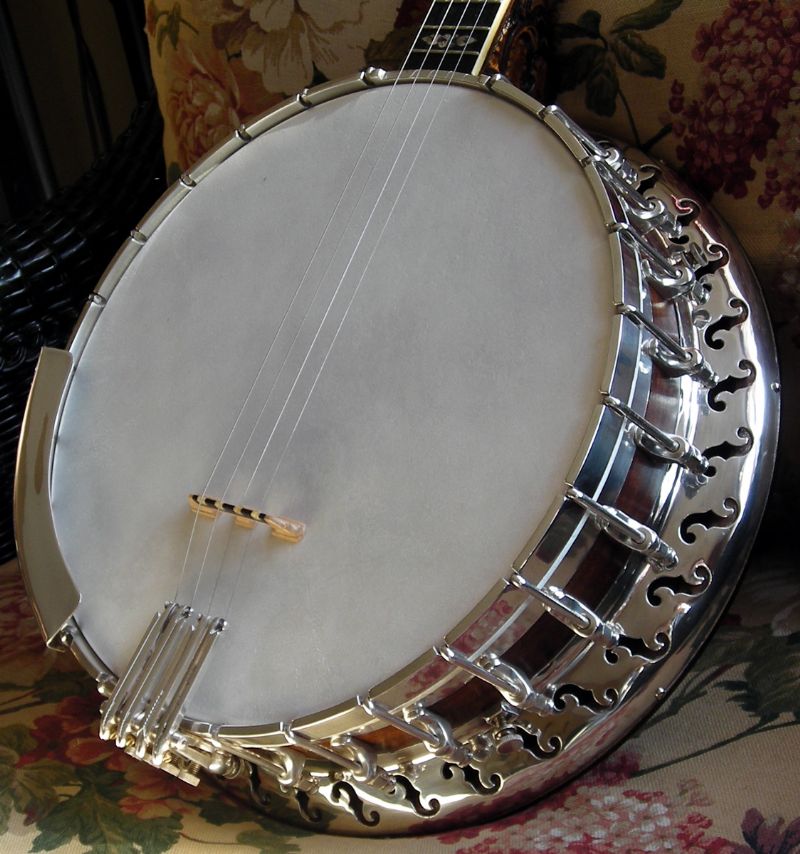
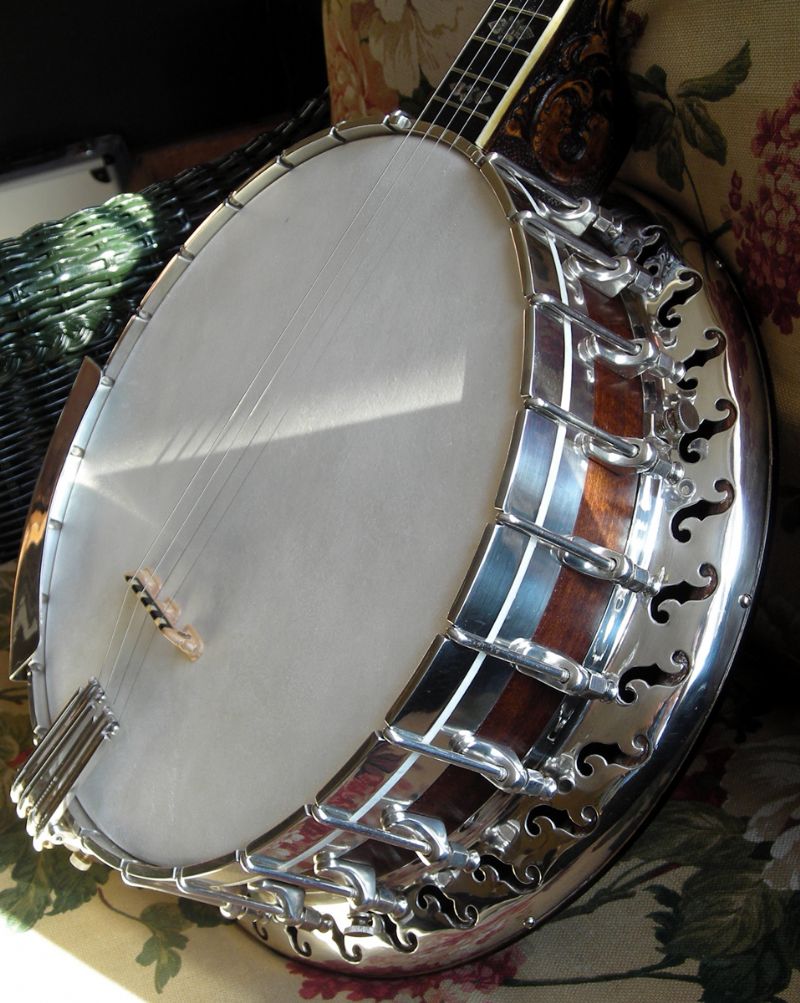
For comparison - a 1924 B&D Silver Bell No. 2 tenor of mine - the high grade maple neck with its Style B peghead btw. originally meant for a No. 3 or 4 - "restored" to pristine and as-close-as-possible-to-original condition and construction - as most of you guys like it, it seems:


Purchased from Buddy Wachter 6-7 years ago.
Feel free drooling - LOL!
Polle
Edited by - Polle Flaunoe on 06/17/2014 02:13:48
jbalch - Posted - 06/17/2014: 06:40:43
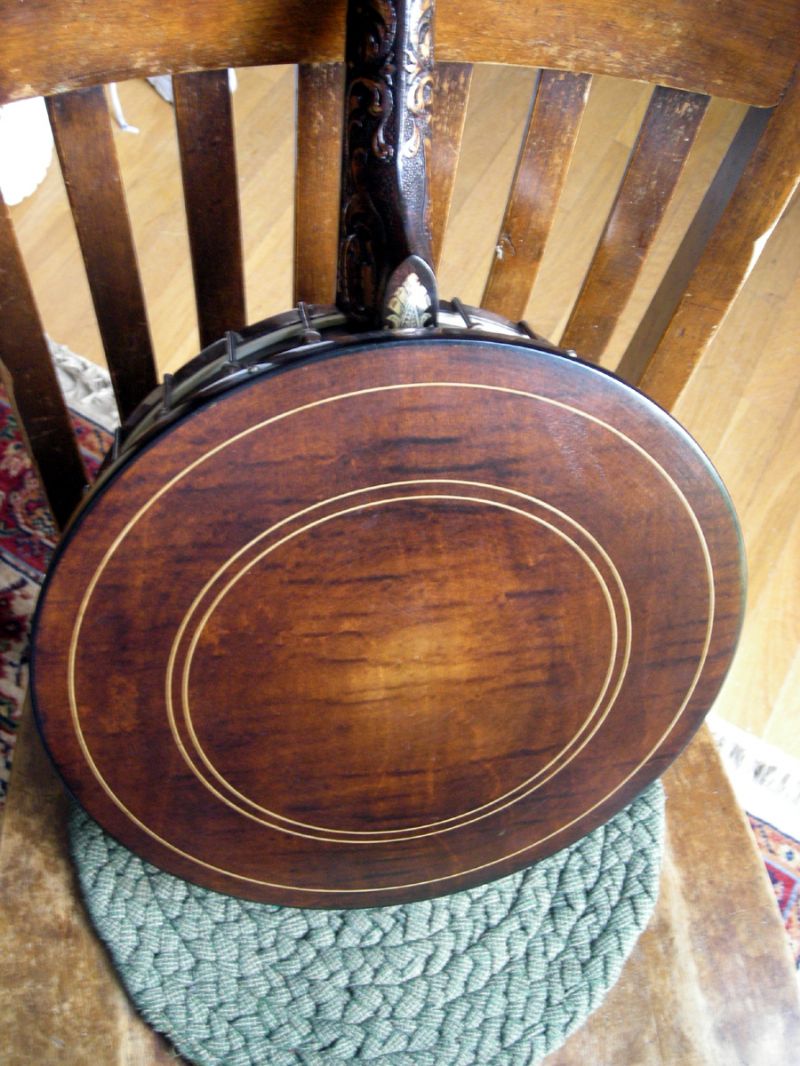
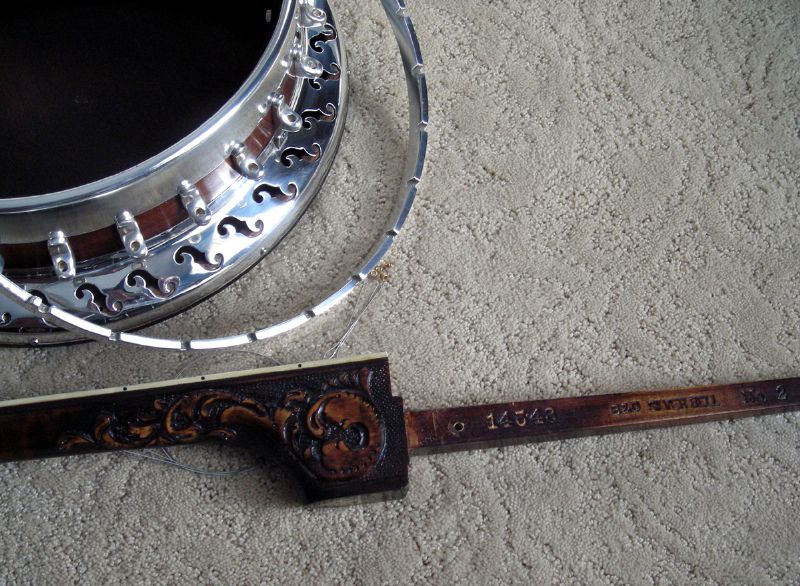
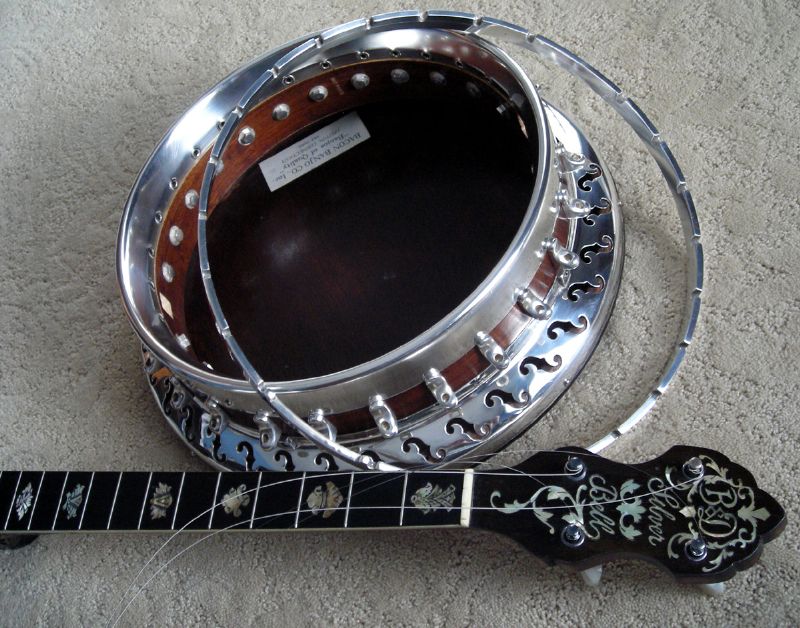
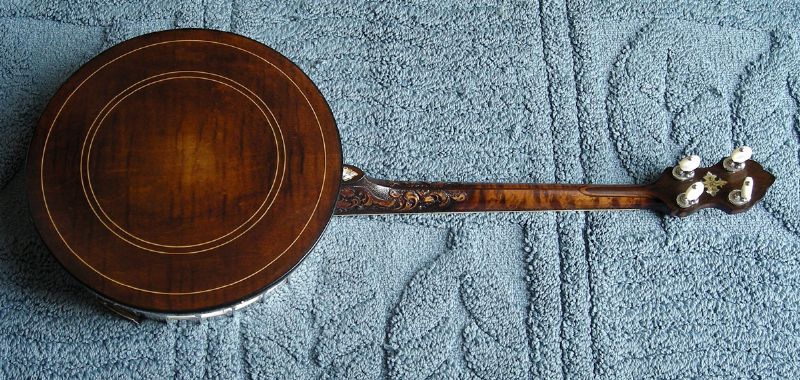
Also for comparison, here is an un-restored - original - #2. This one from 1925. It has very unusual engraved inlay (similar to that found on #5 banjos of that period).
BTW some folks lament maintaining the real silver plating. I did choose to clean it when I found the banjo (it was tarnished to the point that it felt "dirty"). These photos her taken after the cleaning. But since that time I have not polished it again. I love the smoky grey appearance the silver has again achieved. I also really like the patina of the original wood finish - it is not too thick and glossy.
"Full restoration" and even "customization" is all part of the honest history of these great instruments. Many players want their tenor or plectrum banjos to look bright shiny and new. I have no problem with that.
On the other hand, more-and-more collectors and players today value the originality of an unrestored piece. I probably fall into that camp myself. As long as sound and playability are not compromised, I'd personally rather see an old banjo with honest (not abusive) evidence of use and age. If it is in excellent, well-cared-for, original condition - even better!
Edited by - jbalch on 06/17/2014 06:51:46
 |  |  |  |
 |  |
pgroff - Posted - 06/17/2014: 07:41:02
quote:
Originally posted by jbalch"Full restoration" and even "customization" is all part of the honest history of these great instruments. Many players want their tenor or plectrum banjos to look bright shiny and new. I have no problem with that.
On the other hand, more-and-more collectors and players today value the originality of an unrestored piece. I probably fall into that camp myself. As long as sound and playability are not compromised, I'd personally rather see an old banjo with honest (not abusive) evidence of use and age. If it is in excellent, well-cared-for, original condition - even better!
Hi John,
For my personal preferences, I'm with you all the way.
Nothing like silver. I have some old wooden flutes with coin-silver keys and they develop a great patina when used . . . the contrast between the bright areas where your fingers wear away the tarnish and the untouched areas that retain tarnish gives a rich appearance, appropriate to an instrument with some history.
I often prefer mostly-original instruments, when they can be highly functional as musical instruments. When you need to change or repair a part to make them function, well of course! I'm sure you have at least new strings on that #2, if not a new head and bridge. But I like original finishes (even if worn) and original specifications. Sometimes it takes a good amount of restoration work to get an instrument playing and sounding "close to the way it did when new," and I would still call that restoration if the original specifications are respected. . . such as cleaning, repairing cracks, resetting a dowel, replacing a stripped screw etc.
And I also can appreciate modified and hot-rodded instruments. A lot of the instruments I play myself have been modified to make them work better for me. I love them and I prefer them modified. But I would never represent those instruments as "restored."
IMO, there are two kinds of issues with the banjo in the original link I posted.
First, does a knowledgeable player want, or not want, a classic instrument that has been modified in those particular ways? I really appreciate that the seller seems to have listed the modifications explicitly, so that a *very knowledgeable* player should be able to understand exactly what's on offer. I'm sure there will be a buyer for this banjo, at the right price -- someone who wants a customized Silver Bell, or someone who just doesn't care if it differs from an original one. However, it seems to me that some (maybe not all) of the hangout members contributing to this thread view those modifications as misguided, and having hurt the quality and desirability (so, the value) of that banjo. That fact about potential resale value may be useful for prospective buyers to know, and also for anyone to consider before undertaking those kinds of modifications.
But second, there is the way this customized instrument is presented as "fully restored." Could the use of this positive phrase in the description be confusing to less-knowledgeable potential buyers, who may not realize that the modifications to this banjo could have hurt the value?
"Restoration" should respect original specifications. There isn't only one way to do that. Even if you wanted to, you can't really "restore" any old object into "mint condition" (exactly as it left the factory). Not all the changes of time are reversible. Some of them we want to retain, if we think that an old instrument can sound better as it ages. If your goal is restoration, judgments and compromises are needed with regard to cleaning, replacing ephemeral parts (strings, sometimes heads, etc), maybe finish work, etc, and sometimes more important structural and functional repairs to get things working properly. So the exact details of a "restoration" can be argued.
But IMO it's not "restoration" if you change the instrument in a direction deviating from the original appearance or change essential structural features or materials.
PG
Edited by - pgroff on 06/17/2014 07:46:08
pgroff - Posted - 06/17/2014: 18:27:43
quote:
Originally posted by rudykizuty
The term used in classic car circles is "resto-mod".
Hi rudykizuty,
I've heard that term from the car collectors, though it doesn't seem to have caught on with musical instruments. Here's another related area:
en.wikipedia.org/wiki/Antiques_restoration
Back to musical instruments, here's a discussion I liked:
mandolincafe.com/forum/archive...2557.html
PG
Edited by - pgroff on 06/17/2014 18:28:32
Polle Flaunoe - Posted - 06/18/2014: 11:10:30
Paul & Others,
So much for restorings, moderations and conversions - but how about rebuilds?
I do myself rebuild ALL vintage (and also some never) 4-string banjos passing my House of Banjos - with an elevation of the neck for obtaining the largest possible string/head clearance close to the neck/rim joint and the acceptance of a tall bridge (min. 5/8") - both features musts for modern pro performance and playability.
And if a certain banjo does not have an fully adjustable 4-finger casted tailpiece - it will get one at once. Another must!
IMHO!
Hmmmm?
Polle
Edited by - Polle Flaunoe on 06/18/2014 11:11:30
pgroff - Posted - 06/18/2014: 11:41:13
Hi Polle,
BTW, Thanks for posting the pics of your amazing Silver Bell No. 2, above. I "liked" that post but should have commented also.
Re: rebuilding an instrument to work much better, while respecting its originality too (ideally by doing reversible modifications) -- I'm all for it unless the highest value of the instrument is as a museum piece. Maybe someday if we all live long enough I'll be lucky enough to play one of your rebuilt banjos. I'm sure I'd enjoy that.
Many of the instruments that I play (of all kinds, mostly not banjos) have been rebuilt or modified to work better for me. I'm a musician and these are tools of my trade that need to perform (including optimizing their sound).
I also have some instruments here that are very historical, so in getting them working again, I made the decision that they should be truly restored. I won't say much in detail about them here because they happen not to be banjos. But IMO, for many instruments, true restoration requires so much effort and understanding of history that it's not to be taken lightly.
Did you have time to read the discussion I linked, from "mandolin cafe?" Quoting Bob DeVellis:
"In my own musings on this general topic, I've classified approaches to vintage instruments according to different levels of modification:
1. Conservation. This is what museums often do. The intent is to arrest any further deterioriation in the instrument but not to reverse what has already happened. Often (although not always) the playability of the instrument is not a primary conern. It is regarded more as a histoical artifact than a musical device. There are variations in the "conservativeness" of conservation, of course, but what I've described is the purest form.
2. Preservation. This approach recognizes that musical instruments are intended for playing music. When absolutely necessary, the smallest possible interventions needed to make an instrument functional are performed.
3. Restoration. The goal here is to bring the instrument back as close to possible to its original condition. To the extent possible, the work should be done in the same manner as it was originally (e.g., finishing by the same methods). Questions arise as to when "leaving it alone" or "fixing it" actually result in a closer approximation to "original." Whether to refinish or not is a good example.
4. Modernization. In this category, an instrument is modified to incorporate later features of similar instruments. Because there has been relatively little change in bowl-back mandolins in the past century or so, this category is less common among that type of instrument than among other types. For example, replacing a non-adjustable bridge on a teens Gibson with an adjustable one from the '20s would be an example of simple, reversible modernization. Replacing tuners would be a bit more drastic. Changing the neck angle would be rather drastic.
5. "Improvement." This is often the nightmare scenario when someone decides to alter an instrument in a way that he or she considers an improvement but that disregards both the original state of the instrument and modifications to later examples of the same style instrument. Putting a cast tailpiece or a humbucking pickup on a Calace would be examples."
(end quote).
If I understand Bob correctly, I think with my own instruments and those I helped put together for students and customers I have often gone beyond "modernization" (which might describe your Silver Bell rebuilds, Polle?), I think I have gone as far as "improvement" with some of my working instruments. This can make sense when you are on a really slim budget and maybe salvaging a broken instrument with little present value. . . when starting with cheaper, somewhat junky instruments, that might be very common, not made very artistically, or with those in poor condition . . I admit sometimes using them as raw material to make something that works for me as a musical tool. With the help of other craftsmen in most cases, I've gotten these instruments into a very useful condition, but not aiming to recreate their specifications when they were new. But in those cases, I would never describe those modified, converted, rebuilt/reconstructed, or hot-rodded instruments as "fully restored."
PG
Edited by - pgroff on 06/18/2014 11:53:31
NYCJazz - Posted - 06/19/2014: 14:45:00
My SB has had the neck raising modification that Polle describes which was done many years ago.
It's great to be able to use a 5/8" bridge on it. Makes it much easier to play.
I don't think I'd have the modification done, but I'm glad it was done to mine!
Terms of Use | Privacy Policy | Privacy Consent (EU/GDPR Only)
Copyright 2026 Banjo Hangout. All Rights Reserved.


