DVD-quality lessons (including tabs/sheet music) available for immediate viewing on any device.
Take your playing to the next level with the help of a local or online banjo teacher.
Weekly newsletter includes free lessons, favorite member content, banjo news and more.
Premier Sponsors


|
Please note this is an archived topic, so it is locked and unable to be replied to. You may, however, start a new topic and refer to this topic with a link: http://www.banjohangout.org/archive/224936
Page: 1 2
kmwaters - Posted - 01/08/2012: 04:41:59
Two questions for you historians and banjo experts that I would love to have answers for:
1. Why don't we see more top tension models from the builders nowadays?
2. Is top tension a superior or inferior way of tightening the hoop and head?
Outside of a few on the classifieds from time to time, and the Prucha model I see offered by them, I am not sure they can be bought anywhere else these days. The Prucha top tension looks like a really nice banjo too, and not all that pricey. Curious.
lightgauge - Posted - 01/08/2012: 05:36:29
No expert here, but I can give it a shot:
1-They are heavier and quite a bit more expensive
2-Easier , yes, but not superior. The flange has to hold the tension in it's threads and it is much thinner than a nut. When stripped, you hope it can be heli coiled. On a regular setup, just put another nut on it.
Big I - Posted - 01/08/2012: 05:37:39
I was in a music store yesterday and they had a couple of new Gibson top tensions. Only $5000.00
banjoy - Posted - 01/08/2012: 05:47:44
They're just cool looking. I was so taken by the look of top-tensions (when I saw Bill Keith playing one in all those Triska and Wernick banjo books back in the late 70's) that I was compelled to assemble one myself back in 1978, with the help of Bill Sullivan at First Quality Banjo, and Bob Flesher at Liberty banjo. It's a wonderful banjo that I still pick to this day. I've been meaning to take photos of this beauty and post them and will soon, I hope.
Problem is, it weighs about 14.5 lbs. No problem 30 years ago. As I get older, that weight makes a difference so I've semi-retired that banjo and pick my Nechville out in the world now, because it too sounds great and only weighs 7.2 lbs. Me and my back love the Nechville.
But top tensions are waaaay cool and I love 'em, and they have a nice tone. Something different there. As far as having any practical use (no one uses skin heads much these days), other than looking cool, I'm not sure.
Hope this helps.
P.S. -- Have you seen that thread where gRich has made that new RK Top Tension? WOW what a beautiful banjo.
Edited by - banjoy on 01/08/2012 05:50:17
southerndrifter - Posted - 01/08/2012: 05:52:00
The technology of the plastic head, render the need for the top-tension design obsolete. Another victim of "newer and better"!
kmwaters - Posted - 01/08/2012: 06:06:58
Thanks for the education. I too think they have a great look, but it sounds like when it comes to functionality, there is really no distinct advantage. And it sounds as though the weight difference is rather significant which is an obvious drawback for many. I appreciate the posts. Thanks again.
kmwaters - Posted - 01/08/2012: 06:18:35
Top tension history attached which I never knew until I got curious and posted this topic. Then I started surfing around this morning. Gruhn had this.
 Top Tension History |
lethegoodtimesroll - Posted - 01/08/2012: 06:38:17
These banjos have a unique tone. However my TT also weighs about 14.5 lbs...My back doesnt like it, but my ear does. to quote JD Crowe" A Banjo doesnt need to be heavy to have a good tone..that's not where it's at"
sunburst - Posted - 01/08/2012: 06:40:26
I have a TT. I got it because the sound was just what I wanted... that and it had potential for appreciation in value. I'm not crazy about the look, the weight is more and more of a problem as I get older, but I still love the sound.
I've often said I wish I could find a banjo that sounds the same, weighs 2 pounds, and costs $200, but I guess that wont happen.
Anyway, the technology is more or less obsolete since we almost all use plastic heads these days, there is nothing superior or inferior about how they tension the head, they are just different, and some of them just have that sound...
chaosfrailer - Posted - 01/08/2012: 07:28:53
I have a Gibson RB-12 copy made by Tut Taylor, and before I got it, I had no interest in top-tensions besides thinking they looked cool. The second after I picked it up and picked it, I knew I had to have it. I guess my point is, one advantage to a top-tension banjo is that they sound really freakin' good. Mine has a walnut neck and resonator, and the resonator is flat on the inside, which may or may not affect the sound.
Edited by - chaosfrailer on 01/08/2012 07:33:44
rockb59 - Posted - 01/08/2012: 07:36:16
I love the look of the top tension hoop! It looks like it can do the job it was designed to do!!
The purpose was to make adjustments to head tightness easier! I have a hide head on a new top tension that I built and I like the ease of adjustments!
I really use the function it was designed for! The armrest comes off really easy so adjustments are quick.
It is heavier but it has a full sound !
This cut has the hide head, banjo tuned in the key of G!
This banjo is about 1 month old!
Rock from Kalamazoo
 |  Gold banjo soundbite |  |
kmwaters - Posted - 01/08/2012: 07:36:18
Thanks guys. Good input and insights from all. I fell much more educated on top tensions now, and more curious to listen to one in the flesh. May do that before long if I can locate one in the area. Not a major priority but something I would like to do some day.
kmwaters - Posted - 01/08/2012: 07:38:29
RockB - great soundbite and nice clean picking of a great tune. Thanks.
banjoy - Posted - 01/08/2012: 07:43:38
WOW rockb59. BEE-YOU-TEE-FULL
...to the ears and eyes!
Edited by - banjoy on 01/08/2012 07:44:54
rockb59 - Posted - 01/08/2012: 07:50:24
Thanks Ken
actually I own 2 top tensions! I think they both sound really good! This one is Michigan Black Cherry, the first one I showed is Mahogany! both have flat backed reso"s
You never know how they are going to sound when you build them! Just hope for the best!
I think they are unique!
Rock from Kalamazoo
Little Sadie |  |  |  |
banjoy - Posted - 01/08/2012: 08:19:25
Wow I'm in love with top-tensions all over again.
Thanks for that rockb59. This ain't my thread, but as far as I'm concerned, keep 'em coming. Wow.
Edited by - banjoy on 01/08/2012 08:20:52
kmwaters - Posted - 01/08/2012: 08:31:57
I agree with Banjoy. You may have started a rebirth!! Your name may end up in some Hall of Fame somewhere!! Now you just gave me another idea - a Hangout Hall of Fame. For those distinguished members who have made the most significant contributions to the world of banjo lovers via the Banjohanout.
Emiel - Posted - 01/08/2012: 08:45:04
The name comes from the new tension system which really made sense in the the time of real skin heads. But there was more to the design of course. From earnestbanjo.com/ :
The Top-Tension Models
Edited by - Emiel on 01/08/2012 08:46:04
The Old Timer - Posted - 01/08/2012: 09:11:15
I have several "regular" and one top tension Mastertone(s), and a very good friend has a couple of pre-wars, so I've been exposed to them for decades.
They are not only heavier, but the balance point is different than a "regular" Mastertone. I can play a regular one with the strap over my right shoulder, like Earl in the old days. The TT, I must use a longer strap and put it over my left shoulder. It "hangs heavy" straight down. Feels much different.
Then the tone -- TT's are plenty loud but they definitely have a different tone from regular flat head Mastertones. I don't know how to describe except possibly it's drier. Doesn't have that "twang" that you get out of a well set up regular flat head.
I find the radiused fingerboard to be a real pain as far as capoing. Even using a radiused capo, you really have to fool with the capo to make it "sit" right on the fingerboard.
I almost never adjust heads once I get them where I like them, so the TT adjustment feature means nothing to me.
It is a tiny bit harder to fret the highest frets on a TT because of those two big semi-circles poking out of the tension hoop right beside the highest 2 frets. It's crowded up there.
Nevertheless, I love my 21st century RB 18 very much and I'm glad I have it. But I must say, I got it on EBay for what I considered a bargain price. I would never pay full retail or even "typical" music store used retail for one. They're not THAT great!
kmwaters - Posted - 01/08/2012: 09:23:58
Thanks again for the added input and background of the top tension phenomenon. Sounds more like the VW Beetle every day - innovation but not for a lifetime. It has its place in history however, and the true collector probably feels it should be part of the collection since it is another departure from the norm that had an era.
banjodad - Posted - 01/08/2012: 11:10:56
My top tension is the banjo for me. I believe that the mass of the banjo has a great deal to do with the tone. I built it with a lot of love too that might have something to do with it. Of course it is different from other TT's in that it is an arch top as well. I have a new one coming that will be a monster.
El Dobro - Posted - 01/08/2012: 16:36:15
quote:
Originally posted by The Old Timer
I have several "regular" and one top tension Mastertone(s), and a very good friend has a couple of pre-wars, so I've been exposed to them for decades.
They are not only heavier, but the balance point is different than a "regular" Mastertone. I can play a regular one with the strap over my right shoulder, like Earl in the old days. The TT, I must use a longer strap and put it over my left shoulder. It "hangs heavy" straight down. Feels much different.
Then the tone -- TT's are plenty loud but they definitely have a different tone from regular flat head Mastertones. I don't know how to describe except possibly it's drier. Doesn't have that "twang" that you get out of a well set up regular flat head.
I find the radiused fingerboard to be a real pain as far as capoing. Even using a radiused capo, you really have to fool with the capo to make it "sit" right on the fingerboard.
I almost never adjust heads once I get them where I like them, so the TT adjustment feature means nothing to me.
It is a tiny bit harder to fret the highest frets on a TT because of those two big semi-circles poking out of the tension hoop right beside the highest 2 frets. It's crowded up there.
Nevertheless, I love my 21st century RB 18 very much and I'm glad I have it. But I must say, I got it on EBay for what I considered a bargain price. I would never pay full retail or even "typical" music store used retail for one. They're not THAT great!
Hey Dick, you're resonator's not carved out?
Dr Ralph - Posted - 01/08/2012: 16:54:16
quote:
Originally posted by El Dobro
Top-tensions, you gotta love 'em.
Heres another one for your collection currently for sale on ebay
Banjo40 - Posted - 01/08/2012: 17:03:07
The best sounding banjo I ever played was a re-issue RB18, it was outstanding!
DHutchens - Posted - 01/09/2012: 10:49:35
The Top Tension hoops are an involved process with a lot of extra work compared to a standard hoop yet there were several folks who gave it a shot over the years.
The first Gibson reproduction Top Tension hoops I know of were made by Jim Faulkner (Faulkner Ring) in the late 60's. They were crude in detail when compared to the prewars but well made and very serviceable. Jim gave me a great deal on a set in Bean Blossom in 1970, I used them for years. Jim used Drum tightners for bolts.
The next I saw was a Roger Siminoff hoop followed shortly by the ones that Mark Taylor did for the Tennessee instruments of the 70's (Mark also did reasonable attempt at the prewar armrest, but used bolts tightened by using an Allen Wrench).
In the 70's Liberty Banjo Paul Morrisey and Bob Flesher offered a hoop set in their catalog but I'm pretty sure it was from Siminoff.
Harry Lane did one in the 70's he used on his instruments as did Great Lakes including their Bill Keith Model. Stelling offered it as an option for a while during the mid to late 80's (I think my time frame on this is correct) I'm not sure if Geoff had them made specially or if he used an existing vendor.
Then Jim Berlile set up and did a complete very accurate top tension set: hoop, correct style bolts and armrest in the late 80's and provided them for the Gibson's re-issues and later for the Rich and Taylor/R&T. Jim has stopped production as far as I know.
Since Pruca has offered them. There are others somewhere I'm sure, but these are the ones know of.
Edited by - DHutchens on 01/09/2012 10:54:03
Brooklynbanjoboy - Posted - 01/09/2012: 11:19:34
Are TTs as a rule heavier than other resonated banjos?
trapdoor2 - Posted - 01/09/2012: 11:20:31
Several years ago, I visited the Gibson factory store there in the Opryland mall in Nashville. The only banjo on their 'wall 'o banjos' that sounded worth a tinker's damn (to me) was the RB-18 (tt). Lovely chocolate brown...and horribly over-priced.
BTW, Gibson did not invent the top tension system. Top tensioning systems have been used by a variety of makers since the 1860's. Earliest example would be the Dobson system ( billsbanjos.com/brassdobson.htm )but the most similar to the Gibson version would be the Zither-Banjos built by Cammeyer or Windsor (and a variety of other English makers) from the 1880's thru the 1930's. billsbanjos.com/Windsorgold.htm The top flange on these banjos is almost exactly like the Gibson (or vice versa) but none used a flange quite like Gibson. Since the resonator of a Z-B is integral with the neck (not demountable), they are almost always TT banjos.
El Dobro - Posted - 01/09/2012: 11:37:02
Leedy and Ludwig also had top-tension models and the Vegavox was a top-tension too.
El Dobro - Posted - 01/09/2012: 11:43:59
quote:
Originally posted by DHutchens
The Top Tension hoops are an involved process with a lot of extra work compared to a standard hoop yet there were several folks who gave it a shot over the years.
The first Gibson reproduction Top Tension hoops I know of were made by Jim Faulkner (Faulkner Ring) in the late 60's. They were crude in detail when compared to the prewars but well made and very serviceable. Jim gave me a great deal on a set in Bean Blossom in 1970, I used them for years. Jim used Drum tightners for bolts.
The next I saw was a Roger Siminoff hoop followed shortly by the ones that Mark Taylor did for the Tennessee instruments of the 70's (Mark also did reasonable attempt at the prewar armrest, but used bolts tightened by using an Allen Wrench).
In the 70's Liberty Banjo Paul Morrisey and Bob Flesher offered a hoop set in their catalog but I'm pretty sure it was from Siminoff.
Harry Lane did one in the 70's he used on his instruments as did Great Lakes including their Bill Keith Model. Stelling offered it as an option for a while during the mid to late 80's (I think my time frame on this is correct) I'm not sure if Geoff had them made specially or if he used an existing vendor.
Then Jim Berlile set up and did a complete very accurate top tension set: hoop, correct style bolts and armrest in the late 80's and provided them for the Gibson's re-issues and later for the Rich and Taylor/R&T. Jim has stopped production as far as I know.
Since Pruca has offered them. There are others somewhere I'm sure, but these are the ones know of.
I had one of those Mark Taylor armrests and it was cast instead of sheet metal.
Shimdog - Posted - 01/09/2012: 12:22:22
There is also a 1939 Style-12 available (currently at Steve Huber's). He is planning to put it on his new site. For now, you can see it on Greg Earnest's site. It is the J.G. Hemmis banjo. The pot is all original. If you want a second opinion of it (in addition to Greg's), call Steve.
earnestbanjo.com/gibson_banjo_...emmis.htm
 |
spoonfed - Posted - 01/09/2012: 12:44:22
why are they so much heavier ? Are they just over engineered because of their inherent peculiarities ?
banjoy - Posted - 01/09/2012: 12:48:05
I think they're heavier mainly because, aren't TT parts made from solid brass or bronze, rather than cast pot metal?
The resonator is a little heftier too with that flat inside bottom, more wood to it..
Edited by - banjoy on 01/09/2012 12:49:00
El Dobro - Posted - 01/09/2012: 13:33:19
The stretcher band and the bolts are a little heavier. If the T-T resonator is the type that's flat on the inside, it's a little heavier. All that together adds about a pound and a half to the weight. Both of my T-T's have resonators that are carved on the inside, so they are lighter.
sunburst - Posted - 01/09/2012: 15:34:41
quote:
Originally posted by DHutchens
The Top Tension hoops are an involved process with a lot of extra work compared to a standard hoop yet there were several folks who gave it a shot over the years.
The first Gibson reproduction Top Tension hoops I know of were made by Jim Faulkner (Faulkner Ring) in the late 60's. They were crude in detail when compared to the prewars but well made and very serviceable. Jim gave me a great deal on a set in Bean Blossom in 1970, I used them for years. Jim used Drum tightners for bolts.
The next I saw was a Roger Siminoff hoop followed shortly by the ones that Mark Taylor did for the Tennessee instruments of the 70's (Mark also did reasonable attempt at the prewar armrest, but used bolts tightened by using an Allen Wrench).
In the 70's Liberty Banjo Paul Morrisey and Bob Flesher offered a hoop set in their catalog but I'm pretty sure it was from Siminoff.
Harry Lane did one in the 70's he used on his instruments as did Great Lakes including their Bill Keith Model. Stelling offered it as an option for a while during the mid to late 80's (I think my time frame on this is correct) I'm not sure if Geoff had them made specially or if he used an existing vendor.
Then Jim Berlile set up and did a complete very accurate top tension set: hoop, correct style bolts and armrest in the late 80's and provided them for the Gibson's re-issues and later for the Rich and Taylor/R&T. Jim has stopped production as far as I know.
Since Pruca has offered them. There are others somewhere I'm sure, but these are the ones know of.
Doug, I don't remember who made the early Stelling TT hoops (if I ever knew at all...), but the more recent ones (at least the ones when I was there) were made by Prucha.
Mike Casey - Posted - 01/09/2012: 16:23:06
I've owned and played several of the newer Gibson TT banjos including the RB-18 I have now. One of them was a very nice RB-7 with Prucha TT parts. the stretcher band had a little bird impressed in it. All of these modern TTs were well made and had a distinct tone from the standard Masterone construction banjos. I attribute some of that to the amount of wood in them. They have solid wood resonators, whether flat or dished out. The necks are also shaped differently from the standard Mastertone especially at the volute (more wood) and peghead (more wood). Of course there is a difference in the fingerboards with the arched shape, (more wood). I have an RB-12 neck I sometimes switch out in an RB-250 which changes the sound of that banjo quite a bit. I also have a mahogany TT resonator I got off of Cliff Fitch. This resonator is a full TT with carved back and flat inside and when I combine the TT neck and that resonator on the 250 it is a very different sounding banjo. i still want to put together a Mahogany TT just to see what it sounds like. The RB-18 I have is one of those with the carved our resonator and so is a little lighter, but it is heavier than my other banjos. The TTs are really great banjos.
stanger - Posted - 01/09/2012: 20:55:31
Prucha is selling a lot of top tensions these days.
One of the reasons why the Prucha is becoming popular is he voices the solid wood back in a similar, but less complicated fashion as mandolin and fiddle backs are voiced. This allows him to get the particular tone a customer may want, or what he likes best in that banjo, and each resonator's voicing is slightly different, but all have the characteristic 'knock' that a good top tension has.
Gibson left the inside surface of the solid wood back flat, but carved the outside into a curve with a reflex curve at the edges. Prucha also curves the inside surface.
He sells these resonators as an option to his regular line. They are called the 'Massif' and can be ordered on any of his models, but the top tension hardware adds a lot of extra mass around the head, which is a big part in creating the distinctive tone. His standard models with a Massif typically sound halfway between a banjo with a laminate reso and a top tension.
Pruchas are expensive and sometimes scarce, but he has a dealer here, Greg Boyd in Missoula, Montana. Greg sells Pruchas all over N. America and much of the world outside of Europe. He always has a good stock on hand, and can order anything a customer wants.
I own one, but mine isn't a TT. My next Prucha will be a TT, though... I've played a bunch of them over the years and they are exceptional banjos in all respects. And while I will eventually get another, my first isn't going to be for sale. It's simply too good to let go.
Greg's site can be found at:
gregboyd.com
regards,
stanger
Mike Johnson - Posted - 01/10/2012: 08:30:03
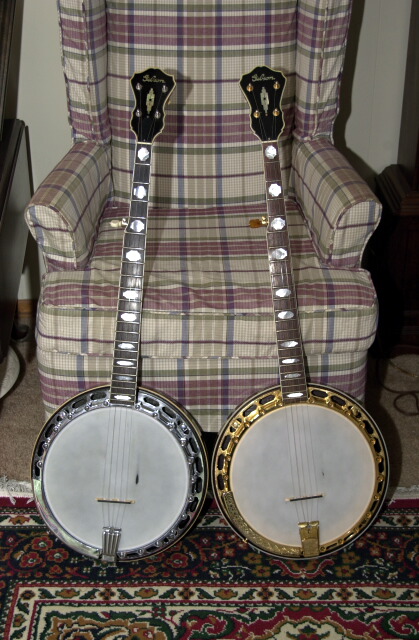
PW RB-12s are rare.Here's a picture of half of them. M
 two RB-12s |
saltcreek - Posted - 01/10/2012: 11:55:45
Here is Prucha"s 600 th banjo he made and it is a Hoss.
 Prucha TT |  Prucha TT |  Prucha TT |
saltcreek - Posted - 01/10/2012: 12:04:58
I had this R&T TT that in fact was a Sonny Osborne custom model that I sold to someone and I lost all my contact info one time when my computer crashed because I wish I could remember who it was, I would love to have this one back.
 |  |  |
El Dobro - Posted - 01/10/2012: 17:45:43
quote:
Originally posted by stanger
Gibson left the inside surface of the solid wood back flat, but carved the outside into a curve with a reflex curve at the edges. Prucha also curves the inside surface.
Some prewar and postwar Gibson top-tension resonators left the factory dished on the inside.

Banjo Vision - Posted - 02/17/2012: 18:46:09
In regards to the Top tension Topic... I own an original Great lakes TT Elite circa 1977.Other than the weight, I have to say it has a very remarkable full tone rich and deep " like a deep clear pool". It is unlike my flat head Gibson which is a beautiful sounding instrument as well, but different.
My wife says it is much more like a Gouda cheese over a standard medium cheddar sort of tone. She is very visual. Ha!
I have considered having a new radiused neck built for it for some time, and am sure I would probably play it a lot more. As I am long in the tooth myself, The weight factor and low back issues is a concern for any long term standing position. So for any of us that "Old and in the way.".. bring a chair with you.
Overall, I do believe the weight and the flat bottom resonator interior does have some effect to its tonal character. A presence unlike any I have played before.
El Dobro - Posted - 02/18/2012: 06:22:35
Regular Gibson banjo=Cutty Sark
Gibson Top Tension banjo=Macallen Single Malt 30
David Hodge - Posted - 02/18/2012: 16:55:58
Go to RH Lane Banjo. All he makes is Top Tension, bell brass or aluminium. I love my TT banjo.
beegee - Posted - 02/19/2012: 05:56:48
quote:
Originally posted by El Dobro
Regular Gibson banjo=Cutty Sark
Gibson Top Tension banjo=Macallen Single Malt 30

Page: 1 2
Terms of Use | Privacy Policy | Privacy Consent (EU/GDPR Only)
Copyright 2026 Banjo Hangout. All Rights Reserved.