
DVD-quality lessons (including tabs/sheet music) available for immediate viewing on any device.
Take your playing to the next level with the help of a local or online banjo teacher.
Weekly newsletter includes free lessons, favorite member content, banjo news and more.
Premier Sponsors


|
Please note this is an archived topic, so it is locked and unable to be replied to. You may, however, start a new topic and refer to this topic with a link: http://www.banjohangout.org/archive/407750
chuckv97 - Posted - 03/14/2026: 14:37:49
Any Jimmie Rodgers experts out there? I knew he used some tenor banjo on his recordings , the norm on 1920’s recordings, especially since they often had him in a kind of early jazz/blues sound. There’s a photo of him holding a banjo with the Tenneva Ramblers but I’m not sure if he actually played one.
Banjo solo at 1:04 on the link below….
youtu.be/REAPOu3uRYw?si=zPLS9DbrpUrR5EMI
Edited by - chuckv97 on 03/14/2026 14:44:42
lapsteel - Posted - 03/14/2026: 15:57:22
from RHINO
“ At the age of 14, Rodgers began working on the M&O Railroad as a water boy. He had already started playing banjo and guitar, and he picked up blues influences from the black workers on his crew. He then worked as a brakeman for New Orleans and Northeaster Railroad until, at the age of 24, he contracted tuberculosis and was forced to quit his job.”
writerrad - Posted - 03/14/2026: 16:12:34
Rogers played the tenor banjo and mandolin. He made up a fictional biography of himself as a long time railroad worker. He had worked long enough on the railroad to get a pass to travel, but from about 12 or 13 he had been running away to travel with Carnivals and travelling shows. A very strong part of his style came from his attraction to ragtime and jazz and blues. His only known attraction to old time music was a brief week in which he formed The Jimmy Rodgers Old Time band, whose only purpose seemed to be for Rodgers, who played tenor banjo in the one picture of this aggregation, was to steal the car that the two brothers who participated in the band with him had borrowed from their father and drive it to Washington DC after it was over.
In the biography and story of Rodgers that his wife wrote after he passed away, Carrie wrote that Jimmie like jazz, and show music and ragtime and did not like to play or listen towhat we now call old time music.
I have been a fan of Rodgers since I was a about 15, and I have gone through every single recording he made for banjo. The only banjos that ever appeared on Rodgers records were those played with picks, plectrum, tenor, and mandoling banjos.
There is a picture of him with a tenor I will try to upload
Edited by - writerrad on 03/14/2026 16:14:03
writerrad - Posted - 03/14/2026: 17:27:53
Again, my life has been transformed by first seeing a video about Rodgers which included the video of Waiting for A Train soundie they did on the public tv station (they did not call this that then) back in Hartford when I was in high school in the early 1960s. I listened through all of his recordings starting once when I was in high school, and the Hartford Public Library where me and my nerd friends lived still had copies of the original Peer International Jimmie Rodgers and Carter Family Song books to take out and take home. LOL often the transcriptions made by people in NYC for Ralph Peer to create those song books were harder to understand than the records.
If you really want to know Jimmie Rodgers, listen to the two recordings he made in Los Angeles with Lil Hardin Armstrong on piano and Louis himself on Cornet. Pretty sure that was Blue Yodel #4. You can find a video of Johnny Cash reprising that in his early 70s TV sho with Mr. Armstrong on YouTube as well.
. Rodgers was pretty much a transitional person to what would become known as Country music. His final decline from TB that was no doubt hastened by his growing morphine addiction. The straight lace Pledged-taken hard core Lincoln-freed -the- slaves-Republicans [Pleasant's last words were "never vote for a Democrat" back when a Democrat on the Southside of Va meant a Dixiecrat, no lie} Carters were shocked in that session between them. Jimmie Rodgers had to stop everything to shoot up with morphine.
. He had brought a mandolin thinking he could play it as he was too weak to play the guitar, but he could not manage that, and that total musician then a young twenty something super picker, Maybelle Carter, does have mandolin credit on one of those tunes. Listen to those two sets with the 4 of them together with that in your mind. They are something, a greatness we should cherish.
Its interesting that the discussion of how "Country Music" evolved as a corporate music industry product defined by the radio stations, the publishing companies, and the record companies came into sharp focus at commemoration of Rodgers in the early 50s in Meridian itself, which was one of the last places where Maybelle, Sarah, and Pleasant performed together before the public having long separated personally in the 1930s, living far from each other across the country.
The old-time nostalgia about Rodgers and the Carters was really that they were the beginning of something modern and progressive and advanced that fit into the world of making records. They could fit something that touched your heart, or someplace lower, or your soul in the a 78 recording a little less than 3 minutes. Rodgers in particular became an international star, insofar as the clarity of his voice made his recordings sell all over the world, in particular in Africa and India.
He can be forgiven that unlike Sarah and Maybelle Carter, he could not and did not care to play the five string banjo, There are several good books about Jimmie Rodgers, but not enough solid work on the Carter family, Pleasant could play a little what we call classic banjo today, and both Maybelle and Sarah frailed.
It is rather unfortunate that old time revivalists today do not know Carter Family songs the way we all did in the 1960s. It is unfortunte that every person in need of moral uplift and clarity and and joy in their does not listen to every single available Jimmie Rodgers recording once a year, even if there are not 5 string banjos involved.
Edited by - writerrad on 03/14/2026 17:40:50
writerrad - Posted - 03/14/2026: 17:50:49
Rodgers definitely could play a tenor banjo and definitely could play the mandolin. He never had any interest or affection for the five string banjo or for old time music. There are NO FIVE STRING BANJOS WHATSOEVER ON THE 110 recordings Jimmie Rodgers made. Not one.
Over the past 20 years, I did a search several times through ever single Jimmie Rodgers recording both listening and looking at the session notes.. . The only banjos on any Jimmie Rodgers recordings are tenor banjos and on one record a mandolin banjo player from the Memphis Jug Band was brought in to a Memphis recording of Rodgers.
Rodgers did play the tenor banjo and the mandolin. He did not play or have any association with the five string banjo except a brief hook up with the two brothers who are in the picture you posted. It is pretty clear that his main angle to include those two boys in the "Jimmie Rodgers String Band" was not their old time music roots, but his desire to have use of the boys' father's automobile that they contributed to drive Rodgers from Asheville to Bristol. Rodgers did not return the courtesy. Instead, after Bristol, Rodgers and his charming wife high tailed it to Washington DC in that car leaving those two boys to face their dear father without a car to return!
Anyone who bothers to read Rodgers' Widows book about Rodgers will read there that Jimmie Rodgers did not like what we now call old time music, and did not listen to it or play it and never had anything to do with it.. He was a rag time kid, a blues signer, a sharpie, a sweet back man. Had he not succumbed to TB, he had plans to move to NYC and have a nationally broad cast radio program with jazz musicians involved.
Rodgers considered himself uptown past the hick stage of old time music and five string banjos, moonshine drinking and such, He had moved on to opiod addiction, ragtime and blues and early jazz, morphine and such, He was not gone to the Country but hoping to hit the big time in New York.
Originally posted by chuckv97Any Jimmie Rodgers experts out there? I knew he used some tenor banjo on his recordings , the norm on 1920’s recordings, especially since they often had him in a kind of early jazz/blues sound. There’s a photo of him holding a banjo with the Tenneva Ramblers but I’m not sure if he actually played one.
Banjo solo at 1:04 on the link below….
youtu.be/REAPOu3uRYw?si=zPLS9DbrpUrR5EMI
Edited by - writerrad on 03/14/2026 18:06:47
writerrad - Posted - 03/14/2026: 18:34:41
Books that belong in every home
'Jimmie Rodgers: The Life and Times of America's Blue Yodeler, by Nolan Porterfield,
Meeting Jimmie Rodgers: How America's Original Roots Music Hero Changed the Pop Sounds of a Century by Barry Mazor
The Songs of Jimmie Rodgers: A Legacy in Country Music by Jocelyn R. Neal
My Husband Jimmie Rogers Paperback by Carrie Cecil Williamson Rodgers
Ralph Peer and the Making of Popular Roots Music Barry Mazor
writerrad - Posted - 03/14/2026: 19:06:33
The banjoist on "In the Jailhouse Now" was the great Ellsworth Cozzens who was better known as a steel guitar player who kept working in Nashville until the 1960s or 70s more and more known as a Steel guitar player and less and less known as a banjoist.
As I said I looked for this through all the track notes and there is no record of Jimmie Rodgers playing any kind of banjo on any Jimmie Rodgers record though Cozzens and others play tenor on a number of Rodgers records. Rodgers played tenor on the Bristol sessions record your picture comes from. Otherwise he did not play banjo, but guitar, I think he intended to play Mandolin on one of his last recordings, the Carter family meets Jimmie Rodgers skits, but he ws too week or strung out on Morphine to do so, and Maybelle played Mandolin on at least one of those cuts,
Tenor was pretty widely used across popular music until it started to edged out by the big arch top guitars in the late 20s and 1930s.
Rodgers never played a five string banjo. His wife wrote in her memoir that he did not like old time music and did not play it..
But I am sure he would have liked Earl, and have been jealous of how Monroe Earl did Blue Yodel #4 better than he did twice live on the Opry in 1946 or was than 47???.
Edited by - writerrad on 03/14/2026 19:11:44
chuckv97 - Posted - 03/14/2026: 19:26:58
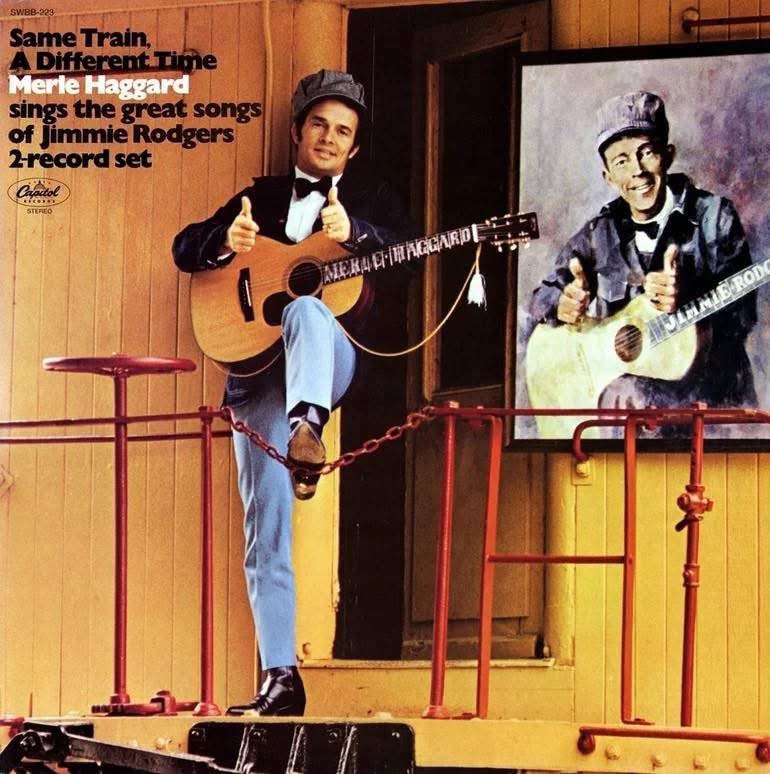
Thank you for the insights, Tony. I had heard Rodgers a bit on folk music radio in the 1960’s, but being a 19 year-old and used to “modern” folk singers I found his recordings dated. But I liked his songs so I bought this album which I think was a sincere labour of love by Haggard.
“California Blues” was on a diner jukebox I frequented at lunchtime and I’d play it over & over.
Joel Hooks - Posted - 03/14/2026: 19:32:51
I can't comment about the banjo, but Rodgers, taught Gene Autry how to "yodel"-- and now people think that "cowboys" yodeled in the 1880s.
The 'yodeling cowboy' was started by Gene Autry. And it is kinda bizarre.
"Yodeling" was part of a 1870s genericized "Tyrolean" fad in the US staring in the 1870s with Joseph Emmett and his character "Fritz". Emmett was also a major factor in the pocket German harmonica becoming popular (despite common belief, there was likely no German harmonicas played during the American Civil War).
"Cowboy music" that we know today is a mash up of Tyrolean yodeling (by way of Jimmie Rodgers), and Hawaiian music combined with John Lomax's "cowboy songs". And it is considered a form of authentic American folk music.
Weird.
chuckv97 - Posted - 03/14/2026: 19:36:33
Interesting, Joel. I had no idea about yodeling,, I always assumed it was a transplant from the Swiss Alps,, although maybe people yodeling in the Alps is also a myth.
Edited by - chuckv97 on 03/14/2026 19:37:28
Joel Hooks - Posted - 03/15/2026: 04:51:13
chuckv97 I have no doubt that it comes from a European tradition, but the reason we connect it with cowboys is Autry via Rodgers.
Ira Gitlin - Posted - 03/15/2026: 06:47:12
quote:
Originally posted by Joel Hooks
"Cowboy music" that we know today is a mash up of Tyrolean yodeling (by way of Jimmie Rodgers), and Hawaiian music combined with John Lomax's "cowboy songs". And it is considered a form of authentic American folk music.
Weird.
No weirder than most everything else about American music!
BTW, Tony, was "Pleasant" the way A.P. was referred to by those who knew him?
Also, IIRC, Ellsworth Cozzens was an uncle of Mike Aldridge, the great bluegrass Dobro player.
Tim Jumper - Posted - 03/15/2026: 10:56:21
Jimmie collaborated with Mr. and Mrs. Armstrong on "Blue Yodel #9" ("Standin' on the Corner). They worked hard to adjust on the fly to Jimmie's quirky phrasing, shifting downbeats, and irregular measures, but they managed to pull it off.
I learned to yodel from Jimmie's "Blue Yodel #10" ("There's Been a Groundhog . . .").
I practiced in the car while driving to gigs, to spare the ears of family and neighbors.
Jimmie spawned a host of imitators and acolytes, one of the best being the late Leon Redbone, an amazingly versatile vocalist, who recorded a host of Rodgers's songs in his warm, inimitable baritone.
ssduke - Posted - 03/15/2026: 14:17:32
Thanks to all — but especially Tony — for the great education. I’ve listened to a lot of the Carter family recordings, but only a smattering of Rogers. I’ll get busy with that.
Banjo North - Posted - 03/15/2026: 15:29:57
Thanks everyone, that was all very interesting.
This may be well-known but I find it fascinating that the Kipsigis tribe of the Great Rift Valley in Kenya were recorded singing songs about “Chemirocha” in the 1950s by ethnomusicologist Hugh Tracey. Chemirocha is how they referred to Jimmie Rodgers. They had been exposed to his music by British missionaries years earlier. I think about the recording Chemirocha III all the time.
If anyone is interested there’s more info here and at Wikipedia:
atlasobscura.com/articles/chem...nyan-star
Here’s a recording of Chemirocha III:
m.youtube.com/watch?v=rhi9mKVQ...WmgBwE%3D
Edited by - Banjo North on 03/15/2026 15:30:59
writerrad - Posted - 03/15/2026: 15:47:29
quote:Yeah Rodgers extremely clear voice and rhythm made his Victor Recordings big sellers in international marketing of starting in the 1920s. It is not missionaries. Victor Records and its English subsidiaries widely marketed Rodgers records across the old British Empire.
Rodgers continued to be particularly popular in North Africa. People I know who traveled in North Africa would report they were still selling Rodgers records in the 70s and 80s. Peer who figured this out eventually moved out of focusing on US markets and moved to Mexico and then I think Argentina, finding and marketing music internationally,
, A number of Rodgers records were also issued by Victors hookups in India. He had a distinctly clear voice of a type that was much more adaptable to recorded music when many singers who sounded OK in live performace had not mastered how to sound good on a microphone. He also was a master at compressing a song into a real performance and experience in a 78 record's just less than 3 minutes., Not everyone could do that, as this was all new,
The Carters, especially Alvin Pleasant were also masters of that, That was an art that many musicians and singers before records came along in the 1920s (they had them before but they were too expensive and sounded like crap). How do you take a song or a tune that someone might have played or sug for 15 minutes and cut it down to less than 3 minutes and make it complete, There were many artists who were world famous who never made it once records came along. Rodgers and the Carters did!
Ralph Peer who produced them both and a slew of other artists was a genius at finding people who were out the musical culture he was recorded who could figure this out and work with musicians to do this.
Originally posted by Banjo NorthThanks everyone, that was all very interesting.
This may be well-known but I find it fascinating that the Kipsigis tribe of the Great Rift Valley in Kenya were recorded singing songs about “Chemirocha” in the 1950s by ethnomusicologist Hugh Tracey. Chemirocha is how they referred to Jimmie Rodgers. They had been exposed to his music by British missionaries years earlier. I think about the recording Chemirocha III all the time.
If anyone is interested there’s more info here and at Wikipedia:
atlasobscura.com/articles/chem...nyan-star
Here’s a recording of Chemirocha III:
m.youtube.com/watch?v=rhi9mKVQ...WmgBwE%3D
writerrad - Posted - 03/15/2026: 16:01:18
The most authentic thing about what Peer did was make authentic dollars. For him an other record producers finding blues, purportedlly old time (a phrase invented largely by Ralph Peer) acts was to create the idea of their authenticity or rather of the first generation of post war folk revivalists to assume their authenticity flowed from their "true folk roots." One of the record company's biggest struggles with Charlie Poole, for example, was that he wanted to recorded classic banjo solos and compositions like Fred Van Eps had made and I think he did record just one. The record company told Poole they could go out on 14th St (there were recording at the Union Square Hotel) and find 20 guys in 20 minutes who could do a classic banjo solo ala Van Eps, but it was "Dont let the Deal Go Down" that sold hundreds of thousands of records for Poole and the record company.
They created authenticity. Very much of the thinking of contemporary Bluegrass, Old Time, and Blues people is just lack of any knowledge of the massive amount of white, black and otherwise popular music, ragtime, parlor music, tht was floating around and the degree to which practicioners of those musics were the expression of "true folk roots," rather than being expressions of the vibrancy of popular musical culture.
The Carters are often mistaken for true folk people, but an extremely high number of their songs were already composed, already published, often already copyrighted and even recorded by other artists songs, "Will the Circle Be Unbroken" was written copyrighted and I believe published by a Black minster around 1920. Pleasant and later Maybelle did genius work compressing things down to 3 minute songs.
,
Edited by - writerrad on 03/15/2026 16:01:51
ssduke - Posted - 03/15/2026: 16:32:00
quote:Originally posted by @writerrad: "The most authentic thing about what Peer did was make authentic dollars. For him an other record producers finding blues, purportedlly old time (a phrase invented largely by Ralph Peer) acts was to create the idea of their authenticity . . .,"
There is a good book — originally recommended by Joel Hooks in a different context some months ago — about the invention of “authenticity” in country music, from the early days of recording up to what we currently identify as authentic in country music. If you are interested the history of the music, it’s a worthwhile investment of time.
amazon.com/Creating-Country-Mu...mp;sr=1-1
Edited by - ssduke on 03/15/2026 16:45:32
Banjo North - Posted - 03/15/2026: 16:48:40
Authentic dollars indeed. Well said.
I’ll check that book out, thanks.
Terms of Use | Privacy Policy | Privacy Consent (EU/GDPR Only)
Copyright 2026 Banjo Hangout. All Rights Reserved.


