DVD-quality lessons (including tabs/sheet music) available for immediate viewing on any device.
Take your playing to the next level with the help of a local or online banjo teacher.
Weekly newsletter includes free lessons, favorite member content, banjo news and more.
Premier Sponsors


|
Please note this is an archived topic, so it is locked and unable to be replied to. You may, however, start a new topic and refer to this topic with a link: http://www.banjohangout.org/archive/407689
Diulin - Posted - 03/09/2026: 18:19:42
I've always used steel strings with railroad spikes at the 7th and 9th frets. I've recently switched to Nylgut (red), which I suppose wouldn't hold up to being stuck under a railroad spike. So I'm looking for suggestions for retuning quickly (G to A) without breaking the 5th string. It's happened to me only once so far (this evening) but it seems like such a likely thing that I'm wondering if others have suggestions for tuning up a whole step with less risk of breaking.
RELATED QUESTION: When you DO break a Nylgut or nylon string, is it even possible to just throw on a new string and go on playing? Ideally I'd let them stretch out overnight without bringing them to full tension. But what do you do if you're in the middle of a jam session or a performance?
banjered - Posted - 03/09/2026: 19:15:52
I use a spike for the fifth nylon string taking care to remove all sharp edges, no problems.
Keep a used fifth or first string for a quick jam replacement. banjered
John Yerxa - Posted - 03/09/2026: 22:15:33
What Tom said. Might have to redo spikes for fit.
Never used the reds, have heard they break more easily. Haven't broken a classic since I replaced the planetary 5th peg (which broke every one!). I use Classic guitar D string for 4th - those wear out, the rest last a very long time.
And yes, winding on a new nylgut string takes time.
raybob - Posted - 03/09/2026: 22:48:34
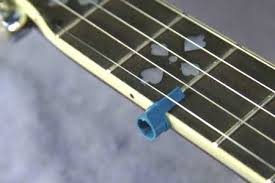
I use a “pen top” capo on the old banjo I have strung up with nylons. They are small and easy to lose, but until then it’s all good.
Diulin - Posted - 03/10/2026: 03:03:20
quote:
Originally posted by raybobI use a “pen top” capo on the old banjo I have strung up with nylons. They are small and easy to lose, but until then it’s all good.
I'm intrigued. What is that?
Joel Hooks - Posted - 03/10/2026: 07:25:32
To be clear, "nylgut" is polyester.
Nylon, the standard for strings since after WW2 when it became available, is abrasion resistant. This is why it also (when extruded) makes excellent fishing line.
"Nylgut" is polyester. This is NOT abrasion resistant, the slightest sharp edge and it is a goner.
For the strains of modern "old time" jam culture, capos, and quick/constant use of scordatura, wire strings might be the best option.
Jon Borcherding - Posted - 03/10/2026: 07:52:02
I play a banjo with Nylgut stings and RR spikes. I have not broken a string since I went over every notch in bridge and nut and every spike with very fine sandpaper. Like Joel says above, Nylgut (Polygut?) strings will surrender at the very hint of a sharp edge.
A brief sidetrip down tangent lane:
I recently changed the head on this banjo. As a sort of half-arsed experiment I reinstalled the same strings after the head change. I did this by simply removing the tail piece with strings still tied on while I did the head-change.
I noticed the strings were "dented" at the places where they contacted the frets, not eroded, but dented. The same was true of the thumb string where it contacted the RR spike. These dents did not cause the string to play falsely as I would have thought. (Maybe my hearing is failing?) I have since noticed that as these "dents" increase the string begins to have intonation issues probably cause by the disruption of the strings normal wavelength. I'm just guessing, but that sounds pretty sciencey, right?
Another thing: The Nylguts (Polyguts?) sat, unattached and loose for about 48 hours while I was distracted by a bunch of sheep that were lambing. (BAAAaaaa)
When I finally returned to my head-change project, the strings had shrunk significantly, requiring me to loosen them at the tuning pegs prior to reattaching the tailpiece. Fortunately they did NOT require several days to stretch back to their prior tuned length. This speaks to Tom's suggestion to keep a used string handy in case you break one at a jam or gig. It is also vitally important to own and maintain at least 7 banjos to alleviate this potential crisis.
Thank you for hearing my confessions. :-)
Terms of Use | Privacy Policy | Privacy Consent (EU/GDPR Only)
Copyright 2026 Banjo Hangout. All Rights Reserved.