DVD-quality lessons (including tabs/sheet music) available for immediate viewing on any device.
Take your playing to the next level with the help of a local or online banjo teacher.
Weekly newsletter includes free lessons, favorite member content, banjo news and more.
Premier Sponsors


|
Please note this is an archived topic, so it is locked and unable to be replied to. You may, however, start a new topic and refer to this topic with a link: http://www.banjohangout.org/archive/407342
Stargorn - Posted - 02/15/2026: 03:08:12
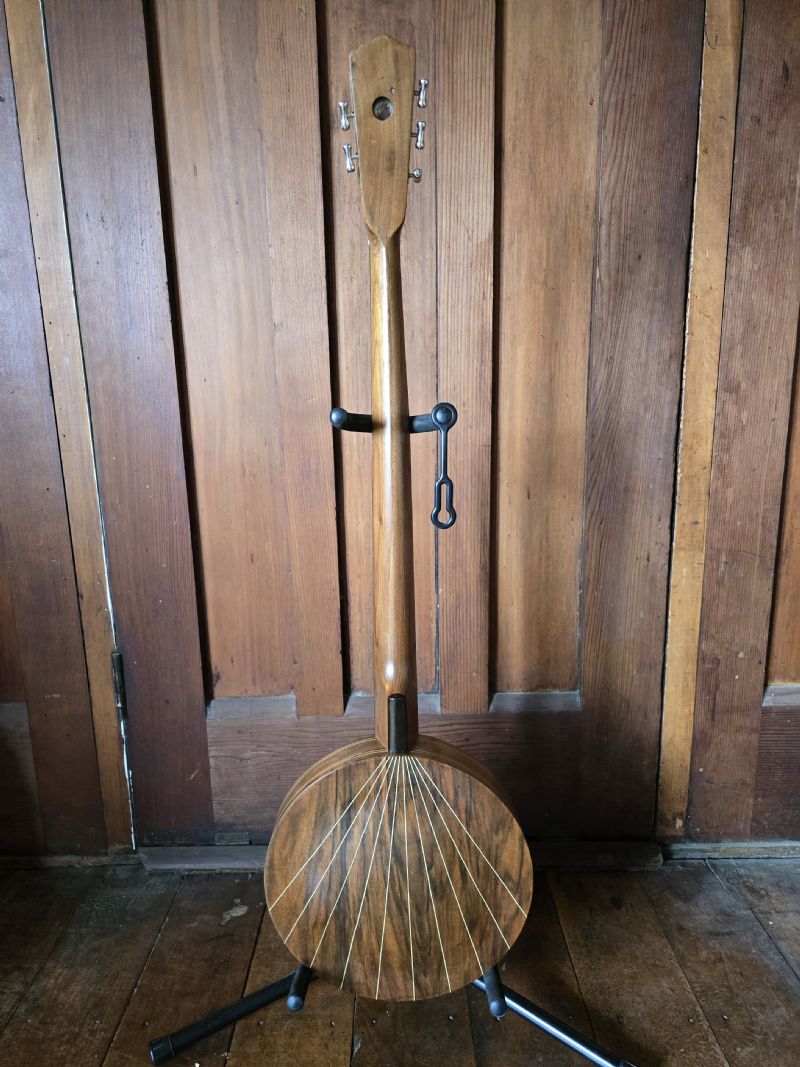
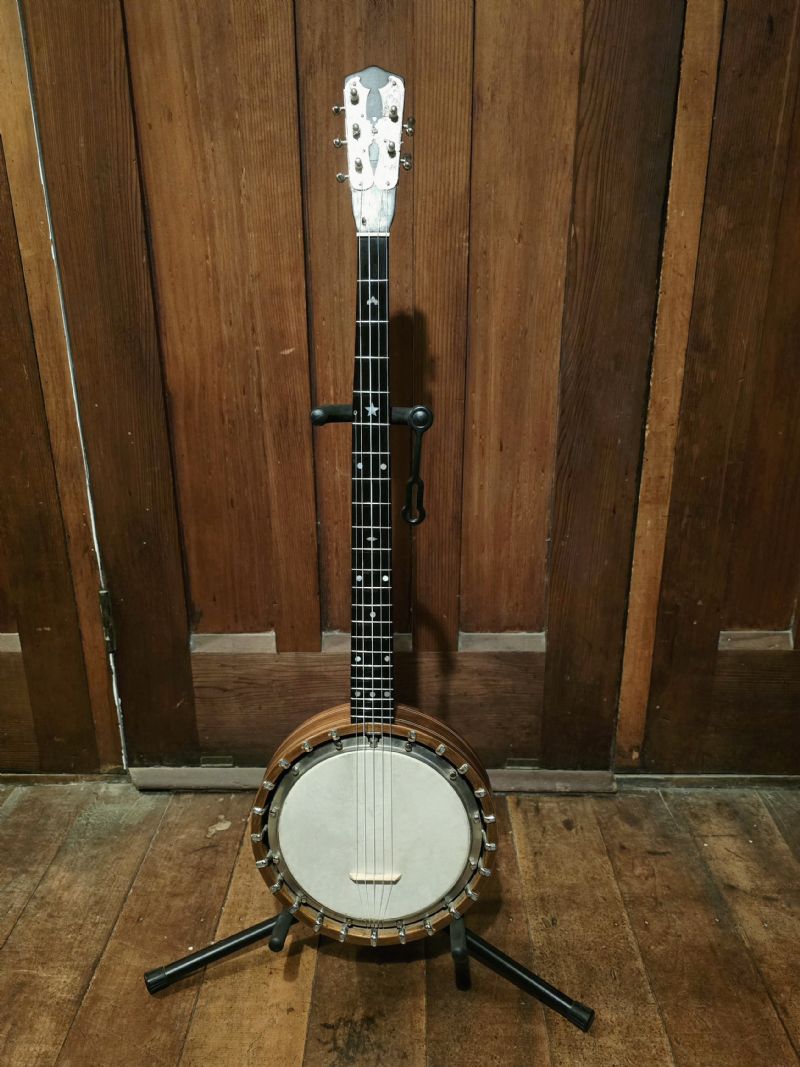
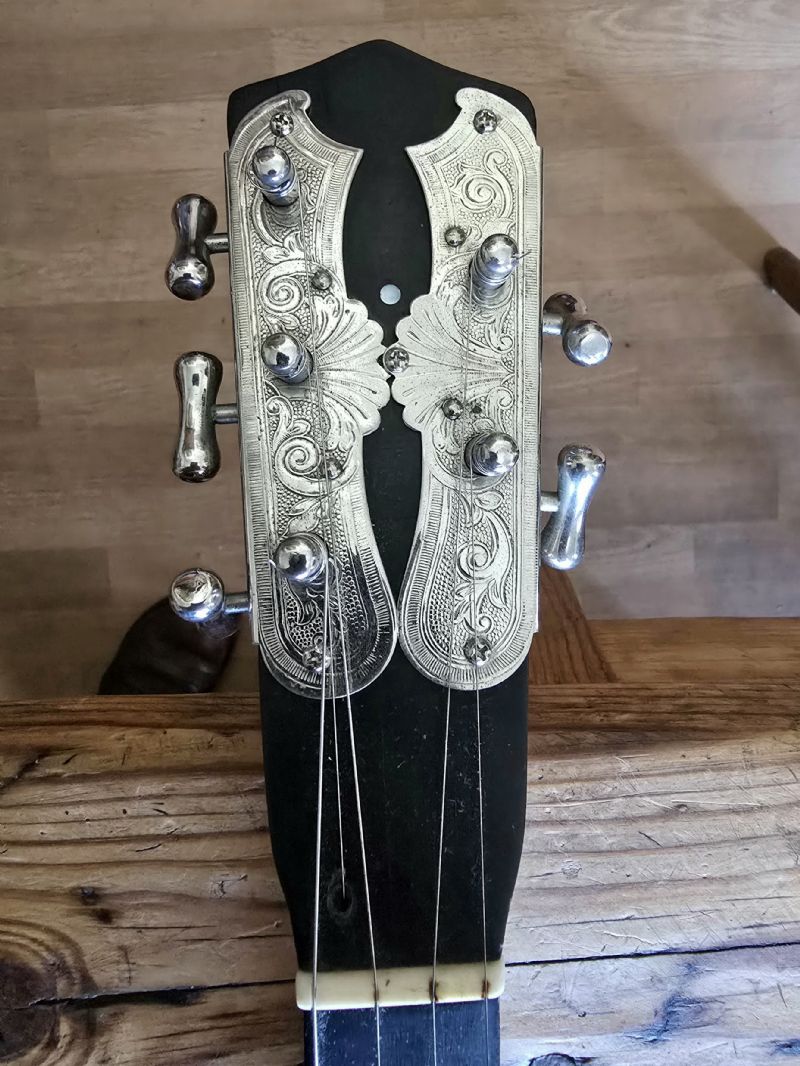
I recently acquired a George P Matthew 5-string zither banjo from a local music store here in New Zealand. It has a tunneled 5th string, German silver hardware, and some unusually designed tuning buttons that I haven’t seen on other instruments.
When I got it, it wasn’t playable. The head was loose and uneven, the bridge was misplaced, and it had steel strings installed which had begun cutting into the maple bridge. I’ve since restrung it with Aquila Nylgut Minstrel strings, corrected the setup, and it is now playing beautifully, currently tuned to fCFAC.
Banjo is new territory for me, but I’ve really enjoyed bringing this instrument back into playing condition. It has a wonderful warm, clear tone.
I'd love some more information on the tuning buttons, the maker and any tips for setting up zither banjos.
Joel Hooks - Posted - 02/15/2026: 04:53:49
Zither banjos, invented or developed by Alfred Cammeyer, are correctly strung with very light (or “sensitive”) wire first, second, and fifth. Third is gut and fourth is copper wound on silk floss. Nylon and copper on nylon floss is the current and best substitute.
I’ve been slowly scanning and uploading all of the materials I have by Alfred Cammeyer, including a lot of stuff he wrote in personal letters, concert programs, catalogs, and eventually I’ll start scanning the handful of issues of his magazine.
Cammeyer composed music to take advantage of the unique voicing that the mixed strings provided. Generally this put the melody on the wire strings and the harmony on the gut and wound strings.
I believe that there is merit in studying this instrument, as designed, with the unique stringing.
EEB - Posted - 02/15/2026: 10:55:54
George Matthew (1857-1929) was born in St. Pancras, London where his widowed mother ran a business selling pianofortes. The area encompassing St Pancras, Islington, Clerkenwell, Bow and Bethnal Green was the epicentre of English banjo music making, composing and innovation. A young George began work in his mother’s business. In 1880 he moved to Birmingham, where he was employed by local instrument manufacturer and retailer C. Scotcher & Son. This may initially have been wholly or in part as an agent for his mother’s business. He also began making banjos for Scotcher. Primary sources reveal that by November 1882 Matthew had established his own banjo making business in nearby Aston Street, Birmingham and was advertising his 'Perfected Silver' 20-bracket banjo. During the 1880's Matthew made 5, 6 and 7-string banjos. Several leading touring banjoists recommended Matthew banjos for professional use. This banjo business quickly outgrew this first small workshop and Matthew expanded into a succession of larger premises.
Birmingham was a primary centre of metalworking, with hundreds of component workshops in the 19th century including those producing hardware for banjos. Without doubt the tuning machines on your Matthew were made locally in Birmingham.
Edited by - EEB on 02/15/2026 11:11:50
AndrewD - Posted - 02/15/2026: 11:13:49
Clifford Essex do what looks like a good approximation of what would have been used on zither banjos. light steel 1st, 2nd and 5th, nylon 3rd, wound nylon 4th. Never tried them. If I ever get one of my zither banjos up and running I'll give them a go.
EEB - Posted - 02/15/2026: 11:26:14
I don’t play zither banjo, but I do own and play several ‘standard’ banjos made by Matthew dating from c. 1884 to 1905. Their build quality, tone and sound projection are consistently good.
By the 1890’s Matthew was mass-producing instruments and offering a range of models. This output was not limited to a domestic market, and were exported to all four corners of the British Empire.
EEB - Posted - 02/15/2026: 11:57:06
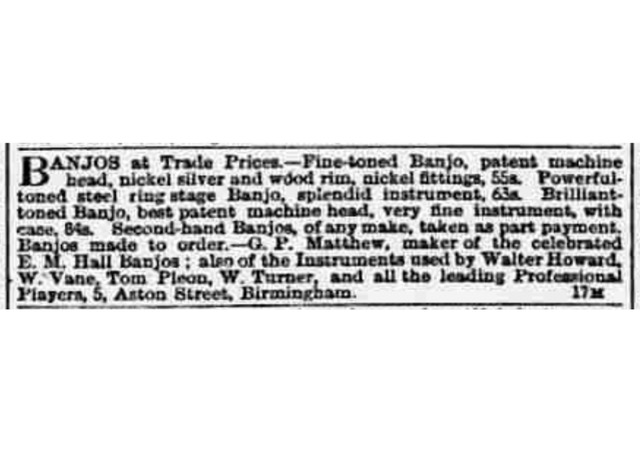
This Birmingham press advertisement from 1885 does provide an idea of the pace at which the Matthew business was expanding.
csacwp - Posted - 02/15/2026: 14:44:13
quote:
Originally posted by AndrewDClifford Essex do what looks like a good approximation of what would have been used on zither banjos. light steel 1st, 2nd and 5th, nylon 3rd, wound nylon 4th. Never tried them. If I ever get one of my zither banjos up and running I'll give them a go.
I think the third and fourth strings in this set are comically thick.
Edited by - csacwp on 02/15/2026 14:45:24
EEB - Posted - 02/16/2026: 01:27:25
quote:
Originally posted by csacwpquote:
Originally posted by AndrewDClifford Essex do what looks like a good approximation of what would have been used on zither banjos. light steel 1st, 2nd and 5th, nylon 3rd, wound nylon 4th. Never tried them. If I ever get one of my zither banjos up and running I'll give them a go.
I think the third and fourth strings in this set are comically thick.
A modern dogmatism that only the thinnest strings are by default 'authentic' to 19th century specification is a selective misrepresentation. Comprehensive and conclusive data for gauge preference across the diverse range of playing contexts simply does not survive and probably never existed in any collated form. What does emerge from close study of a broad spectrum of primary sources is evidence to indicate variation, and that Victorian banjoists did not conform to a singular 'rule'.
In a research context the term 'comical' has no meaning whatsoever as it is entirely subjective. An individual today may regard heavier gauge as not their preference. But to confute what is individual subjectivity with objective analysis has no valid basis. If Victorian banjoist X or Y opined upon or recommended specific gauge strings, regardless of assumed 'status', that cannot be taken at face value as representing a 'rule' in what were diverse, informed practical playing contexts where alternative choices were easily available.
Edited by - EEB on 02/16/2026 01:42:30
EEB - Posted - 02/16/2026: 03:52:34
quote:
Originally posted by StargornI recently acquired a George P Matthew 5-string zither banjo from a local music store here in New Zealand. It has a tunneled 5th string, German silver hardware, and some unusually designed tuning buttons that I haven’t seen on other instruments.
I’ve since restrung it with Aquila Nylgut Minstrel strings, corrected the setup, and it is now playing beautifully, currently tuned to fCFAC.
Banjo is new territory for me, but I’ve really enjoyed bringing this instrument back into playing condition. It has a wonderful warm, clear tone.
Fascinating that your first banjo is a zither banjo. Today that gives you a fairly unique perspective, that hasn't been common at all since the 1890's. High profile banjoists (e.g. Oakley) born in the 1870's, who became associated with the zither banjo often began on 5, 6 or 7 string banjo and transferred to the zither banjo. Your experience is a closer match to Generation 3 born in the mid-1880's and whose formative music education was in a context where the zither banjo was numerous and very popular and more likely to be a first banjo of choice.
My inclination is to observe and - hopefully hear - your progress. You are already experimenting with tuning and string gauge. There are 19th and early 20th century tutor books still available that were published for the zither banjo.
Edited by - EEB on 02/16/2026 03:56:46
csacwp - Posted - 02/16/2026: 03:56:37
quote:
Originally posted by EEBquote:
Originally posted by csacwpquote:
Originally posted by AndrewDClifford Essex do what looks like a good approximation of what would have been used on zither banjos. light steel 1st, 2nd and 5th, nylon 3rd, wound nylon 4th. Never tried them. If I ever get one of my zither banjos up and running I'll give them a go.
I think the third and fourth strings in this set are comically thick.
A modern dogmatism that only the thinnest strings are by default 'authentic' to 19th century specification is a selective misrepresentation. Comprehensive and conclusive data for gauge preference across the diverse range of playing contexts simply does not survive and probably never existed in any collated form. What does emerge from close study of a broad spectrum of primary sources is evidence to indicate variation, and that Victorian banjoists did not conform to a singular 'rule'.
In a research context the term 'comical' has no meaning whatsoever as it is entirely subjective. An individual today may regard heavier gauge as not their preference. But to confute what is individual subjectivity with objective analysis has no valid basis. If Victorian banjoist X or Y opined upon or recommended specific gauge strings, regardless of assumed 'status', that cannot be taken at face value as representing a 'rule' in what were diverse, informed practical playing contexts where alternative choices were easily available.
That's not true - plenty of primary source evidence does survive specifies what gauges of strings were used, as do the banjos themselves, which did not leave the factories with nuts slotted to take a .036" third.
EEB - Posted - 02/16/2026: 04:08:36
quote:
Originally posted by csacwpquote:
Originally posted by EEBquote:
Originally posted by csacwpquote:
Originally posted by AndrewDClifford Essex do what looks like a good approximation of what would have been used on zither banjos. light steel 1st, 2nd and 5th, nylon 3rd, wound nylon 4th. Never tried them. If I ever get one of my zither banjos up and running I'll give them a go.
I think the third and fourth strings in this set are comically thick.
A modern dogmatism that only the thinnest strings are by default 'authentic' to 19th century specification is a selective misrepresentation. Comprehensive and conclusive data for gauge preference across the diverse range of playing contexts simply does not survive and probably never existed in any collated form. What does emerge from close study of a broad spectrum of primary sources is evidence to indicate variation, and that Victorian banjoists did not conform to a singular 'rule'.
In a research context the term 'comical' has no meaning whatsoever as it is entirely subjective. An individual today may regard heavier gauge as not their preference. But to confute what is individual subjectivity with objective analysis has no valid basis. If Victorian banjoist X or Y opined upon or recommended specific gauge strings, regardless of assumed 'status', that cannot be taken at face value as representing a 'rule' in what were diverse, informed practical playing contexts where alternative choices were easily available.
That's not true - plenty of primary source evidence does survive specifies what gauges of strings were used, as do the banjos themselves, which did not leave the factories with nuts slotted to take a .036" third.
I agree that primary source spec is available that mention thinner gauge strings. We have many examples in our library. However, mere 'presence' alone does not equate to a comprehensive basis on which to assume patterns of behaviour or compliance with spuriously asserted 'rules'. We also possess many primary sources detailing diverse preference and practice. That diversity is a characteristic feature of English banjo contexts.
A significant impediment to a detailed analysis and better understanding of the neglected English banjo and its banjoists has been the pedantic assertion of 'truths' on selective and partial - very often American -sources. That blind projection of assumption is the fundamental basis of the often unconscious process that is dominant narrative. You rather perversely choose continue in that discredited vein. And from a professional research perspective that process and critical distinction is important to highlight.
Edited by - EEB on 02/16/2026 04:24:09
csacwp - Posted - 02/16/2026: 04:26:58
quote:
Originally posted by EEBquote:
Originally posted by csacwpquote:
Originally posted by EEBquote:
Originally posted by csacwpquote:
Originally posted by AndrewDClifford Essex do what looks like a good approximation of what would have been used on zither banjos. light steel 1st, 2nd and 5th, nylon 3rd, wound nylon 4th. Never tried them. If I ever get one of my zither banjos up and running I'll give them a go.
I think the third and fourth strings in this set are comically thick.
A modern dogmatism that only the thinnest strings are by default 'authentic' to 19th century specification is a selective misrepresentation. Comprehensive and conclusive data for gauge preference across the diverse range of playing contexts simply does not survive and probably never existed in any collated form. What does emerge from close study of a broad spectrum of primary sources is evidence to indicate variation, and that Victorian banjoists did not conform to a singular 'rule'.
In a research context the term 'comical' has no meaning whatsoever as it is entirely subjective. An individual today may regard heavier gauge as not their preference. But to confute what is individual subjectivity with objective analysis has no valid basis. If Victorian banjoist X or Y opined upon or recommended specific gauge strings, regardless of assumed 'status', that cannot be taken at face value as representing a 'rule' in what were diverse, informed practical playing contexts where alternative choices were easily available.
That's not true - plenty of primary source evidence does survive specifies what gauges of strings were used, as do the banjos themselves, which did not leave the factories with nuts slotted to take a .036" third.
I agree that primary source spec is available that mention thinner gauge strings. We have many examples in our library. However, mere 'presence' alone does not equate to a comprehensive basis on which to assume patterns of behaviour or compliance with spuriously asserted 'rules'. We also possess many primary sources detailing diverse preference and practice. That diversity is a characteristic feature of English banjo contexts.
A significant impediment to a detailed analysis and better understanding of the neglected English banjo and its banjoists has been the pedantic assertion of 'truths' on selective and partial - very often American -sources. That blind projection of assumption is the fundamental basis of the often unconscious process that is dominant narrative. You rather perversely choose continue in that discredited vein. And from a professional research perspective that process and critical distinction is important to highlight.
Mike, you have no idea what sources I am drawing from, because I have yet to reveal them. I somehow doubt your "library" contains much that I haven't read before.
Edited by - csacwp on 02/16/2026 04:27:34
EEB - Posted - 02/16/2026: 04:42:37
A hopefully helpful, simple, decontextualised ABC of the nature, mechanism and projection of dominant narrative. Actually published by an American university:
sites.lsa.umich.edu/equitable-...tives.pdf
csacwp - Posted - 02/16/2026: 11:12:49
quote:
Originally posted by EEBA hopefully helpful, simple, decontextualised ABC of the nature, mechanism and projection of dominant narrative. Actually published by an American university:
sites.lsa.umich.edu/equitable-...tives.pdf
Neo-Marxian claptrap. . . the workings of a mind possessed by ideology. But even if it weren't, do you honestly believe that classic banjoists today hold the "dominant narrative"? Or are you too married to the notion of a British banjo victimology (and the social cachet it affords you) to see clearly?
reubenstump - Posted - 02/16/2026: 13:51:46
BHO. Come to learn styles, tunes, techniques, construction, setup, and so on. Stay for the historical pissing contests.
Daniel, I'm sorry that you stumbled into this, but it's not your fault.
Edited by - reubenstump on 02/16/2026 13:54:22
AndrewD - Posted - 02/16/2026: 14:17:42
quote:
Originally posted by csacwpquote:
Originally posted by AndrewDClifford Essex do what looks like a good approximation of what would have been used on zither banjos. light steel 1st, 2nd and 5th, nylon 3rd, wound nylon 4th. Never tried them. If I ever get one of my zither banjos up and running I'll give them a go.
I think the third and fourth strings in this set are comically thick.
I'm sure that one could put together a custom set with a rectified gut 3rd and a wound over silk 4th and congratulate oneself on authenticity. It would cost far more and wear out more quickly. Would it actually produce better music ?
What would be your recommendation for somebody starting out on banjo with a zither ?
csacwp - Posted - 02/16/2026: 16:06:55
quote:
Originally posted by AndrewDquote:
Originally posted by csacwpquote:
Originally posted by AndrewDClifford Essex do what looks like a good approximation of what would have been used on zither banjos. light steel 1st, 2nd and 5th, nylon 3rd, wound nylon 4th. Never tried them. If I ever get one of my zither banjos up and running I'll give them a go.
I think the third and fourth strings in this set are comically thick.
I'm sure that one could put together a custom set with a rectified gut 3rd and a wound over silk 4th and congratulate oneself on authenticity. It would cost far more and wear out more quickly. Would it actually produce better music ?
What would be your recommendation for somebody starting out on banjo with a zither ?
I'd order single strings from LaBella, D'Addario, Pyramid, etc. I'm not advocating for HIP (so no gut), but there are structural and musical reasons to use the proper gauges.
csacwp - Posted - 02/17/2026: 08:12:21
To bring things back to the original topic, I haven't seen these particular tuner buttons before. They're aesthetically pleasing, and they look practical to boot. Very neat.
I've tried stringing zither banjos with all-nylon sets, and I've never been impressed by the result. I do recommend trying the traditional zither banjo stringing Joel mentioned above, and check out Cammeyer's compositions while you're at it - they're lovely. The zither banjo is truly underappreciated these days.
Edited by - csacwp on 02/17/2026 08:14:45
Stargorn - Posted - 02/19/2026: 04:22:21
quote:
Originally posted by EEBFascinating that your first banjo is a zither banjo. Today that gives you a fairly unique perspective, that hasn't been common at all since the 1890's. High profile banjoists (e.g. Oakley) born in the 1870's, who became associated with the zither banjo often began on 5, 6 or 7 string banjo and transferred to the zither banjo. Your experience is a closer match to Generation 3 born in the mid-1880's and whose formative music education was in a context where the zither banjo was numerous and very popular and more likely to be a first banjo of choice.
My inclination is to observe and - hopefully hear - your progress. You are already experimenting with tuning and string gauge. There are 19th and early 20th century tutor books still available that were published for the zither banjo.
I'm definitely not a banjo player, but I am having fun messing around with it. I found a few banjo players on youtube that are inspiring to me - Murphy Campbell and Clifton Hicks. I am part Scottish, my ancestors were harpers in the royal courts. I guess something in my blood loves that mountain folk sound.
I wrote the music for an art deco radio play my theatre company is putting on and I sing one of the songs. Decided to try out the banjo. I made recordings - made to sound like old 'sing into a can' style vinyl tracks. We're performing the show on stage over the next couple weeks for Art Deco weekend here in Napier. The old banjo looks very appropriate.
Here's a recording I made today:
soundcloud.com/danielmunro/ohgodiknow
EEB - Posted - 02/19/2026: 04:40:20
quote:
Originally posted by Stargornquote:
Originally posted by EEBFascinating that your first banjo is a zither banjo. Today that gives you a fairly unique perspective, that hasn't been common at all since the 1890's. High profile banjoists (e.g. Oakley) born in the 1870's, who became associated with the zither banjo often began on 5, 6 or 7 string banjo and transferred to the zither banjo. Your experience is a closer match to Generation 3 born in the mid-1880's and whose formative music education was in a context where the zither banjo was numerous and very popular and more likely to be a first banjo of choice.
My inclination is to observe and - hopefully hear - your progress. You are already experimenting with tuning and string gauge. There are 19th and early 20th century tutor books still available that were published for the zither banjo.
I'm definitely not a banjo player, but I am having fun messing around with it. I found a few banjo players on youtube that are inspiring to me - Murphy Campbell and Clifton Hicks. I am part Scottish, my ancestors were harpers in the royal courts. I guess something in my blood loves that mountain folk sound.
I wrote the music for an art deco radio play my theatre company is putting on and I sing one of the songs. Decided to try out the banjo. I made recordings - made to sound like old 'sing into a can' style vinyl tracks. We're performing the show on stage over the next couple weeks for Art Deco weekend here in Napier. The old banjo looks very appropriate.
Here's a recording I made today:
soundcloud.com/danielmunro/ohgodiknow
Daniel, thank you for sharing your recording. That performance is captivating and assured, and quite beautiful.
The delight that jumps out at me immediately after the first few seconds of listening is the exquisite blend of your vocal with the tonality of the zither banjo as you have set it up. That is a subtle but incredibly powerful lesson in the personal instinct that is 'musician-sensibility' and craft. I'd love to hear more of that blend and your talent.
You just made my morning! 
Edited by - EEB on 02/19/2026 04:50:34
Steven Ayres - Posted - 02/23/2026: 15:46:02
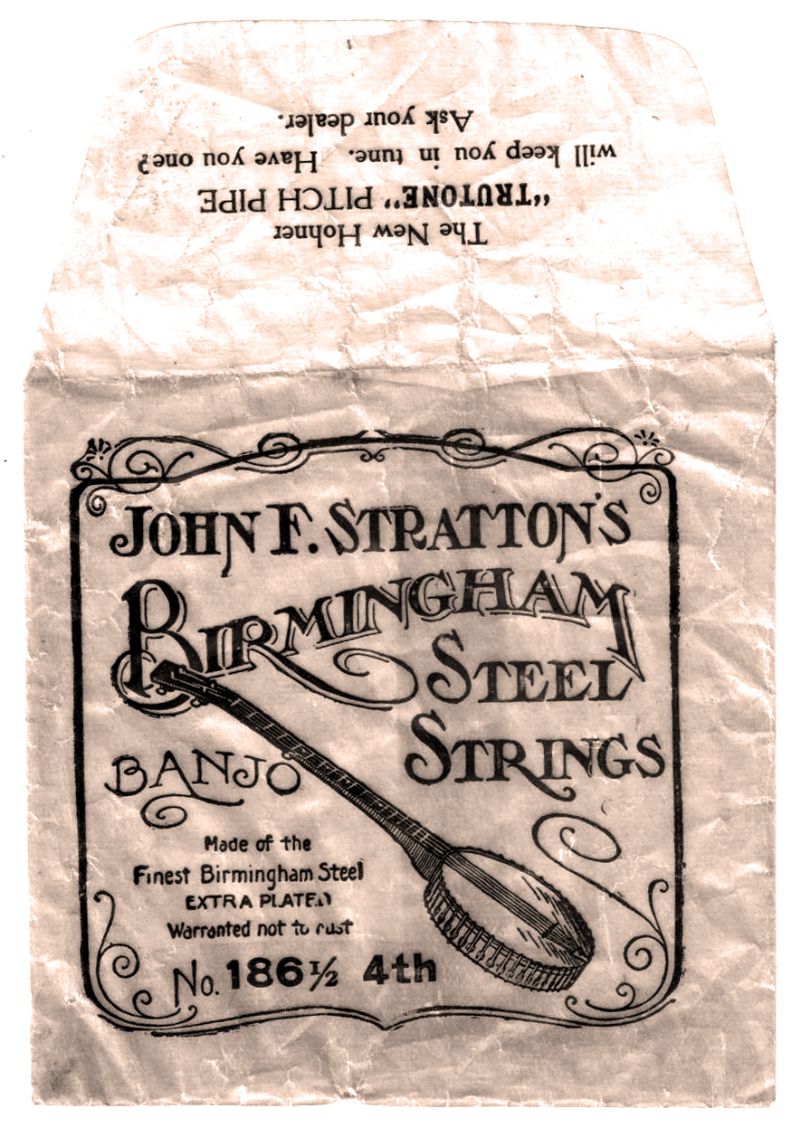
Speaking of English strings, I found this in the case of a Paramount I just acquired; thought it might be of interest here.
Edited by - Steven Ayres on 02/23/2026 15:53:26
Terms of Use | Privacy Policy | Privacy Consent (EU/GDPR Only)
Copyright 2026 Banjo Hangout. All Rights Reserved.