DVD-quality lessons (including tabs/sheet music) available for immediate viewing on any device.
Take your playing to the next level with the help of a local or online banjo teacher.
Weekly newsletter includes free lessons, favorite member content, banjo news and more.
Premier Sponsors


|
Please note this is an archived topic, so it is locked and unable to be replied to. You may, however, start a new topic and refer to this topic with a link: http://www.banjohangout.org/archive/407278
timsch - Posted - 02/10/2026: 15:42:34
I've got a Vegaphone with an open back that I play clawhammer on. I'm looking for the great sound that I had in mind when I got it, and feel that it's eluding me. It's sounding more muted than I expect. That being said, it's the only one I've ever played. It has medium steel strings (0.011) and a new Remo frosted head that should be adjusted about right based on what I've read here.
Reading a post here about bridge height, some said that those old banjos were made for 1/2 bridges. I had a 5/8 bridge on it, but swapped it out for an 11/16. Initially it sounded a little stronger, but i just shimmed the neck to get the action at the 12th fret back down and I'm not sure that it's still any better off. The shim is from some steel shim stock, about 3/8 tall and as wide as the neck. It's placed between the tension ring and the upper section of the neck. Now, I was playing in the garage rather than inside, so maybe the acoustics were different, although with more concrete, it should have sounded better.
So, before continuing to make adjustments, I figure I ought to check in with you more experienced people to see if I'm not working against myself anywhere.
What are tradeoffs with a taller bridge with regards to TONE on this older banjo?
Could shimming have an adverse effect?
pinenut - Posted - 02/10/2026: 16:17:40
quote:
Originally posted by timschI've got a Vegaphone with an open back that I play clawhammer on. I'm looking for the great sound that I had in mind when I got it, and feel that it's eluding me. It's sounding more muted than I expect. That being said, it's the only one I've ever played. It has medium steel strings (0.011) and a new Remo frosted head that should be adjusted about right based on what I've read here. med/lite 0.010 strings require less input for full volume and may help
Reading a post here about bridge height, some said that those old banjos were made for 1/2 bridges. I had a 5/8 bridge on it, but swapped it out for an 11/16. Initially it sounded a little stronger, but i just shimmed the neck to get the action at the 12th fret back down and I'm not sure that it's still any better off. The shim is from some steel shim stock, about 3/8 tall and as wide as the neck. It's placed between the tension ring and the upper section of the neck. Now, I was playing in the garage rather than inside, so maybe the acoustics were different, although with more concrete, it should have sounded better.
So, before continuing to make adjustments, I figure I ought to check in with you more experienced people to see if I'm not working against myself anywhere. Please discuss the head tension with drum dial numbers or deflection measurements.
What are tradeoffs with a taller bridge with regards to TONE on this older banjo? a 5/8" bridge is fine if the action allows it.Could shimming have an adverse effect? Yes, pressure against the tension hoop -> tone ring is bad; touching can be okay.
What tailpiece?
timsch - Posted - 02/10/2026: 17:05:27
quote:
Originally posted by pinenutquote:
Originally posted by timsch.... It has medium steel strings (0.011) and a new Remo frosted head that should be adjusted about right based on what I've read here. med/lite 0.010 strings require less input for full volume and may help
.....Please discuss the head tension with drum dial numbers or deflection measurements.
What are tradeoffs with a taller bridge with regards to TONE on this older banjo? a 5/8" bridge is fine if the action allows it.Could shimming have an adverse effect? Yes, pressure against the tension hoop -> tone ring is bad; touching can be okay.
What tailpiece?
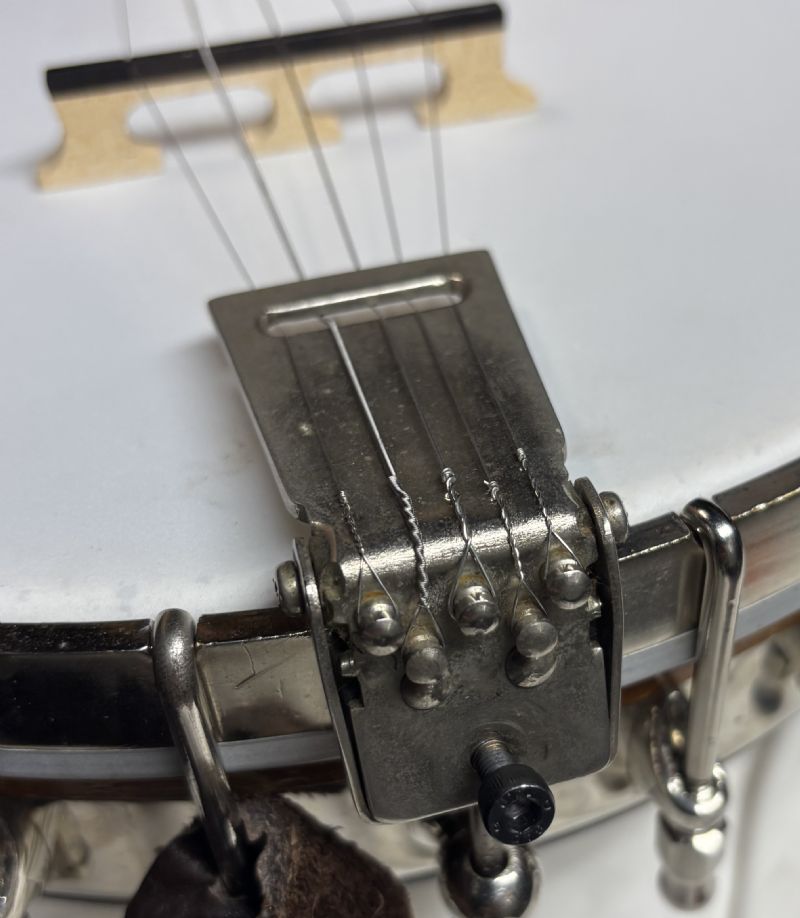
Tailpiece shown in photo below.
Head tension set using the 6" bar & coin method. I set the tension for a penny width gap under the bar at the bridge
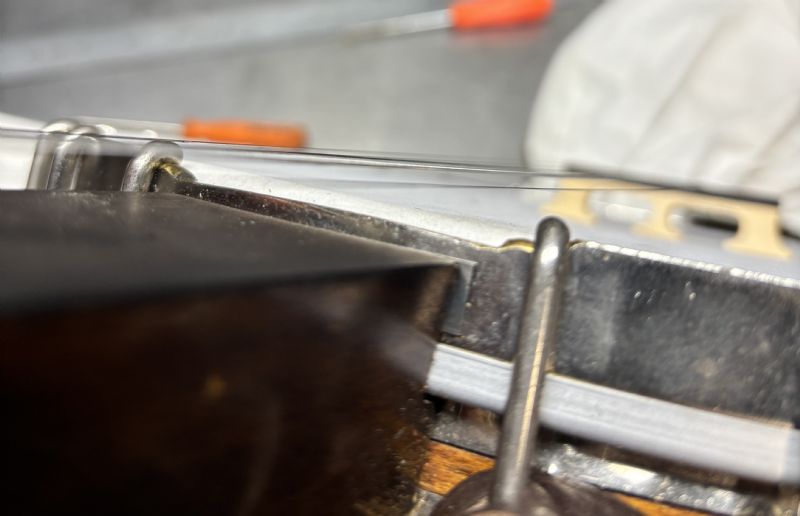
The shim as it currently is is shown in the pic below, just sticking out past the neck to the right. It makes perfect sense that you wouldn't want shim pressure to be on the tone ring. Too bad that location gives the best torque for tweaking the head angle. I'll move it down.
From the guitar world, lighter strings result in lower output. That's not necessarily the case on a banjo?
Edited by - timsch on 02/10/2026 17:06:37
tdennis - Posted - 02/10/2026: 19:19:52
How long have you been playing the Vega ? It sometimes takes a while for the player to understand an instrument & find the sweet spots to bring out it's best voice.
timsch - Posted - 02/10/2026: 19:30:36
quote:
Originally posted by tdennisHow long have you been playing the Vega ? It sometimes takes a while for the player to understand an instrument & find the sweet spots to bring out it's best voice.
Not long, but it's unlikely that I'd been doing everything right with the setup.
RG - Posted - 02/10/2026: 19:43:26
I'm not a big one for shimming the neck, I've built upwards of 40 banjos and have worked on a lot of vintage ones. here's a few suggestions:
1) Make sure the bridge is "free floating", in other words, you want down pressure, but make sure that the bridge isn't screwed down too tight on the tension hoop. It should be loose and as you tighten the strings "rise" a little. Then you can tighten your set screw.
2) I use thicker 2 foot bridges on vintage banjos, or Bart Veerman (he's a member here) "mystery wood" bridges that are un-topped and usually with a wider cross section at the top. Height is only an issue in regards to how much down pressure your tailpiece is exerting on the bridge.
3) Put a thin calf-skin head on it.
4) For head tension, the rule of thumb is a quarter width height over the pot using a 10" ruler for an 11" pot (or a ruler that is long as the inside head diameter). I suspect your head tension isn't set right. I set mine by feel, but I've done it for over 50 years and easier to show than describe.
5) Instead of shimming, reset your dowel stick (I'm assuming it's a dowel stick) or re-shape the heel to get the action at the 12th you want.
6) Also, double check your bridge placement, it might just be the photo, but the bridge looks close to the tailpiece which could also affect sound.
All of these suggestions are for what I *think* you're looking for in regards to "sound." Good luck.
Edited by - RG on 02/10/2026 19:56:40
timsch - Posted - 02/10/2026: 19:57:07
quote:
Originally posted by RGI'm not a big one for shimming the neck, I've built upwards of 40 banjos and have worked on a lot of vintage ones. here's a few suggestions:
1) Make sure the bridge is "free floating", in other words, you want down pressure, but make sure that the bridge isn't screwed down too tight on the tension hoop. I assume you mean the screw on the tailpiece. If so, can you elaborate on what "free floating" would be like?
2) I use thicker 2 foot bridges on vintage banjos, or Bart Veerman (he's a member here) "mystery wood" bridges that are un-topped and usually with a wider cross section at the top. I'll look into that. What does that change?
3) Put a thin calf-skin head on it. Is that for tone or projection? It came with one, but in my ignorance, I split it tightening it like a Remo.
4) The penny width you describe would indicate to me that the head tension is too high. possibly choking off the sound. Quarter width would be more appropriate and use a 10" ruler. Is that for the calfskin, or even my Remo?
5) Instead of shimming, reset your dowel stick (I'm assuming it's a dowel stick) or re-shape the heel to get the action at the 12th you want. Resetting the dowel stick would probably be beyond my comfort level. The heel sounds workable for me though. Any pointers on that?6) Also, double check your bridge placement, it might just be the photo, but the bridge looks close to the tailpiece which could also affect sound. Bridge is placed to get intonation correct
All of these suggestions are for what I *think* you're looking for in regards to "sound."
Thanks for the suggestions. Questions above
Bill Rogers - Posted - 02/10/2026: 21:03:57
I have a ‘24 Tubby that I’ve never really tweaked. We’re I to do that, I’d start with a lightweight, all-maple bridge. Whatever height works. All-maple is the key. Stay with your strings. Lighter ones run the risk of twanging and breaking up when used for clawhammer. If you don’t like the sound with a maple bridge, try different designs with ebony tops; I would stay with lighter weight. It may take 5 or 6 bridges to get the sound you want.
Bob Buckingham - Posted - 02/11/2026: 07:11:17
I've had good luck with Renn head on a tubaphone, with the tailpiece not cranked down. I use an old Snuffy Smith bridge I had sitting around. Heavier maple with ebony cap. GHS-PF160 strings. If it still has the old Rogers skin on it that should work great too.
pinenut - Posted - 02/11/2026: 11:09:16
quote:
Originally posted by timschquote:
Originally posted by pinenutquote:
Originally posted by timsch.... It has medium steel strings (0.011) and a new Remo frosted head that should be adjusted about right based on what I've read here. med/lite 0.010 strings require less input for full volume and may help
Tailpiece shown in photo below. It's a good tailpiece and should sound fine tensioned or floating.
Head tension set using the 6" bar & coin method. I set the tension for a penny width gap under the bar at the bridge
You are in range; try it a half turn up/down, or so. I currently choose about 91-92 on a Drum Dial. Too tight can sound tinny and too loose can sound muted and too tight or loose 'sorta' have similar tonal deficits. With banjos, head tension is the 'elephant in the room'.
banjohangout.org/archive/343194
hangoutstorage.com/banjohangou...52018.pdf
From the guitar world, lighter strings result in lower output. That's not necessarily the case on a banjo?
sorta... Unlike a guitar, too much volume can be a problem on the banjo; it's about finding balance.
Starting out, it's generally recommended to use light nines until the muscles and tendons get accustomed to the work; nines are easier to control and do come with a volume penalty (nylons are a good fit too). When a person starts to overdrive the nines and lose good musical sound it's time to look at refining control or move up in string size. I initially started with tens and moved to nines because I was not able to fully actuate the tens. That is not to say that going bigger is the goal, many people like the lighter nines and stay with them, because, they like the sound and feel.
I eventually moved up to light tens (PF150, 10-12-14-22w-10) and may move up to the more typical medium Vega (V730, 10-12-16-23w-10) strings. Larger strings need a stronger attack to fully realize their potential; a stronger attack wears the fingernails faster and is more difficult to execute quickly. note: yes, I have used elevens and they are a little thin sounding unless I get after it in a more pronounced fashion; more work and wear is not worth the gain for me at this time...
I view string choice as an 'ages and stages' or 'horses for courses' activity. Try them all and choose your personal 'Goldilocks'.
Edited by - pinenut on 02/11/2026 11:24:25
timsch - Posted - 02/11/2026: 11:54:34
I should get a drum dial if it's that finicky and varies so much from one head type to the next.
I've been playing lights on my Goodtime for several years now. Very easy to play. I wail on it pretty good and fast and haven't noticed any issues with the strings that I know of. Sounds nice, but not terribly loud.
Regarding bridges, I have a good amount of leftover maple stock from a stair project and tooling to be able to make my own. Anyone have drawings/dimensions for some recommended designs I could follow?
pinenut - Posted - 02/11/2026: 13:16:36
quote:
Originally posted by timschI should get a drum dial if it's that finicky and varies so much from one head type to the next.
Yes, do not wait ten years to get a Drum Dial
.
Tighten and loosen the head, evenly, until the tone/volume maxima is found. My observation has been that even tension is arguably more important than total tension. Once you get it where you want it; heads are pretty stable. I set my amber/frosted/suede mylar heads at roughly the same tension (91-92). note: Fiberskyn is a strong mute. I would still tension it the same; more than 92 is edging into the 'danger zone'. Skin/Hide heads are maintenance pigs; it's good to have/try them, but, not right out of the gate on your main player.
I've been playing lights on my Goodtime for several years now. Very easy to play. I wail on it pretty good and fast and haven't noticed any issues with the strings that I know of. Sounds nice, but not terribly loud. Me/Mine too; amber and nylons now. Also, Is the Vegaphone's head tension set the same as your Goodtime? The Vega should sound noticeably louder and richer than the Goodtime especially if it's a multi-ply Gumby. note: it may take a decent amount of time for your hand's play style and your ear to adjust to the Vega; this is normal and enhances your skills (tiny bit)...
Regarding bridges, I have a good amount of leftover maple stock from a stair project and tooling to be able to make my own. Anyone have drawings/dimensions for some recommended designs I could follow? Steel strings typically need a hard topper like ebony and the third leg; this helps with wear, distortion and energy transfer. Nylon strings do well with plain untopped two leg bridges. Your current bridge will do for getting setup roughed-in and can be refined at your convenience.I like the sweeter tone of compensated bridges, but, the more abrasive cutting tone of straight bridges has it's place.
Edited by - pinenut on 02/11/2026 13:31:04
RG - Posted - 02/11/2026: 14:20:21
quote:
Originally posted by timschquote:
Originally posted by RGI'm not a big one for shimming the neck, I've built upwards of 40 banjos and have worked on a lot of vintage ones. here's a few suggestions:
1) Make sure the bridge is "free floating", in other words, you want down pressure, but make sure that the bridge isn't screwed down too tight on the tension hoop. I assume you mean the screw on the tailpiece. If so, can you elaborate on what "free floating" would be like?just *very* loosely hand tighten the bridge nut at the shoe and let it "float" upwards as you adjust the strings to tension. Then, once tuned, just hand tighten the nut to the shoe. It shouldn't require much, if any, additional tightening.
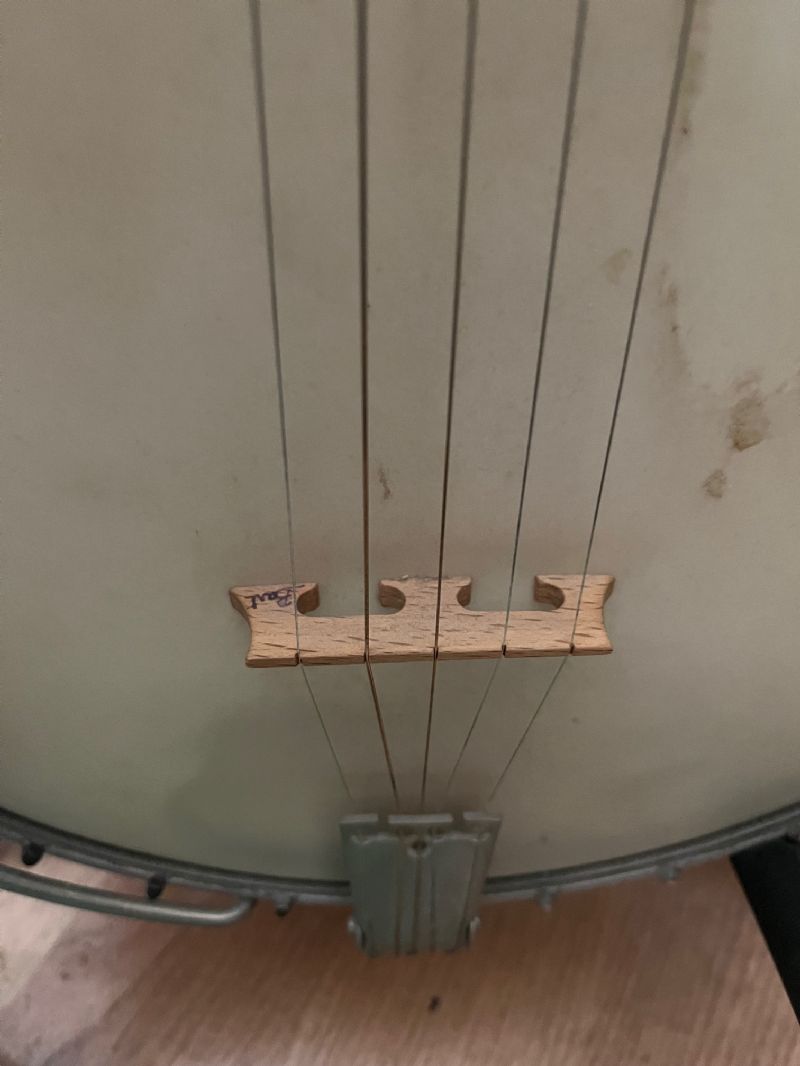
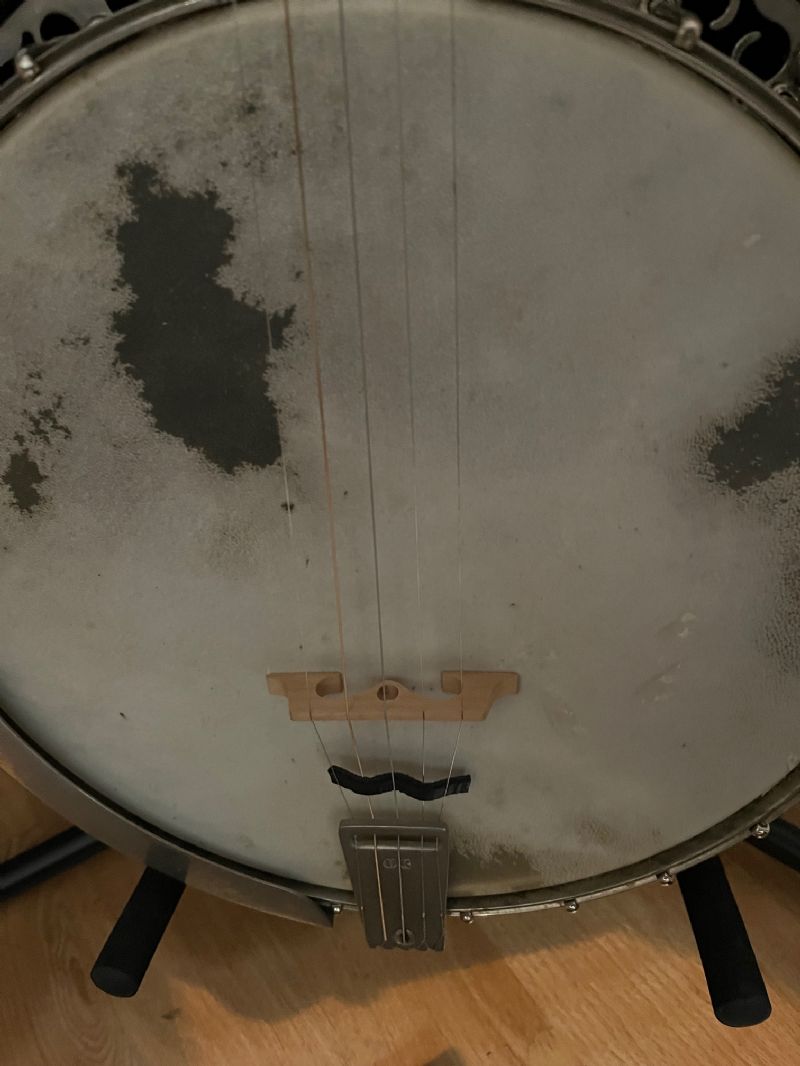
2) I use thicker 2 foot bridges on vintage banjos, or Bart Veerman (he's a member here) "mystery wood" bridges that are un-topped and usually with a wider cross section at the top. I'll look into that. What does that change?I've found sound transfer for older banjos to get that *sound* (and I exclusively use thin, unbleached medium goatskin heads on all my openback, resonated flathead and archtop tonering banjos) that most people look for is better to my ears with a two foot bridge. Topped bridges are too "brittle" and tinny to my ear, has to do with the "usually" harder wood they are topped with. A bridge made from a single piece of wood transmits sound to the head better in my experience, thicker bridges seem to "absorb" more of the overtones in my 50+ years experience of playing, and it doesn't have to be exclusively maple either, all woods have different tonal properties, and I believe that Bart's "mystery wood" bridges were at one time made from old bowling alley wood, whatever that was (hence the "mystery wood" moniker). I've attached photos of both 2 footed and 3 footed bridges on a couple of my banjos, the 2 footer (which is maple and made for me by request from David Cunningham) is on my 1974 Ome resonator with flathead tonering, and the 3 footer is a Bart Veerman untopped medium "mystery wood" on my openback Vega Little Wonder that I made a repro neck for,
3) Put a thin calf-skin head on it. Is that for tone or projection? It came with one, but in my ignorance, I split it tightening it like a Remo.Since a banjo doesn't have a soundboard, the head transmits the vibrations from the strings via the bridge to the tonering/pot assembly... I won't go into detail about the 3 play, multi-ply rims debate (vintage Vega's are multi-ply), but pot weight means a LOT to the overall sound of a banjo, as does the rim... skin heads can greatly affect tone and projection depending on thickness, material of the skin (cow or goat or muskrat or cat) and head tightness. I've installed hundreds of skin heads on banjo's including Ry Cooder's Mastertone that he got from Mike Seeger and played on tour with Ricky Skaggs, in general skin transmits sound better to the tonering/pot assembly than plastic in my opinion, I'm not an engineer so couldn't tell you why (it's all subjective to the player anyway), thin calfskin with gut strings on a vintage Fairbanks, Cole, SS Stewart et al. cranked down with gut strings can be LOUD. I buy medium unbleached heads from Elderly, and they are for me, the best sounding banjos heads for MY style of playing and what I'm looking for, but overall, I think any banjo sounds better with a skin head, UDM played with a skin head, as did Earl Scruggs when he played with Bill Monroe in the late 40's and early 50's as Flatt & Scruggs (plastic heads weren't available until the late 50's)... you can hear how different both players sounded depending on banjo played, tailpiece, tailpiece down pressure, bridge, strings and setup etc. i wouldn't waste money on a drum dial, over time, you'll learn to adjust a head just right by the feel of the head tension when it's depressed by thumb pressure at the bridge location, and by how it sounds to you for what sound you're trying to get out of a banjo.
4) The penny width you describe would indicate to me that the head tension is too high. possibly choking off the sound. Quarter width would be more appropriate and use a 10" ruler. Is that for the calfskin, or even my Remo?For any banjo head material. measured at the bridge.
5) Instead of shimming, reset your dowel stick (I'm assuming it's a dowel stick) or re-shape the heel to get the action at the 12th you want. Resetting the dowel stick would probably be beyond my comfort level. The heel sounds workable for me though. Any pointers on that?I wil only reset a dowel stick or recut a heel at customers insistence after I try to talk them out of it. Dowel stick resetting is the preferred method since it is reversible and retains the original attachment of the stick to the pot. Heel reshaping is generally best done along with a dowel stick reset, or if there is some type of dowel stick end adjuster (think Cole banjos which is an ingenious design), or if the banjo has truss rods; I assumed your banjo had a dowel stick, in which case if you re-cut the heel, you'd have to reset and re-drill the dowel stick end attachment which would usually require drilling another hole in the pot or using an "L" bracket which i would NEVER do. Dowel stick reset is a fairly simple repair , but for older banjo's I set them up with the bridge they were intended for... is the neck back-bowed, up-bowed or straight? Older banjos were built with zero neck incidence, most modern banjos are built with three degree incidence. The higher the bridge, the more down pressure is exerted on the tailpiece. What is the lowest bridge you can use to get the action that you want?
6) Also, double check your bridge placement, it might just be the photo, but the bridge looks close to the tailpiece which could also affect sound. Bridge is placed to get intonation correct
Copy.
All of these suggestions are for what I *think* you're looking for in regards to "sound."Thanks for the suggestions. Questions above
Edited by - RG on 02/11/2026 14:24:28
timsch - Posted - 02/11/2026: 16:06:03
Hooo Boy!!! These things are a lot more complex than I'd imagined. I shouldn't be surprised though.
RG, Thanks for all of this. I'm sure with your experience, a thumb is all that's needed, but I'm mighty green so will splurge on a drum dial at this point. It'll give me data to work with.
I'd love another skin head, but I am on the gulf coast and humidity is the norm. I've seen plenty of warnings on this combo, although they can be conditioned/waterproofed from what I read. Do you do any of this?
The dowel stick reset in this case is just removing it and then reinstalling it at a different angle? Considering I'm looking at this for action alone, I ought to try a 1/2" bridge to see if that gets me what I want before going to greater/riskier effort. The neck has about 0.005" gap at the 12th fret under a machinist's ruler with string tension, so I'd imagine it's straight without tension.
Pinenut, I do have the head tension set up the same. The Vega is louder, but is still shimmed up against the tension ring, so I'm likely not getting the true sound I should be.
Are nylon strings only really good with a skin head? Would the Remo not be a good match?
pinenut - Posted - 02/11/2026: 17:01:30
quote:
Originally posted by timschHooo Boy!!! These things are a lot more complex than I'd imagined. I shouldn't be surprised though.
RG, Thanks for all of this. I'm sure with your experience, a thumb is all that's needed, but I'm mighty green so will splurge on a drum dial at this point. It'll give me data to work with.RG is a powerful resource (drinking from a fire-hose, save that data and eat it slow).
I learned more about head tension and how to go about it, in a few months with a Drum Dial than in years without (faster learning curve). I may not actually 'need' one anymore, but, using tools to be faster and more accurate is a 'good thing'.
I'd love another skin head, but I am on the gulf coast and humidity is the norm. I've seen plenty of warnings on this combo, although they can be conditioned/waterproofed from what I read. Do you do any of this?
The dowel stick reset in this case is just removing it and then reinstalling it at a different angle? Considering I'm looking at this for action alone, I ought to try a 1/2" bridge to see if that gets me what I want before going to greater/riskier effort. The neck has about 0.005" gap at the 12th fret under a machinist's ruler with string tension, so I'd imagine it's straight without tension.
Pinenut, I do have the head tension set up the same. The Vega is louder, but is still shimmed up against the tension ring, so I'm likely not getting the true sound I should be.If the shim can be removed and the action set with bridge height; do so. Tweak the head tension until it maximizes. Go slow, this is usually noticeable and graceful with 1/8~1/4 turns on the nuts. Work the edges of the vellum with your thumbs to make sure the tension changes take and learn what it's supposed to feel like and take lots of time to play between changes. note: just like strings, head tension adjustments work best when increasing.
And as others have said triple check that bridge location; use a tape measure initially and an electronic tuner by fretting at the twelfth and comparing to the open string until it's just the right compromise between the first four strings (usually within ~1/16" is good)
And, it is a real thing about 'new to me' banjos changing just by playing them; we like to attribute this to the instrument opening up (and they can), often, it's just us adapting to the instrument. Beware of yourself.
Are nylon strings only really good with a skin head? Yes, but, skin heads, especially fresh installs, need to be adjusted regularly for peak performance and they have their on/off days.Would the Remo not be a good match? I like Rennaisance/Amber heads with nylon strings, a simple two legged bridge and a short tailpiece; it's a fine compromise.
Edited by - pinenut on 02/11/2026 17:19:16
timsch - Posted - 02/11/2026: 20:10:54
quote:
Originally posted by Bob BuckinghamI've had good luck with Renn head on a tubaphone, with the tailpiece not cranked down. I use an old Snuffy Smith bridge I had sitting around. Heavier maple with ebony cap. GHS-PF160 strings. If it still has the old Rogers skin on it that should work great too.
Is the Renn head just short for Renaissance head?
pinenut - Posted - 02/11/2026: 20:45:28
quote:
Originally posted by timschquote:
Originally posted by Bob BuckinghamI've had good luck with Renn head on a tubaphone, with the tailpiece not cranked down. I use an old Snuffy Smith bridge I had sitting around. Heavier maple with ebony cap. GHS-PF160 strings. If it still has the old Rogers skin on it that should work great too.
Is the Renn head just short for Renaissance head? Yes, also known as amber. Tubaphones can really peel the paint with an amber head; I now run frosted on mine...
Edited by - pinenut on 02/11/2026 20:46:57
RG - Posted - 02/11/2026: 21:11:14
quote:
Originally posted by timschHooo Boy!!! These things are a lot more complex than I'd imagined. I shouldn't be surprised though.
RG, Thanks for all of this. I'm sure with your experience, a thumb is all that's needed, but I'm mighty green so will splurge on a drum dial at this point. It'll give me data to work with.
I'd love another skin head, but I am on the gulf coast and humidity is the norm. I've seen plenty of warnings on this combo, although they can be conditioned/waterproofed from what I read. Do you do any of this?A properly installed hide head should have minimal movement in humidity; the number of intact and playable original Jos.Rogers (or other brand & unnamed) hide heads found on vintage banjos 100+ years old is a testament to that. There's a trick to installing a skin head that I learned through doing; DON'T soak the hide in water, just dampen he entire skin under running cold water for 5-10 seconds. When it's damp, install it (I turn 1/8' square brass stock for my flesh hoops since I think they "hold" better against the tension hoop), and then tighten the tension hoop a half turn around the pot at a time almost to the point that you would want the finished tension to be. Once the hide is dry (I usually wait 48 hours and NEVER dry any hide/leather with heat, let it air dry), then tighten the tension hoop to final specs... it usually should only be an eighth to a quarter turn on the nuts and there you go... the mistake most people make is completely soaking the hide and then installing it initially under minimal tension, and then over-tightening to get to the desired tension. I don't use water repellent on the hide (don't need it) and have only had one head split in 30+ years of installing them, and that was acually a flaw in the hide. I find goat skin to be far more forgiving to temp/humidity changes than calfskin. If you regularly check head tension, you shouldn't have any problems.
The dowel stick reset in this case is just removing it and then reinstalling it at a different angle? Considering I'm looking at this for action alone, I ought to try a 1/2" bridge to see if that gets me what I want before going to greater/riskier effort. The neck has about 0.005" gap at the 12th fret under a machinist's ruler with string tension, so I'd imagine it's straight without tension.Essentially yes. I would definitely try a 1/2' bridge, that's probably the original size bridge the banjo was designed for.
Pinenut, I do have the head tension set up the same. The Vega is louder, but is still shimmed up against the tension ring, so I'm likely not getting the true sound I should be.
Are nylon strings only really good with a skin head? Would the Remo not be a good match?I string all of my banjos with wire (they all have hide heads and are not banjos designed originally for gut) with the following gauge strings (I make up my own sets using GHS strings); 0.0125 first; 0.013 2nd; 0.018 stainless wound 3rd; 0.024 bronze wound 4th; and a USED 0.013 second string for the 5th, I like the used and slightly "dull" second string (for lack of a better word) 5th as I find it doesn't "ring" as much as a new string, and I obviously like heavy gauge strings. I RARELY change strings, although I play a lot... for the simple fact that once I get the tone I like, I don't mess a lot with the setup, and that includes strings. You can hear from my sound files that my banjos have decent tone (to my ears anyway) for my style of play, and those strings have basically been on the banjos played for over 10 years. If a vintage banjo was originally designed for gut, I'll use thin monofilament fishing line or nylon strings in various thicknesses depending on what sound I want. So, long answer to a short question, nylon works fine with hides or plastic heads, as does wire if the banjo was designed to utilize wire strings, or the vintage banjo has a sufficiently thick enough neck to take wire (most vintage Vega banjos built after 1910 are in my experience).
Edited by - RG on 02/11/2026 21:13:52
Bob Buckingham - Posted - 02/12/2026: 13:15:04
quote:
Originally posted by timschquote:
Originally posted by Bob BuckinghamI've had good luck with Renn head on a tubaphone, with the tailpiece not cranked down. I use an old Snuffy Smith bridge I had sitting around. Heavier maple with ebony cap. GHS-PF160 strings. If it still has the old Rogers skin on it that should work great too.
Is the Renn head just short for Renaissance head?
Yes.
timsch - Posted - 02/20/2026: 12:18:45
Yessir!! Just made me a 1/2" bridge from maple, pulled the shim, let the bridge float. Left everything else the same, and it sounds ALOT better. Action is about perfect for me too.
I'm looking forward to trying some different nut weights & materials and different heads and strings too to see how much better/different it can be still.
Thank you much!
timsch - Posted - 03/17/2026: 07:35:18
I just got the parts & tools I need to make the rest of these changes. are there any better instructions/tips than in this video for using the Drumdial?
What Drumdial tension settings are recommended for old time clawhammer with a Renaissance head and medium steel strings? Thanks.
Terms of Use | Privacy Policy | Privacy Consent (EU/GDPR Only)
Copyright 2026 Banjo Hangout. All Rights Reserved.