DVD-quality lessons (including tabs/sheet music) available for immediate viewing on any device.
Take your playing to the next level with the help of a local or online banjo teacher.
Weekly newsletter includes free lessons, favorite member content, banjo news and more.
Premier Sponsors


|
Please note this is an archived topic, so it is locked and unable to be replied to. You may, however, start a new topic and refer to this topic with a link: http://www.banjohangout.org/archive/403815
Banjo Bolton - Posted - 06/19/2025: 23:04:24
Hello.
I’ve just bought my first Tackhead (fretless, goat head and nylon strings)
My other banjo is a RK-OT strung with nylon strings - rightly or wrongly I never worry or think too much about tunings. I simply tune to which ever song I’m learning.
However, with the new Tackhead…
Am I correct in thinking the tunings of a banjo like this should be lower than that of a regular banjo?
If so why? Is it because tackheads and gourd banjos are more delicate or because they simply sound better in lower tunings?
And is there a particular method I can use to convert the tunings of my favourite songs ? For example, if I usually play Josie O in (f,D,G,C,D) would I tuning a note down (E,C,E,B,C)?
I did try this and it didn’t sound nice.
Any advice would be much appreciated
Thankyou
amsweet - Posted - 06/20/2025: 03:28:07
Congratulations on the new banjo!
I'll let others with more knowledge than me answer your question about why gourd and tackhead banjos tend to use lower tunings.
The reason Josie O did not sound good in the new tuning, however, is because you did not "convert" the tuning correctly. If you were looking to tune f D G C D a whole step down, you would end up in eb C F Bb C tuning. There is not a whole step in between E and F and in between B and C, only a half step, which is where you went wrong. Think of it like a piano and count down the keys, taking the black keys into consideration.
For a quick way to convert your tunings, you can write down the notes in order in a piece of paper and then count down the number of half steps you want to tune.
A A#/Bb B C C#/Db D D#/Eb E F F#/Gb G G#/Ab
So if you wanted to tune down your Josie O tuning three half steps, you would end up with d B E A B.
I hope that makes sense!
Banjo Bolt - Posted - 06/20/2025: 07:24:31
thank you, thats Really helpful!
so, as long as I tune all 5 strings by incriments of half steps, I'll be able to experement to find lower tunings for all the songs I know.
trapdoor2 - Posted - 06/20/2025: 07:40:09
Generally, lower tunings are simply harking back to history. Sometimes we find those old tunings tickle our ears.
The strength of the banjo can be a limiting factor. A tackhead's head cannot be tightened to support higher string tension if it is slack.
For any given tuning, you have to move every string equally to reduce pitch or raise it. Steps only matter in that they're all done equally. Half, whole, two, six...just make sure every string is moved the same.
trapdoor2 - Posted - 06/20/2025: 11:14:55
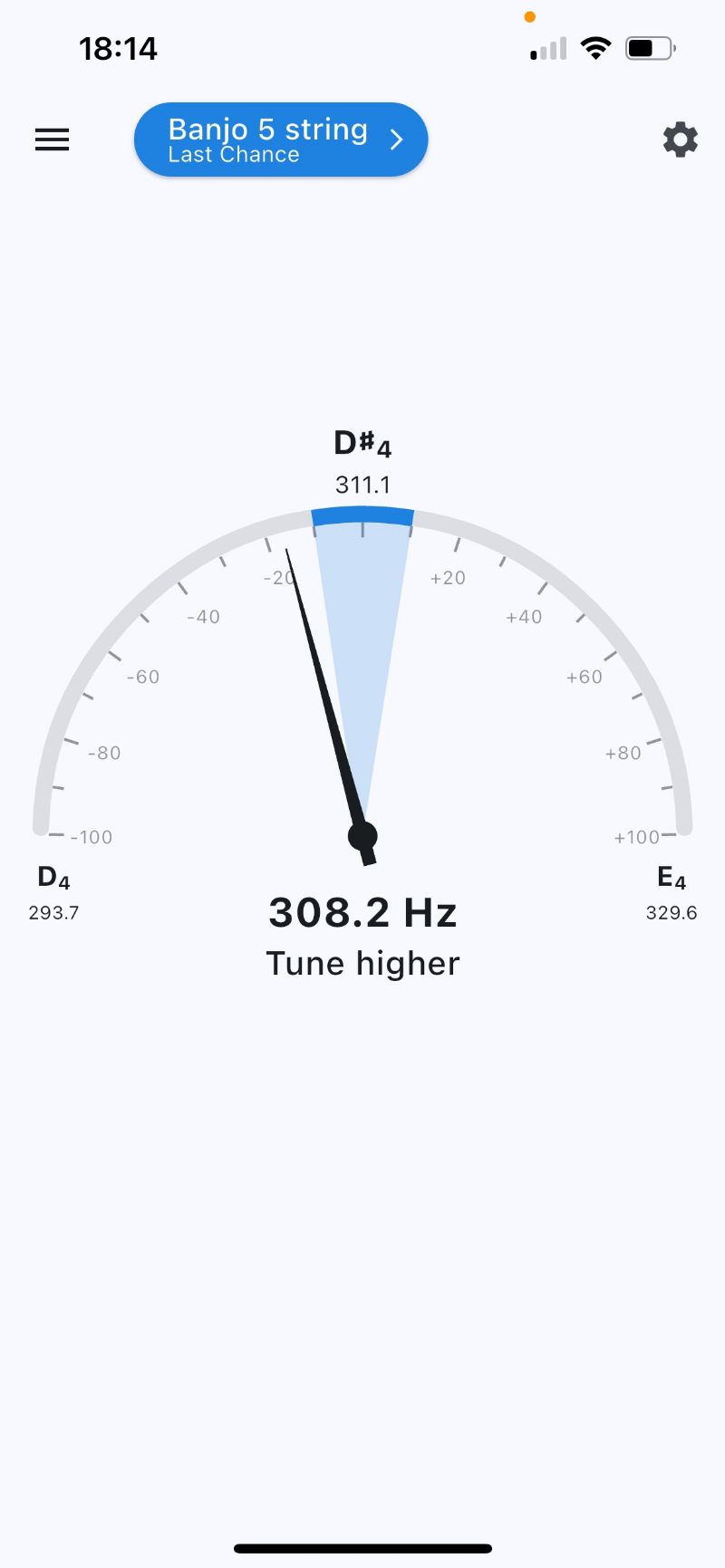
It is a Helmholtz system number. It indicates the specific octave using Helmholtz's system.
en.wikipedia.org/wiki/Helmholt..._notation
LyleK - Posted - 06/21/2025: 10:57:27
An excellent source is Noah Cline's gourd banjo tuning guide at YouTube, described and linked in his thread: banjohangout.org/archive/363481
Granted, a tackhead is not a gourd, but Mark Smith's comment about not being able to tighten the head on a tackhead applies in both cases. When I got a tackhead banjo made by Eric Prust he supplied it with different height bridges to deal with changes in the humidity.
John Yerxa - Posted - 06/21/2025: 12:43:11
The small markings on the tuning app are just percentages of a tone. Useful for tuning things like accordion or harmonica reeds to slightly different pitches.
Wobba - Posted - 06/21/2025: 20:36:06
You do need to pay attention to those numbers when you're tuning.
The strings should be tuned as follows:
1st: D4
2nd: B3
3rd: G3
4th: D3
5th: G4
The larger number indicates a higher octave of the note, so D4 is an octave higher than D3, and G4 (5th string) is an octave higher than G3 (3rd string).
Terms of Use | Privacy Policy | Privacy Consent (EU/GDPR Only)
Copyright 2026 Banjo Hangout. All Rights Reserved.