
DVD-quality lessons (including tabs/sheet music) available for immediate viewing on any device.
Take your playing to the next level with the help of a local or online banjo teacher.
Weekly newsletter includes free lessons, favorite member content, banjo news and more.
Premier Sponsors


|
Please note this is an archived topic, so it is locked and unable to be replied to. You may, however, start a new topic and refer to this topic with a link: http://www.banjohangout.org/archive/342391
Texasbanjo - Posted - 05/03/2018: 08:21:34
Circle of 5th is easy, Pat Cloud's book takes some studying until the light bulb comes on in your brain.
What problem are you having with the circle of 5ths?
kmwaters - Posted - 05/03/2018: 08:24:43
Nothing in particular - thanks for asking. I think I just have to read it more slowly and let things sink in little by little. Just looking at the circle is intimidating.
n1wr - Posted - 05/03/2018: 08:37:32
I always just used the circle to remember key signature - clockwise from C, G (1 sharp), D (two sharps), A, (3 sharps), etc. Go counter clockwise from C, same thing but flats.
Mooooo - Posted - 05/03/2018: 08:49:46
I never had the Pat Cloud book, but the Circle of 5ths is really cool when you see all that you can get from it. the order of flats and sharps in keys, pick a key and easily see the 1,4,5 chords. Draw a square inside and see the notes to augmented chords, draw a triangle and see the notes to diminished chords. Opposite sides show you tritone substitutions...etc. If you draw it yourself you can learn a lot more than if you just look at someone else's. Of course you can live your entire life without it and be just as happy.
Edited by - Mooooo on 05/03/2018 08:52:18
Fathand - Posted - 05/03/2018: 09:19:10
The Circle of fifths is also the Circle of Fourths depending if you go around clockwise or anti-clockwise. Like Mooooo said there is a lot of other info that you can get from it.
I think one of the first things that can help understand the Circle, Pat's Book and the Nashville Number system is to be able to calculate a Major Scale from the root note going Whole Tone, Whole Tone, Half Tone, Whole Tone, Whole Tone, Whole Tone, Half Tone. From there you can learn other scales or chords by knowing which interval to sharp or flat. That is what helped me and I learned most of it from the Scruggs Book.
Like many things you won't learn much by just reading about it. Put things into practice. Try using what you know to change a song's key for instance.
rockyisland - Posted - 05/03/2018: 10:11:00
quote:
Originally posted by MoooooDraw a square inside and see the notes to augmented chords, draw a triangle and see the notes to diminished chords.
Correct me if I'm wrong but isn't it the other way around, augmented with the triangle and diminished with the square?
kmwaters - Posted - 05/03/2018: 10:30:32
yeah I may have to go with the old adage "ignorance is bliss".
Mooooo - Posted - 05/03/2018: 10:32:50
quote:
Originally posted by rockyislandquote:
Originally posted by MoooooDraw a square inside and see the notes to augmented chords, draw a triangle and see the notes to diminished chords.
Correct me if I'm wrong but isn't it the other way around, augmented with the triangle and diminished with the square?
Yes, you are right and I am a moron....sorry about that. And it's a full diminished. Thanks for the correction
Lew H - Posted - 05/03/2018: 11:25:44
Given Mooooo and Fathand 's remarks, I wonder if there is commercial wheel with the square and triangle to show the augmented and diminished chords--so you can just spin the wheel or square or triangle, and get an answer.
Mooooo - Posted - 05/03/2018: 11:30:52
quote:
Originally posted by Lew HGiven Mooooo and Fathand 's remarks, I wonder if there is commercial wheel with the square and triangle to show the augmented and diminished chords--so you can just spin the wheel or square or triangle, and get an answer.
Lew, I think the same thing when I look at the wheel I have drawn too, would be great to have made out of laminated cardboard or thick paper. I have the modes on the outside of the circle which could also be swerved around to give the modes in each key too.
Here's a cool link to help out Interactive Circle of Fifths, mine is bookmarked
Edited by - Mooooo on 05/03/2018 11:34:47
250gibson - Posted - 05/03/2018: 12:20:53
The circle of 4ths/5ths is just a tool to visually illustrate the relationships between various keys/intervals. There is no magic associated with the understanding of it. There are other ways to draw the relationships. For instance, I "think" music in terms of a bass neck as it is the first instrument I learned to play. So is someone asks me what the realitive minor of Eb (or any key for that matter), I usually mentally visualize the 6th interval of Eb on the bass neck to determine the root. It is also usually easier/quicker for me to write music in the bass clef, then later transpose to the clef needed (computer software makes this very easy). Usually this is how any language works. I had an old German teacher years ago who spoke, Russian, German, Portuguse, and English due to different circumstances in her life (He parents were Russian, she was born in Germany, married Brazilian, and emigrated to the US after marriage. She spoke all fluently, however she told me she "thinks and speaks to herself" in Russian as that was the first language she learned, albeit the one she used least in everyday life.
Fathand - Posted - 05/03/2018: 13:41:06
quote:
Originally posted by Lew HGiven Mooooo and Fathand 's remarks, I wonder if there is commercial wheel with the square and triangle to show the augmented and diminished chords--so you can just spin the wheel or square or triangle, and get an answer.
There are Circle of Fifths "Apps" available to download online. I have one in my phone but it is somewhat basic showing the circle including the relative minors and the diminished chords which I don't understand the relationship or use of C to B dim for example.
Rawhide Creek - Posted - 05/03/2018: 14:34:52
quote:
Originally posted by Moooooquote:
Originally posted by Lew HGiven Mooooo and Fathand 's remarks, I wonder if there is commercial wheel with the square and triangle to show the augmented and diminished chords--so you can just spin the wheel or square or triangle, and get an answer.
Lew, I think the same thing when I look at the wheel I have drawn too, would be great to have made out of laminated cardboard or thick paper. I have the modes on the outside of the circle which could also be swerved around to give the modes in each key too.
Here's a cool link to help out Interactive Circle of Fifths, mine is bookmarked
There was one available, made from plastic, back in the early/mid-80s. It was presented on an 8-1/2x11 page punched for inclusion in both 2- and 3-ring binders, with a grommet for the round part to revolve. I wouldn’t be surprised if I don’t have one in one of my boxes of method materials downstairs. I con’t remember the publisher, but maybe it will come to me.
Edited by - Rawhide Creek on 05/03/2018 14:38:18
Laurence Diehl - Posted - 05/03/2018: 15:15:50
Once you internalize the theory you don't need any gadgets, charts or diagrams. And unless you internalize the theory you will never be able to really use it. It's like having to read FMB from tab still when you're 3 years into it. But you don't have to take my word for it.
monstertone - Posted - 05/03/2018: 15:57:22
Circle of 5ths. Fiddle, Mando & Tenor banjo are tuned in fifths that is G D A E (TB is C G D A same as viola & mandola) going from low to high, each string is the fifth tone of the previous. Going from high to low, each string is the forth tone of the previous. Transposing from D to A for example ,on the fiddle or mando, is simply a manner of moving everything over to the the next string.
3/4 Bass as well as the 6th thru 4th strings on guitar are low to hi E, A, D, G, 4ths going up, 5ths going down.
All of this is logical one you learn it. The 5 string banjo tuning makes no sense at all musically, just that open tuning makes a G chord.
When I started studying banjo, I was totally clueless about this stuff. Fortunately, the old guy I was studying under understood it all and had a simple way of explaining it. Count it on your fingers. A major chord consists of the 1, 3, & 5 tones of a scale. A minor chord flats the 3rd. A dominate 7th adds a flatted 7th note to the major chord. The most common chords in any scale are the 1, 4, & 5. The relative minor chords to that scale will be the 6m. 9m & 10 dom7. It goes on from there but that was enough that I could remember. (6, 9, & 10 are the same intervals as 1, 4, & 5, just keep counting on the other hand, like a little kid learning to count to ten  )
Music is all about intervals, basic math. The common western scale (Ionian mode) starting at the root being zero advancing up one octave , ) 0, 2 whole tones, one half tone, 3 whole tones, one half tone.
Mooooo - Posted - 05/03/2018: 16:37:00
A cool thing I learned over on the 4-String Jazz Forum from Eddy Davis is that you don't really need all the notes of the chord to imply the Dom 7th chord, you only need the 3 and the 7. So going through the cycle of 5ths is easy as those two notes descending a half tone at a time giving you the circle of say C7 to F7 to Bb7 to Eb7...etc... just by making a tritone interval and sliding it down one fret at a time where the 7(Bb) and 3(E) of C7 slid down become the 3(A) and the 7(Eb) of F7...etc... back and forth like that just by sliding one shape down each fret.
Rawhide Creek - Posted - 05/03/2018: 16:40:18
quote:
Originally posted by Laurence DiehlOnce you internalize the theory you don't need any gadgets, charts or diagrams. And unless you internalize the theory you will never be able to really use it. It's like having to read FMB from tab still when you're 3 years into it. But you don't have to take my word for it.
Of course, you may need a chart or diagram to “internalize” the Circle of Fifths (and perhaps other concepts) in the first place, i.e., as a (conceptual) starting point. A good way to “internalize” the Circle of Fifths is to learn to draw it, an exercise I required of all my students back when.
Mnemonics are sometimes useful, too.
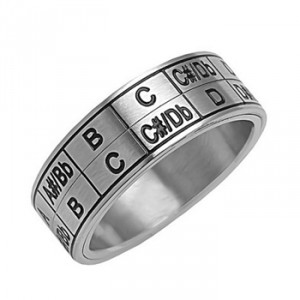
I do draw the line at “gadgets” like the “transposiing ring”:
Edited by - Rawhide Creek on 05/03/2018 16:52:50
Lew H - Posted - 05/03/2018: 17:33:17
Thanks for all the responses and comments. Y'all motivated me to look to see what is available. Amazon has a batch of wheels and books on the circle of 5ths.
amazon.com/s/ref=nb_sb_ss_i_4_...6EY6355Z6
I was in a workshop by Bill Keith at Suwannee Banjo Camp on the circle of fifths a decade or so ago. I didn't use it until I wanted to learn to play banjo on a tune with several major chords and a couple of minors. The song seemed to be in a minor key. Being an oldtime picker and needed to find a compatible tuning or key, however, I found the banjo tuning-key to be a problem. I drug out the circle of fifths handout and looked to see where central spot was--where all the chords were related in some way. I found that F major (on my longneck banjo) was the tuning where the chords made sense, and where I could quickly find open chords.
These days I'm doing more old pop tunes that are really chordy in ways I don't understand. I can sometimes infer chords correctly, but not always--there's so many augmented, sustained, and diminished chords that I don't infer right. Maybe I'll order one of those circle of 5ths wheels--but from Elderly instead of Amazon!
Meles_Meles - Posted - 05/03/2018: 19:28:56
!) I actually use that 'transposing ring' to teach my students; I find that it serves as a good conceptual aid.
2) As far as mnemonics go, as a young'un we were taught:
"Father Charles Goes Down and Ends Battle" for the sharps, and
"Battle Ends And Down Goes Charles' Father" for the flats of the key signature.
It works for the circle of fifths, too.
Rawhide Creek - Posted - 05/03/2018: 21:21:14
Good point—and taken—about the transposing ring. I shouldn’t deprecate something I’ve not used.
Texasbanjo - Posted - 05/04/2018: 04:50:03
My husband made us a circle of 5ths/4ths many years ago. It was a circle with the notes (chords) written in and you could twist it around to whatever key you wanted and it would point to the 1, 4, 5 chords. I have no idea if I still have it or not, but I'll look and see and if I can find it, I'll post a picture.
Ira Gitlin - Posted - 05/04/2018: 07:36:47
Ken, instead of talking 4ths, 5ths, key signatures, etc., how about starting with actual musical experience, like "Salty Dog Blues". Why does that chord progression work? Well, the E makes you want to go to the A, the A makes you want to go to the D, and the D finally brings you home to the G.
OK, so maybe we do have to talk 5ths a little. ;^)
In general he 5 makes you want to go to the 1. D is the 5 of G, and you must have noticed how the second-to-last chord in most G songs is a D, right? Well, the A is the 5 of the D, and the E is the 5 of the A, so (as said in previous paragraph) E makes you want to go to the A, the A makes you want to go to the D, and the D finally brings you home to the G.
If we keep going like that, the 5 of E is B, the 5 of B is F# or Gb, the 5 of F# or Gb is C# or Db, the 5 of Db is Ab, the 5 of Ab is Eb the 5 of Eb is Bb, the 5 of Bb is F, the 5 of F is C, and the 5 of C is G.
At this point we've hit all 12 major chords without repeating. No one song is going to use the whole circle, but it's a way of organizing the relationships among the chords--or keys, or key signatures, etc.--in ways that correspond to what we actually play.
Our late master Bill Keith could discuss this for hours on end!
Edited by - Ira Gitlin on 05/04/2018 07:38:11
monstertone - Posted - 05/04/2018: 09:11:34
To the novice, all of this may as well be Greek. So I'll muddy the waters a bit more.  The phase "makes you want to go to" is called "resolve" a D chord naturally wants to resolve to G. (V resolves back to I) adding the 7th, in this case C to the D chord making it a dominate 7th makes that "want" even stronger. For lack of a better way of putting it. But you don't want to play that note until it's time to move. That's the signal!
Now that I have (some) thoroughly confused, it gets easier with time. If you really listen and pay attention to what you hear and play, your ears will be able to pick out these signals. You'll hear these chord changes coming, & you'll know where it is going. You can read or be lectured about this stuff until you're blue in the face or like me, nod off. But after a while, it begins to click. Like singing Do Re Me Fa So La Ti Do. Most of us have been doing that for as long as we can remember. We take it for granted, even though even one ever explained how it worked. Ear training, conditioning.
Mooooo - Posted - 05/04/2018: 09:35:14
Another cool thing about the Circle is that you can take any 5 consecutive notes of the circle, rearrange them alphabetically and you have a pentatonic scale. It's easy to memorize the order of the Circle. It repeats on each side (flat and sharp).
Edited by - Mooooo on 05/04/2018 09:39:21
Texasbanjo - Posted - 05/04/2018: 13:18:28
Well, I've looked and looked and I can't find the circle of 5th deal that Dave made. Maybe I'll come across it one of these days.
Basically, it was two circles, one smaller than the other that he put a hole through each one and put a brad through the holes to keep them together and then he went around and put the notes in C, D, E, etc. and you could spin the little circle to the key you wanted and get the major chords for whatever key you needed. It was a neat little deal.
dr4dpet - Posted - 05/05/2018: 17:41:06
quote:
Originally posted by TexasbanjoWell, I've looked and looked and I can't find the circle of 5th deal that Dave made. Maybe I'll come across it one of these days.
Sherry, there is a downloadable pdf of this at Creek Don't Rise.
Also, Fretboard Toolbox has a 15 page pdf on the use of the Circle of 5ths.
Texasbanjo - Posted - 05/06/2018: 04:43:19
Thanks, that's similar to what Dave made, but his was simplier, easier to read and understand.
Maybe I'll come across it one of these days and if I do, I'll post it.
G Edward Porgie - Posted - 05/06/2018: 09:11:01
If you're too confused by the circle of fifths theory, simply draw a circle on your table and place all your whiskey bottles in it.
Ferry - Posted - 05/06/2018: 18:02:24
Circle of Fifths is made a lot easier w/ knowledge of major scales and vice versa.
dr4dpet - Posted - 05/16/2018: 18:59:21
Sherry,
I made this based on the the circle for Creek Dont Rise, hopefully the font is easier to read. I hope it is useful to someone.
Edited by - dr4dpet on 05/16/2018 18:59:51
Terms of Use | Privacy Policy | Privacy Consent (EU/GDPR Only)
Copyright 2026 Banjo Hangout. All Rights Reserved.


