DVD-quality lessons (including tabs/sheet music) available for immediate viewing on any device.
Take your playing to the next level with the help of a local or online banjo teacher.
Weekly newsletter includes free lessons, favorite member content, banjo news and more.
Premier Sponsors


|
Please note this is an archived topic, so it is locked and unable to be replied to. You may, however, start a new topic and refer to this topic with a link: http://www.banjohangout.org/archive/336821
rmcdow - Posted - 11/19/2017: 18:56:01
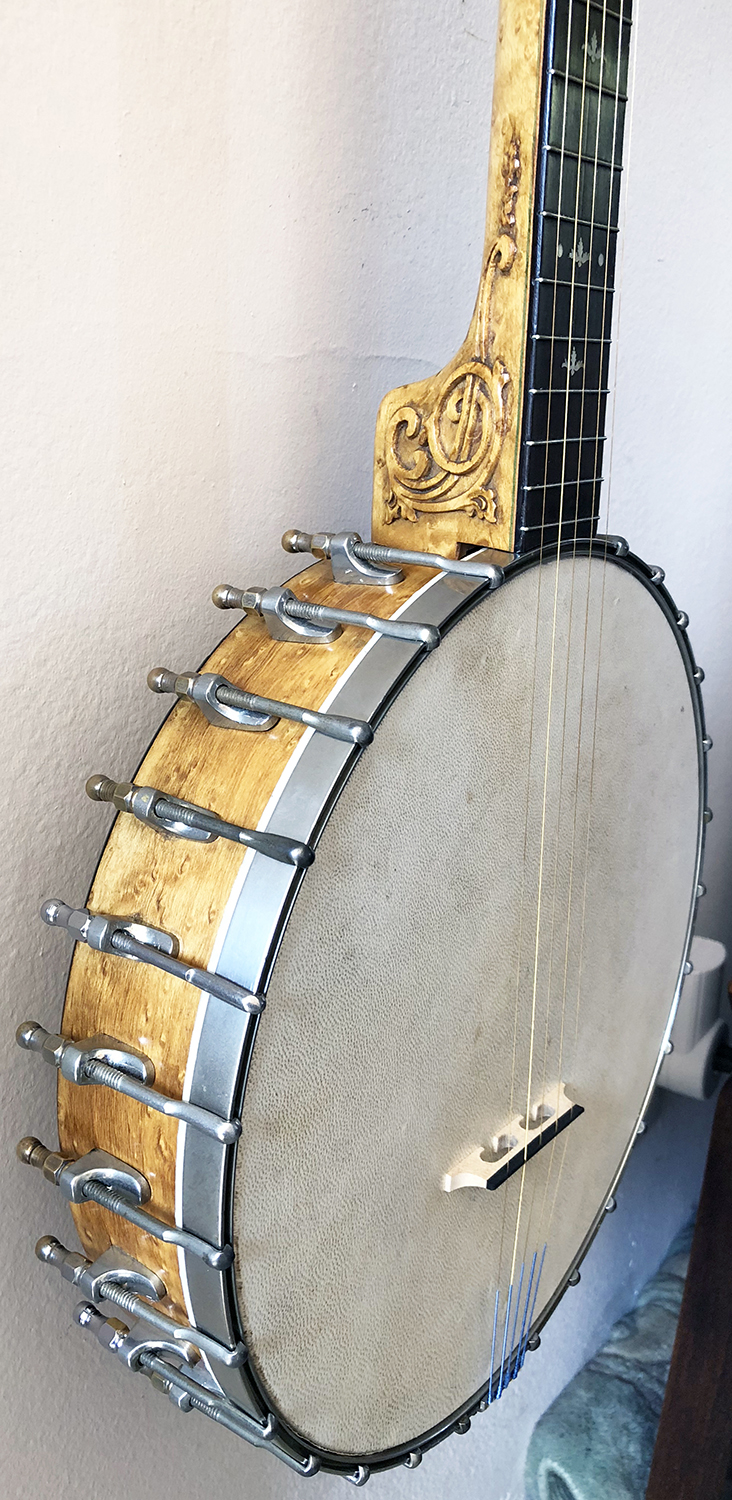
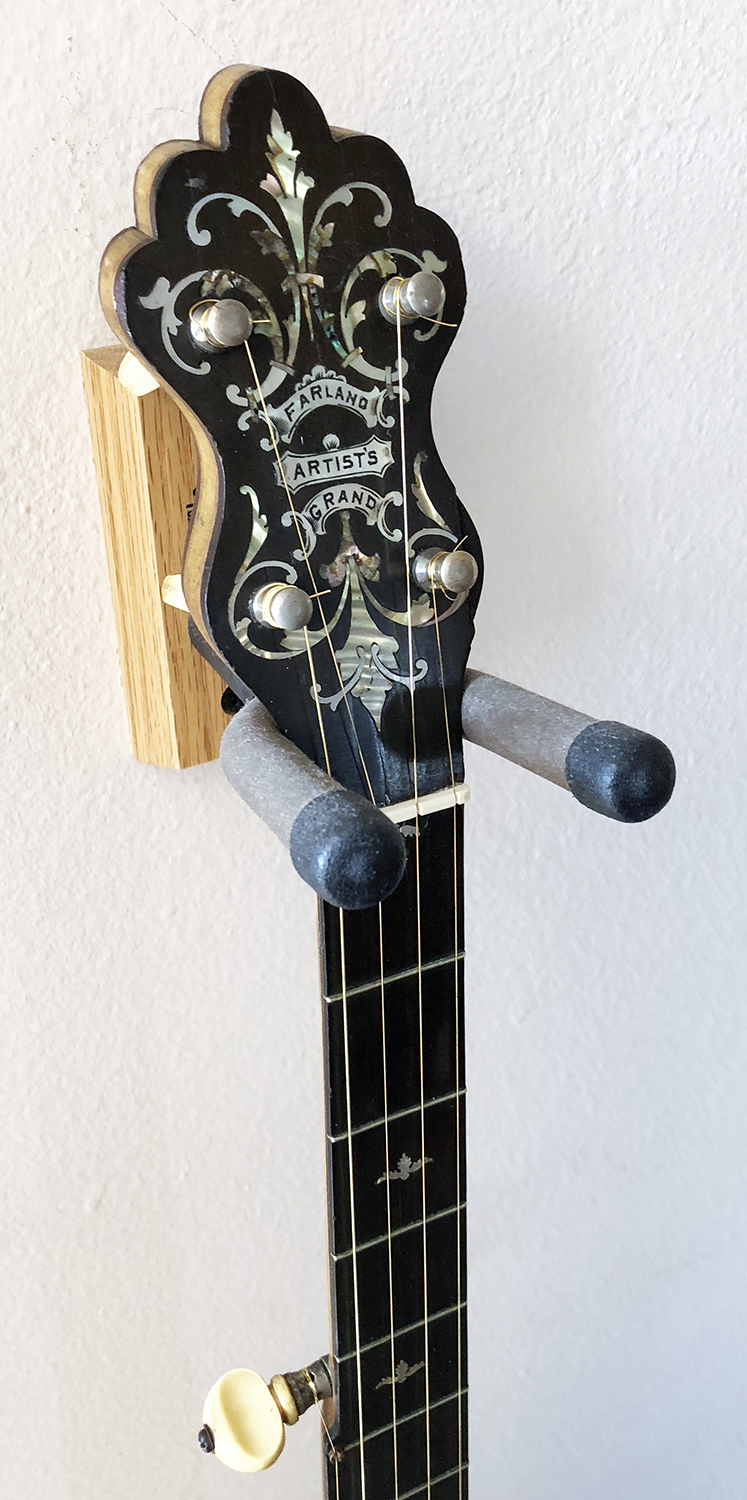
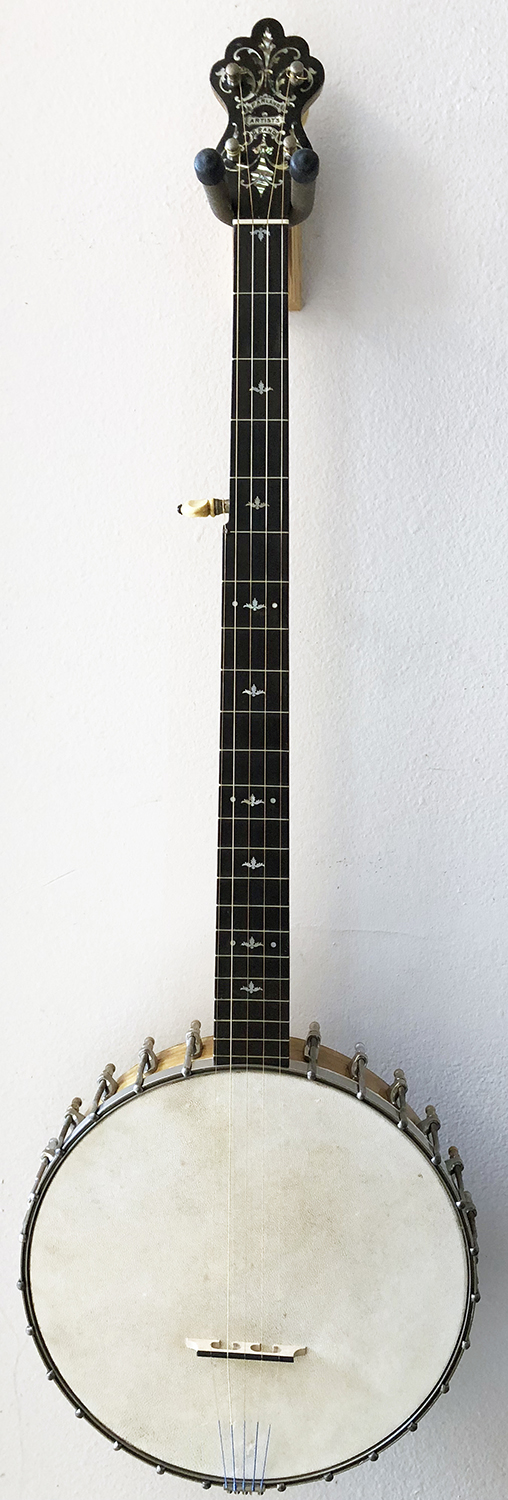
I just finished cleaning up and re-assembling an A. A. Farland banjo that I acquired a few months ago. I'd like to thank Larry Hill for picking this one up for me in Pheonix after I found it on Craigslist. It has all the signs of being a Lange manufactured banjo, and has a nice curly maple neck with birdseye maple rim. I like the carved heel detail that Farland put on his banjos; it's a nice touch.
Helix - Posted - 11/21/2017: 04:02:21
I resemble this project, somebody left me derelict, now I'm back down on the street again. I'm very proud to see this, I thought she showed potential.
If this is any indication of future work, and it is, then I'm in grand anticipation.
This Farland looks Good. Birdseye Maple, rim and neck. Did you keep the leg mute?
rmcdow - Posted - 11/21/2017: 06:06:44
I kept the mute Larry, but need to make the wooden part that pushes up against the head to do the muting, and find a spring to do the pushing. It took me a while to figure out how it was supposed to work, but I finally found a couple of photos of a working Farland mute; it's a bit of a Rube Goldberg contraption. I'll get it up and running with the mute at some point.
Joel Hooks - Posted - 11/21/2017: 07:01:15
The "Harp Attachment" is different than a pedal mute in that it is always on. In other words, in the default position it is pressed against the underside of the bridge muting the volume.
It is turned off by pressing the lever against the players chest. I seem to remember reading a recommendation from Farland to have something stiff and flat in your breast pocket to press the lever against (like the large wallets that people carried at the time).
Farland had some different ideas about how a banjo should sound. He was slowly going deaf and I speculate that had an effect on the tone he wanted. It was published several times that he was quiet in concert. In a least one instance that I know if he was actually booted from a concert program because he was not loud enough to fill the hall (Vess Ossman replaced him).
These were built by R&L for Farland. There is some evidence that he did some assembly work but he had lots of models so there is no telling what he bought complete. They are very attractive banjos but the dyed maple fingerboards tend to crumble and fall apart. I have not played many but the ones I have tend to be lacking in carrying power.
He was known for his "tremolo" work, that is where the first finger rapidly oscillates across the first string for the melody while the thumb plays the accompaniment harmony. Right around the turn of the century (1900) he developed focal dystonia and took up "pick playing" using a leather plectrum attached to his first finger with a loop of elastic. As explained in his later instruction book one could switch back and forth between plectrum and fingerstyle.
He used gut or silk strings exclusively-- even with a plectrum (many early plectrum banjoists used gut).
In the late 1940s he was one of the founding members of the American Banjo Fraternity and was the first "Honorary President"
Different from just about all other "classic era" banjoists-- Farland could be called a "Classical Banjoist." He was one of the very few banjoists that would play classical music (as opposed to popular music) in concert. Sadly this limited his popularity and there are several accounts of him boring the audience.
Attached is a recording of him playing in "duo style" with a plectrum on gut strings.
vintagetenor - Posted - 11/21/2017: 08:35:51
Thanks, Joel. That was very special. Do you know when it was recorded?
rmcdow - Posted - 11/21/2017: 19:50:36
When I acquired the banjo, it had a set of steel strings on it, and not having gut strings on hand right now, I put the same size steel strings on the banjo (actually gold plated steel). I have some gut strings coming, and am looking forward to putting them on. The banjo has a really pleasing tone to it. It has just the slanted edge of the rim as a tone ring, as I understand all the Farland's had. Joel, is the black wood on the back of the rim of these R&L's dyed maple? It has shrunk down and cracked in several places. The fingerboard is fine on this one. The whole neck had shrunk in width enough to cause the frets to protrude about a third to half a millimeter.
Joel Hooks - Posted - 11/27/2017: 05:42:45
quote:
Originally posted by vintagetenorThanks, Joel. That was very special. Do you know when it was recorded?
1917
Joel Hooks - Posted - 11/27/2017: 06:07:05
quote:
Originally posted by rmcdowWhen I acquired the banjo, it had a set of steel strings on it, and not having gut strings on hand right now, I put the same size steel strings on the banjo (actually gold plated steel). I have some gut strings coming, and am looking forward to putting them on. The banjo has a really pleasing tone to it. It has just the slanted edge of the rim as a tone ring, as I understand all the Farland's had. Joel, is the black wood on the back of the rim of these R&L's dyed maple? It has shrunk down and cracked in several places. The fingerboard is fine on this one. The whole neck had shrunk in width enough to cause the frets to protrude about a third to half a millimeter.
I can't say with any authority what it is. I do know that R&L would use a "fiberboard" for the center laminate on necks.
There is no reason not to use nylon strings of the appropriate sizes, Farland did in the late 40s (he died in 1954). Chances are that any gut strings you get today will be much thicker than what was used at the time it was built and sold. All packaged nylon and polyester strings currently sold are thicker than what was used originally.
So if you wanted to go "period correct" then buy Lute Singles from Labella in .017, .019, .023, .024w, .017 those are the closest you will get.
Unless you plan on playing "classic banjo" with bare fingertips then you should string it however you like. Chances are you will find the thin strings will not work well for modern clawhammer playing.
Gut strings that are thicker than the above sizes will not be "period correct" anyway.
rmcdow - Posted - 11/27/2017: 06:40:08
quote:
Originally posted by Joel HooksThere is no reason not to use nylon strings of the appropriate sizes, Farland did in the late 40s (he died in 1954). Chances are that any gut strings you get today will be much thicker than what was used at the time it was built and sold. All packaged nylon and polyester strings currently sold are thicker than what was used originally.
I have tried several types of strings, and so far, with the way I am learning to play the banjo, and enjoy playing it, the gut strings have worked the best. I like the stiffness of the steel strings, as compared to the floppiness of nylon and gut strings, but as I don't typically us picks, the steel is harder on my fingers than gut. I have sets of gut from Olav, and you are correct, they are thicker than what was made in the period of this banjo being made. I'm working with Optima now to build some high tension gut strings, and if they work out as it appears that they might, I can have some period correct gut strings made. I think I may have sets made slightly thicker than the strings of that period, though, but not as thick as what I got from Olav, as they will last a bit longer, and I think will feel better on the fingers. Olav's strings (he made a couple of light sets for me) are 018, 020, 030, 032w, 018.
Andy FitzGibbon - Posted - 11/27/2017: 07:23:52
The rim cap has been dyed Maple, or some similar wood, on every Farland I've worked on.
Andy
John Heeley - Posted - 12/01/2017: 08:35:26
I also have one of these. Is there any way of dating them (they have no serial number)? They appear in the 1915 Farland catalogue reproduction published by the American Banjo Fraternity some time ago. Also, does anyone have any idea what a "period correct" bridge for one of these would look like?
pastorharry - Posted - 12/11/2017: 15:26:52
My first banjo was a Farland, I bought for 28 $ when I was 8 years old. Wish I still had it. When I first bought it there was sheet music transposed for the 5 string banjo in the case....Bach and Beethoven , which led us to believe it may have been one of Mr. Farland's personal banjos, or perhaps a diligent student's.
Edited by - pastorharry on 12/11/2017 15:27:37
blm10jn - Posted - 12/11/2017: 19:32:39
I currently build 3 banjos based on the Farland Top Beveled rim design. All are 11.5 D but with a "modern clawhammer configuration , 25.5 scale and scooped fret board. I have 5 Farlands, the small Pony banjo, and 11.5 D Grand Artist and 3 12" D instruments. One has the patented steel head and one is very late possible mid 20's with an Orpheum style resonator that appears to be original. Given that it is Farland and he was willing to try I believe that the resonator may well be original to the instrument. 2 of the banjos I build are a straight Farland Top Beveled style 3 ply rim, The 3rd has a 2 ply wood tone ring of Hornbeam fit to the 3 ply Maple rim. These may be seen on my website. bloomsbanjos.com
John Heeley - Posted - 12/12/2017: 01:13:56
I believe from my readings (although I currently have no proof) that:
1. Farland assembled all the banjos bearing his name (hence the crude pen lettering on the peghead).
2. Farland used to perform on stage and afterwards, if anyone asked where one of his banjos could be purchased, he would sell them the instrument he had just used on stage.
csacwp - Posted - 12/12/2017: 03:04:02
quote:
Originally posted by John HeeleyI believe from my readings (although I currently have no proof) that: 1. Farland assembled all the banjos bearing his name (hence the crude pen lettering on the peghead). 2. Farland used to perform on stage and afterwards, if anyone asked where one of his banjos could be purchased, he would sell them the instrument he had just used on stage.
It was common practice at the time for pros to sell “their” banjo after a performance. As for Farland assembling these, it is extremely unlikely. He had one of the busiest touring schedules of any musician back then.
Andy FitzGibbon - Posted - 12/12/2017: 04:34:05
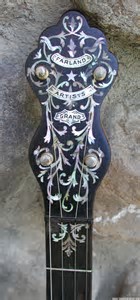
I'm not sure what "crude pen lettering on the peghead" is being referred to. Nearly all Farland banjos I've seen have inlaid pegheads, some with silk screened "faux engraving". All appear to have been manufactured by Rettburg & Lange.
I have seen one or two very crude instruments that were marked Farland. Those may have been made by the man himself, but I have no evidence for that.
Andy
John Heeley - Posted - 12/12/2017: 05:30:56
Hopefully the attached photo illustrates my point. The lettering appears to have been done by a fountain pen or similar and is not very uniform. I have seen this on photos of several Artist Grands as well as banjo on the photo. It does not, however, appear in the reproduction 1915 Farland catalogue issued by the American Banjo Fraternity in their 1980 winter issue of their newsletter "5 Stringer". The same issue is mostly dedicated to Mr. Farland and on page 20 paragraph 5 it discusses problems he is having with his instruments saying "Farland's problem indicates that he was, at least, assembling his own instruments."
John Heeley - Posted - 12/12/2017: 08:31:48
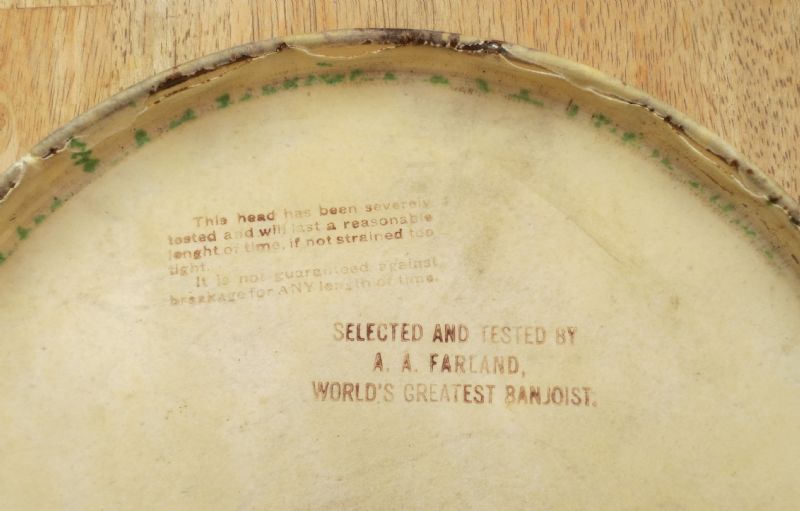
Finally attached photo only to find the first message in this stream illustrates my point.
Andy FitzGibbon - Posted - 12/13/2017: 04:00:05
quote:
Originally posted by John HeeleyFinally attached photo only to find the first message in this stream illustrates my point.
I'm pretty sure those are silk screened, or some similar process- not hand lettered. They are a bit rough around the edges, but they are uniform from banjo to banjo- I've had two in the shop, side by side.
Rettburg & Lange sometimes used the same process on other, non-Farland instruments.
Andy
Ira Gitlin - Posted - 12/14/2017: 06:20:00
quote:
Originally posted by csacwpquote:
Originally posted by John HeeleyI believe from my readings (although I currently have no proof) that: 1. Farland assembled all the banjos bearing his name (hence the crude pen lettering on the peghead). 2. Farland used to perform on stage and afterwards, if anyone asked where one of his banjos could be purchased, he would sell them the instrument he had just used on stage.
It was common practice at the time for pros to sell “their” banjo after a performance.
Ralph Stanley used to do something like that in the 1980s with the Stanleytone banjos that Frank Neat was making for him. He's quoted in Trischka and Wernick's Masters Of The 5-String Banjo as saying, "I play this banjo on stage and to myself. A lot of people have told me they'd rather have it after I play it for a while."
Do we know of any other musicians--banjo players or not--who have done this kind of marketing?
Joel Hooks - Posted - 12/14/2017: 06:44:15
quote:
Originally posted by Ira Gitlinquote:
Originally posted by csacwpquote:
Originally posted by John HeeleyI believe from my readings (although I currently have no proof) that: 1. Farland assembled all the banjos bearing his name (hence the crude pen lettering on the peghead). 2. Farland used to perform on stage and afterwards, if anyone asked where one of his banjos could be purchased, he would sell them the instrument he had just used on stage.
It was common practice at the time for pros to sell “their” banjo after a performance.
Ralph Stanley used to do something like that in the 1980s with the Stanleytone banjos that Frank Neat was making for him. He's quoted in Trischka and Wernick's Masters Of The 5-String Banjo as saying, "I play this banjo on stage and to myself. A lot of people have told me they'd rather have it after I play it for a while."
Do we know of any other musicians--banjo players or not--who have done this kind of marketing?
Fred Bacon did this too. He would also "put a mark" on the banjo he was playing and then ship it to you when he got back from tour (or so he claimed he would, chances are you just got a banjo with the same mark that he put on the one he was playing and would repeat anytime someone wanted to buy his banjo and he did not have any inventory with him).
csacwp - Posted - 12/14/2017: 06:48:32
quote:
Originally posted by John HeeleyFinally attached photo only to find the first message in this stream illustrates my point.
All Farland’s have the lettering done this way. It wasn’t written by hand.
banjowilly22 - Posted - 12/15/2017: 12:02:50
I have just one of these Farland Banjos, it was sold to a pupil of Albert Lyle, of Dewsbury,
England after he played a concert at the Leeds Town Hall, I think around 1903,
But I would have to check that date to be certain.
Keith
John Heeley - Posted - 12/18/2017: 04:01:05
According to the Farland catalogue reproduction I have, Albert Lyles of Birkdale Road, Dewsbury was the sole British Agent for Farland Banjos. I was born in Dewsbury so I have that connection with my Farland.
John
Terms of Use | Privacy Policy | Privacy Consent (EU/GDPR Only)
Copyright 2026 Banjo Hangout. All Rights Reserved.