
DVD-quality lessons (including tabs/sheet music) available for immediate viewing on any device.
Take your playing to the next level with the help of a local or online banjo teacher.
Weekly newsletter includes free lessons, favorite member content, banjo news and more.
Premier Sponsors


|
Please note this is an archived topic, so it is locked and unable to be replied to. You may, however, start a new topic and refer to this topic with a link: http://www.banjohangout.org/archive/275080
Page: 1 2
Bart Veerman - Posted - 12/01/2013: 12:14:51
Over the years several long threads about compensated bridges have been posted with lots of questions, answers and discussions that took several asperins to read through the whole thing. Another one appeared recently and someone asked me if I kept a database of the intonation correction measurements that people had me make for them over the years.
For those of you who don't know me, I make custom compensated banjo bridges and I figured maybe folks of you might also be interested to find out what numbers people actually come up with when they measure how much compensation each string needs, or if it needs any compensation at all.
It would be really cool if a bunch of you take a few minutes to go through the motions to do this and post the results you came up with. Let's stay away from discussions why, or why not, you need compensation and let the numbers speak for themselves so you can draw your own conclusions. This way we're talking real case numbers instead of the ones I have collected as they should be considered biased.
Here's a nice and simple routine that shows how to do the measuring so you can post your measurements (in millimeters please) for strings 1 to 5, or 1 to 4 for the tenor/plectrum folks, in this format:
1 - 0 mm
2 - x mm
3 - x mm
4 - x mm
5 - 0 mm
Please note: for 5 string banjos the numbers for string 1 & 5 should always be 0
It would also be helpful if you let us know which banjo, bridge height and string gauges you're using.
Here's the measuring routine: banjobridge.com/br-06.htm
It would also be interesting to find out what the measurements are for the various compensated bridges that are on the market now as the makers don't really advertise these important numbers.
It should be a fun project and if nothing else, you'll end up with your bridge being in the correct location.
Edited by - Bart Veerman on 12/02/2013 19:02:06
Corwyn - Posted - 12/02/2013: 06:33:55
It would seem to me that knowing the size of the strings would be very important in order to make any sense out of this data. Can people please include that information? Thanks.
MOUNTAIN GOAT - Posted - 12/02/2013: 16:05:43
Amazing how people won't go to the trouble to figure out how to make their banjo sound better. Doing the above is a great learning experience and you just might be surprised how better your banjo could be.
Bart Veerman - Posted - 12/02/2013: 18:34:32
My own two banjos, Framus & Mann - bridge slanted according to the routine, straight line, proper intonation meaning strings 1, 2, 3, 4 & 5 = 0 (010, 012, 014, 022, 010)
Commercial compensated bridges:
Shubb, 5/8, circa 1975~1980, 2.0 gram
Grover, 1/2" "newer crop," 1.70 gram

Bart Veerman - Posted - 12/03/2013: 08:08:38
I just finished setup up a couple of banjos:
Deering Vega: 5/8 stock bridge, medium gauge strings, bridge @ 90 degrees to 3rd string (not slanted).
Goldtone White Lady: 5/8 Archie, light gauge strings, bridge @ 90 degrees to 3rd string (not slanted).
The battery in my calipers was toast so couldn't measure the exact string gauges.
Cervecero - Posted - 12/03/2013: 08:33:50
Corwyn is exactly right. The amount of compensation depends on the diameters of the core wire of the string in question. Plain, unwound strings are core wire; wound strings, you have to measure the wire that ... has the winding stuff wrapped around it. Then you do the math and come up with the correct amount of compensation.
But I'm just an Old Timey type, I just angle a straight bridge and don't worry much about the 4th string. And if you play with strings that aren't way tight the way you fret can make the whole point moot anyway. ;-)
Ken LeVan - Posted - 12/03/2013: 14:26:15
quote:
Originally posted by Cervecero
Corwyn is exactly right. The amount of compensation depends on the diameters of the core wire of the string in question. Plain, unwound strings are core wire; wound strings, you have to measure the wire that ... has the winding stuff wrapped around it. Then you do the math and come up with the correct amount of compensation.
But I'm just an Old Timey type, I just angle a straight bridge and don't worry much about the 4th string. And if you play with strings that aren't way tight the way you fret can make the whole point moot anyway. ;-)
Not exactly right - thickness is not the same as stifness. The physics of strings assumes the strings have no stiffness, which of course, is only theoretical - the stiffer they string, the more the fretted note departs from the harmonic - the harmonic is never wrong, as any vioiln player will tell you.
Granted, thicker steel strings are usually stiffer, but in the case of wound strings, there is variation, and some players use a wound third string - then what about the nylgut people? - those strings are a lot less stiff than steel ones even though they are thicker.
You can make a compensated bridge exactly right for one particular set of strings. You'd have to know the stiffness of the strings in order to do any mathematical calculation,
Ken
Ken LeVan - Posted - 12/03/2013: 14:56:01
I'm glad you brought this up, Bart - It's an interesting subject, and my slowness in responding has been from the Thanksgiving holiday, nothing more.
As usual from me, a long-winded answer to a simple question.
About 4 years ago, after a lifetime of making straight bridges and cocking them at an angle, I started making "moon bridges" because they gave you a "little help" plus, I just liked them - a smile on your banjo head - they are not all things to all people. I started off with a 7" radius and moved inward to a 4" radius.

If you measure the string difference with the bridge straight, this is what you get - as you can see, there is a big jump from the first to the second string, less from the second to the third:

This is straightforward, but I cock mine (usually, although variaing between banjos) 5 degrees, so that changes everything (as it would with any bridge):

So why do we do this, and does it help?
We are all trying to get the fretted note at the octave to sound the same as the harmonic (which doesn't lie).
Just so you can hear what the variances are with a 4" radius moon bridge cocked at a 5 degree angle, 27" scale open, key of G. here's a really boring sound file - The moon bridge ain't perfect and it's hard to tell the harmonic from the fretted notes (which is good).
 Harmonics vs fretted G |
Bart Veerman - Posted - 12/05/2013: 08:59:58
BUMP
Nobody interested in finding out whether generic off-the-rack comps will actually do the trick? Considering that the various makers comp them by different amounts and/or on different string I find this really curious...
Old Hickory - Posted - 12/05/2013: 09:23:34
Bart:
I jumped on the original Shubb stair-stepped compensated bridge first time I saw it advertised in Banjo Newsletter in the 70s or 80s. To my ear, it improved my banjo's intonation over the straight bridge I had been using. Of course, I thinned it down to a shadow of its former self, because in that era we were all about super-tight heads and super-thin bridges.
Shubb, as you probably know, stopped making those bridges and granted everyone and anyone license to make them without royalty.
For the past 18 months I've switched back and forth between a Steve Davis compensated bridge (about 2.1 grams, maple with purpleheart top) and a KatEyz Spice 1.9 grams maple with pegged ebony top with third-string compensation. Currently using the Davis. Have to admit my banjo sounds good to me with both of them.
I haven't had time to do your experiment, and I'm not sure I have a straight totally uncompensated bridge to use for it. But I'll try to get this done before the topic is archived.
Edited by - Old Hickory on 12/05/2013 09:25:47
banjobart - Posted - 12/08/2013: 12:45:40
Correction: my medium gauge GHS strings and compensation, in a perfect world are:
1 - .010 - + 0
2 - .012 - + 1.5mm
3 - .016 - + 3mm
4 - .024w - +1.5mm
5 - .010 - + 0
I would use half the compensation when installing light gauge strings.
Edited by - banjobart on 12/08/2013 12:46:14
David Cunningham - Posted - 12/08/2013: 16:42:05
It is amazing how when you trig it out it doesn't always work as one might think huh?
steve davis - Posted - 12/08/2013: 16:51:41
My 4th string is half again as far ahead as my third is back.
Edited by - steve davis on 12/08/2013 16:54:00
Arthur Hatfield - Posted - 12/08/2013: 18:39:36
For the life of me I can't understand how any bridge such as a Shubb or Moon bridge helps intonation when the 2nd. string is moved back towards the tailpiece behind the first string and the second when in tune open is already flat with a straight bridge and has to be choked a little to sound in tune.
David Cunningham - Posted - 12/08/2013: 19:00:48
yep. A little on the 3rd maybe and be done with the rest. Hogwash to the rest of it. On most banjps with most players and who can tell the difference? Playability period. With my CNC I'll piss the rest of you off with compensation. I make straight bridges with a frog's hair of comp on the 3rd. If you need more you can ask for it and I'll do it. After playing on AH's bridges, Smith's, Z's and other's, I'll say it though I'll be condemned, most don't give a rat's ass as long as you can play, which I can't as well as most. But I can play enough to know for sure what the previous poster said is true. As AH said, and I agree though it don't mean squish, the over comp on a moon bridge looks nice. It's absolutely ridiculous for anyone who knows what soh-cah-toa means.... Fancy doogangles in most cases. Blah. and Humbug.
Drum roll please.
banjobart - Posted - 12/08/2013: 19:17:07
Action height has a lot to do with necessary compensation for best intonation. The higher the action, the more the pitch is raised when pushing the string down to the fret. With low action and light strings you hardly need any. With the high action and medium/heavy fat strings I use, some compensation helps and a bit more is better yet.
David Cunningham - Posted - 12/08/2013: 19:22:40
A fair and much agreed point. On the OB's I can see the greater need for comp. My experience is ALMOST entirely in BG, where we need much less comp, yet some, even though minor, usually.
Edited by - David Cunningham on 12/08/2013 19:30:02
banjobart - Posted - 12/08/2013: 19:35:40
Compensation is used to counter the effect of raising the pitch of the fretted notes when pushing the string down to the fret. Open notes are not fretted. The idea is to try and get the open notes more in tune with the fretted notes.
If you tune the banjo or guitar so that one first position chord sounds good, then all other chords will be a bit sour. Tempered tuning is another subject. A piano tuner does not use compensation, no notes are fretted, but piano tuning is tempered to sound sweet to the ear.
PS: I put the German straight bridges (Stew-Mac) on my banjos, my favorite for good tone, thin them and angle them about 1/16 inch. Most compensated bridge designs seem to get too heavy and thick. I think a slimmer bridge (but still stiff and strong) rocks more when playing and vibrates the head more.
Then, I like a loud bright banjo. To each his own, that is the beauty of the banjo, we can set it up our favorite way. There is no one perfect/correct banjo set up that suits everyone and no perfect/ideal tone that suits everyone. There is more consensus with other fretted instruments as to what constitutes the best tone. With banjos I can love the sound of one while others despise it.
With motorcycles I think loud pipes sound like donkey dung but I have good buddies that love it. So, I chose not to ride with them any longer. They have their tastes and I have mine.
stringman711 - Posted - 12/08/2013: 19:40:02
Arthur's bridges are the only ones I have used where you don't have to choke the second string up when you play down the neck in order to keep it in tune, like you have to do with a straight bridge. As well, the third string does not note sharp when you go down the neck. I have used most every bridge out there, and there are many good ones. Frank Neat makes excellent straight bridges, as well as many other folks, David Wadsworth, John Coffey,and Snuffy Smith of course, made great bridges, As for me, the compensated bridge that works the best for me are the ones made by Arthur Hatfield.
Edited by - stringman711 on 12/08/2013 19:51:34
steve davis - Posted - 12/10/2013: 05:27:29
No choking necessary with my bridge design,either.
Any of us can live with a straight bridge,but the benefit of a good compensation means not having to retune after capoing or a need to compromise in any way.
Sweeter chord harmonies are also a comp benefit.Very nice sound.
steve davis - Posted - 12/10/2013: 05:55:26
A well compensated bridge is also not fussy about what capo is used.
It forgives more than a straight bridge ever can.
swamplunker - Posted - 12/10/2013: 08:54:08
To Stringman711: I went to the Hatfield website, and looked at his compensated bridge. It immediately reminded me of the one on my Stelling Crusader, which is one of the few Stelling didn't compensate at the nut, and has great intonation. I gather from this that both Hatfield and Stelling agree that the second string needs to be adjusted toward the fingerboard, not away from it. Also interestingly, both choose to leave the 4th string alone, as on a straight bridge. Nice price on the Hatfield as well, I may be trying one.
Bart Veerman - Posted - 12/10/2013: 09:17:45
Almost 700 people have read this topic - how's about posting some more measurements so folks can demystify this whole compensation thing for themselves so they don't have to settle for anecdotal evidence, theories etc.
Steve, Arthur: by how many millimeters do you compensate your bridges?
About the Stelling comp bridge, I've always been curious why they comp the nut to lengthen the 2nd string and comp the bridge to shorten it. To even things out or something...
steve davis - Posted - 12/10/2013: 11:49:51
My compensation is figured on a neck that is carefully built to the very,very consistent and precise standards of Jimmy Cox.
I couldn't think of a more accurately constructed neck than his.
Jimmy and Frank Neat go way back and have similar standards,imo.
I never measured it in that way.
I designed it totally from matching the 12th fret harmonics to the 12th fret fretted note comparison on each string as per my blog description.
I used a tuner reading of 0 and 0 on each comparison.
My bridge design doesn't worry about vagaries of construction.It assumes your nut,frets and neck are attached as they are meant to be in a blueprint of Mastertone banjo,meaning frets where they belong and nut filed right (including gap between 1st fret and strings to not be excessive) and its(nut) leading edge where it belongs on a well built neck.
Calling 1 and 5 zero I get:
1/ 0
2/ +.045
3/ -.075
4/ +.125
5/ 0
Edited by - steve davis on 12/10/2013 11:50:26
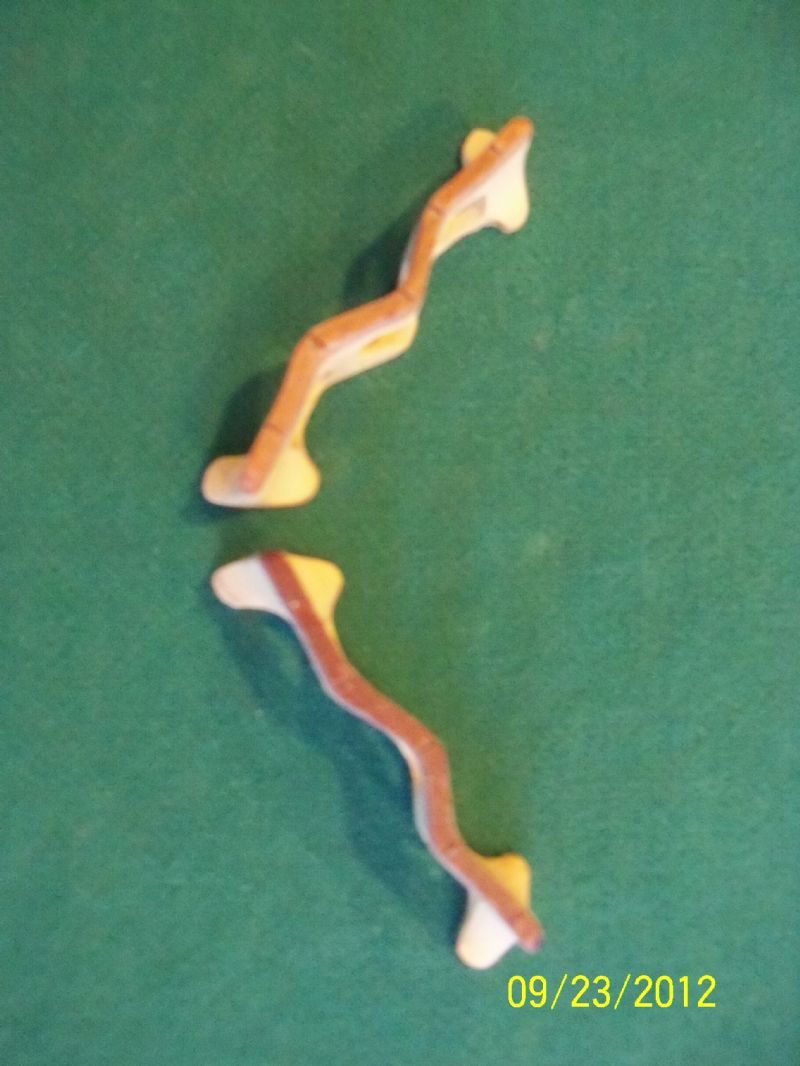 | 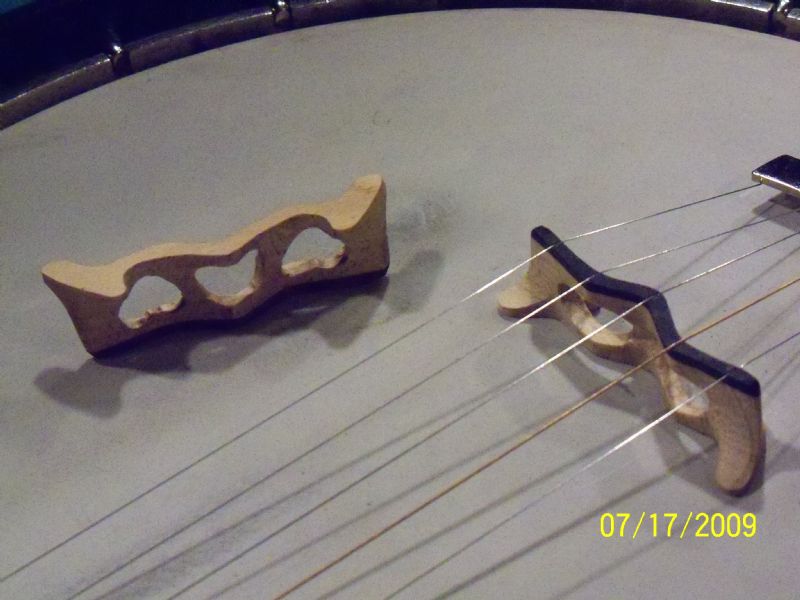 | 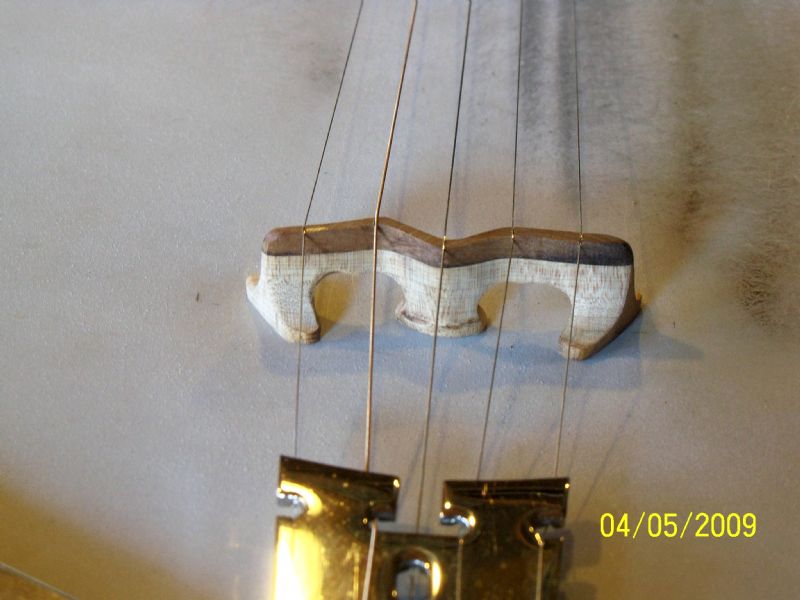 |
MOUNTAIN GOAT - Posted - 12/10/2013: 16:24:55
If I have one and five at zero, then 2 is 1 mm, 3 is 2 mm, 4 is minus 1 mm with my bridge. Bart's straight bridge was 3 to 4 cents off on the 3rd string with the rest within one cent, using a Snark tuner
Arthur Hatfield - Posted - 12/10/2013: 17:16:49
Just read this thread for the first time since I posted. Thanks Dana for the nice compliment I value your opinion highly since you are the great picker that you are and worked with Monroe, Jimmy Martin and stepped into Sonny Osborne's place when he retired from picking. I started making these bridges 1995. I remembered in the Mel Bay book by Sonny Osborne that I had as an early teenager that he said both the second and third string should be compensated. I had no idea at the time what he was talking about but it always stuck in my mind. Later as I progressed I got to where I could hear exactly what he meant. Every comp. one I tried even though the third was better the second was worse. Simply because they moved it towards the tailpiece instead of the neck. What their idea of that was I have no idea. I studied for a long time how to make a bridge that was, not to say perfect , but much better than a straight or any other comp bridge I had ever seen. In 1995 I decided it was good enough to call quits on so what I have now is what I settled on. In 2003 Michael Holmes of Mugwumps Banjo North sent me an email and asked if I would send him a couple to be evaluated because Curtis McPeake , which I remember along with Geoff Stelling and a few others who I cant recall at the moment was to be there. I sent him the two and in 2004 I received several emails that Geoff had a bridge on his website that looked identical to mine. I checked it and sure enough it did. Whether or not he did copy it I dont know all I can say if not his thoughts were exactly like mine after comp. the nut for years. Since, in the last few years I have seen some others that use pretty much the same comp on the top as mine by what I can tell by pictures just changed the feet design around a bit or a lot. But I can understand why whoever makes one has to have basically the same type of curve on top if they are going to have one that works close to right. I never say perfect because there is and never has and never will be a banjo that has perfect intonation with any bridge but compensation on the second and third string in the right direction can make it much closer to right. I think if anyone would know how a bridge should be compensated it would be Sonny Osborne with both his playing and perfect harmony singing ability.
steve davis - Posted - 12/10/2013: 19:28:16
I made my first compensated bridge in 1982.
As Arthur said,when you get the compensation sounding its best the shape of the top has to be the same or very similar.
The correction demands it.
stelling man - Posted - 12/12/2013: 12:45:33
Good post Arthur, I know your's Is the first one I ever seen for sale to the public, I know some that have copied your design, why because It's a good design, I've used your bridges on all my banjos and they are the best..
STELLING MAN
steve davis - Posted - 12/12/2013: 14:54:50
I've read in the past of having copied Arthur'sa design and nothing could be further from the truth.
Bart Veerman - Posted - 12/12/2013: 20:16:33
Quite an interesting story Arthur, thanks for posting it.
I've made a compensated bridge or "two" over the years. From all of those, as per customer & my own offset measurements, only 4 ever needed the 2nd string lengthened instead of shortened. I guess banjos have their own way of deciding what's best for them.
Steve: thanks for posting your compensation offset measurements. I'm confused though, if your offset numbers are in inches, the string numbers don't seems to match the values of bridge on your pictures: when the string gets shortened it's a negative number, if the string gets lengthened it's a positive number.
steve davis - Posted - 12/13/2013: 04:57:25
I didn't think of it that way,Bart.
Just make the positives negative and the negatives positive.
This is the first time I've tried to measure my bridge in this way.
Edited by - steve davis on 12/13/2013 04:59:44
Bart Veerman - Posted - 12/13/2013: 20:52:25
quote:
Originally posted by steve davisI didn't think of it that way,Bart.
Just make the positives negative and the negatives positive.
This is the first time I've tried to measure my bridge in this way.
There's a first time for everything, better late than never. I hope it gave you some insight what proper intonation correction is really all about.
Added: How's about a few more folks posting their compensation measurements though, it's a real easy routine and everyone can do it. Doing & posting it for more than one banjo can be quite an eye opener and you'll soon find out that not all banjos are created equally.
Edited by - Bart Veerman on 12/13/2013 20:59:03
steve davis - Posted - 12/14/2013: 05:08:33
You haven't given me any insight,Bart.
I just measured my bridge and gave you the numbers you were asking for.
steve davis - Posted - 12/14/2013: 05:46:12
When you put one of my bridges through its paces in what way did you find it inaccurate in the intonation,Bart?
Shawn Hoover - Posted - 12/14/2013: 08:52:20
1 - .010 - 0
2 - .012 - 0
3 - .016 - 0
4 - .023w - 0
5 - .008 (full length) - 0
Ken LeVan - Posted - 12/14/2013: 09:46:08
Bart,
This is very interesting, inasmuch as all compensated bridges are designed to do the same thing.
Are you going to put this all into a chart or graph when you have collected all the data? It would be a very instructive and useful thing.
Ken
swamplunker - Posted - 12/14/2013: 11:34:06
Stelling doesn't do what you said, Bart. They don't comp the nut and bridge at the same time. To prevent misunderstanding, I said the Crusader was one of the few Stelling didn't compensate at the nut. In fact, it may be the only one. Regarding what Mr. Hatfield said, I don't have any reason to think Stelling abandoned his idea of comping the nut, despite going "traditional" on the Crusader. What I wanted to do was point out that both Hatfield and Stelling shorten the B string rather than lengthen it, and now that Steve posted his numbers (which didn't confuse me, because everyone so far is elongating the 3rd string) there's a third person doing it, beginning to look a lot like consensus......
Bart Veerman - Posted - 12/14/2013: 13:10:22
Here's some more, these are my own banjos:
Mann, 1970ties RB250 clone, nickle plated, 1/2" bridge
Mann, 1970ies RB250 clone, fake gold plating, 9/16 bridge
S.S. Stewart, Special Thoroughbred, 1/2" bridge
Steve: I can't use your bridges on my banjos because, as you can see, your intonation offsets are not compatible with my measurement requirements.
Ken: there really isn't a sufficient data sample size in this thread to base any opinions on... Your measure a bunch of banjo though and you'll have your own database soon enough. Any bridge maker, whether commercial or private, should go through this routine, and be familiar with it, on at least several banjos to verify their theories. Compensation 101 really.
Swamplunker: "They don't comp the nut and bridge at the same time" Good point and yup, I can see that. Folks ordering their comp bridges from them might not be aware of that though.
Added: some line feeds to make it more readable
Edited by - Bart Veerman on 12/14/2013 13:11:43
Ken LeVan - Posted - 12/14/2013: 13:33:44
Bart,
There's aren't enough hours in the day, but I'm thinking of blowing up a compensated bridge "curve" about 10X and showing the variations commonly used as different colored lines. Yours are very consistent, and I would bet large amounts of money that yours are very correct.
I always make templates of neck profiles if they are different, and I trace them and record them for future reference. When you superimpose them on top of one another you can see where the variances are.
It's interesting - you can see it on the bottom picture. What would a similar thing of compensated bridge curves look like? Where would they coincide, and where would they vary?

Ken
steve davis - Posted - 12/14/2013: 13:55:55
You have strong opinions about stuff you're not familiar with,Bart.
Bart Veerman - Posted - 12/14/2013: 14:02:34
quote:
Originally posted by steve davisYou have strong opinions about stuff you're not familiar with,Bart.
no prob
Bart Veerman - Posted - 12/14/2013: 14:05:38
There'd be a lot of combinations to keep track of Ken. Here's one I took a picture some years ago, it was one of the very few ones people ever ordered with a shortened 2nd string. The lines on the label are at 1 mm spacing.
Ken LeVan - Posted - 12/14/2013: 14:07:41
quote:
Originally posted by steve davisYou have strong opinions about stuff you're not familiar with,Bart.
I would just like to make a chart that shows the variations between makers, not a rating system of them. That's up to the individual player to determine.
I have no strong opinions and don't make compensated bridges myself.
Ken
steve davis - Posted - 12/14/2013: 14:14:44
We approach intonation correction from different directions,Bart.
My compensation is figured to make the best 12th fret harmonic/fretted note comparisons on all 5 strings.
When these matchings are attained there are benefits to be reaped over the entire neck.
Perfect intonation is notes that are at 0 on a tuner.
I believe any standard banjo has more fretted notes at or near zero than almost any other bridge with my design.
Arthur's will also have a very high percentage of fretted notes at or near zero.
That is the wave that banjo necks with a straight nut correct at.
I can prove it on any banjo.
Our ears will forgive a bit of variance from zero,but to play a banjo where all the Gs are in tune on the whole neck and feel the closer harmonies in the chords is very rewarding.
Edited by - steve davis on 12/14/2013 14:17:12
Bart Veerman - Posted - 12/14/2013: 15:49:08
Please folks, let's stick to pencils & rulers to get them measurements posted.
Page: 1 2
Terms of Use | Privacy Policy | Privacy Consent (EU/GDPR Only)
Copyright 2026 Banjo Hangout. All Rights Reserved.


