
DVD-quality lessons (including tabs/sheet music) available for immediate viewing on any device.
Take your playing to the next level with the help of a local or online banjo teacher.
Weekly newsletter includes free lessons, favorite member content, banjo news and more.
Premier Sponsors


|
Please note this is an archived topic, so it is locked and unable to be replied to. You may, however, start a new topic and refer to this topic with a link: http://www.banjohangout.org/archive/269367
mscotts - Posted - 08/26/2013: 15:52:36
Hi all, I'm told this is the forum to find out everything regarding banjos!
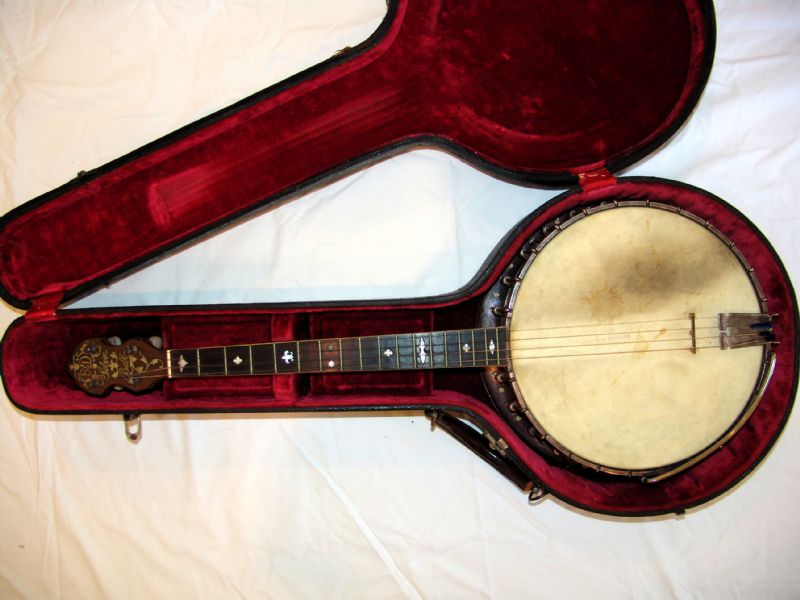
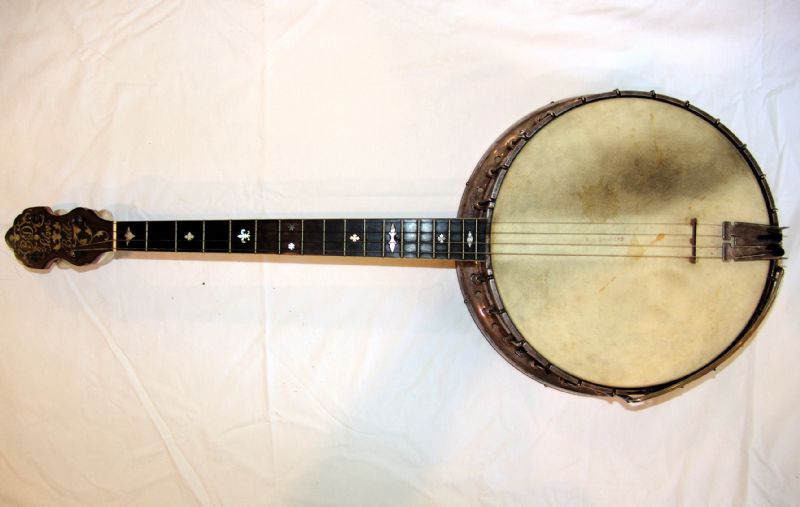
I'm looking for some information about this old banjo I own.
My grandfather gave it to me when I was 5 years old as I had just begun to play guitar.
He told my parents he got it from a fellow named Eddie Peabody.
I never learned to play the banjo, and it ended up being stored under my bed thru the years.
I visited my parents a few months ago to help them downsize.
I went to my old room and looked under my old bed, and there it was-
right where I left it.
My guitar playing has taken me down many wonderful paths, but
sadly this banjo has resided under that bed for the last 45 years! I figured it
was time for it to see the light of day…
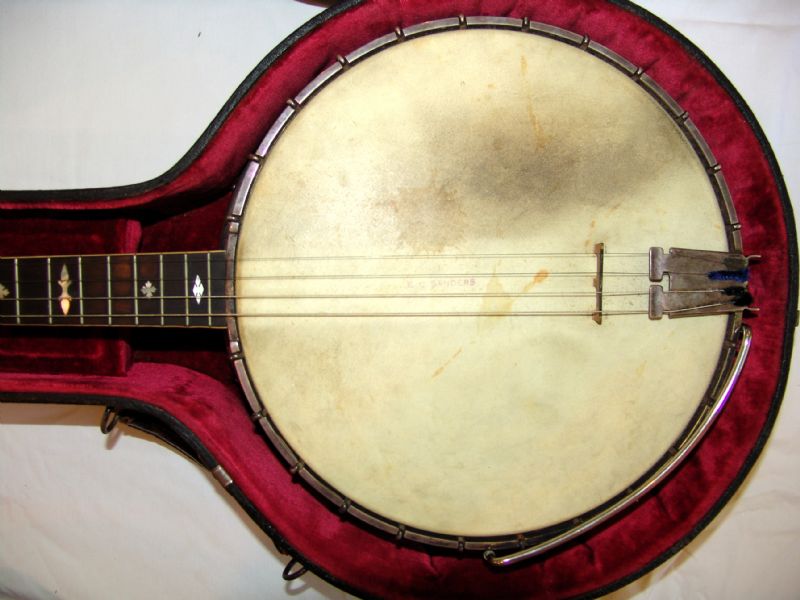
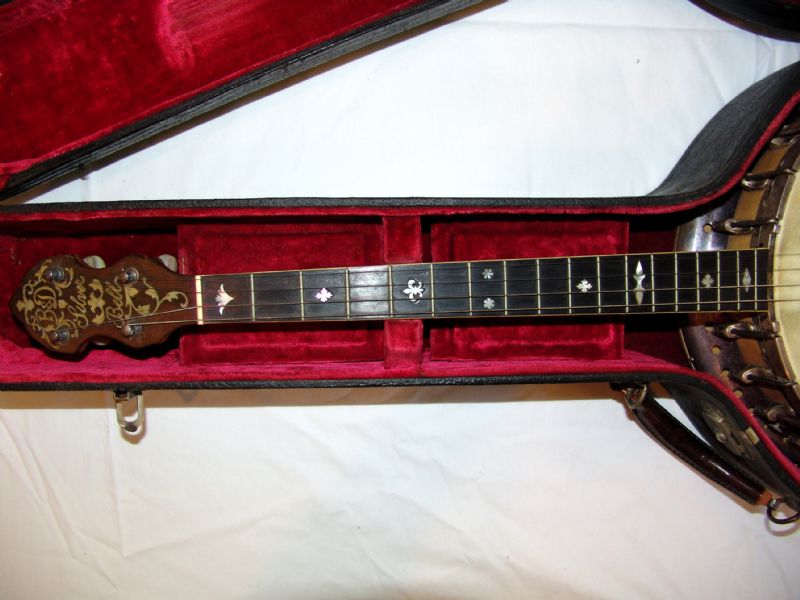
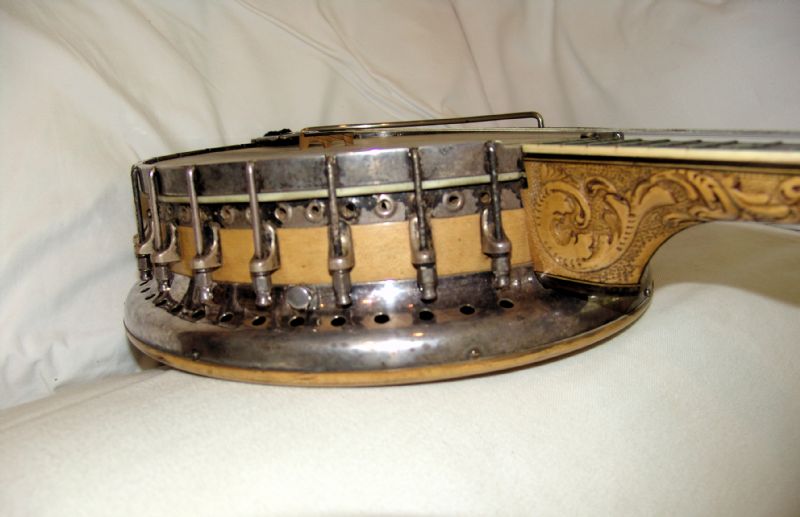
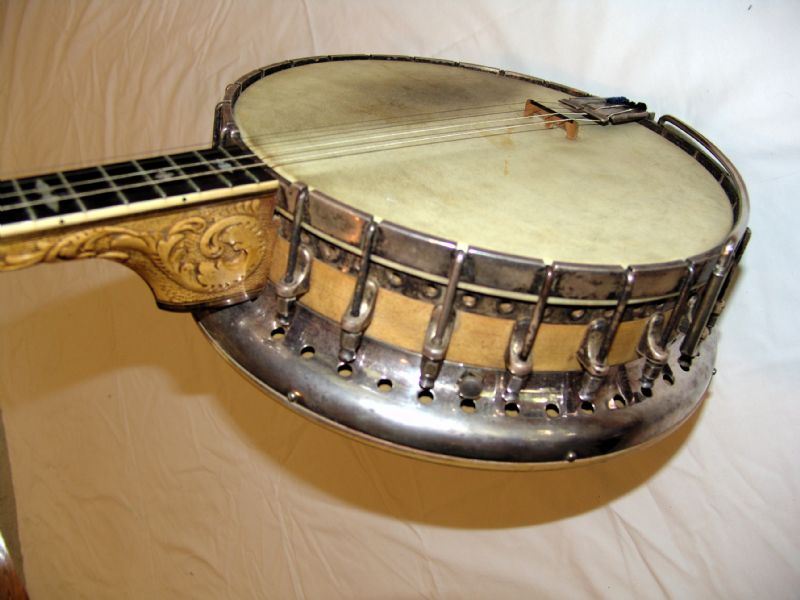
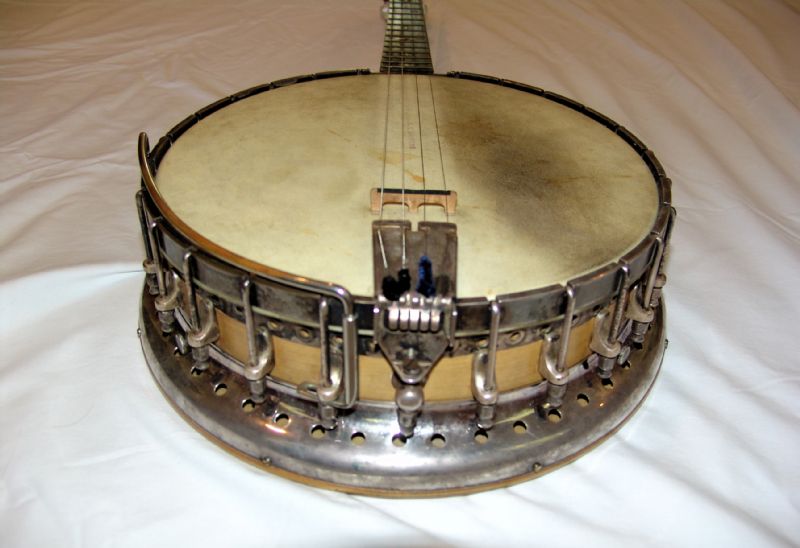
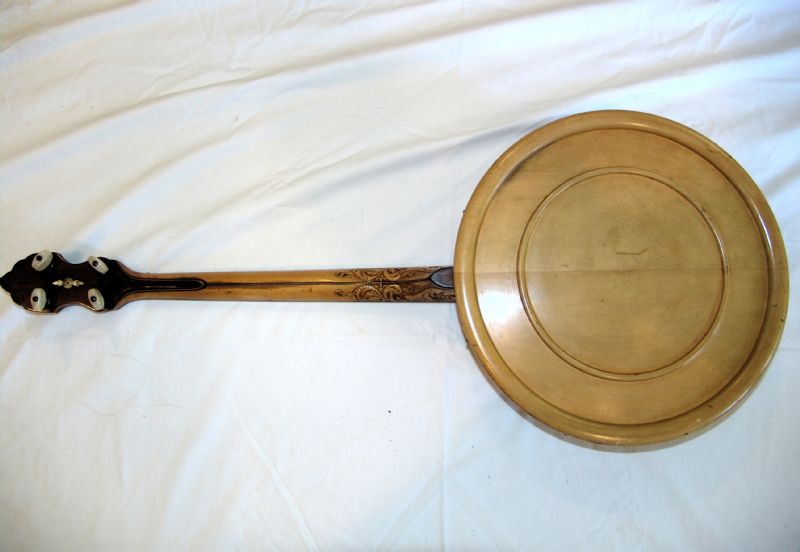
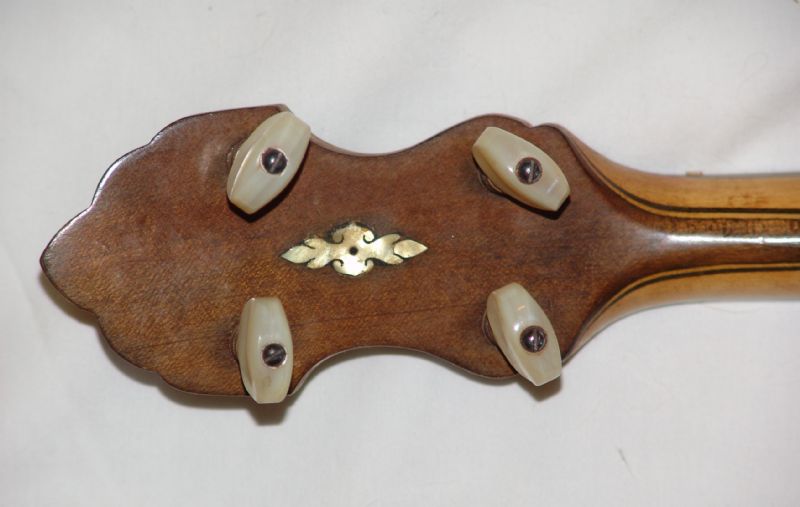
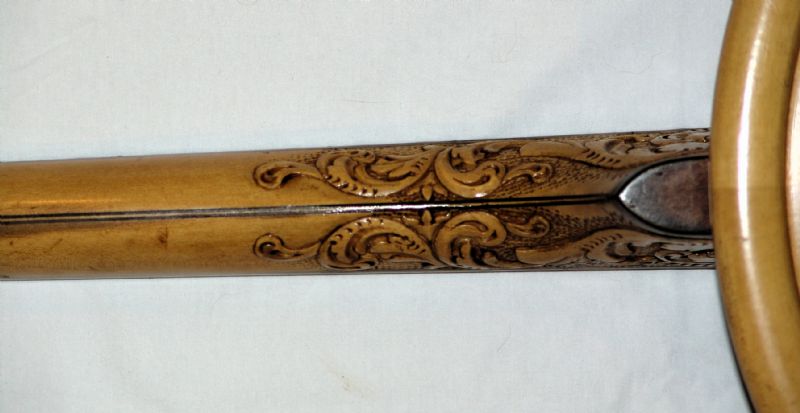
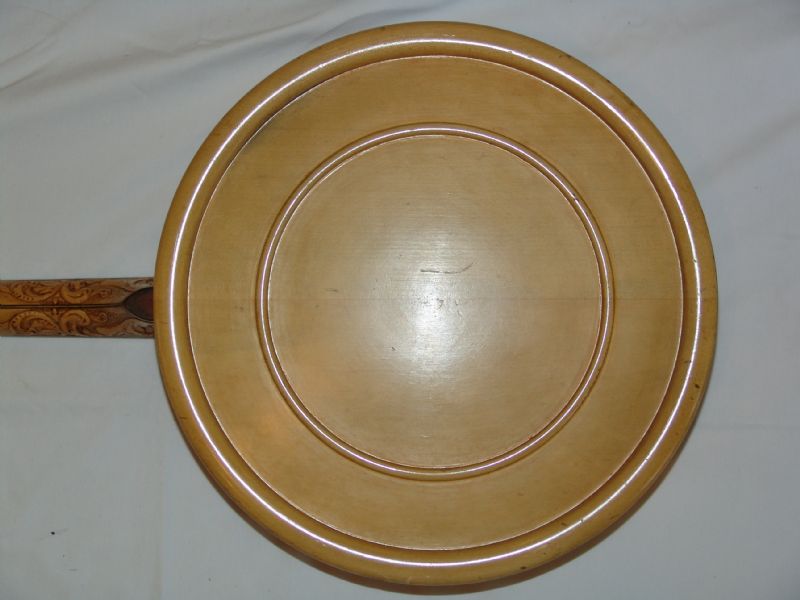
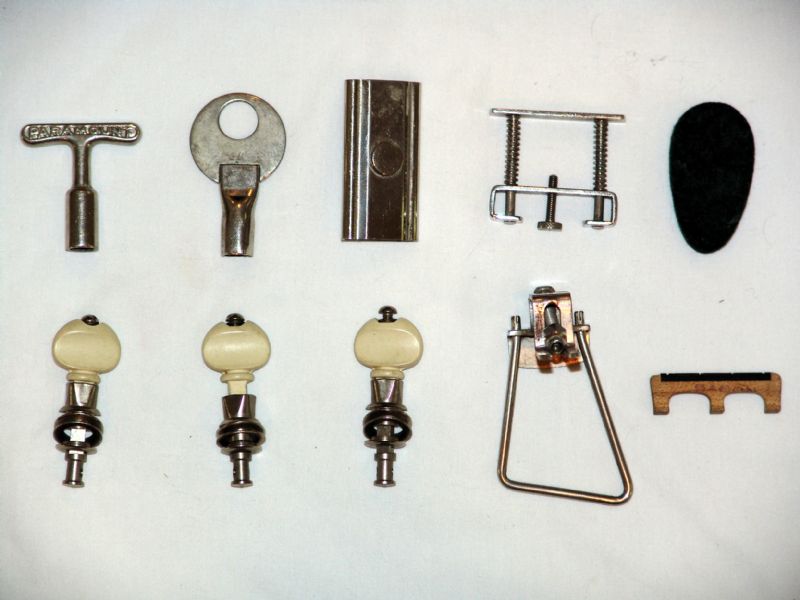
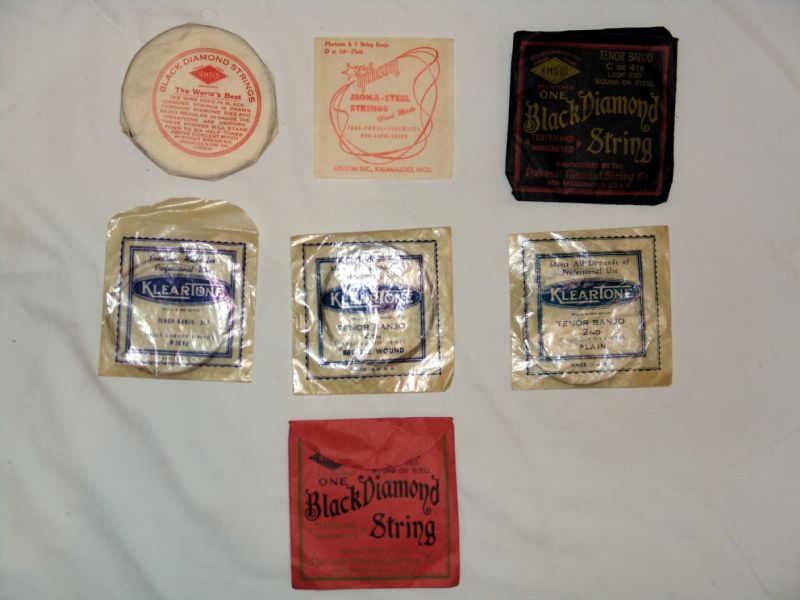
Here are some pictures of it and some accessories I found in the case.
Any information about any of it would be appreciated!!
Thanks very much,
Scott
Edited by - mscotts on 08/26/2013 16:08:34
 |  |  |  |
 |  |  |  |
 |  |  |  |
 |
jbalch - Posted - 08/26/2013: 17:11:18
That is a nice looking banjo. I'll link this to the B&D group for more exposure. banjohangout.org/group/baconandday
It looks like an early Silver Bell #2 to me. But I have not seen a blonde colored example like that. There are some real B&D experts here who might comment.
Here is a resource you might enjoy: acoustudio.dk/BD_and_Bacon_database.html
Google "Eddie Peabody" ... He is tenor banjo "royalty." It might be worth proving a connection if you can.
Best Wishes!
ps: here is a link to photos of my 1925 silver bell #2 for comparison: banjohangout.org/myhangout/pho...umid=3269
Edited by - jbalch on 08/26/2013 17:13:34
mscotts - Posted - 08/26/2013: 17:49:11
Hi Jbalch,
Thanks for the info, resources and for linking my post to the group.
I think it's nice looking instrument also! Amazing carving on the heel.
I'm really looking forward to finding out more info about the old gal...
Yours is beautiful!! Interesting to compare them, yours looks to be in very good shape.
I'll bet it sounds fantastic.
Best,
Scott
gdoc - Posted - 08/26/2013: 18:11:54
45 years under a bed... geeish... That's as good as "we were remodeling the house and found this inside a wall"...
Nice find though, even though you had a good idea it was there.
I love these tales, especially when they are true.
ps... did you mom keep the case dusted?
As mentioned above, try to get the banjo tied to Peabody. I'm jealous.
Deaf Lester Crawdad - Posted - 08/26/2013: 19:44:09
quote:
Originally posted by gdoc
As mentioned above, try to get the banjo tied to Peabody.
Even if it's real, the Peabody connection doesn't mean much. Eddy was known to have sold lots of banjos that he'd picked up cheap somewhere and sold at a healthy markup as being "Eddy Peabody's banjo".
When I was working in a retail music store we saw one of these come in every couple of years with the same story attached -and sometimes even with an autograph- but the banjos in question were rarely as good as the B&D in this thread.
~Pete
mscotts - Posted - 08/26/2013: 21:17:34
Thanks for the replies and for the emails guys! I have no way of proving the Peabody connection, it's something my folks kept telling me as I grew up and would pull the banjo out
from under the bed every few years....
Edited by - mscotts on 08/26/2013 21:29:02
Deaf Lester Crawdad - Posted - 08/26/2013: 22:23:37
quote:
Originally posted by mscotts
Thanks for the replies and for the emails guys! I have no way of proving the Peabody connection, it's something my folks kept telling me as I grew up and would pull the banjo out
from under the bed every few years....
Take care of it anyway. It's a very nice old tenor banjo in any case, and may be rather collectable as I've never before seen one quite like it.
BTW: Thanx for the very well done photos. People posting banjo photos to BHO frequently seem to have taken them with an old box Brownie under dim lighting conditions during a severe sandstorm; and it's really nice to see detailed and well focused photos that actually portray the information needed to tell us what we're looking at.
~Pete
Polle Flaunoe - Posted - 08/26/2013: 23:34:02
Scott,
What you have is a - most likely - late 1923 B&D Silver Bell No. 2 tenor banjo.
The metal parts are silver plated - hence the black tarnish - except for the tension hooks most of these may be polished to a fantastic bright shine - as Jon Balch´s example shows.
The blond wood surface is very unusual - the classic Silver Bell´s are normally dark brown stained.
It´s really fantastic to see an example from the first year of production so well preserved and original - I take, that many collectors/players would love to purchase and refinish it.
I´m very interested in knowing the serial number - for my research and my database as linked above. If you loosen the 4 thumb screws - the resonator assembly will come off easily - the SN is stamped inside the banjo in two places - at the inside of the rim close to the neck and at the dowel stick.
Polle
Emiel - Posted - 08/27/2013: 05:11:09
quote:
Originally posted by jbalch
Google "Eddie Peabody" ... He is tenor banjo "royalty."
More known for playing the plectrum banjo, I would say...
Gordy Ohliger - Posted - 08/27/2013: 07:56:17
You got yourself a very nice banjo sir.
Tune it up like the first four of your guitar and join us! Your right hand technique will improve immediately, and your guitar work will have more dynamics.
This is a fine early B&D.You can stand proud. Please respect this fine instrument.
PS~ All above info about Eddie is true...Except he played a longneck plectrum..usually a Vegavox.
mscotts - Posted - 08/27/2013: 08:09:47
Fantastic, Thanks guys for so many informative replies and e-mails. I have a whole new respect for this beautiful instrument that's been in hiding all this time.
I will attempt to take off the resonator, and I'll post some information/pictures of what I find inside. Is there anything I should be aware of in taking the back off
or is as simple as removing the screws and I guess it slides off? Thanks again guys!!
Scott
Emiel - Posted - 08/27/2013: 08:18:07
quote:
Originally posted by mscotts
I will attempt to take off the resonator, and I'll post some information/pictures of what I find inside. Is there anything I should be aware of in taking the back off
or is as simple as removing the screws and I guess it slides off?
Simple as that...
mscotts - Posted - 08/27/2013: 08:31:17
quote:
Originally posted by Deaf Lester Crawdad
BTW: Thanx for the very well done photos. People posting banjo photos to BHO frequently seem to have taken them with an old box Brownie under dim lighting conditions during a severe sandstorm; and it's really nice to see detailed and well focused photos that actually portray the information needed to tell us what we're looking at.
~Pete
My pleasure, I figured some decent pictures would be the best way to help the members here help me....
BrittDLD1 - Posted - 08/27/2013: 08:44:08
Hello Scott --
I basically agree with Polle, it's a late-1923, or early-1924 Silver Bell No. 2. It IS rare -- because it's an EARLY 'first period' Silver Bell made of White Holly.
It appears to be completely original, with the initial 1/4" holes in the resonator flange, a 'square-hole' Grover tailpiece, and wire armrest.
The first Silver Bells to be CATALOGED with White Holly, were the "Montana" models, introduced in the "1925" Bacon catalog (written in late-1924). YOUR Silver Bell was probably made BEFORE the intro of the Montana models.
The Montana models had white celluloid ("ivoroid") covering the peghead face, and the fingerboard. The Montana models also came 'standard' with the newly-introduced geared tuning pegs (called
"internal reduction pegs" in the catalog).
I do NOT agree with Polle that your banjo needs to be refinished. It looks to be completely original, well taken care of, and the I don't see ANY scratches on the resonator back. These banjos were purposely given a dark 'patina' -- to give them the look of Old World antiquity. Some careful cleaning, and light use of silver polish looks to be all it needs.
The actual "playability" of your banjo -- "as-is" -- will need to be determined by a good player, or repair person. Bacons from this early period often had problems with the necks warping or twisting, due to some poorly seasoned the woods they were using, at that time.
It's a SUPERB, rare, EARLY example. Keep it as original as possible. (Including leaving the ORIGINAL friction pegs in place!).
Think of it as your "90-year-old Grand Mother". Treat her with care, dignity, and respect. And don't expect to take her out dancing every night... She's from a VERY different Era -- and she WILL NOT take the same strain that a modern banjo (or later-vintage Silver Bell) is able to take. You'll 'kill' her, if you do. (The friction pegs tend to slip a LOT! And that's why they went with geared tuners on the later models. It also has a shorter 17-fret neck, to keep the string-tension lower.)
THIS banjo -- in its completely original state -- really belongs in a museum collection! It's perhaps the FINEST, early example of its type, that I've seen...
Best-- Ed Britt
BrittDLD1 - Posted - 08/27/2013: 08:50:40
quote:
Originally posted by BrittDLD1
Hello Scott --
I basically agree with Polle, it's a late-1923, or early-1924 Silver Bell No. 2. It IS rare -- because it's an EARLY 'first period' Silver Bell made of White Holly.
It appears to be completely original, with the initial 1/4" holes in the resonator flange, a 'square-hole' Grover tailpiece, and wire armrest.
The first Silver Bells to be CATALOGED with White Holly, were the "Montana" models, introduced in the "1925" Bacon catalog (written in late-1924). YOUR Silver Bell was probably made BEFORE the intro of the Montana models.
The Montana models had white celluloid ("ivoroid") covering the peghead face, and the fingerboard. The Montana models also came 'standard' with the newly-introduced geared tuning pegs (called
"internal reduction pegs" in the catalog).I do NOT agree with Polle that your banjo needs to be refinished. It looks to be completely original, well taken care of, and the I don't see ANY scratches on the resonator back. These banjos were purposely given a dark 'patina' -- to give them the look of Old World antiquity. Some careful cleaning, and light use of silver polish looks to be all it needs.
The actual "playability" of your banjo -- "as-is" -- will need to be determined by a good player, or repair person. Bacons from this early period often had problems with the necks warping or twisting, due to some poorly seasoned the woods they were using, at that time.
It's a SUPERB, rare, EARLY example. Keep it as original as possible. (Including leaving the ORIGINAL friction pegs in place!).
Think of it as your "90-year-old Grand Mother". Treat her with care, dignity, and respect. And don't expect to take her out dancing every night... She's from a VERY different Era -- and she WILL NOT take the same strain that a modern banjo (or later-vintage Silver Bell) is able to take. You'll 'kill' her, if you do. (The friction pegs tend to slip a LOT! And that's why they went with geared tuners on the later models. It also has a shorter 17-fret neck, to keep the string-tension lower.)
THIS banjo -- in its completely original state -- really belongs in a museum collection! It's perhaps the FINEST, early example of its type, that I've seen...
Best-- Ed Britt
PS: Most of the hardware 'accessories' you show, have NOTHING to do with that specific banjo. They are from DIFFERENT banjos. The ONLY part that MIGHT be original to that Silver bell is the bracket wrench -- top row second from left.
mscotts - Posted - 08/27/2013: 09:29:35
quote:
Originally posted by BrittDLD1
quote:
Originally posted by BrittDLD1
Hello Scott --
I basically agree with Polle, it's a late-1923, or early-1924 Silver Bell No. 2. It IS rare -- because it's an EARLY 'first period' Silver Bell made of White Holly.
It appears to be completely original, with the initial 1/4" holes in the resonator flange, a 'square-hole' Grover tailpiece, and wire armrest.
The first Silver Bells to be CATALOGED with White Holly, were the "Montana" models, introduced in the "1925" Bacon catalog (written in late-1924). YOUR Silver Bell was probably made BEFORE the intro of the Montana models.
The Montana models had white celluloid ("ivoroid") covering the peghead face, and the fingerboard. The Montana models also came 'standard' with the newly-introduced geared tuning pegs (called "internal reduction pegs" in the catalog).
I do NOT agree with Polle that your banjo needs to be refinished. It looks to be completely original, well taken care of, and the I don't see ANY scratches on the resonator back. These banjos were purposely given a dark 'patina' -- to give them the look of Old World antiquity. Some careful cleaning, and light use of silver polish looks to be all it needs.
The actual "playability" of your banjo -- "as-is" -- will need to be determined by a good player, or repair person. Bacons from this early period often had problems with the necks warping or twisting, due to some poorly seasoned the woods they were using, at that time.
It's a SUPERB, rare, EARLY example. Keep it as original as possible. (Including leaving the ORIGINAL friction pegs in place!).
Think of it as your "90-year-old Grand Mother". Treat her with care, dignity, and respect. And don't expect to take her out dancing every night... She's from a VERY different Era -- and she WILL NOT take the same strain that a modern banjo (or later-vintage Silver Bell) is able to take. You'll 'kill' her, if you do. (The friction pegs tend to slip a LOT! And that's why they went with geared tuners on the later models. It also has a shorter 17-fret neck, to keep the string-tension lower.)
THIS banjo -- in its completely original state -- really belongs in a museum collection! It's perhaps the FINEST, early example of its type, that I've seen...
Best-- Ed Britt
PS: Most of the hardware 'accessories' you show, have NOTHING to do with that specific banjo. They are from DIFFERENT banjos. The ONLY part that MIGHT be original to that Silver bell is the bracket wrench -- top row second from left.
Hello Ed
Wow! What a great post. Gave me goose bumps. Really great information and I really appreciate it. I don't plan on changing anything on it, I'm even hesitant to try to polish it or clean it! It's lived it it's case for all these years and that's likely where it will stay in it's original condition.
As others have said I will attempt to take the resonator off and get at the information inside. Hopefully that will shed some more light on it's history...
Thanks again Ed for a really great post!
Scott
BrittDLD1 - Posted - 08/27/2013: 10:36:03
Scott --
Only because people removing the WRONG screws has happened before...
You are going to remove the 4 large THUMB-screws, at the top edge of the metal resonator flange... They are very long! So keep backing them out, and remove them completely. Place them on a plate or something, in the order you took them out. So you can put the SAME screw back into the same hole.
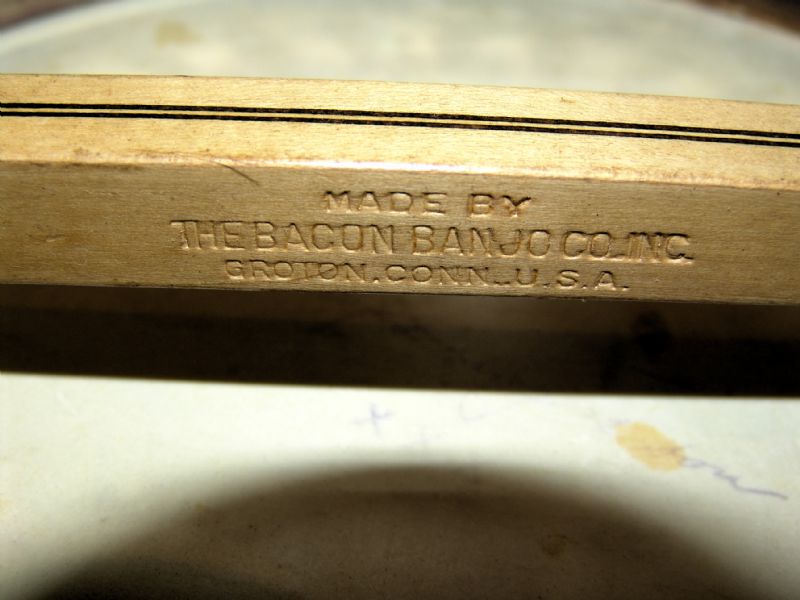
There should be a 4-digit or 5-digit serial number stamped on the square dowelstick, which runs through the center of the rim (body). AND there should be a MATCHING serial number stamped on the inside wall of the rim, near to the dowelstick.
Also write down (or photograph) any other stampings, or marks. Check all 4 surfaces of the dowelstick. Same with any markings, stampings, or paper labels on the inside of the wood resonator back.
Watch-out for belt-buckles, etc. scratching the back while you're taking the resonator off, and putting it back on. (And anytime you are holding it, or carrying it.)
Enjoy! -- Ed Britt
mscotts - Posted - 08/27/2013: 17:10:48
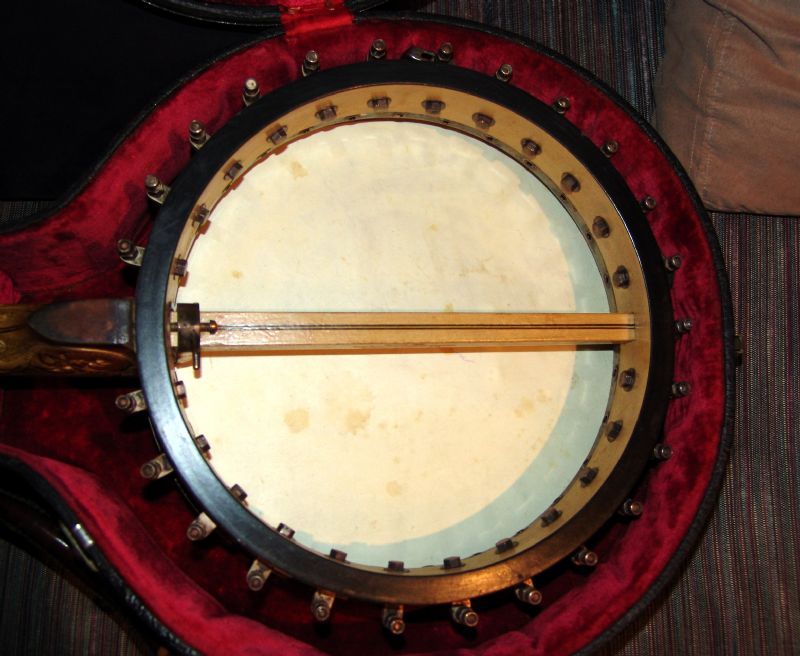
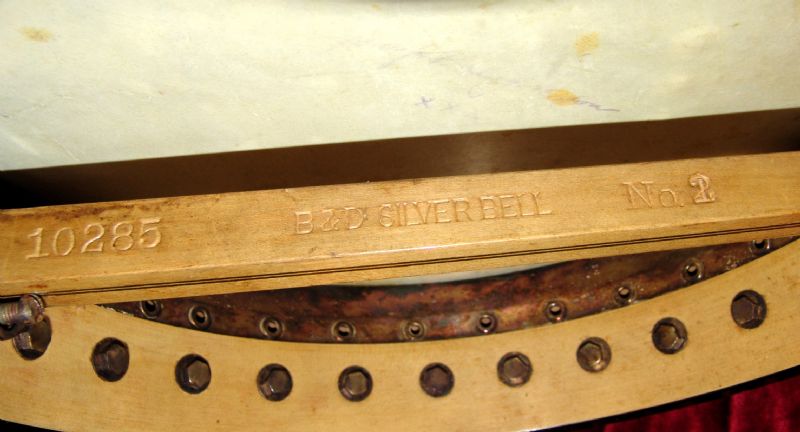
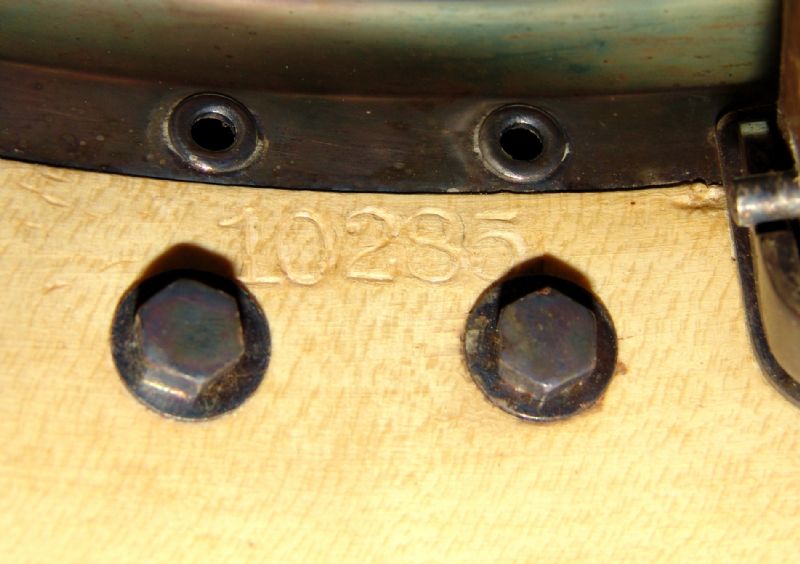
I was able to take the resonator off and snap a couple of photos. Looks like a number 2 that was stamped over a number 1?
Serial number 10285
Thanks again for all the information folks!
Scott
 |  |  |  |
Polle Flaunoe - Posted - 08/28/2013: 00:01:40
Scott,
Thanks - it´s now included in my general database acoustudio.dk/BD_and_Bacon_database.html and - together with all pics and details - in my extended DB and archive.
And Ed is right - it´s made of Holly - I wasn´t aware of this at first hand - especially as I have never seen another example of the classic Silver Bell model made of this wood sort. The only Silver Bell model made of this wood is the Montana SB - introduced a little later.
What´s more - this ultra-rare and maybe one-of-a-kind banjo turns 90 years these days - it was manufactured early fall 1923.
Congratulations - what a "find"!
Ed,
By refinishing I mean a cleaning and polishing, an overhaul of tuners and possibly the frets and fretboard plus a possible correction of a neck bow and/or twist - nothing else. Maybe the word "refurbishing" is a better word for this procedure - I don´t know - I´m an alien - LOL!
Polle
NYCJazz - Posted - 08/28/2013: 07:42:33
In my opinion, the silver tarnish gives the silver depth. As you play the banjo, areas that you contact, such as the armrest and the part of the flange that rests in your lap will become "polished" naturally.
I would expect that your banjo will be a spectacular sounding/playing instrument, as well as being a very unusual model.

mscotts - Posted - 08/28/2013: 08:43:01
Hi NYCJazz: I agree, the way it looks at the moment it just oozes character. It sounds fantastic, sounds just jump off of the instrument even with the 45 year old strings that are on it.
Hi Polle: It's exceedingly cool that you have taken the time to catalog so many B and D banjos! Labor of love I assume. I'm honored to have my banjo included. It looks like you own the silver bell#2 that was made right after mine! (#10286)
Is it made from a different wood that the one I have? Very interesting.
Thanks again for the information guys!!
BrittDLD1 - Posted - 08/28/2013: 09:12:42
Hi Scott --
I had the feeling that it might be an early 10xxx serial number. The "2" stamped over the "1" on the dowel is interesting... It must have been stamped early on a Monday morning -- before the coffee was ready! ;-)
Another detail I noticed in your earlier photos: it has the "fleur-de-lis" inlay at the 5th fret. My early Silver Bell "Special" (#10228 -- a No.1 with a carved heel) is slightly earlier, and just has a slotted diamond at the 5th.
That fleur-de-lis is still shown in the "1925" catalog, which was prepared in late-'24. (Printed AFTER Nov. 20, 1924 -- the date of a letter printed in the catalog, which contains the FIRST mention of an SB No.4 -- received by Frank DiPrima.)
Again... the inside is immaculate. (Loosen the screw on the horseshoe-shaped dowel clamp, slightly -- and make sure the ends of the round metal pin extend the same distance on each side. And then retighten the screw on the clamp. It looks like the pin may have been slightly loose, and vibrated toward one side.)
Polle --
Thanks for the clarification on "refinishing". Just "cleaning and polishing" would be an OK description. (Even "refurbishing" suggests repairs, replacement, refinishing, and replating, etc.) I thought "refinishing" seemed a little 'too much' from you -- considering the Very Fine condition the banjo was in.
After many years corresponding with Ulf Jagfors, I've learned to give a break to members who do NOT speak English as their primary language. I'm absolutely HORRIBLE at other languages. So, I always figure there will be SOME level of misinterpretation corresponding with other cultures. (I prefer to assume it's simply a 'mistranslation' -- and NOT a 'lack-of-understanding' -- with friends from other cultures.)
Thanks for noting that the banjo will be 90 years old this Fall. It IS quite amazing to see a banjo that old, in such fine shape!
And... IF you really ARE an alien... Why don't you just teleport yourself over here, sometime -- so we can meet in person! ;-)
Best-- Ed Britt
Edited by - BrittDLD1 on 08/28/2013 09:22:17
Polle Flaunoe - Posted - 08/28/2013: 12:35:14
Scott,
Do notice the name for the column in the DB - it says Reference/Reporter - not owner. So - most banjos with my name "attached" are not mine - they are only reported by me - LOL!
However - I do own many and have owned plenty more B&D Silver Bell´s - till now appr. 100 examples.
For comparison - here´re two other Silver Bell No. 2´s - indeed very close to yours - manufactured within the same month (or week) - and both made of dark stained maple:
SN 10226
.JPG)
.JPG)
SN 10227 (do notice the very whitish shine of the silver plated metal parts - after a polishing)
.jpg)
.jpg)
Ed,
Great observation regarding fret marker #3 - I hadn´t noticed this. Do have a look at SN 10226 above - it has the standard marker.
Regarding teleporting - I´ll have to loose a few (read: many) pounds at first hand, I take. LOL!
Polle
Edited by - Polle Flaunoe on 08/28/2013 12:51:20
Polle Flaunoe - Posted - 08/28/2013: 13:03:21
Ed,
BTW - have you ever experienced other examples of the "classic" Silver Bell model - being made of Holly? I myself haven´t.
But - as mentioned by me many times in the later years - regarding B&D´s: Never Say Never! LOL!
Polle
PS!
The fleur-de-lis 3rd fret marker is in the 1925 catalog only present on the Style 4 version.
Edited by - Polle Flaunoe on 08/28/2013 13:15:20
BrittDLD1 - Posted - 08/29/2013: 17:47:52
Polle --
In a strange twist of fate, Silver Bells #10227 AND #10228 were BOTH posted "for sale" within a day-or-so of each other. #10227 was at Gruhn's, first -- and #10228 was posted at Bernunzio's, a day or two later. I had a "HOLD" on BOTH banjos, while I considered which to buy.
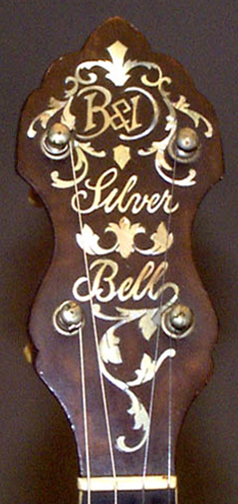
#10227 was in better condition. But #10228 had a VERY distinctive feature, which was DIFFERENT than #10227. #10227 had the typical pearl "D" (of 'B&D') which remained in the peghead for most of the 1920s.
The "D" in the peghead of #10228 was of a completely different 'font'. BUT it was exactly the SAME 'font' as the typical "B" of "B&D". (I'm a product designer, and took Typography and Calligraphy in college. And my Dad was an Industrial Arts teacher, who also taught print shop.)
At that point, I'd only seen 1 other example of the "Different D" peghead. ("Matching D" would be a more correct term.) It's seen in the photo used for the introductory brochure -- when the Silver Bell was first shown -- in Chicago, the first week of June, 1923.
Even though #10228 was NOT in as nice condition as #10227 -- as a designer, I wanted to have an example of that "Different D". (Since then, I've seen a few more early examples of it.) Best I can tell, David Day wanted the "D" changed to a font that was more similar to the "D" in his signature -- a very flamboyant Spencerian Script.
quote:
Originally posted by Polle FlaunoeBTW - have you ever experienced other examples of the "classic" Silver Bell model - being made of Holly? I myself haven´t.
As for other early Silver Bells being made of Holly... Remember that the Bacon "Super Blue Ribbon" Style A1, AND the "B&D Super Banjo" Style A1 were both offered in Holly with carved heels. The ONLY differences between those banjos, and the B&D Silver Bells, was the use of a different peghead veneer -- and the use of snap-on resonators, instead of the later "extension flange and amplifier back" ones.
All that was required was to cut a rabbetted groove, around the lower edge of the rim -- for the flange to fit into.
There are a few other Holly Silver Bell No.1's I've seen . They tend to be from around the time the Montana's were introduced. They have larger round holes in the flange. There were THREE sizes of the round-hole flange used, before the intro of the f-hole flange. In order of use: 1/4" dia., 3/8" dia, and 1/2" dia.
quote:
Originally posted by Polle FlaunoeThe fleur-de-lis 3rd fret marker is in the 1925 catalog only present on the Style 4 version.
I have an original copy of the 1925 catalog. On the "Foreword" page, at the front of the catalog, it states that they "...take pleasure in presenting their 1925 catalogue...". But there is NO picture of the No.4 in that catalog. The No. 4 is MENTIONED in a letter from Frank DiPrima, at the back of the catalog.
The No. 4 was first cataloged, and pictured, in the 1926 catalog. And it does appear to have a fleur-di-lis at the 5th fret
Best-- Ed Britt
Edited by - BrittDLD1 on 08/30/2013 10:43:49
 B&D 1 |
Polle Flaunoe - Posted - 08/30/2013: 01:00:12
Ed,
Aha - interesting. You have mentioned the "Different D" before - but I can´t recall having seen an example. So I don´t know the difference. Here´re btw. both SN10226 & 10227 - identical, as far as I can see - and identical with all later examples in my picture archive, again as far as I can see - LOL!:

I´m aware of the use of Holly for the models as mentioned by you - I wonder - was the geometry and construction for a "semi-finished" neck and rim identical for these and for the early SB? Meaning - were they at that time interchangeable at this production stage? Do you know?
Regarding catalogs - it seems, that my "1925" example as purchased from musicmansteve.com is the one, that you are naming a 1926 example. It´s not dated. Hence the confusion.
Regards
Polle
Edited by - Polle Flaunoe on 08/30/2013 01:01:46
BrittDLD1 - Posted - 08/30/2013: 10:48:29
Hi Polle --
This photo of the "Different D" (or "Matching D") on Silver Bell #10228, is in "Album 01 -- Misc. Photos Used In BHO Topics" on my BHO Photo page. And I did posted it, in a couple topics, a few years ago.
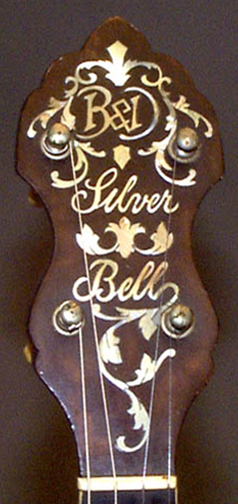
Link to image in my BHO Photo "Album 01":
hangoutstorage.com/banjohangou...12011.jpg
If you look at the letters "B" and "D" you'll see that the 'ascender' (the vertical line) in each letter has 'serifs' and is shaped like a capital "I". And, it is an exact match between the two letters. Note that the top and bottom ends, of the curving strokes of the both letters, also overhang the ascenders in the exactly the SAME way. They are were designed, as a 'set' to MATCH.
Compare that to the "B" and "D" in Polle's photos... The "B" is the SAME letter-form as on #10228. BUT the "D" is a radically different 'script' letter-form. (Which is similar to the style of the capital D's that David L. Day used in his signature.)
As I mentioned, the "Different D" (or "Matching D") on the B&D logo is seen in the earliest-known photo of a Silver Bell -- which was used for the first published brochure, at the Chicago introduction of the Silver Bell, the first week of June, 1923.
The first time I noticed the "Different D" was in the Ebay sale of the earliest-known Silver Bell (at that time) #9196. The dowel and rim serials matched. (I believe it went to a fellow in France... Not sure where it is now...) It came from a family in Groton, CT -- and had been upgraded over the years, with a newer f-hole resonator, Soft Pedal, Oettinger tailpiece, etc. With the later-style resonator removed, you could see that the rim was originally drilled for only TWO resonator flange screws. (That is a VERY IMPORTANT detail -- seen ONLY on the EARLIEST Silver Bells.)
The "geometry" of Bacon Blue Ribbon necks --vs-- early B&D Silver Bell necks:
One of the major things that David Day brought to Bacon, was how to design and make 'modular' interchangeable parts. And YES, the basic part-geometry (rims, necks, dowels, resonator) of the post-#7500 Bacon Blue Ribbons, and the 1923-25 -Silver Bells WAS interchangeable.
The ONLY difference between a #8000 BACON Super Blue Ribbon neck, and a #9000-#12000 B&D Silver Bell neck -- is the PEGHEAD overlay.
That way of thinking was a HUGE help with the manufacturing and assembling of an extensive product line -- which included 6 different variations of Silver Bell necks, by 1924. (And that's just for the No.1 thru No.3 models -- and BEFORE the introduction of the No. 4 through No. 9 models!)
But unfortunately, that innovation has also turned into THE MAJOR PROBLEM with Silver Bells... You can swap parts quickly, from one banjo to another -- and they will FIT! It's why so many Silver Bells are 'suspect' and NON-ORIGINAL. Regardless of what their current owners were told, when they bought it.
I have seen LOTS of Blue Ribbon Necks on Silver Bell pots, and vice-versa. And I have even seen a few original Blue Ribbon necks, REFITTED with Silver Bell overlays, and attached to Silver Bell pots -- by "swapping the dowels", so the serial numbers match. (There are minor details, which can identify a 'swapped' neck. But it takes LOTS of knowledge to recognize the clues. (And even when I suspect a swapped neck -- I'm not always 100% positive about it.)
Bacon Catalogs:
Normally... Bacon wrote the text, prepared prototypes, and had them photographed, during the Fall and Winter -- for the next year's catalog. The NEW catalog was usually printed in February, or March. The new catalog and the new models were introduced at the annual Spring convention of "The American Guild of Banjoists, Mandolinists, and Guitarists" -- in April or May.
The INFAMOUS "1923-24" catalog:
The WORST screw-up in Bacon's history is their "1923-24" catalog. It started-out, in Sept of 1922, as the "1923" catalog. A total of 4 completely different updated half-page pricelists were published during the interim, and sent out -- all of them stating "Effective September 1, 1923". But the actual catalog wasn't even delivered until August of 1923 -- and advertised as their "1923-1924" catalog. (Even though it's finally called the "1924 catalogue" on the 'Foreword' page, and the page is dated: "Sept. 1 1923" -- AFTER the catalog was delivered!)
Confused? It's worse than that...
To put a 'fine point' on it... The 1923-1924 catalog has IMAGES from the products developed in mid-1922 -- with titles and descriptions of the new products developed in late-1922, and early-1923. It is the most confusing Bacon catalog ever produced... AND, it is probably the most widely reproduced Bacon catalog!
In the Fall of 1922 -- shortly after David Day arrived at Bacon -- they were absolutely flat-out, trying to get the new Bacon Supertone/Super Blue Ribbons finished. When that was done, they had to create a NEW "B&D Family", consisting of: The B&D Silver Bell, The B&D Super Banjo, and the B&D Blue Bell. (Thinking modularly, David Day had designed the rim and tonering of the Bacon Supertone/Super Blue Ribbon to ALSO be used for the B&D Super Banjo , and the B&D Silver Bell. He designed a different lower-cost rim assembly for the B&D Blue Bell -- but few of the Blue Bells were ever made...)
Creating all of those NEW banjos, almost simultaneously, was a huge amount of work. And Bacon and Day were probably overconfident that they could finish it all, in time for the Spring 1923 Guild show. It would take me several pages to completely lay out everything that happened during the period from September 1922, to the catalog's delivery in August of 1923!
So, Polle... I think the reason the 1926 catalog is NOT marked, is that Fred Bacon and David Day were (once again...) up to their eyeballs in the work necessary to get their NEW line of high-end banjos ready for introduction. In 1926 they would introduce their carved, gold-plated and engraved models:
o The Silver Bell No. 4
o The Silver Bell No. 5
o The Silver Bell No. 6 Ne Plus Ultra
And most models in the Silver Bell line (from No. 2, up) would come fitted with their NEW accessories:
o A 19-fret neck (17-fret necks/extended fingerboards, option)
o "Internal Reduction" (geared) pegs
o The f-hole flange
o An Oettinger tailpiece
o A Bestone armrest
o The B&D Soft Pedal
Best-- Ed Britt -- ©2013
Polle Flaunoe - Posted - 09/01/2013: 00:17:56
Ed,
Thanks - I hadn´t noticed your BHO Photo Album.
Do have in mind, that you´ll rarely find very early B&D´s over here - I think, that the earliest for me to work on is SN 9120 - the fantastic Dale Small Super #9 creation - and that one did get an overlay of his own design. My earliest Silver Bell till now is SN 13741.
Regarding catalogs etc. - yes, it´s an absolutely mess. And the mess went on - f.ex. is the Montana No. 7 NPU pictured in the 1930 catalog a 1924 build.
BTW - regarding the "NEW accessories" as mentioned - the very first banjo in my extended DB with ALL of these - and also the very first tenor with a 23" scale - and also the very first SB with the Type B peghead (with small ears) - is a Montana No. 8 NPU - SN 12056 - manufactured in the spring 1924. The first examples for now of the low grade SB´s - with these features (except for the peghead) were manufactured 6-7 months later.
Regards
Polle
mscotts - Posted - 09/01/2013: 12:40:17
Thanks for the education guys, your knowledge of these instruments is really impressive. I have a whole new respect for these banjos and this one I have in particular.
I don't think I could have found such well rounded information any where else, the wealth of information that is so readily shared with the ability to meet some
really knowledgeable people is what makes forums like these truly amazing.
Thanks again!
Scott
irish-tenor - Posted - 09/01/2013: 21:27:16
How fun! I just happened to join (new account) Banjo Hangout this very evening - and found photos of a banjo I'm familiar with. I'm the present owner of the SN10226 banjo Polle posted earlier (small world). If you'd like photos of any details on that instrument, I'll be happy to post them. -jeff
Polle Flaunoe - Posted - 09/01/2013: 22:42:46
Jeff,
What a coincidence. LOL!
I have 11 pics of your banjo - from March this year - I take, that I have them from an auction or some classifieds. Did you purchase it at that time?
Polle
BrittDLD1 - Posted - 09/02/2013: 07:10:05
Hi Jeff (irish-tenor) --
Welcome to the BHO. Nice to meet the 'caretaker' of one of MY Silver Bell's (#10228) other 'siblings'. I think you'll find a LOT useful information, and interesting people (characters...?) on the BHO. Enjoy!
****************************************************************
And Scott ---
More than glad to help you ID your banjo. You'll find LOTS of knowledgeable people on the BHO. But... while we know a LOT -- we still don't know EVERYTHING.
So the type of interchange between Polle and me, is a typical 'learning' situation -- where EACH of us provided some NEW information to each other. That kind of 'collaboration' is crucial to understanding what actually happened at The Bacon Banjo Co., Inc. Because ALL of the company records were destroyed, during the company's bankruptcy, in 1939-'40. It's a form of detective-work.
Best-- Ed Britt
Edited by - BrittDLD1 on 09/02/2013 07:22:42
mscotts - Posted - 09/02/2013: 14:08:12
Great- Thanks Ed (and Polle)
Hi Jeff, That's amazing, yet more proof that online forms shrink the world in the best of ways! I for one would love to see pictures of #10226!
Scott
Polle Flaunoe - Posted - 09/02/2013: 23:04:40
Guys,
Jeff has told me off-line, that SN10226 does not carry the stamp No. 2 on the dowel - instead it´s stamped SPECIAL.
Bacon did often use this stamp - before the introduction of the style number system for Silver Bell´s - for anything non-standard - for the later Montana model, which for many years was stamped MONTANA SPECIAL etc.. Much later came a new model simply called SPECIAL.
Jeff,
From my pics of your banjo I can´t tell about its metal plating - due to a lot of tarnish. Please tell me/us - is it silver or nickel plated? Silver would in principle make it a No. 2 - nickel most likely a SPECIAL.
Ed,
Do you know appr. when the style number system was introduced? Do notice, that I in the DB have No. 2´s going back to SN9908 - and No. 3´s back to SN9951. However I do not have detailed infos of the stamping of the "upper" grade examples between SN99XX and SN10285 (~ 1-2 months of production). BTW - how is your SN10228 stamped?
Polle
John Gill - Posted - 09/04/2013: 12:41:38
Hello Silver Bell fans
I've been enjoying this topic very much, and learning many things. Just wanted to mention that I have A silver Bell # 2 also. It's a plectrum, serial number 12753. Polle, I think I gave you this info? Anyway it's a standard finish and a fine player. It was in very rough shape when I got it, and the silver plate was worn thru to the brass in many places. So, it's been re finished and replated in nickle plate. So it's not original but has a fine full sound and makes a good working banjo.
Regards to all
John Gill
Polle Flaunoe - Posted - 09/05/2013: 01:35:28
Guys - for those of you interested - here´s Vinnie Mondello´s workpage for his recent restoration of John Gill´s #2: 4stringbanjos.com/Restorations...pair.html
John - yes, I have it in my databases. The same goes for your Peerless.
Polle
BrittDLD1 - Posted - 09/05/2013: 10:43:04
quote:
Originally posted by Polle FlaunoeEd,
Do you know appr. when the style number system was introduced? Do notice, that I in the DB have No. 2´s going back to SN9908 - and No. 3´s back to SN9951. However I do not have detailed infos of the stamping of the "upper" grade examples between SN99XX and SN10285 (~ 1-2 months of production). BTW - how is your SN10228 stamped?
Hi Polle --
"Bacon Models" NUMBERED Styles & LETTERED Styles -- SHORT Answer:
Fred Bacon started-out using the 'NUMBER' styles, on his "Professional" (donut resonator) models (made by Vega), way back in 1906-1910. In 1912-13 Fred added the high-end "Grand Concert" and "Special Grand Concert" (DeLuxe) styles to his Forest Dale catalog. (Although, I think he called some of the 1908-10 Vega-made Professionals by those names...)
Fred introduced the "LETTER" styles, when he created his "Orchestra" banjos (c1919-1920 -- to serve the 4-string market) they were exactly the same construction -- EXCEPT they had an openback rim. The 1922 Blue Ribbon models (and later Supertone/Super BR's) were an extension of the Orchestra Line -- with a snap-on resonator -- so he kept the 'Letter' styles for the BRs. (at that point only an "A", "A-1", and Deluxe (usually "SPECIAL", "DLX", "X", or finally "DE-LUXE").
When Fred and David Day developed the Silver Bell -- with the 'extended-back' resonator, They used the "NUMBER" styles for that line. At first, it was just the single plain model -- shown at the Chicago Convention, in 1923. But quickly, they developed 3 models, which matched the details of the 3 "B&D Super Banjo" models -- except for the use of a different peghead veneer, and the extended resonator: The Silver Bell No.1, No.2 (carved heel, silver plated), and No.3 (carved heel, gold plated).
Unfortunately, the "SPECIAL" designation stamp was soon used for almost ANY detail, or custom option, which did NOT match the catalog description of the model. It became almost useless, since any single feature could have been added, subtracted, or modified -- to a standard model -- and it would get the "SPECIAL" stamp. Sometimes they were stamped WITH the normal model designation... Sometimes they were stamped WITHOUT the normal model designation...
My Silver Bell #10228 is an example of that. It is NOT stamped with a model number designation. It's ONLY stamped "SPECIAL". It's either: a No.1 with a carved heel --OR-- a No.2 that is Nickel-plated. Depends on how you think about it... (I like to think of it as No.2 that is Nickel-plated.)
I'm working on a longer, more detailed, and comprehensive description of Bacon's TYPICAL models -- for each time-period of Bacon Banjos manufacture, from 1906 to 1926. Including: Vega-made Bacons (1906-10), NYC-School made Bacons (1910-1920), Groton-made Bacons (1921-1926).
The later-period Bacon models are so numerous, ever-changing, and with so many custom features and versions -- that I don't think anyone can make complete sense of the expansive period from 1926 to 1930. OR... of the belt-tightening cost-reduction, during the Depression period from 1930 to 1938.
Best-- Ed Britt -- ©2013
Edited by - BrittDLD1 on 09/05/2013 10:48:25
Polle Flaunoe - Posted - 09/05/2013: 11:29:25
Ed,
Thanks - this is really interesting.
I do totally agree regarding Bacon´s SPECIAL stamp - the use of it is/was for sure confusing.
Also I do think about both SN10226 and your SN10228 as No. 2 examples - however turned into SPECIAL´s due to their nickel instead of silver plating. I´ll add a remark about this in my general DB and keep more detailed infos in my extended DB.
I´ll very much be looking forward for your up-coming description of "Bacon's TYPICAL models" 1906-1926.
However - regarding your remark "The later-period Bacon models are so numerous, ever-changing, and with so many custom features and versions -- that I don't think anyone can make complete sense of the expansive period from 1926 to 1930. OR... of the belt-tightening cost-reduction, during the Depression period from 1930 to 1938." - I do absolutely not agree - LOL!
IMO the 1925-1939 production is far more consistent in regards of models, versions, features and versions - I have no problem keeping these apart. But do have in mind - the banjos from this period are within my main field of interest. (Can you say so in English?)
Kind regards
Polle
BrittDLD1 - Posted - 09/05/2013: 12:22:04
quote:
Originally posted by Polle FlaunoeIMO the 1925-1939 production is far more consistent in regards of models, versions, features and versions - I have no problem keeping these apart. But do have in mind - the banjos from this period are within my main field of interest. (Can you say so in English?)
Hi Polle --
Oh, yes! I fully agree that the 1925-1939 period is definitely the MAJOR part of YOUR interest in Bacon Banjos. And I do agree that their products were more consistent, and of the highest quality, and design. (Especially from 1925 to 1930!)
But... probably because I'm a professional product designer, who has also had a lifelong interest in history -- I find that the beginnings and endings of periods seem to be when the MOST interesting things happen. THAT is when the major CHANGES happen -- for the good, or the bad.
They are usually tumultuous times, "full of sound and fury" which signify the changing of the 'status quo'. Or, as the old saying goes: "May you live in interesting times."
So, MY major interest in The Bacon Co. is from 1920-26, and 1932-40 -- the periods which form the 'bookends' of David L. Day's tenure at Bacon, and of the Company itself. Both periods show Day's personal "tenacity in the face of adversity".
Best-- Ed Britt
Edited by - BrittDLD1 on 09/05/2013 12:27:46
Terms of Use | Privacy Policy | Privacy Consent (EU/GDPR Only)
Copyright 2026 Banjo Hangout. All Rights Reserved.


