DVD-quality lessons (including tabs/sheet music) available for immediate viewing on any device.
Take your playing to the next level with the help of a local or online banjo teacher.
Weekly newsletter includes free lessons, favorite member content, banjo news and more.
Premier Sponsors


|
Please note this is an archived topic, so it is locked and unable to be replied to. You may, however, start a new topic and refer to this topic with a link: http://www.banjohangout.org/archive/264082
BrittDLD1 - Posted - 06/04/2013: 05:47:20
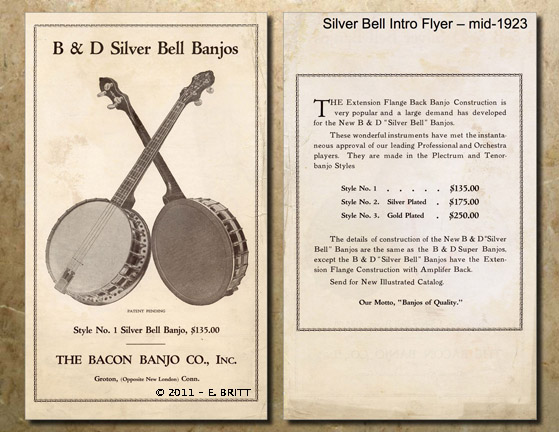
90 years ago, today -- June 4th, 1923 -- the NEW B&D Silver Bell banjo was officially introduced to music store merchants, and professional musicians, at the "Music Industries Chamber of Commerce Convention" -- held in Chicago, at the Drake Hotel, from June 4th to 7th, 1923.
Well-known Pittsburgh tenor player, Mike Scheidlmeier, demonstrated the new Silver Bell, and represented The Bacon Banjo Company, Inc. -- on behalf of President Fred Bacon, and VP David L. Day, who were unable to attend the show.
Below is the link to a copy of a rare introductory brochure for the new B&D Silver Bell. The brochure was probably first distributed at the convention of The American Guild of Banjoists, Mandolinists, and Guitarists -- held in Washington, DC, beginning April 22, 1923.
hangoutstorage.com/banjohangou...12011.jpg
Below are close-ups of some details of the earliest Silver Bells:
... o A different "D" on the peghead, than used on later versions.
... o Grommets (eyelets) used in the round 1/4" dia. flange holes.
... o NO holes shown in the tonering skirt.
... o A flatter resonator back, single raised ring at the outside edge.
... o Only 2 thumbscrews used, to hold the resonator on.
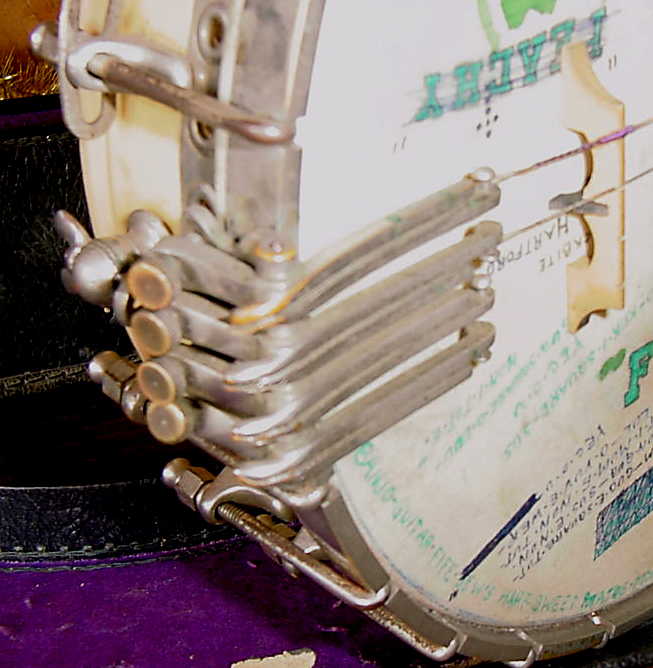
... o The use of the new Grover "Presto" tailpiece.
... o A 17-fret neck, with metal friction pegs in the peghead.
hangoutstorage.com/banjohangou...12011.jpg
NOTE: With "PATENT PENDING" shown under the banjo, it could possibly be a later printing of the initial brochure. The Silver Bell patent was filed on Nov. 24, 1923. The term "Patent Pending" is only supposed to be used after the patent application is filed with the US Patent Office. But during that time period, the phrase was often used to warn competitors that the official patent application was already in-process (perhaps undergoing review by their patent attorney) even though it had NOT been filed yet.
The main drawing for the Silver Bell patent was traced directly from the photo used for the introductory brochure:
hangoutstorage.com/banjohangou...12011.jpg
In Trademarking the "Silver Bell" name, the registration states: "...this trademark has been used continuously since April 2nd, 1923..." Which is about typical for the 'lead-time' Bacon used for the printing of their introductory brochures for the spring Guild shows.
Another possibility for the 'first use' of "Silver Bell", was for the peghead overlays. They would have been inlaid by then, to apply to the prototypes and the earliest production models, intended for display at the official introduction.
I assume Fred Bacon and David Day originally INTENDED the Silver Bell to be introduced at the Spring '23 Guild show -- which was typical for new model introductions by Bacon. But they probably ran into some production problems, and it simply wasn't ready in time.
Best- Ed Britt -- (© 2013)
 02 SB Flyer 1923 | 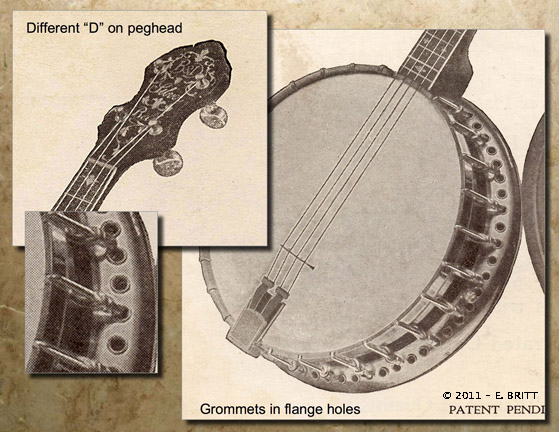 03 SB Flyer Details | 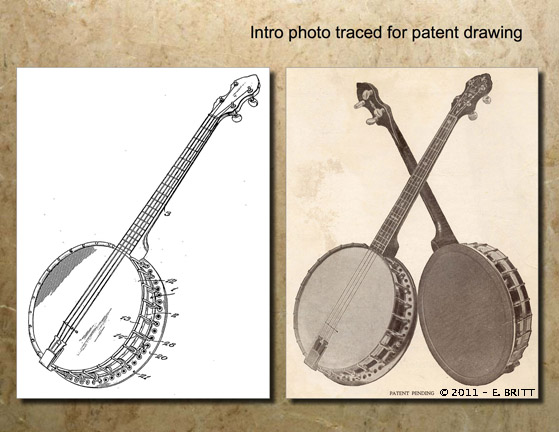 04 Patent Dwg & 1923 SB flyer |
wbelm - Posted - 06/04/2013: 06:30:12
Interesting, how do you know this stuff? wow.....thanks for sharing, Bill Anderson
McUtsi - Posted - 06/04/2013: 08:19:44
"It was ninety years ago today---Day & Bacon taught the band to play"...McUtsi
Edited by - McUtsi on 06/04/2013 08:21:14
Polle Flaunoe - Posted - 06/04/2013: 08:37:48
Ed,
So - have you ever seen a Silver Bell like this? With grommets in the flange holes, without holes in the tone ring skirt and with the flat resonator back?
I haven´t - but on the other hand - I haven´t seen them all - LOL!
With this in mind I´ll however dare claiming, that the banjo pictured/drawn is an early prototype - from late 1922/very early 1923 - ALL of the first production examples in my database do not have the flange grommets - they do ALL have the Type I tone ring with holes in-/out-side - and they do ALL have the characteristic lathed solid wood resonator back.
Just curious - LOL!
Polle
Polle Flaunoe - Posted - 06/04/2013: 11:26:00
PS!
For now I have the first production Silver Bell in my extended database dated to March 1923 - the next early May - and then a whole bunch in June/July.
This seems to fit the missed Guild Show and the Chicago Convention somehow/well. Maybe I´ll even - when/if further confirmed dating infos pop in - be able "pushing" these dates let´s say one month back.
Edited by - Polle Flaunoe on 06/04/2013 11:29:46
BrittDLD1 - Posted - 06/05/2013: 07:18:18
quote:
Originally posted by wbelmInteresting, how do you know this stuff? wow.....
Because I've been researching David L. Day (my banjo-design hero) and his effect on the Fairbanks Co., the Vega Co., and the Bacon Banjo Co., for over 35 years.
Day started with Fairbanks & Cole, in 1883 -- at age 18. After the Hurricane of 1938, Day sold the remnants of The Bacon Banjo Co. to Gretsch, in 1940 -- at age 75. His entire adult working-life (57 yrs!) had been devoted to making some of the finest banjos ever made.
In 1895, when AC Fairbanks sold The Fairbanks Co., to Cummings and Dodge (two of AC's Somerville, MA business associates) -- David Day became the General Manager of The Fairbanks Co., and ran the day-to-day business of the company. That period -- from 1895 to the 1904 fire -- is arguably the FINEST and most innovative period of Fairbanks' production.
When Vega bought the remnants of Fairbanks, after the fire -- Day was hired as a VP -- to get the Fretted Instrument Department going again. 1904 to 1922 was also arguably VEGA's finest period of fretted instruments. (Although there was some decline during WWI.)
After Day left Vega (in August 1922, to go to Bacon) -- there was a noticeable loss of quality in Vega's instruments. And, according to Vinnie Mondello's father (who worked at Vega) the EMPLOYEES of Vega gave David Day a gold watch -- as a token of their respect and admiration for him. Vega's (new) Management didn't...
Upon arriving at Bacon, that Fall... There was a rapid improvement in the design and quality of Bacon's instruments.
So... it was THAT obvious 'tipping-point', in 1922, which made me realize that DLD had been responsible for producing a major positive effect at EACH of the companies where he was employed. He definitely deserves the "Banjomaker's Lifetime Achievement Award"!
Best- Ed Britt
PS -- Polle, I'll respond to your postings later today or tomorrow. (You're basically correct...)
Edited by - BrittDLD1 on 06/05/2013 07:29:01
Polle Flaunoe - Posted - 06/05/2013: 08:05:01
Ed,
"He definitely deserves the "Banjomaker's Lifetime Achievement Award"!"
I do absolutely agree! As do I everyday enjoy his fantastic creations/products! I have many examples in-house these days - some will go - but the best will stay and be played by me - as long as I´ll live - LOL!
Regarding my posting above - if I could move the datings in my extended DB one month backwards - everything would fit perfectly! However I´ll have to wait for further confirmed shipping/sales dates.
Polle
Edited by - Polle Flaunoe on 06/05/2013 08:17:05
mikehalloran - Posted - 06/05/2013: 21:30:06
Preceded the Vegaphone and the Presto tailpiece by 4 months. Also the first year for Gibson 5 string and plectrum banjos. 1923 turned out to be a most interesting year for the banjo.
aroblin - Posted - 06/06/2013: 03:28:43
Ed, you are a treasure. What remarkable research.
Thank you.
beezaboy - Posted - 06/06/2013: 05:52:26
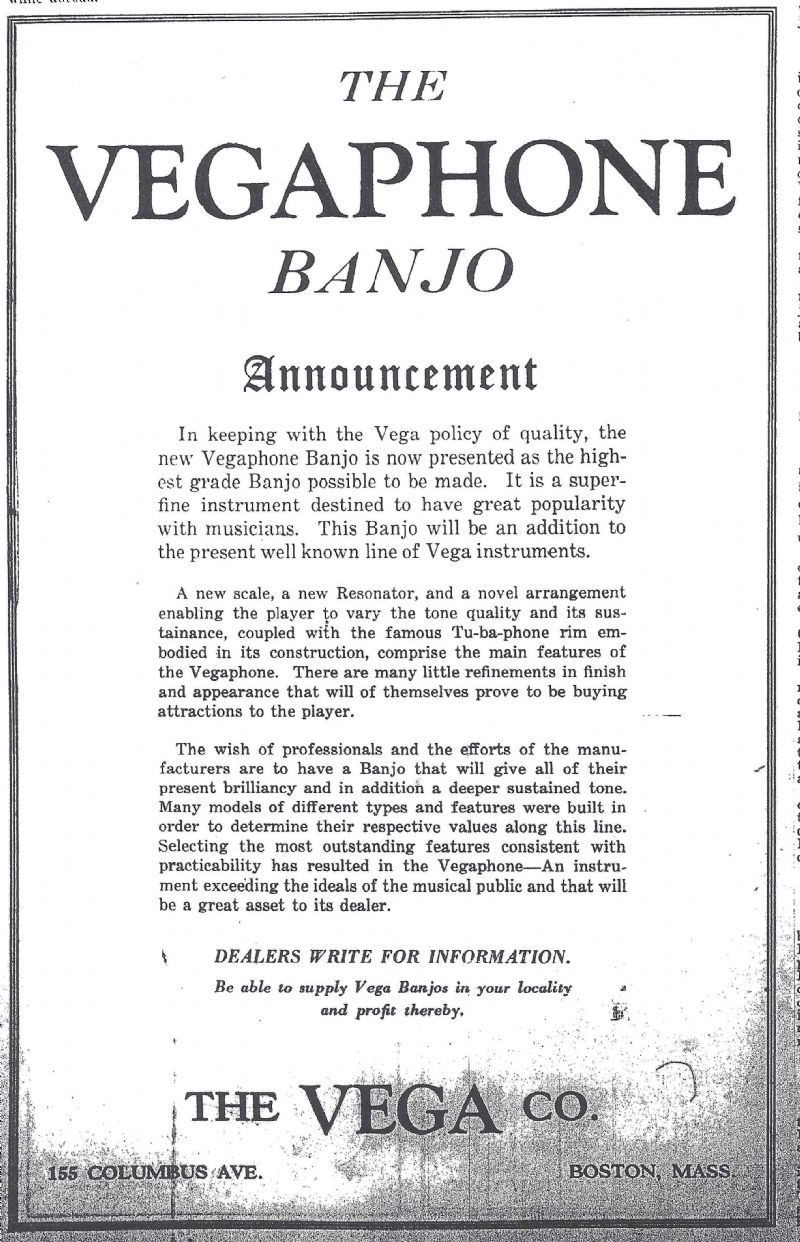
Hi Mike and gentlemen - Some food for thought. The Vegaphone was formally introduced a little earlier than we once thought. Attached is an ad from the June 9, 1923 The Music Trades magazine. I found this issue on microfilm at the Univ. of Illinois music library last summer. This same ad appeared in The Crescendo magazine but somewhat later. Now, given the lead time for producing this Music Trades ad and actually getting it published...well, I'll let you draw your own conclusions about those that next followed Lange into the era of the extended resonator "modern" tenor banjo. I will say that often as I research the origins of tenor or plectrum banjos the name Vega seems to pop up.
John
 The Music Trades - June 9, 1923 |
beezaboy - Posted - 06/06/2013: 06:10:36
Here is another interesting article from the same June 9, 1923 issue of The Music Trades about the Grover tailpiece going to both Bacon and Vega.
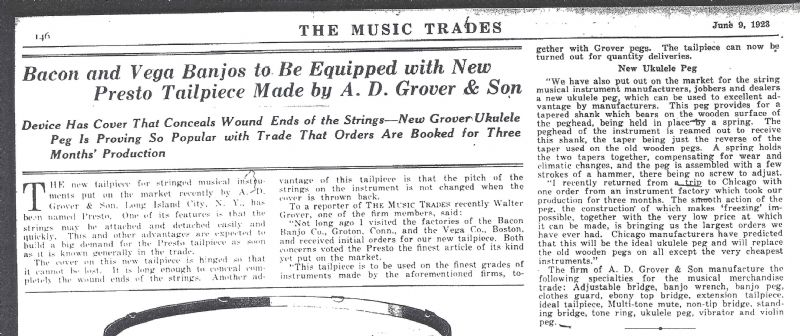 The Music Trades - June 9, 1923 |
Polle Flaunoe - Posted - 06/07/2013: 03:23:29
John,
"- well, I'll let you draw your own conclusions about those that next followed Lange into the era of the extended resonator "modern" tenor banjo."
I guess, that Ed will agree - do think David L. Day first of all - it´s maybe/most likely a "left-over" from his last days at Vega. But do also have in mind, that Mr. Day most likely - as mentioned before - did "ride two horses" during 1921-22. If so - any Bacon/Vega competition at that time has no meaning.
Regarding the Presto TP - do notice the Silver Bell "prototype" as pictured/described by Ed. The article as shown by you does most likely - regarding the Silver Bell - go for the first line of production examples - manufactured in the spring/early summer 1923. Bacon and Day would for sure have used/tested this device months in advance.
BTW - they continued looking for and testing other and more suited TP´s - the Oettinger came into the picture late 1923 and was fitted on many examples during 1924 - in the spring 1925 they decided to use only this for all Silver Bell styles.
Polle
Polle Flaunoe - Posted - 06/07/2013: 09:33:36
PS!
As a side remark - do never trust printed ads, flyers, articles etc. etc. back from the 20s - they were often totally out-dated. F.ex. the Vega catalog introducing the Vegaphone was published 1-2 years after the actual introduction.
Another and even more terrible example - 1-2 years ago a Grover Clamshell TP - with a poorly engraved "BACON" was put up for sale at a high cost - it was at that time - by a so-called/well known Bacon expert - claimed to be time correct for a 1927/28 upper grade B&D - and an original part of this - as this banjo model/style was shown with a similar TP in the 1928 Bacon catalog.
Oh Dear - the banjo in question was for sure an early 1924 production - from a time, when the gents Bacon and Day were searching the best possible TP´s for the Silver Bell series - and long before a patent for the Clamshell was applied for. And as you and I know - in the spring 1925 these gents decided only to use Oettinger TP´s for ALL Silver Bell models/styles!
Edited by - Polle Flaunoe on 06/07/2013 09:34:05
Polle Flaunoe - Posted - 06/07/2013: 09:40:13
Dear Ed,
Do you have any comments - as promised/foreseen - and/or any corrections to my postings above - please post them now.
Polle
BrittDLD1 - Posted - 06/07/2013: 17:58:27
**********************************************************
So - have you ever seen a Silver Bell like this? With grommets in the flange holes, without holes in the tone ring skirt and with the flat resonator back? ...
Hi Polle -- Sorry to get back to you so late.
No, I've never -- in-person, or in a modern photo -- seen a Silver Bell with the grommets in the flange holes. But it is a photo of a real instrument, on the intro flyer -- although the back of the resonator appears to have been 're-touched' to make some last-minute changes.
The grommets ARE also shown, in cross-section, in the patent. (As I've mentioned before, the Silver Bell patent cross-section started out as a truly superb drawing, by master draftsman... But then, it was apparently finished by a complete idiot -- who had never seen a REAL banjo, and didn't understand the mechanics of how the head was clamped-down by the tension hoop, and bracket hooks! He turned a masterpiece of drafting into a laughable absurdity.)
However... looking at the cross-section drawing, of the grommets in the flange holes -- you can see that they were intended to be clamped onto the inner perimeter of the holes. (Just like the grommets for your shoelaces -- which is what they were!) But I can also imagine that those grommets could easily start to rattle agaisnt the metal of the flange -- IF they were NOT clamped tight-enough to the edge of each hole.
Quickly counting the flange-holes on the photo... There are approximately 50 chances, on each banjo, for a single grommet to rattle! And a good probability for MULTIPLE grommets rattling! That would drive a good player crazy -- and would be reason enough to NOT use them in production. (And that's MY 'experienced product-designer guess' as to WHY they were NOT used in production.)
**********************************************************
... With this in mind I'll however dare claiming, that the banjo pictured/drawn is an early prototype - from late 1922/very early 1923 - ALL of the first production examples in my database do not have the flange grommets - they do ALL have the Type I tone ring with holes in-/out-side - and they do ALL have the characteristic lathed solid wood resonator back. ...
I agree. It IS photo of a REAL prototype, which has been slightly 'retouched'. As mentioned above, the BACK of the resonator seems to be the area with the most retouching. (Bacon referred their resonator as having an "Extension Flange Construction with Amplifier Back.")
All of the ORIGINAL very-early Silver Bells that I've seen DO have the lathe-turned solid back. But I've never SEEN an early lathe-turned back with ONLY the raised outer-ring, and a flat center -- WITHOUT the smaller raised center-ring.
The most interesting detail to me, is the LACK of grommets in the outer-skirt of the tone ring. All of the early
Silver Bells I've seen HAVE the stamped 'fake' grommets. That same retouched introduction photo WAS eventually used in Bacon's 1925 catalog.
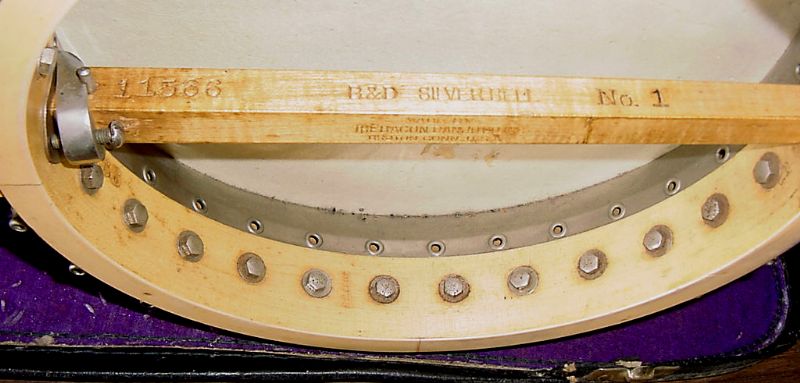
Interestingly... the 1925 catalog (printed early-'25) was the first year the "Montana" model was shown. And the image of the Montana did NOT show grommets in the tone ring, either! (Even though the earliest Montana I've seen -- #11566 -- DID have the 'stamped-grommets' in the tone ring.) The '25 catalog also shows the slightly larger 3/8"-diameter flange holes, used in the Montana's flange.
But by the 1926 catalog (printed in late-'25?) -- the new 19-fret, f-hole flange Silver Bell is shown WITHOUT the holes in the tonering skirt.
Polle's "PS":
**********************************************************
For now I have the first production Silver Bell in my extended database dated to March 1923 - the next early May - and then a whole bunch in June/July.
This seems to fit the missed Guild Show and the Chicago Convention somehow/well. Maybe I´ll even - when/if further confirmed dating infos pop in - be able "pushing" these dates let´s say one month back.
I'd guess a few "working prototypes" were probably started in late-'22, for testing. And a final "production prototype" was made for the show, and sent to Scheidlmeier -- for him to practice with. But I have not seen an article describing how many actual 'production' Silver Bells were shown (and/or sold) at the Chicago show.
We DO know the necks were basically the SAME as the previous "Super Blue Ribbon" necks -- but with a new Silver Bell peghead veneer. So there was no NEW production process used on those. The rims had an extra recess at the botton -- for the flange. But that would be only a minor change. And the finishing was the same as used on the "Super Blue Ribbons" -- so no 'surprises there, either.
The construction of the resonator flange, and the turning of the resonator back, would have taken the most time-and-effort, in the production of the new Silver Bells. BUT... The metal flange would have been made by an outside 'metal-spinning' company, with a lot of experience. I assume it was the SAME company that was already spinning the tone rings for Bacon.
Best- Ed Britt
Edited by - BrittDLD1 on 06/07/2013 18:14:16
howseth - Posted - 06/07/2013: 20:14:43
I wonder - How does the tone of an original 1920's Silver Bell - compare to the the tone of a recent Ome Silver Bell tone ring banjo? (my Ome is a 2008 - 12" pot, Silver Bell open back)
Polle Flaunoe - Posted - 06/08/2013: 00:53:28
Ed,
Many thanks - what a great description/summary - and of course they had to give up the idea about the flange grommets - I can for sure imagine the banjo sounding somewhat like a cymbal with rivets.
Regarding the first flanges - I have lately seen quite a few examples of these with severe cracks starting at the holes for the small screws attaching it to the resonator - and going appr. 1" up over the bevel. So maybe their supplier - with regards to your comment "The metal flange would have been made by an outside 'metal-spinning' company, with a lot of experience." - did not have sufficient experience after all. I have never seen cracks like this on F-hole and Fleur-de-lis-hole flanges - only on the early round-hole flanges.
I´m wondering - did Day maybe become aware of a possible built-in weakness soon after the release of the model - did he at first hand try to make the "ventilation" holes larger, later double punch the holes and finally ending up with the large F-holes - in order taking away tensions, built up during the spinning? Meaning, that the transformation from the small round holes to the large F-holes was first of all based on a constructional problem - and not so much for getting better a acoustic response or a more refined design. How do you think about this?
The same goes for the flanges for the later XL 13½" resonators. They used flanges with different profiles (some of these can easily be deformed) - before ending up with the strong, yet elastic stair step (double bump) profile.
Regarding the first Montana picture - showing no outside skirt holes - do have my remark above in mind: "As a side remark - do never trust printed ads, flyers, articles etc. etc. back from the 20s - they were often totally out-dated." LOL!
Plus have a look at this site of mine acoustudio.dk/BD%20Classic%20S...ment.html - it shows, that the tone rings with holes both in- and out-side were basically not used anymore by late 1924.
Regards
Polle
Polle Flaunoe - Posted - 06/08/2013: 04:35:53
quote:
Originally posted by howseth
I wonder - How does the tone of an original 1920's Silver Bell - compare to the the tone of a recent Ome Silver Bell tone ring banjo? (my Ome is a 2008 - 12" pot, Silver Bell open back)
Howard,
Sadly OME´s fantastic banjos are very rare in Europe - I´ve had the chance playing only very few (tenors and plectrums) over the years - however later this year I´ll most likely get the chance setting up TWO tenor examples - both with the Silverspun/Silver Bell tone ring - one with OME´s first version of the B&D Type III tone ring - and one with the present version.
If things go as planned - I´ll then be able comparing these banjos/tone rings with my own and fantastic B&D Silver Bell´s - I´m looking forward for this.
If possible - more about my experiences later.
Regards
Polle
howseth - Posted - 06/08/2013: 16:23:15
quote:
Originally posted by Polle Flaunoe
quote:
Originally posted by howseth
I wonder - How does the tone of an original 1920's Silver Bell - compare to the the tone of a recent Ome Silver Bell tone ring banjo? (my Ome is a 2008 - 12" pot, Silver Bell open back)
Howard,
Sadly OME´s fantastic banjos are very rare in Europe - I´ve had the chance playing only very few (tenors and plectrums) over the years - however later this year I´ll most likely get the chance setting up TWO tenor examples - both with the Silverspun/Silver Bell tone ring - one with OME´s first version of the B&D Type III tone ring - and one with the present version.
If things go as planned - I´ll then be able comparing these banjos/tone rings with my own and fantastic B&D Silver Bell´s - I´m looking forward for this.
If possible - more about my experiences later.
Regards
Polle
I will look forward to your report - on these Silver Bells. My Ome 12" ring has the holes. Other's I have seen in photos do not have the holes. (I do like the way my Ome sounds.)
BrittDLD1 - Posted - 06/09/2013: 07:23:32
Polle wrote:
*****************************************************
... Regarding the first flanges - I have lately seen quite a few examples of these with severe cracks starting at the holes for the small screws attaching it to the resonator - and going appr. 1" up over the bevel. So maybe their supplier - with regards to your comment "The metal flange would have been made by an outside 'metal-spinning' company, with a lot of experience." - did not have sufficient experience after all. I have never seen cracks like this on F-hole and Fleur-de-lis-hole flanges - only on the early round-hole flanges.
I´m wondering - did Day maybe become aware of a possible built-in weakness soon after the release of the model - did he at first hand try to make the "ventilation" holes larger, later double punch the holes and finally ending up with the large F-holes - in order taking away tensions, built up during the spinning? Meaning, that the transformation from the small round holes to the large F-holes was first of all based on a constructional problem - and not so much for getting better a acoustic response or a more refined design. How do you think about this? ...
Hi Polle --
Metal spinning was done in New England since the early-1700s. (Perhaps even earlier...) So there were plenty of skilled shops to do high-quality spinning work. I do agree with you -- that the early flanges DID crack at the screw holes. BUT... I believe the cracks are due to the initial design -- using a lathe-turned piece of solid maple, 3/4-inch thick, for the resonator back. I feel the wood was probably NOT dried properly during the first few years of the Groton works.
As you know, I've visited the Groton factory building a few times. It still has the original small wood-drying kiln in it. (Non-working for many years.) The early 1920-to-1925 Bacons did NOT have the same high-quality woods that David Day was used to using at Vega. Vega's President, Julius Nelson, was a Swedish cabinetmaker -- and apparently, a highly-respected judge of fine woods.
The most notable difference between "Pre-fire" Fairbanks-made Whyte Laydies (1901-- Feb 1904), and "Post-fire" Vega-made Whyte Ladies (late-1904 to 1920) -- was the SUPERIOR quality of the highly figured curly maple used by VEGA. The typical 1901-1904 Fairbanks-made WL had very bland curly maple, by comparison. But David Day was responsible for BOTH versions!
The difference was that Julius selected all of the woods for Vega. And I'm sure that Day gained a tremendous amount of knowledge about wood-selection, by working with Julius Nelson.
On the other hand... many of the early 1920-1923 Bacon Professionals, and Blue Ribbons suffered from warped necks, and poorly dyed fingerboards. There was a noticeable change in the quality of woods used once David Day was involved. But it still seems to have taken a couple of years to get the quality of Bacon's woods under good control.
So... I feel that the cracks at the flange screw-holes were caused by the poorly dried slabs of wood used for the early resonator backs -- which rapidly expanded and contracted, with the seasonal humidity changes of New England and the US East Coast. (And perhaps the fit of lathe-turned resonators, to the metal flange, was too tight at first.)
Since I only have an early 17-fret SB (#10228), I can't tell if the early flanges were made of thicker sheet brass, than the later f-hole flanges. My flange is approximately between .032-inch and .036-inch thick -- and 5 of the 8 screw locations have hairline cracks.
The Flange Holes:
The simplest way to put a hole in something is to drill it. In thin sheetmetal, the cheapest tooling to use is a "punch-and-die" set. A round punch, made from a simple hardened steel rod, with a matching steel 'die-block' with a hole drilled through it. (Similar to the way you punch holes in paper.) You can mount the punch-and-die set in a simple "arbor-press" and punch the holes on your home workbench.
But be aware... there were THREE sizes of round holes used on the early 17-fret Silver Bells -- before they went to the more complex, and costly, "f-hole" shape:
... o First: 1/4"-dia. --- Second: 3/8"-dia. --- Last: 1/2"-dia.
I believe it was a simple issue of producing more volume, and a more 'open-tone' by using bigger holes ("acoustic sound ports").
Look at Bacon's competitors: Initially, the Paramount used BIG round simple holes. But the Weymanns (which also preceded the Silver Bells) used a VERY elegant vine pattern, for their high-end sound holes. David Day may have come from lower-class background... but he acquired EXCELLENT taste, and a superb 'aesthetic sense', during his time at Fairbanks & Cole, and The Fairbanks Co. (And... putting on MY own 'Product Designer' hat...) To me, the "f-hole" shape was simply Day's "elegant design solution" to putting even LARGER sound ports into the flange. (The angled f-holes might have allowed the flange to flex a bit more, but I feel that was a secondary consideration. If it was considered at all.)
And it's obvious that they 'over-punched' the f-holes into some older 1/4"-hole flanges -- for the earliest prototypes, and production versions of the No. 4 thru No. 6. The NPU No. 6, shown in the 1926 catalog, appears to have the "over-punched" f-holes -- in what seems to be a 47 or 48-hole flange. (My early 17-fret SB has 47 of the 1/4" holes. It also has the rectangular slot for the heel. I believe they added more holes, when they eliminated that rectangular slot.)
One other important aspect of the Silver Bell's flange:
The sound holes are punched into a surface that is at an approximate 18-20 degree angle, relative to the flat surface of the head. Gibsons, Paramounts, Vegas, etc., have their flange sound holes parallel to the head of the banjo, and the sound is completely directed forward. (They are "front-firing".)
The Silver Bell's shallow flange-angle allows the sound to be directed primarily forward -- toward the audience. BUT... it ALSO allows some of the sound to escape UPWARDS, toward the players ears -- and OUTWARDS, toward the other instruments on the bandstand. The flange-angle creates a 'monitor' for the player to be able to HEAR what he/she is playing -- and the rest of the band can also hear the banjo better, as well.
(The Orpheums and Paramounts also provided a monitor, by having a 'rear-firing' space -- between apron of the tone ring, and the rim -- to allow the player to hear better. But remember... back then, most of this stuff was just 'seat-of-the-pants' acoustics. It was NOT usually based on proven scientific principles. Although, Gibson's Lloyd Loar WAS educated in "Acoustical Engineering".)
Best- Ed Britt (© 2013)
Edited by - BrittDLD1 on 06/09/2013 07:33:05
Polle Flaunoe - Posted - 06/10/2013: 00:42:03
Ed,
I´ve measured the F-hole flanges from a 1925 and a 1927 SB - they are both 0.046" thick - whereas your 1923 example has an appr. 0.034" thickness.
Good point about the not so well dried wood - solid wood soaking moisture and thereby swelling - especially perpendicular to the grains - can for sure act very destructive. As a former civil engineer within constructions etc. I do know all about this phenomenon.
I´ve had a glance at my extended DB - it seems, that they stopped using solid resonator plates several months before they stopped using flanges with round holes. I hadn´t noticed this before now. This does for sure indicate or even confirm, that the crack problem most likely is related to the wood - and not the flanges.
I do for sure agree about the great projection of the sound towards the player - via the F-holes in the sloped part of the flange - that´s one of the reasons for me preferring Silver Bell´s for my own playing.
BTW - and FYI - the last version of the stepped 13½" F-hole flange has 28 nos. very large holes - almost following the circumference - and with the remaining metal parts between the holes only 1/4" wide and also almost following the circumference. This gives the flange a great flexibility and thus the resonator a somewhat high resonance tone - allowing the resonator to become a very active part in the sound production - and projecting quite a good bit of the sound backwards. Silver Bell´s with this type of resonator assembly are my favorites - and because of the backwards projection I do always play sitting with the resonator back free of my body. In the same way as for a great acoustic guitar and instruments of the violin and mandolin families.
Earlier stepped flanges and also the smaller beveled flanges do mostly have 36-38 nos. smaller F-holes with somewhat wider metal parts between the holes - this makes them much more stiff and thus the resonator resonance tone very low. I love these as well - but they do not give me the same fantastic response and projection as the version mentioned above.
Did you know about this difference? Feel free telling Chuck about it - maybe he´ll want to test another flange design for his otherwise great Classic Jazz OME´s - LOL!
Ed - thanks for the great postings above - I do really appreciate your efforts.
Polle
Edited by - Polle Flaunoe on 06/10/2013 00:44:46
BrittDLD1 - Posted - 06/11/2013: 08:58:15
Polle wrote:
*****************************************************
... I´ve measured the F-hole flanges from a 1925 and a 1927 SB - they are both 0.046" thick - whereas your 1923 example has an appr. 0.034" thickness.
Good point about the not so well dried wood - solid wood soaking moisture and thereby swelling - especially perpendicular to the grains - can for sure act very destructive. As a former civil engineer within constructions etc. I do know all about this phenomenon.
I´ve had a glance at my extended DB - it seems, that they stopped using solid resonator plates several months before they stopped using flanges with round holes. I hadn´t noticed this before now. This does for sure indicate or even confirm, that the crack problem most likely is related to the wood - and not the flanges. ...
Hi Polle --
Interesting to know that the later flanges were thicker than the earlier ones. I noticed that MY flange bends inward, at each screw -- toward the edge of wood back. So it's obvious to me that the diameter of wood back DID shrink over time. (Perhaps it's possible that the early flanges didn't crack until many years afterwards...?)
I'm pretty sure that the 2nd generation (Type 2) of resonator backs were also solid. (Is that TRUE?) But they were the "flat-back" type -- with a few concentric circles deeply-incised into the back. The back was 'flat' in comparison to the large raised circles on the early back -- but the backs of Type 2 resonators DID have a shallow spherical arch to them, inside and out.
But I'm pretty sure that they went to LAMINATED (multiply) back later -- with an even shallower arch to the back. Those usually had very shallow circles incised into them. And some had wood purfling stripes inlaid into the back. (And, of course, they also started using celluloid sheet to cover the outer surfaces of some models. I believe the early Montana models were the FIRST to use the celluloid. "Grained Ivoroid", specifically.)
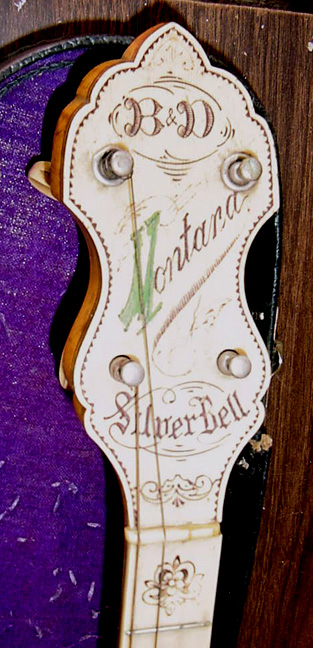
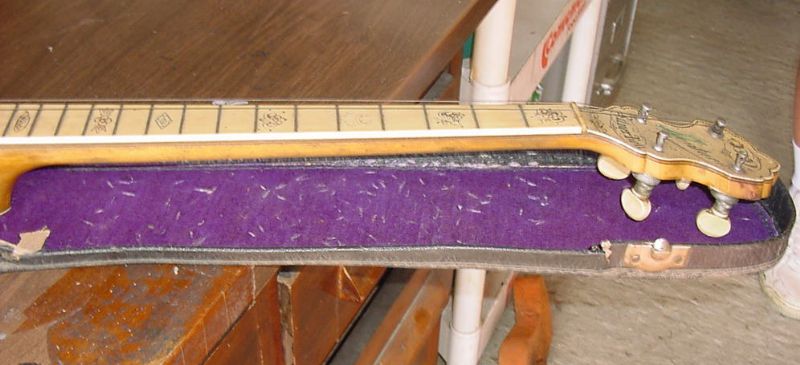
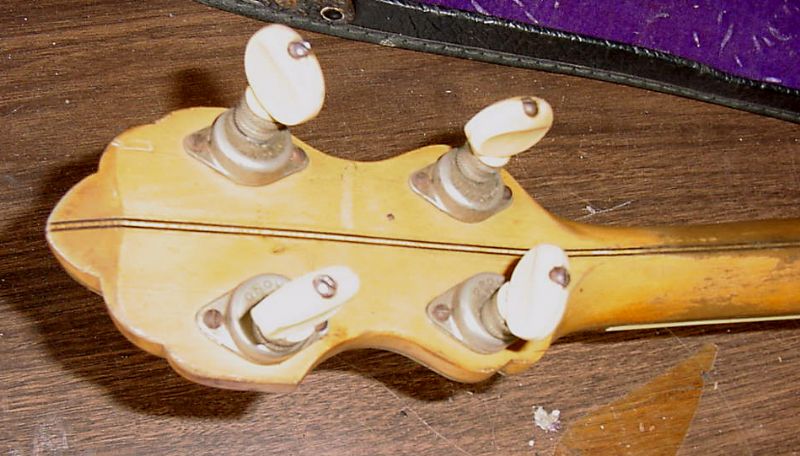
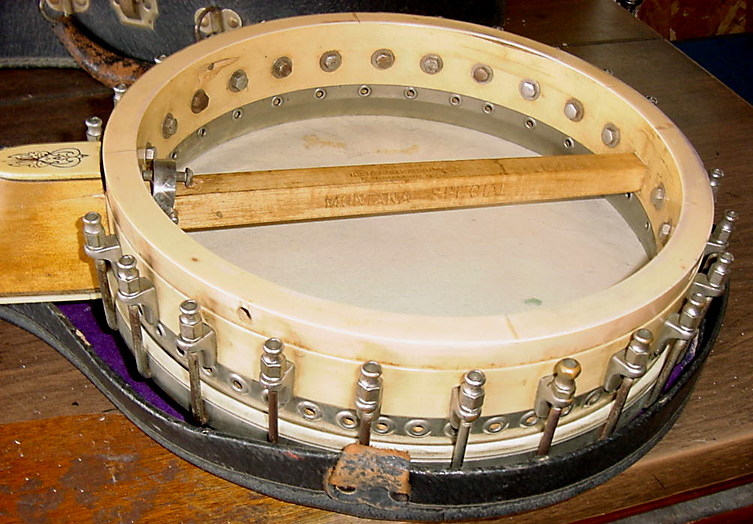
By the way... I just realized, that a few years ago I had posted photos of the EARLIEST "Montana" that I've seen. Here are the URLs for the photos. (Once BHO discussions are "archived" -- the links to the original images are GONE. With the URLs, at least you can go find what WAS posted.) -- I've also attached the little "postage-stamp" links to them, below.
Peghead:
hangoutstorage.com/banjohangou...22011.jpg
Side of Neck:
hangoutstorage.com/banjohangou...22011.jpg
Peghead Back:
hangoutstorage.com/banjohangou...22011.jpg
Rim Back:
hangoutstorage.com/banjohangou...22011.jpg
Dowel with Serial & Stamps:
hangoutstorage.com/banjohangou...22011.jpg
Oettinger Tailpiece:
hangoutstorage.com/banjohangou...22011.jpg
*****************************************************
... I do for sure agree about the great projection of the sound towards the player - via the F-holes in the sloped part of the flange - that´s one of the reasons for me preferring Silver Bell´s for my own playing. ...
My first banjo-collecting 'mentor' (back in the 1970s) is a Trad Jazz player, in the Syracuse, NY area -- named Dick Sheridan. When I first met Dick, he said that he really couldn't tell how GOOD a banjo was -- until he played it with his band, at a gig. But he DID prefer Silver Bells -- because they ALWAYS 'cut-through', and he could always hear himself on stage. Many years later, I realized that the angled flange was a major reason that so many Trad Jazz banjoists played Silver Bells. (It's pretty tough to hear your own banjo -- when you have a trumpet, trombone, clarinet, and Tuba blasting away, right next to you!)
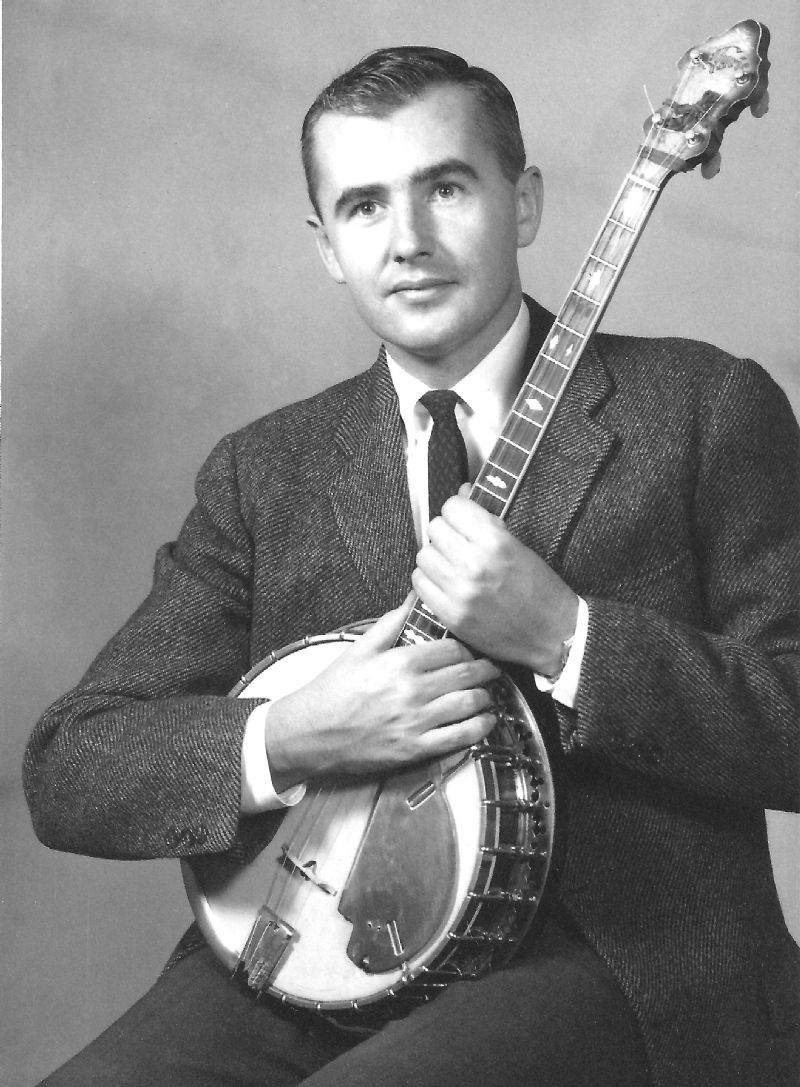
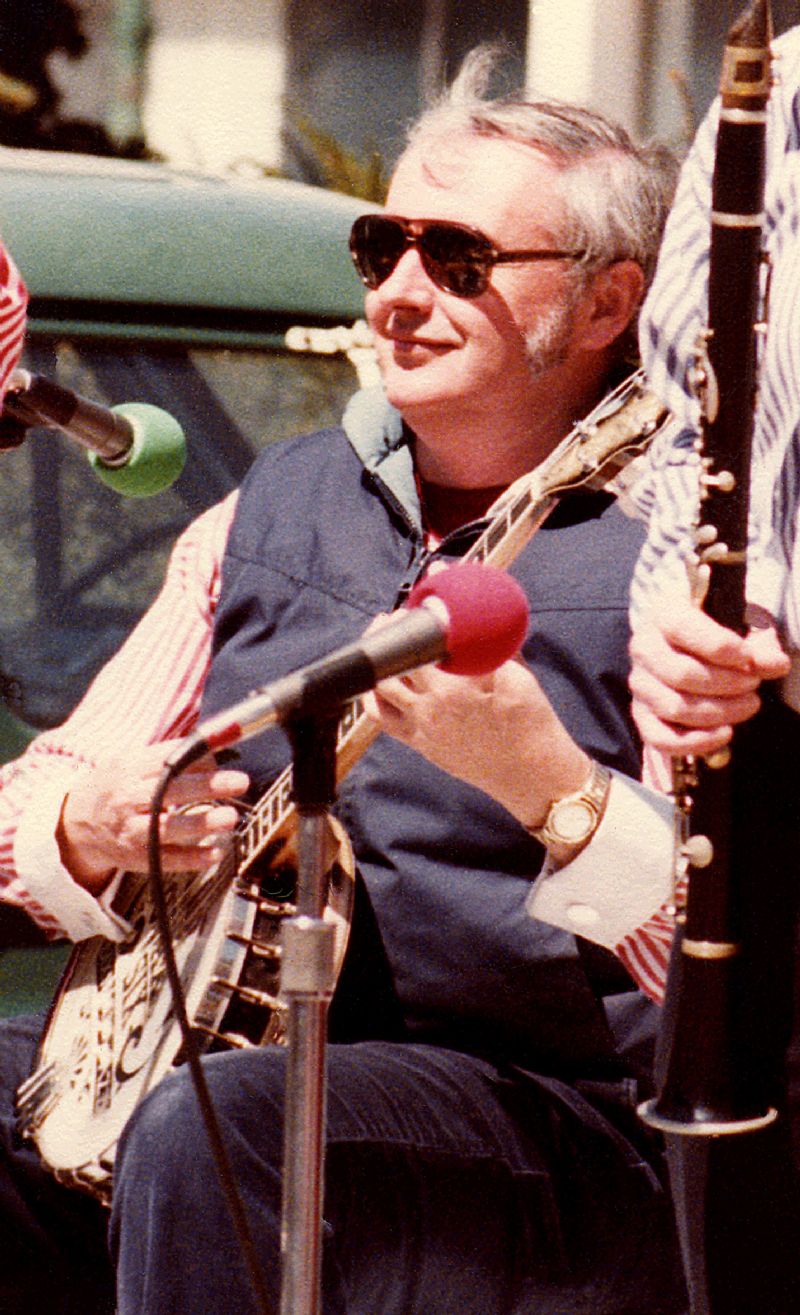
Dick started playing Dixieland, in college, during the mid-'50s. He did Corporate Marketing for a few years, and then decided to make his living teaching banjo, and as a working musician. He's still teaching, and still going strong with his band of almost 50 years -- "The Soda Ash Six".
I just posted a few photos of Dick:
A 1950s photo of Dick with his first banjo -- a "Lyric" made by Bacon:
hangoutstorage.com/banjohangou...62013.jpg
Dick Playing an outdoor gig (late-1990s / early-2000s) with The Soda Ash Six, using his 'knockaround' banjo, another Lyric:
hangoutstorage.com/banjohangou...62013.jpg
Dick in a local Vets Parade (last few years) -- with his main Silver Bell:
hangoutstorage.com/banjohangou...62013.jpg
Over the years, Dick had several hundred banjos (of all types) go through his hands -- including some rare mid-19th Century ones, and high-end Jazz Age examples. Some of those wound-up in the collections of Akira Tsumura, Jim Bollman, Peter Szego -- and some strange guy in Wakefield, MA.
*****************************************************
... BTW - and FYI - the last version of the stepped 13½" F-hole flange has 28 nos. very large holes - almost following the circumference - and with the remaining metal parts between the holes only 1/4" wide and also almost following the circumference. This gives the flange a great flexibility and thus the resonator a somewhat high resonance tone - allowing the resonator to become a very active part in the sound production - and projecting quite a good bit of the sound backwards. Silver Bell´s with this type of resonator assembly are my favorites ...
Earlier stepped flanges and also the smaller beveled flanges do mostly have 36-38 nos. smaller F-holes with somewhat wider metal parts between the holes - this makes them much more stiff and thus the resonator resonance tone very low. I love these as well - but they do not give me the same fantastic response and projection as the version mentioned above.
Did you know about this difference? Feel free telling Chuck about it - maybe he´ll want to test another flange design for his otherwise great Classic Jazz OME´s - LOL! ...
I wasn't aware of the flange flexibility providing more resonance. Does it also add some 'sustain' to the sound? I know that keeping the back 'free' to vibrate, increases both resonance and sustain. (Which I DO prefer in a banjo.) I'll often change position while playing clawhammer with my OME -- moving it onto my thigh, without the back of the rim touching anywhere except my leg, left hand, and right forearm. That radically changes the volume and tonality -- which I use for musical effect -- to vary the sound between parts of some tunes, or when going to a different tune in a medley.
I'll certainly mention your observations to Chuck. He has plenty of good four-string endorsers to advise him on the finer points of their playing styles. BUT... He's still a small company, with a small-but-dedicated range of niche customers. OME produces several hundred banjos a year (mostly 5-strings...) -- not several thousand a year, like The Bacon Co. during the 1920s. So it's also the classic business issue of: "cost-of-development" -vs- "return-on-investment".
AM glad you like the OMEs. It's not the same as getting a "one-off" completely custom instrument, from a custom, high-end maker. But MY favorite banjos are:
... o The 1895--1920 Fairbanks
... o The pre-war Bacons
... o The 1960s Boulder-made ODEs
... o The OMEs
For each brand there is an obvious common dedication to high quality, and good design, as well as to great tone and playability -- in a 'production' instrument. And there are TWO specific people -- with similar views about combining the best quality, design, engineering, technology, and materials -- to produce a first-class musical product: David L. Day and Charles S. Ogsbury. (The combined talents of those two people span 130 years of banjomaking. And their lifetimes overlapped.)
I wish there was some way to 'turn-back-time' and meet Mr. Day. But I'm proud to a friend, advisor, and consutant, to Mr. Ogsbury -- for the last 25 years. My research into Day's work, and and his contributions to banjo design -- helps to 'inform' me about the issues that Chuck wrestles with. And vice-versa.
Best- Ed Britt
Edited by - BrittDLD1 on 06/11/2013 09:14:55
Polle Flaunoe - Posted - 06/11/2013: 12:30:30
Ed,
Oh - it´s so great for me to exchange some knowledge, stories, pics, ideas etc. Thanks for taking part.
F.ex. I do have, what might be a surprise for you - LOL! AFAIK and have been told, the Type 2 (your name for it) resonator is laminated and afterwards (wet, steam, heat?) pressed/stamped - leaving "beveled ring(s)" a little above the "flat" resonator surface - giving the resonator a look a little like that of the solid wood Type 1. Is this understandable to you - I don´t know the correct terms in English. Pressed/stamped in the same way as f.ex. Gibson did on some of their high grade models late 20s/early 30s. By doing so Gibson saved all the carving of the resonator back. A technique also used by f.ex. Salstrom and Fender after WW II.
Do you have an idea how this was made - and when someone started doing so?
Regarding laminated resonators - the very first in my extended DB is also the very first Montana Silver Bell No.1 - a plectrum with Ivoroid cladding, soft pedal mute and Planet tuners - SN 12029 (B). I´ve added the (B), as I have two B&D´s with this SN. You can find several similar "twins" in the DB - sometimes discovered icw. the QC - if so, one of the twins got an A added.
The few laminated/stamped examples in my DB- your Type 2 - come after this Montana - so maybe we should call it Type 3 - or Type 2 A?
Regarding Montana´s - the SN 11566 is still the oldest in my DB. Do you recall our discussion of the mixed peghead design - with both painted engravings and Bacon inlaid in Abelone - after this I put together an overview of the various designs, that I so far have seen - do notice, that the mixed design is placed between the two other designs:

Surprised?
Regarding OME - should I ever want to have a tenor custom built - with a performance at the same level or above my B&D NPU´s - I would ask Pietsch or Chuck & Co. - or maybe both (?) LOL!
As mentioned in my reply to Howard above - I hope for the chance setting up two OME tenors later this year - it will be great fun - and I´ll get a chance comparing them with my B&D´s.
Polle
BrittDLD1 - Posted - 06/11/2013: 13:06:14
I wrote:
*****************************************************
*****************************************************
That's NOT exactly correct. Let me re-phrase that:
1. I move my openback rim onto the top of my right thigh. So that the BACK of the rim is completely away from my stomache. (Sometimes, I will also support the rim on the tops of both thighs, at the same time.)
2. I use a short leather strap to stabilize the banjo. One end attaches to the bracket hook next to the neck; then goes over my shoulder and back under my arm; the other end of the strap attaches to the bracket hook next to the tailpiece.
3. My left thumb stabilizes the neck, keeping the strap taught -- while I finger the notes.
4. My right arm rarely even touches the banjo, while my right-hand fingers stroke the strings.
Sounds more complex than it is. It's fairly simple to do.
Best- Ed Britt
Edited by - BrittDLD1 on 06/11/2013 13:12:19
aroblin - Posted - 06/12/2013: 05:48:06
Thanks, guys, for having your discussion publicly. What a wealth of fascinating banjo ideas, experience, history and wisdom.
Again, thank you.
Andrew
Terms of Use | Privacy Policy | Privacy Consent (EU/GDPR Only)
Copyright 2026 Banjo Hangout. All Rights Reserved.