DVD-quality lessons (including tabs/sheet music) available for immediate viewing on any device.
Take your playing to the next level with the help of a local or online banjo teacher.
Weekly newsletter includes free lessons, favorite member content, banjo news and more.
Premier Sponsors


|
Please note this is an archived topic, so it is locked and unable to be replied to. You may, however, start a new topic and refer to this topic with a link: http://www.banjohangout.org/archive/262081
OldandOutoftheWay - Posted - 05/04/2013: 13:29:11
I'm brand-new here and am hoping that someone can help me with the information I am seeking. I recently purchased a very old no-name banjo on eBay. The person who sold it to me bought it at an estate sale and knew nothing about its history. The tailpiece is marked "Patent Pending." I have tried searching online for a similar tailpiece in the hope that it might give me a clue about the age of my banjo, but haven't found anything similar. I'm attaching a photo in the hope that someone can identify it. Any information is greatly appreciated!
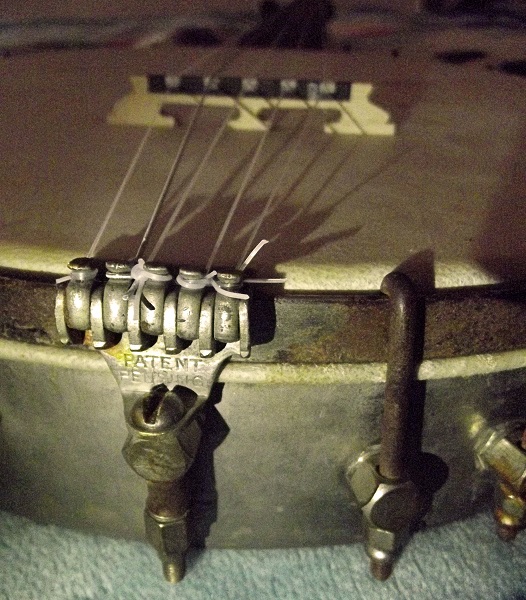 Vintage tailpiece |
Brooklynbanjoboy - Posted - 05/04/2013: 13:36:10
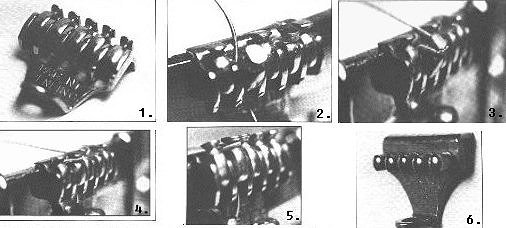
It's a nice example of a cammed no knot tailpiece.
This info on Mugwumps ought to help:
jacktraylor - Posted - 05/04/2013: 13:36:35
this is a cammed noknot tailpiece I have one on my 1924 Regent. Perhaps earlier. For those interested, Gil Rickard has reproductions available at a very reasonable price.
Play on,
Jack
Jim Carr - Posted - 05/04/2013: 16:15:03
For what it's worth, an original cammed no-knot sells for about $160.00 at Bernunzios when he an get one!
OldandOutoftheWay - Posted - 05/04/2013: 16:30:46
Hi Jim! (This is Nancy Z. from the CBA,) Wow, that's good to know! It sounds like the tailpiece nearly paid for my banjo! 
mikehalloran - Posted - 05/04/2013: 17:17:22
There's a diagram on the internet showing how strings are supposed to be mounted on these but I can't find it at the moment.
My 1925 Vega Tu-Ba-Phone NO 3 had one of these.
Even though Bill makes a nice repro, the originals are worth some $$$.
ACFairbanks - Posted - 05/04/2013: 18:18:29
quote:
Originally posted by mikehalloran
There's a diagram on the internet showing how strings are supposed to be mounted on these but I can't find it at the moment.
My 1925 Vega Tu-Ba-Phone NO 3 had one of these.
Even though Bill makes a nice repro, the originals are worth some $$$.
Howdy,
Though a diagram would be nice to see, it is very easy to describe the method:
Tilt one of the string posts back and and you will see a slot will open between the post, and the body of the tailpiece. Slide the end of the string down into that space. Then push the post back up into (close) to a vertical position, and it will press on the string, holding it.
At that point, if you tried to bring the string up to tension, it would just pull out of the slot, so instead of doing that, wrap the string around the post one turn before bringing it to tension. By doing that, the string is held in the slot by its own tension...
Works like a charm...
All the best,
A.C.
ACFairbanks - Posted - 05/04/2013: 18:23:51
quote:
Originally posted by ACFairbanks
quote:
Originally posted by mikehalloran
There's a diagram on the internet showing how strings are supposed to be mounted on these but I can't find it at the moment.
My 1925 Vega Tu-Ba-Phone NO 3 had one of these.
Even though Bill makes a nice repro, the originals are worth some $$$.
Howdy,
Though a diagram would be nice to see, it is very easy to describe the method:
Tilt one of the string posts back and and you will see a slot will open between the post, and the body of the tailpiece. Slide the end of the string down into that space. Then push the post back up into (close) to a vertical position, and it will press on the string, holding it.
At that point, if you tried to bring the string up to tension, it would just pull out of the slot, so instead of doing that, wrap the string around the post one turn before bringing it to tension. By doing that, the string is held in the slot by its own tension...
Works like a charm...
All the best,
A.C.
Hi again,
Here is a photo of this thing in use:

The string runs up from the slot, around the post, and over the bridge to the tuning peg...
All the best,
A.C.
bigdream53 - Posted - 05/05/2013: 06:45:09
quote:
Originally posted by OldandOutoftheWay
I'm brand-new here and am hoping that someone can help me with the information I am seeking. I recently purchased a very old no-name banjo on eBay. The person who sold it to me bought it at an estate sale and knew nothing about its history. The tailpiece is marked "Patent Pending." I have tried searching online for a similar tailpiece in the hope that it might give me a clue about the age of my banjo, but haven't found anything similar. I'm attaching a photo in the hope that someone can identify it. Any information is greatly appreciated!
I've never seen one of these! Could you possibly post a few more pics? Maybe better lit & from other angles? Thanx!
Nuts - Posted - 05/05/2013: 09:11:32
With the cam down (open), slip the string behind the cammed post and out through the bottom. Rotate the post into a vertical position and give the post a couple of wraps, that's it. They work quite well with real gut strings as are used on this Stahl label banjo and also for Nylgut strings.


I made the Yellow spacer between the pot and end bolt from cow bone. Looks better than a stack of washers when you are retro fitting a different tailpiece.
OldandOutoftheWay - Posted - 05/05/2013: 10:10:52
Great info on how to mount the strings! It certainly looks a lot neater than the way I did it! I really appreciate this great information. My (Nylgut) strings seem to be holding well so I'll leave it alone until I need to change the strings again, but now I'll know the proper method for next time.
When the banjo first came to me, it had steel strings on it and I couldn't get it to stay in tune to save my life...too much tension on the wooden peg tuners, but it's doing much better with the Nylgut strings (and sounds way better too).
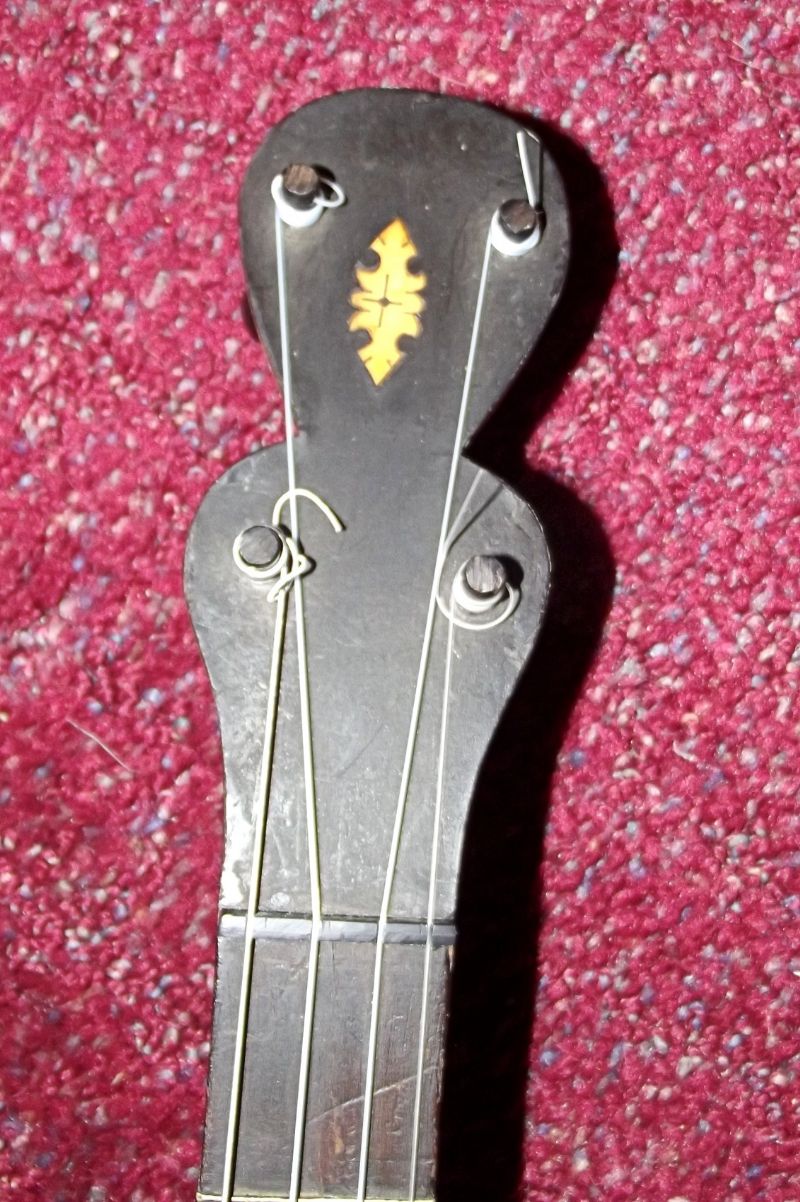
I don't believe my banjo was manufactured by a company...The workmanship is rather crude (inlay off-center and headstock a bit uneven) so I'm guessing that it was made by a private individual. I'll take some more pictures of the banjo and will post them here later.
OldandOutoftheWay - Posted - 05/05/2013: 11:05:35
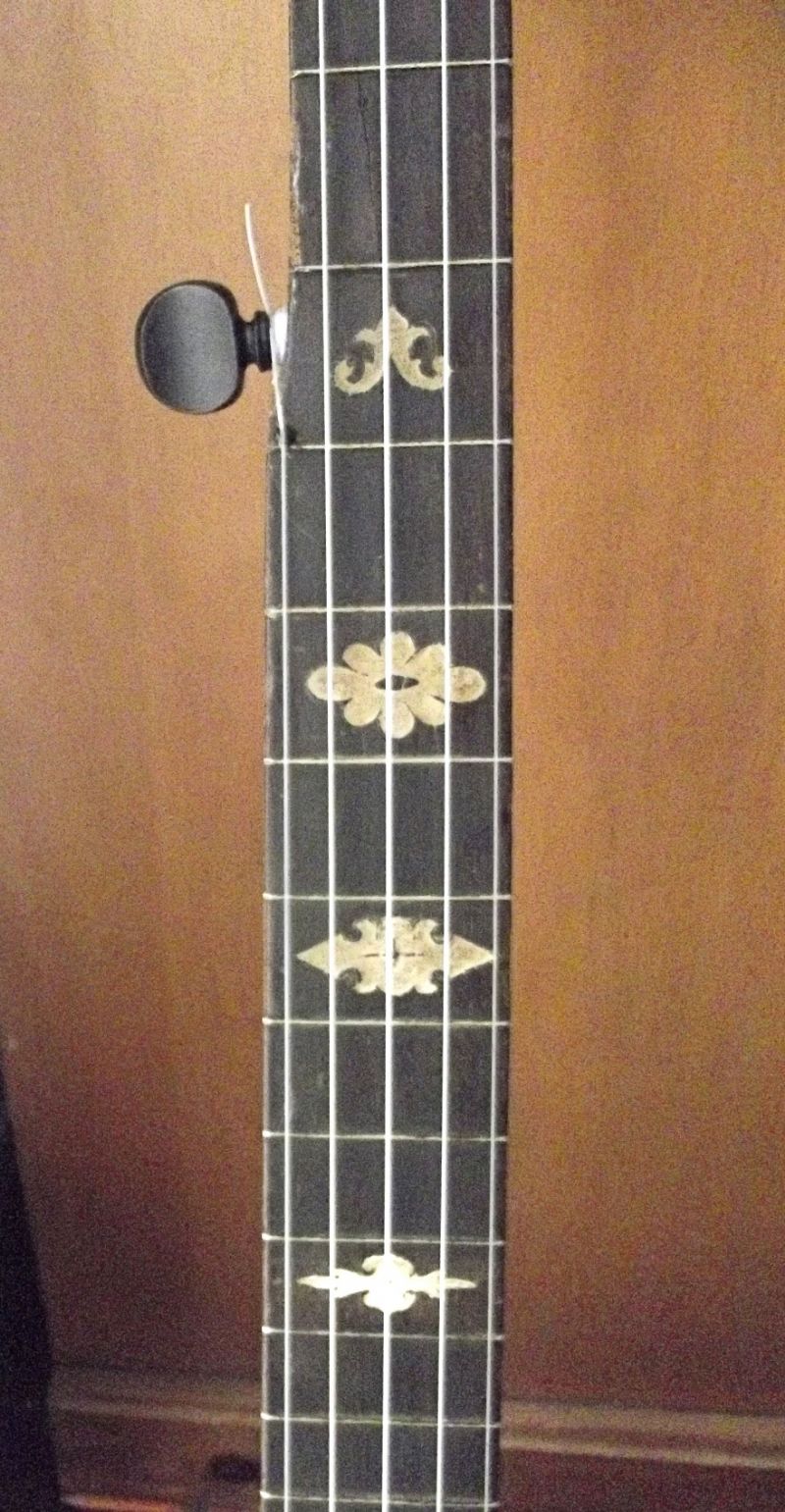
Here are a few more pictures of my old banjo. Overall length is 35 inches. It has 30 bracket hooks. Only the inlay on the headstock is intact; the inlays on the neck are missing, with gouged-out shapes where they once were. I thought the surviving inlay might have been made out of wood, but my husband thinks it may be ivory.
 |  | 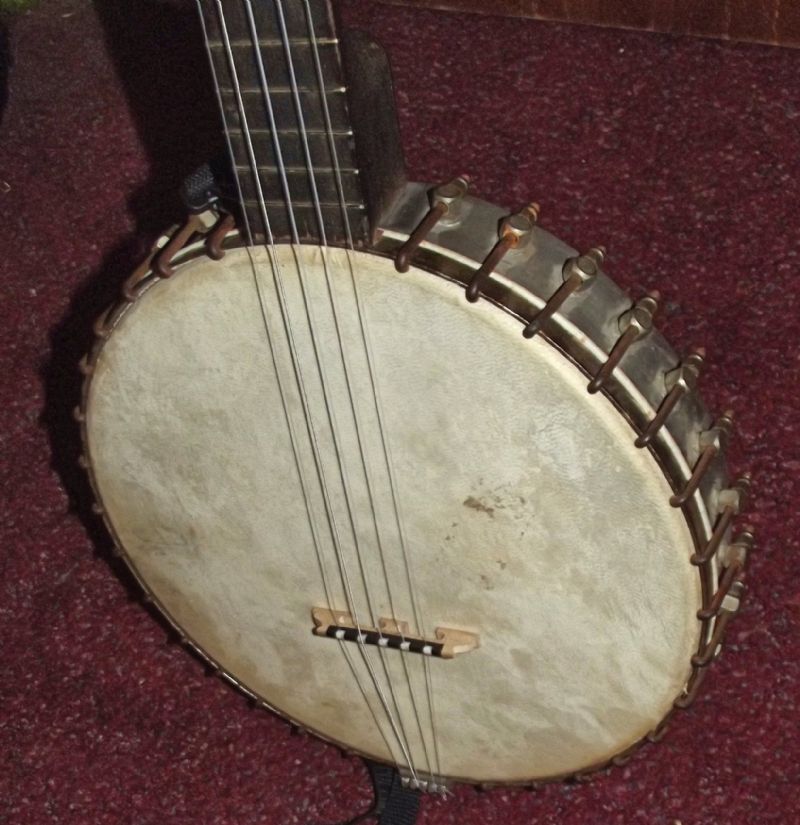 | 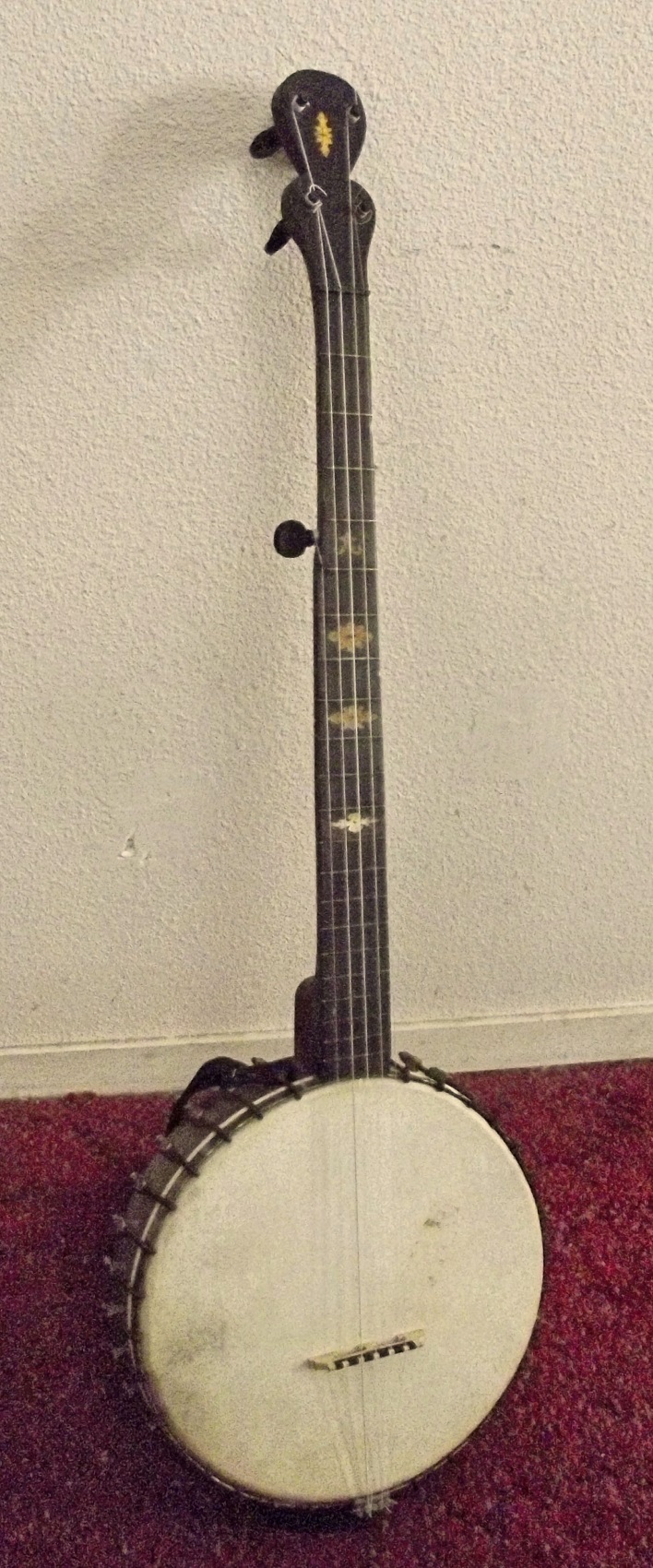 |
Nuts - Posted - 05/05/2013: 11:37:08
quote:
Originally posted by OldandOutoftheWay
Great info on how to mount the strings! It certainly looks a lot neater than the way I did it! I really appreciate this great information. My (Nylgut) strings seem to be holding well so I'll leave it alone until I need to change the strings again, but now I'll know the proper method for next time.
When the banjo first came to me, it had steel strings on it and I couldn't get it to stay in tune to save my life...too much tension on the wooden peg tuners, but it's doing much better with the Nylgut strings (and sounds way better too).
I don't believe my banjo was manufactured by a company...The workmanship is rather crude (inlay off-center and headstock a bit uneven) so I'm guessing that it was made by a private individual. I'll take some more pictures of the banjo and will post them here later.
The Nylgut strings are a much better match for your banjo. I'm guessing that your banjo is likely a Supertone, it was designed for gut strings. Steel strings can have issues as you have discovered and are too high tension for a lightly built instrument such as yours. The cam style tailpiece was not designed for steel strings either.
OldandOutoftheWay - Posted - 05/05/2013: 12:24:10
That would be interesting if it's a Supertone. There is no name, model, or serial # on it.
Here's a little sample of how the banjo sounds; I got my friend Carl Pagter to pick it a little when I saw him at the CBA campout last month. (Of course this video doesn't do justice to Carl's stellar talent on the banjo...He was just trying to get the feel of it, and this is a very different instrument from what he is used to playing!
youtube.com/watch?v=vMVV9IuQNYo
bigdream53 - Posted - 05/05/2013: 12:46:58
quote:
Originally posted by Nuts
With the cam down (open), slip the string behind the cammed post and out through the bottom. Rotate the post into a vertical position and give the post a couple of wraps, that's it. They work quite well with real gut strings as are used on this Stahl label banjo and also for Nylgut strings.
I made the Yellow spacer between the pot and end bolt from cow bone. Looks better than a stack of washers when you are retro fitting a different tailpiece.
Wow! Great pics. Now isn't that a neat old tailpiece. I'm a sucker for old unusual stuff in great condition and I had never seen one of these before this post started. Thanx for the pics!
stanger - Posted - 05/05/2013: 16:23:31
While they work great for gut and nylon strings, the No-Knot was developed for use with the then-new steel strings that were just entering the market.
The first steel strings came in lengths of plain wire, with no loops or ball ends to secure them to the tailpiece. Players had to devise their own ways of knotting or looping the wire, which was both a hassle and, sometimes, a pain inducing mess from the sharp wire string ends.
The No-Knot made using wire strings fast, secure and easy for the first time, and became instantly very popular. Over 100 years ago, players were looking for more volume, brighter and more penetrating tone. Steel strings filled the bill.
The very first Kerschner DeLuxe tailpieces were essentially No-Knots with cams; the cams were mounted to a hinged base and the long blade was soldered on separately.
As soon as the string manufacturers began twisting loop ends on the strings the cams were no longer needed.
regards,
stanger
OldandOutoftheWay - Posted - 05/05/2013: 20:25:27
Interesting history about the advent of steel strings! (I still manage to stab myself occasionally with the non-ball end of strings.) 
Terms of Use | Privacy Policy | Privacy Consent (EU/GDPR Only)
Copyright 2026 Banjo Hangout. All Rights Reserved.