
DVD-quality lessons (including tabs/sheet music) available for immediate viewing on any device.
Take your playing to the next level with the help of a local or online banjo teacher.
Weekly newsletter includes free lessons, favorite member content, banjo news and more.
Premier Sponsors


|
Please note this is an archived topic, so it is locked and unable to be replied to. You may, however, start a new topic and refer to this topic with a link: http://www.banjohangout.org/archive/257135
NYCJazz - Posted - 02/26/2013: 08:57:13
Latest project
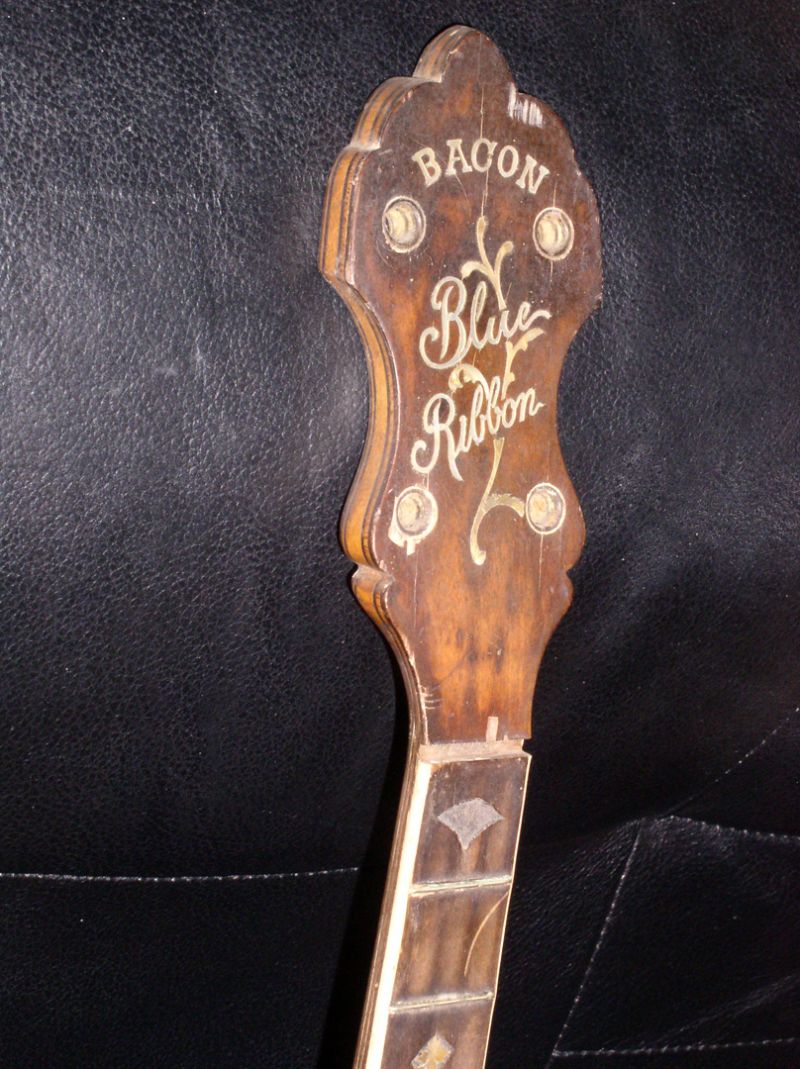
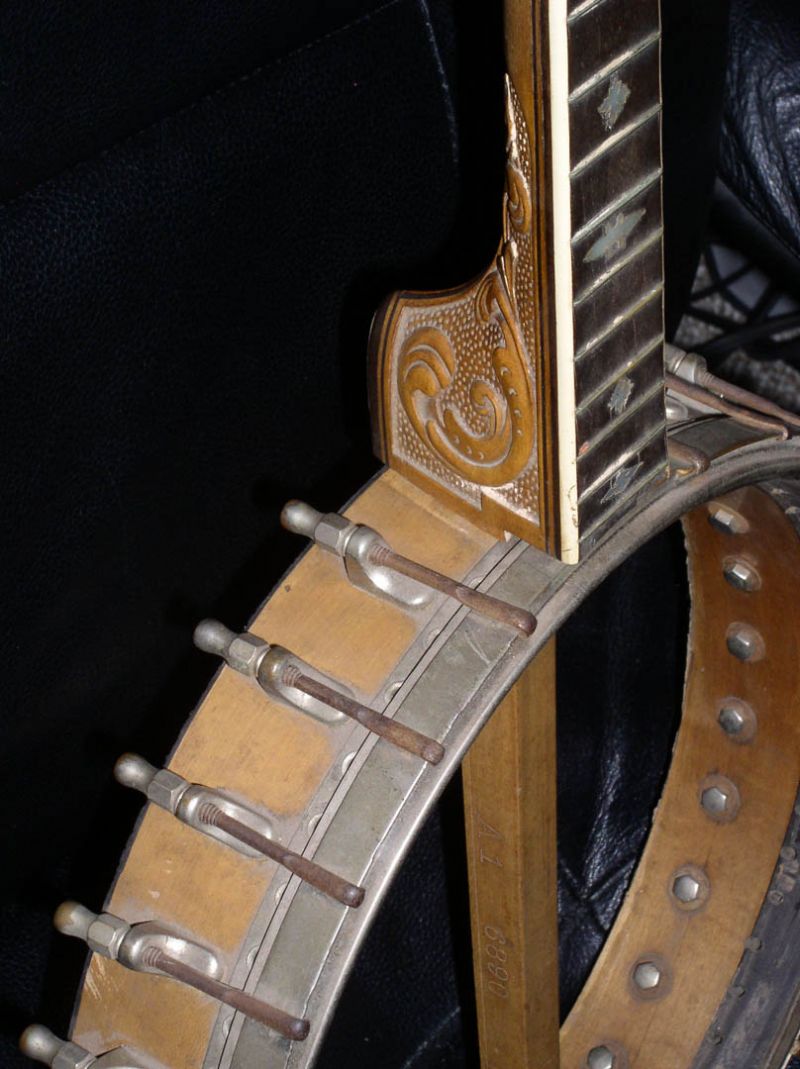
More pics later...
17 fret 11 1/2" pot
No tuners nut tailpiece or neck hardware
incorrect endpin
Resonator disc and the rim cap layer is missing
Grommets are smashed
Dowel stick (strangely pieced together) marked "A1 6890" on side and "The Bacon Orchestra". No Groton stamp.
No serial number that I can find on the rim
BrittDLD1 - Posted - 02/26/2013: 11:26:39
Hi Nathan --
That's an EARLY Bacon Blue Ribbon. And It's one of the earliest examples with the new "Blue Ribbon" inlay on the peghead. From the Serial Number, it was probably made to be displayed at the initial showing of the Blue Ribbon banjos -- at the Annual connvention of the American Guild of Banjoists, Mandolinists and Gutarists, held in NYC, in mid-April 1922.
There were some earlier prototypical Blue Ribbons made, by modifying some the previous "Orchestra" models. They cut a tall bevel into the top inner surface of the rim; cut the inner flange of the Orchestra tonering back to only 1/4" wide; and drilled holes through the skirt of the tonering and the rim. (No grommets were used on the earliest prototypes.) They added the hubcap-style snap-in resonator -- which had 2 small wooden knobs.
The neck was simply a standard "Orchestra" neck. BUT... on the dowelstick, they added a "B --" in front of the "The Bacon Orchestra" stamp -- and added an "-- R" at the the end of the stamp. (For Blue Ribbon.)
The early Lange (Orpheum) style recessed heel-carving (with a border around it) the lack of a Serial Number on the rim, and "The Bacon Orchestra" on the dowel -- are typical of the PRE-David Day Blue Ribbons.
After David Day arrived at Bacon, in Sept 1922, he eliminated the recess around the carving; added "The Bacon Blue Ribbon" and the "Made by ... Groton ..." stamp to the dowelstick; and also began stamping the serial number into the rim (as well as the dowelstick).
That's a nice banjo! By the way... it should have a "Bacon--Winship" extension tailpiece on it. (They are a bit rare...) See: mugwumps.com/tailpieces/bacon-ff.jpg
Best- Ed Britt
Edited by - BrittDLD1 on 02/26/2013 11:29:03
NYCJazz - Posted - 02/26/2013: 17:15:45
That's a lot of very good info, Ed. Thanks
The heel carving is just gorgeous on this thing. I knew the carving was way different than my Silver Bell. Your description explained it.
Polle's database puts this banjo at late 1921, which makes sense if they were introduced early 1922

NYCJazz - Posted - 02/26/2013: 18:24:36
Speaking of Winship....
ebay.com/itm/261175435807?ssPa...423.l2649
Check out the dealer plate... coincidence or part of Dr Winship's family?
The Old Timer - Posted - 02/26/2013: 19:02:52
A friend of mine has one of these in tenor, with the "snap in" semi-flat wood resonator back. I think only the tailpiece is incorrect. He doesn't play it or intend to do anything with it.
Are these valued by tenor players at all? Should he list it here on BHO?
NYCJazz - Posted - 02/26/2013: 19:34:02
I would like to see photos of your friend's tenor.
Mine is missing the snap-n back, and I'm going to be looking for proper neck hardware.
Eddy Davis used to have one... 17 fret oversize pot is his jam.
I'm certainly going to string this up plectrum and see how it plays.

esmic - Posted - 02/26/2013: 20:55:04
Nathan :
I have found that BR crushed grommets are not restorable. If you are able to find an orphaned BR rim with good grommets and have access to a metal lathe, you can machine a 2" brass bolt head down to match the inner diameter of the grommet sleeve, leaving a lip near the end of the bolt to match the grommet sleeve's outer diameter. This makes a perfect grommet punch. With a little patience you can tap out all the crushed grommets without further damage, and exchange them for good ones similarly removed from the orphaned rim. Worked like a charm for me in restoring a BR 5 string.
Wayne Holcombe - Posted - 02/27/2013: 04:14:32
My BR is a little different,it has an extended fingerboard,a bound peghead,a notched stretcher band and the metal is gold plated.There is no visible serial number.The tailpeice is the one with the 4 arms.
There is no resonator.Any thoughts on replacing it ?
wfawley - Posted - 02/27/2013: 04:33:36
Nice banjo, Nathan. I had one of those long long ago. It's odd that you would post this now ... since I am converting one for a fellow from Pittsburgh that Ed knows. Norm says "Hi".
Norm's is the one with block letters rather than the script. It's actually on an Orchestra pot ... and has orchestra fretboard inlays as well. The headstock on the tenor neck isn't bound,but having just restored an orphaned 17 fret "Super Banjo" neck which has a carved heel and bound headstock, I decided that I really liked the look onthat headstock and opted to do these with the bound headstock. I also completed the restoration of a 17 fret "Blue Ribbon" tenor neck. I have no need of the tenor necks, but they're both pretty nice necks (now) and somebody may need them some day. I have always liked this particular inlay.
The one with the script "Bacon" has "Blue Ribbon" cut from green snail rather than white pearl.
The "Orchestra" is numbered in the 6500s ... so when was it made?
Wyatt
Edited by - wfawley on 02/27/2013 04:37:07
 |
Wayne Holcombe - Posted - 02/27/2013: 04:49:01
Found a Bacon Peerless,#10868,hanging on the wall.Has a preso tailpeice and no resonator.There is a bracket on the dowell stick that i think would be part of the resonator.The banjo is blond finished maple.
Polle Flaunoe - Posted - 02/27/2013: 05:28:12
Wyatt,
Do compare any Bacon/B&D´s with the recordings in my General Database - this should give you a hint of the vintages.
acoustudio.dk/BD_and_Bacon_database.html
SN 65XX does f.ex. indicate a late 1921 build.

Polle
Edited by - Polle Flaunoe on 02/27/2013 05:30:20
BrittDLD1 - Posted - 02/27/2013: 07:50:14
Hi Shawn --
I'm fairly certain that the BR grommets ("eyelets" is the PROPER term) were originally made by Stimpson. I remember Stimpson as being in Connecticut originally (at least in the 1960s and '70s) -- then they later moved to Bayport, NY.
Sometime, in the last decade, they moved to Florida. They make a HUGE variety of eyelets. But remember... The BR 'grommets' were (and are) simply shoelace eyelets!
Here is their website: stimpson.com/eyelets.htm
My guess is that you could send an original one to them, and they could find one of their stock pieces that would work for replacement/restoration. (Including the white celluloid variety -- used on the earlier BRs.)
You are correct that PUSHING grommets out of the tonering skirt, is far superior, than trying to PRY them out with a screwdriver-blade or knife. That wil ALWAYS dent the skirt. I simply use the back end of a drill bit, that matches the hole diameter in the wood.
Wayne --
From your description, your Blue Ribbon could be a somewhat later DeLuxe model. The notched tension hoops came in AFTER David Day showed-up (by #7500) , and were part of the lead-up to creating the Supertone/Super Blue Ribbons -- and later, the Silver Bell.
Does yours have the stamped (fake) grommets in the skirt of the tonering? Or are they individual grommets pressed into the holes?
But, be warned... LOTS of the early Blue Ribbons were upgraded and/or had parts swapped, later-on. I've seen scores of UN-original ones. Swapping dowelsticks ("slipping the dowels") -- to make it appear as if the swapped necks were "original to the rim", was unfortunately common -- right up into the 1980s. I once bought a carved-heel, holly, Blue Ribbon 5-string (from a well-known dealer) which had a Silver Bell peghead overlay glued ON TOP of the original BR overlay. It had many other problems, so I sent it back. The dealer DID warn me about the problems -- but I wanted to inspect the neck and rim, anyway.
The Oettinger tailpiece (with 4 arms) on yours wasn't even produced until the mid-20s. Even the initial versions of the Silver Bell (June, 1923) had Grover "Presto" taipieces on them. The Oettingers weren't cataloged, by Bacon, until the 1926 catalog. (The '26 catalog was prepared in late-1925, and was "back from the printers" in early March of 1926.)
Wyatt --
"Hi!" back to Norm! He and I have been sharing info on BRs since the late-'80s. He's had a few nice ones over the years.
Best- Ed Britt
Edited by - BrittDLD1 on 02/27/2013 08:00:27
Wayne Holcombe - Posted - 02/27/2013: 11:24:06
Ed, Mine has the individual grommets,metal on the outside white plastic on the inside.On further inspection I found #7732 stamped inside the rim.
esmic - Posted - 02/27/2013: 12:16:59
Ed : Thanks for the eyelet link. Perusing the on-line Stimpson catalogue, I found just one eyelet , among their many hundreds, with nearly comparable barrel length, barrel diam, flange diam. and metal thickness. Have emailed to get their minimum order quantity and pricing. Will let you know how this works out.
NYCJazz - Posted - 02/28/2013: 07:12:05
I'm going to need neck hardware.
What would be proper? Any photos?
From the impression in the rim, it looks like similar, but thinner. construction.
BrittDLD1 - Posted - 02/28/2013: 09:51:08
Hi Nathan --
Neck hardware? Real simple. Basically, the SAME hardware as used on Fairbanks, Vegas, and Vega-made Bacon FFs -- since 1901.
The heavy, cast-brass, two-legged neck-clamp (or cleat) with adjustment screw; the U-shaped (horseshoe-shaped) brass pawl -- made from a bent section of 1/8"-square brass rod; and the short round 'pin' that goes through the dowel -- for the neck-clamp to push against.
At the tailpiece end of the dowel... there is a important difference to the early Blue Ribbon 'end-bolt'.
The B-W tailpiece had a forked, 2-prong extension, pointing downward -- which kept the tailpiece close to the rim of the banjo. The vertical adjustment of the Bacon-Winship was done by loosening, or tightening vertical nut-and-bolt (which went through the tailpiece vertically), and sliding the tailpiece up-or-down.
The end-bolt used on the early Blue Ribbons, had a rounded, ball-shaped, hex-head -- which had a flat hex-collar below it. (Instead of being completely ball-shaped, with a round collar-flange -- like the end-bolts used on Fairbanks/Vegas.)
Best-- Ed Britt
Edited by - BrittDLD1 on 02/28/2013 10:06:33
esmic - Posted - 02/28/2013: 10:56:55
Nathan : For reference, here are some pics of another early, Lange-made A1, courtesy of Intermountain Guitar & Banjo a couple of years ago. It has gold plated Waverley tuners with pearl buttons. Those appear from time to time on ebay, but can be pricey. The same tuners are more commonly found as nickel plated, with ivoroid buttons, and are more affordably priced.
Your rim eyelets, whether celluloid or metal, will be a challenge to replace. The eyelet supplier Ed mentioned makes a metal eyelet that seems to be a close copy that should fit the existing sleeves, but their minimum order is 250,000 units, and nickel plating is extra.
 |  |  |  |
NYCJazz - Posted - 02/28/2013: 11:04:26
Like this?
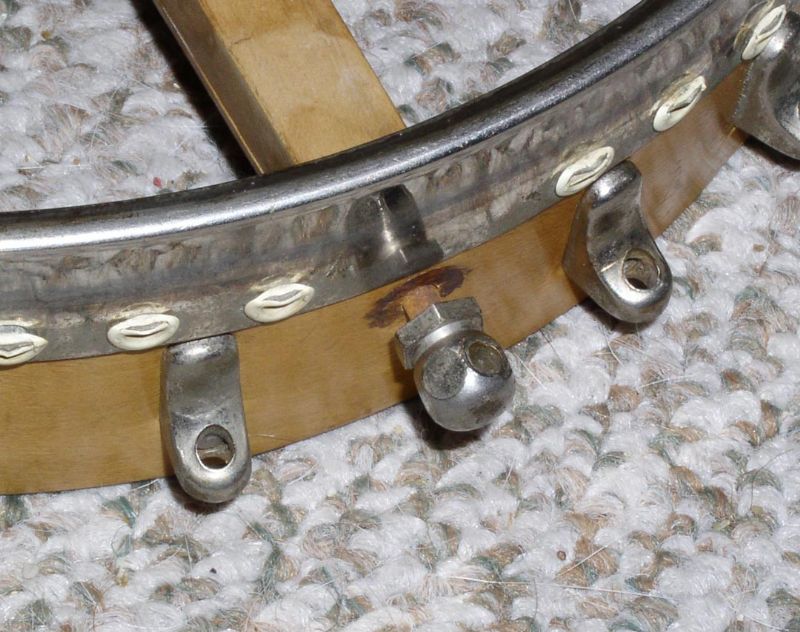
It won't screw into the dowelstick any further. I'm assuming the fork fastens to the space between the rim and the hex sleeve?
Will I have to get a standard ball endpin if I want to use with a non-Winship tailpiece?
Thanks
BrittDLD1 - Posted - 02/28/2013: 13:36:19
quote:
Originally posted by NYCJazz
... It won't screw into the dowelstick any further. I'm assuming the fork fastens to the space between the rim and the hex sleeve?
Will I have to get a standard ball endpin if I want to use with a non-Winship tailpiece? ...
It IS the correct type of end-bolt. But it might NOT be the original one, from this specific banjo. It's not too difficult to use a smaller diameter drill bit, to deepen the hole, and still have the screw-threads 'bite' into the wood at the bottom of the hole.
Yes, the 'fork' of the Bacon-Winship goes between the rear surface of the hex-collar, and the rim. I've seen several that use washers to take-up some of the space, so that the tailpiece will sit correctly agaist the side of the tension-hoop. I've seen one washer used behind the fork. And, I've seen one washer used in front of the fork. And... I've seen 2 washers used -- one on each side of the fork. Often extra washers were used, so that the hole in the hex-head (for the hanger-bolt and nut) would be vertically aligned-- when the endbolt was tight against the fork (Whatever it took, to make it work...)
If you want to use a different tailpiece, that hexhead endbolt will still work for most. You might have to stack some washers to get the hexhead hole into the correct alignment, for the specific tailpiece.
I'm going out tonite -- so I can't take the time to go into it, right now... But I have some specific issues to relate, about the use of Waverly friction pegs on Bacon banjos. Especially on the tenors. With the higher string-tension, caused by the use of wire strings... they have some problems, and don't always work that well... (Gut-strung 5-strings will work just fine with friction pegs.) The development of geared tuners took-off -- when thousands of professional tenor players needed to keep their high-tension wire stings in tune -- while performing. I'll try to get to it tomorrow.
Best- Ed Britt
Edited by - BrittDLD1 on 02/28/2013 13:43:33
Wayne Holcombe - Posted - 03/04/2013: 11:49:49
Inoticed a lack of these banjos in the Tsamura book.Any thoughts on this ?
BrittDLD1 - Posted - 03/04/2013: 16:01:56
Hi Wayne --
When Tsumura was assembling his collection, back in the 1970s and '80s, he ONLY wanted the Top-of-the-Line models, the rarified Presentation models, and the rare "performer-owned" examples. Tsumura was a Jazz 4-string player, and wanted the very BEST examples of the 19-fret, full-resonator, heavy tonering models -- from the zenith of The Jazz Age.
PLUS -- NOBODY (and I mean every MAJOR dealer) had a CLUE what the Bacon Blue Ribbons, and The B&D Super Banjos, and the B&D Blue Bells even were. OR... where they fit into the Bacon line. I was looking for them in the early-'80s, and the major dealers were all just blowing smoke. THEY didn't know about their "importance" as direct ancestors to the Silver Bell. And, since most of the Blue Ribbons were 17-fret 'hubcap' resonator models -- they were NOT considered 'important' to the REAL, MANLY, "Take-no-Prisoners" collectors.
BUT... without the Bacon Blue Ribbons, and Bacon Super Blue Ribbons -- the B&D Silver Bell would NOT exist! The Silver bell was simply the NEXT, FULL-RESONATED evolutionary step -- after the development of the "openback" Blue Ribbons.
They only lasted for about 3 to 4 years total, and by numbers produced are some of the rarest Bacons made. The earliest experimental prototypes came in about SN 6500 in 1921. The FULL Resonator (round-hole) 17-fret Silver Bell was introduced in June of 1923, around SN 9000. Bacon's TOTAL production of ALL types of banjos during that short period was about 2500 banjos. How many of those 2500 do you think were the "TOP-OF-THE-LINE instruments? 15 percent? 20 percent? 30 percent?
So the De Luxe Blue Ribbons, and De Luxe Super Blue Ribbons, are some of the rarest TENOR Bacons ever produced. 15% of 2500 is about 375 banjos. How many of those do you think are left... in usable (much less 'collectible') condition?
Best-- Ed Britt
NYCJazz - Posted - 03/04/2013: 17:21:54
I got the head and the neck hardware today, and now the neck is on the pot
Ed- the heel cut and the heel impression on the rim match perfectly. Looks like the neck & rim have been together for a long time.
I bought a bone nut blank at Guitar Center tonight. Let the shaping begin!
Wayne Holcombe - Posted - 03/04/2013: 18:08:04
Thanks Ed.Makes me glad I I'havn't converted any of the tenors I've gathered up.Now I'm starting to work on tenor playing.Some of them i can play Irish music on inparticular the Blue Ribbon.
NYCJAZZ I'm going to try to post some pictures tomorrow.Another learning curve to confront.
BrittDLD1 - Posted - 03/05/2013: 12:04:56
quote:
Originally posted by NYCJazz
Ed- the heel cut and the heel impression on the rim match perfectly. Looks like the neck & rim have been together for a long time.
Hi Nathan -- Glad to hear that!
Although, in your photo, it seems to appear as if the neck is either NOT centered on the rim... Or else the the dowel-hole in the rim is NOT cut on the center-line of the rim. (Looking at the 'shadow' of the heel on the rim... the dowel-hole does NOT appear to be in the CENTER of the heel. Is that true?)
Try taking a straight-edge, and hold one end directly above the center of the endpin, then hold the other end of the staight-edge directly over the center of the nutslot. Is the straight-edge ALSO in the center of the 17th fret? Or is it off-center at the 17th?
If the straight-edge is NOT centered at the 17th fret -- then perhaps the neck (or dowel) is NOT centered on the rim?
If the straight-edge IS centered at the at the 17th fret -- then the neck is IS centered on the rim. (But perhaps the dowel is NOT centered in the heel?)
Hopefully... it's just an optical illusion in the photo.
Best-- Ed Britt
Edited by - BrittDLD1 on 03/05/2013 12:16:39
trapdoor2 - Posted - 03/05/2013: 12:53:28
Gee, now I'm going to have to go home tonight and dig out my Blue Ribbon...  It has the wooden plate insert resonator and metal eyelets...but probably hasn't seen the light of day in several years.
Wayne Holcombe - Posted - 03/06/2013: 10:31:28
Could you put up a photo of the resonator? Mine is missing and I wonder what one looks like.
Wayne
trapdoor2 - Posted - 03/06/2013: 10:59:24
quote:
Originally posted by Wayne Holcombe
Could you put up a photo of the resonator? Mine is missing and I wonder what one looks like.
Wayne
Can do...if I can remember to do so. I went home thinking I would dig out the BR and got sidetracked (more like 'blindsided') into going shopping by Miz Diane. By the time we got home...I'd forgotten all about it. 
BrittDLD1 - Posted - 03/06/2013: 13:51:07
quote:
Originally posted by trapdoor2
Gee, now I'm going to have to go home tonight and dig out my Blue Ribbon...
See how much good a little information provides?
By the way... Before everyone runs out and buys the nearest Blue Ribbon... Fred Bacon was a VERY innovative guy. He patented special horseshoes for use on ice, and made a fortune. (He bought his estate in Vermont with the $$.) He also patented a push rotary lawnmower.
BUT... Other than the "Forest Dale Factory" (which wasn't much more than dinky little house...) Fred didn't have a lot of experience with really MANUFACTURING any complex and precision products, like banjos, ukes, mandolins, etc.
Mostly (best I can tell) Fred, and a helper or two, were actually just doing the final assembly of banjos -- from parts designed and made by OTHER known manufacturers, like Vega; and some NYC area makers, like Lange, Gretsch, and/or Oscar Schmidt.
As Shawn (esmic) points out, the NEW Bacon models (including the new openback, "Orchestra" models) introduced in 1919, or late-1920, for the "1921 catalog" -- were designed and made primarily by those "NYC-School" makers.
Lange definitely produced SOME of the 'teens FF Bacons. But I'm NOT completely sold on Lange making ALL of the Bacon banjos, in the early-1920s.
It's VERY easy to tell the difference between THOSE early-1920s models -- from the early-'teens models shown in the 1913/14 Forest Dale Catalog. The 1920 models were the FIRST to have "BACON" on the peghead!
When Fred's banjo student, Dr. Oliver Winship, became Fred's 'silent partner' (and bought the Groton property, in July of 1920) their vision was to create a small, but REAL, factory -- with experienced workers and supervisors -- to make their OWN high-quality banjos, from RAW materials. With the metal-work being subbed-out to 'known' suppliers (like Waverly, or Grover) or to machine shops in the area. The Bacon Banjo Company, Inc., was incorporated on April 20th, 1921 -- with Fred Bacon, his wife, Cassie; Dr. Winship, and his wife, as the 4 partners in the Corporation.
And, I might add... their vision was not all that different from what ODE and OME have done, for over 50 years. However, if you've ever seen an early-1960-61 ODE longneck -- you'll know there was a painful "learning curve" period (of making some less-than-inspiring instruments) when they first started. (See note below **)
It was the SAME with Bacon, from late-1920 to late-1922. Fred had apparently hired some employees who had worked at some of the NYC banjomakers. Almost certainly, a few had experience at Lange -- which is where some of the EARLY design details (heel-shape, carving style, very ornate inlay); material choices (holly, abalone); and fabrication processes, came from. It's those aspects that make the early Groton-made Bacons 'LOOK' like they were Lange-made. During that time, Fred had hired a young engineer, Maurice E. Sherman (previously with a NYC engineering consulting firm) as his General Manger.
The simple FACT is: The early Bacon Orchestras, and the Blue Ribbons, were NOT even close to being the equals of the late-'20s Silver Bells! The early 1/2-spun tonering, 17-fret, openback BRs were still relatively immature products -- when they were introduced in April of 1922. (Lange had already filed the patent -- for the rim, tonering, and FULL-resonator -- of the 19-fret Paramount, on 12/14/1921. Although, the patent wasn't granted until 8/25/1925.)
When the highly-experienced and well-connected David L. Day, joined Bacon, in Sept. 1922 -- as Bacon's Vice President and General Manager -- THAT is when the design, fabrication, finishing, assembly, and overall quality of Bacon banjos began to rise dramatically.
Within 9 months, the 17-fret, full-resonator (round-hole flange) B&D Silver Bell was introduced -- in early-June of 1923. But even then, it took until late-1925 for Bacon to bring-out its ultimate 19-fret models -- complete with Soft Pedal, Oettinger tailpiece, geared turners, flat armrest, and f-hole flange.
(The gold, engraved, and carved, Silver Bell No. 4, No. 5, and NPU No. 6, were also introduced in late-1925 -- and first shown in the "1926 catalog", published in early-1926.)
So... we need to treat the RARE "B.--The Bacon Orchestra-- R." banjos, the 1/2-spun Bacon Blue Ribbons, and the full-spun Bacon Super Blue Ribbons, as the charming-but-less-capable "semi-evolved ancestors" -- to the GREAT 19-fret Silver Bells, of the late-'20s. They were crawling on all-fours, but they weren't quite walking-upright… yet.
Best-- Ed Britt
** NOTE: In spite of perhaps being "less-than-inspiring" when it was made, I'll often bring along ODE longneck #102 (c.1961) to folk-singing jams -- where key-changes occur more often. And, while it's far from the most-refined banjo I own... After 52 years, it STILL "does-the-job" -- and does it heroically!
© 2013 E. Britt
Edited by - BrittDLD1 on 03/06/2013 13:58:04
esmic - Posted - 03/06/2013: 19:24:15
Wayne : As requested, here is a BR pic with the hubcap snap on resonator in place.
 |
Polle Flaunoe - Posted - 03/07/2013: 00:11:04
Ed,
Interesting infos and views regarding the first years in Groton - some other notables will be surprised, I take.
Regarding the Silver Bell´s - my main field of interest - I do have some views different from yours.
As you may know, the datings in my general database are based on a large number of confirmed factory shippings, pick-up´s at the factory, first shop sales etc. - not on "official" introductions etc. As we have agreed on earlier, the Bacon Co. was better at building banjos than at performing PR-work. LOL!
I do also keep an extended database - for my own research - with a lot of detailed recordings, pics etc. From this I can pick some interesting infos. F.ex. the first use of certain features, designs, materials etc. for Silver Bell´s. Here are a few:
Oettinger tailpiece - Summer 1923
Geared tuners - Summer 1923
Soft Pedal Mute - Winter 1923/24
23" Tenor Scale - Winter 1923/24
First examples of the "ultimate 19-fret models -- complete with Soft Pedal, Oettinger tailpiece, geared turners, flat armrest, and f-hole flange" - Summer 1924
Steel reinforcement of necks - Autumn 1925
Polle
wfawley - Posted - 03/07/2013: 02:14:52
Hey Polle ....
I have a "bastardized" Ludwig banjo here that I'm repairing for a local musician, and it has a rather worn armrest on it, engraved "Silver Bell No 5". I have yet to see a No 5 anywhere. I may try and swap him something for it. It doesn't belong where it is anyway. It might be good trading stock.
wfawley - Posted - 03/07/2013: 02:22:28
Sorry to sidetrack things again. I'll make it up to you though ... I'll go snap a couple pictures of Norm's Blue Ribbon. Resonator. It does not have, nor can I see any evidence that it ever has had, metal brackets at 3 o'clock and 9 o'clock. It has 2 black knobs screwd to the back at those positions, but the only thing that seems was tohold it in place was the green felt wrapped around its perimeter. It's shrunk and probably degraded a bit over the years. so it doesn't hold so well. I'm going to stick a half a dozen or so presseure sensitive felt "tabs" inside the rim's lower edge to make it snug up a bit better. That's not something that's irreversible and it's not destructive. One of the little knobs is broken ... probably because the resonator was loose and fell off at some point.
Back in a few minutes.
Wyatt
wfawley - Posted - 03/07/2013: 02:44:40
OK...a few more than "a few" minutes....but here's the pictures of the Blue Ribbon resonator, and a cameo of a Vega flowerpot with a green snail center in the urn. That one has Soloist inlays in the fretboard. The engraving is not yet completed, but almost.
Wyatt
Edited by - wfawley on 03/07/2013 02:45:39
 |  |  |  |
mps.bob - Posted - 03/07/2013: 04:35:00
Blue Ribbons with a
Blue Ribbons with a 11&1/2 inch rim are my favorite frailers. Throw the resonators in the corner, send them to Ed Britt, but never play them.
Speaking of E.B., he knows a good slide banjo player when he hears one.
BrittDLD1 - Posted - 03/07/2013: 11:28:25
Hi --
Thanks to Shawn, and Wyatt -- for showing two DIFFERENT types of Blue Ribbon resonators. Wyatt's photo (of Norm's resonator) is the earliest type. They were lathe-turned from solid wood 3/4" thick (either in one-piece, or 2-pieces with a center seam) to create a concave/convex cross-section, that is about 3/8" thick at the edges, and thin at the center (about 3/16"). Norm's also still has the two original wooden knobs (one at each side) that the earliest ones had. As you can see... one is chipped, and they went to metal knobs for the next generation.
I'm posting photos of a "Table-o'-Bacons" that I assembled, about 6 years ago. (Some of them were mine... Some of them were not.) There are TWO sets of 4 photos. One set shows the FRONTS of the banjos. And the other set of 4 photos shows the BACKS of the banjos.
They show a range of models, starting at the left, with an "Orchestra/Blue Ribbon" #6620. the display ends with an early 17-fret, round-hole flange, Silver Bell #10228 -- and two B&D Blue Bell tenors: #10919, and #11254.
#6620 is simply a standard Orchestra "A" model -- which was 'converted' by the factory into a 'prototypical' Blue Ribbon. There is NO evidence of grommets being used in the holes. (See Wyatt's photo of the side of Norm's rim -- it has the same hand-drilled holes.)
#6620 ALSO has the same type of resonator as Norm's. Originally, it had the two wood knobs -- but the knob-holes have been plugged, and the later-style fancy stamped-brass plates, with a single metal knob, have been added to 'update' it.
The dowel on #6620 has a large "B.--" added in front of "The Bacon Orchestra" stamp, and a large "--R." added after the stamp. That was typical, at first.
By Serial #6895, they were stamping the dowel with: "SPECIAL The Bacon Orchestra" -- but the Blue Ribbon peghead overlay was already in use. #6895 is a style "A-1" -- holly, carved heel (with recessed border) nickel-plated. The resonator weighs only a few ounces. The small diameter purfling ring is typical at that time. (The larger-diameter purfling ring -- like the one in Shawn's photos -- comes a bit later.)
I'm going to stop the written description right now -- and get the photos posted. I'll jump back in, later-on, with a short description of each banjo in the group.
Best- Ed Britt
Edited by - BrittDLD1 on 03/07/2013 11:43:13
wfawley - Posted - 03/07/2013: 11:50:27
The Dowel stick on Norm's Simply has "The Bacon Orchestra" on teh side facing you, and a Capital "A" far to the left of the serial no 6741 ... No "B" or "R"stamped on it.
Wyatt
wfawley - Posted - 03/07/2013: 11:57:19
Thanks for posting those pictures, Ed. I will be inlaying Norm's conversion neck later. He and I had discussed inlay placement and had arrived at the same positions as these illustrate.
I had an entertaining afternoon. I had to cut the backstrapping off the new neck for one error. One lousy piece of veneer was thicker than it was supposed to be. It's back in traction again now. I nearly had the headstock cut to its final dimension when I noticed it.
Wyatt
NYCJazz - Posted - 03/07/2013: 15:41:53
I made a nut for this banjo... my first! Did a pretty good job, if I do say so myself (especially when you consider I live in a NYC apartment!).
I picked a a bone nut blank at Guitar Center near Union Square. Nice not to have to order something!
I flipped my router upside down and made a tabletop with a hole for the bit. I clamped a straightedge down using the thickness of the bone against the bit. Turned on the router, and carefully (using eye and lung protection) and ran it through. The blade smoothly shaved the surface of the bone. I unclamped the straightedge, re-butted the bone to the bit, and ran it through again. Did that until it fit in the slot snugly. After that, it was simply trimming the nut to the proper width, shaping the top with a file, and buffing and polishing it out with a fingernail buffer, & cut the grooves for the strings.
I figure I saved $125 and I have a new skill!
I'll get photos up soon. The BR now has a 11 1/2" Renaissance head (from Bob Smakula). I had 3 friction tuners available (4th on order from Tom Camp). I bought proper vintage neck hardware from Steve Senerchia, and I put a vintage No-Knot tailpiece. I strung it up with the 3 strings & tuned plectrum. I put the only 1/2" bridge that I cold find... a two-foot modern Grover that feels like it's made out of balsa!
I shimmed the neck, but it is still pretty high. It is really really really difficult to tune without geared tuners, but it plays & shows promise as far as sound goes. It's never going to be a Silver Bell... I expect it to have a pretty distinct and unique voice.
Next step will be to take the neck off again once I get the tuner & a shipment of strings. Ed... I will call you once that happens & you can talk me through your concerns... The inlay on the overlay on the dowel is off-center, but the dowel is centered in the heel, I think. I've got a 4-string Waverly tailpiece that's going on it... That should provide a much better sound than the No-Knot.
Wayne Holcombe - Posted - 03/07/2013: 16:51:59
Ed, I see a 5 string BR that I could develop a close relationship with.
On a side note I set up my Bacon Peerless into playing condition.I don't have a resonator for it but at least it plays.
wfawley - Posted - 03/07/2013: 23:25:17
Here's the rim I'm putting together for my "Fake-un" Blue Ribbon ... Yes, that's a Vega spin on. My banjo will have a silver bell tone ring in it. It's gold plated right now, but I'm going to polish the gold off of it. It's gold plated over nickel.
I'm clockin' out early tomight. I'm about brain dead from the last 36 hours, which included about 7 hours of sleep.
Wyatt
 |
Polle Flaunoe - Posted - 03/07/2013: 23:43:29
quote:
Originally posted by wfawley
Hey Polle ....
I have a "bastardized" Ludwig banjo here that I'm repairing for a local musician, and it has a rather worn armrest on it, engraved "Silver Bell No 5". I have yet to see a No 5 anywhere. I may try and swap him something for it. It doesn't belong where it is anyway. It might be good trading stock.
Wyatt,
I wonder, how it ended on a Ludwig - LOL!
It will most likely be of great value - if a No. 5 owner is missing an example for his banjo. However this model is very rare - I have only 15 examples for now in my database. For comparison I have 70 No. 4´s and 67 No. 6 NE PLUS ULTRA´s.
Polle
Polle Flaunoe - Posted - 03/07/2013: 23:56:17
quote:
Originally posted by wfawley
Here's the rim I'm putting together for my "Fake-un" Blue Ribbon ... Yes, that's a Vega spin on. My banjo will have a silver bell tone ring in it. It's gold plated right now, but I'm going to polish the gold off of it. It's gold plated over nickel.
Wyatt
Guys,
Do any of you know - how were the golden Bacon/B&D´s generally plated - gold over nickel as mentioned by Wyatt?
The reason for asking - I´ve experienced a few high grade Silver Bell´s, that were originally plated gold over silver over nickel.
Polle
Wayne Holcombe - Posted - 03/08/2013: 06:09:02
Question------What is the best way to set the string hight on dowell stick banjos and what should they be set to?????
Wayne
trapdoor2 - Posted - 03/08/2013: 07:29:52
Well...I took a bunch of lousy pictures of my BR and its plate...but I see y'all got it covered. Mine is S/N 7686 and looks much like S/N 7510 in Ed's pictures. No heel carving, dowelstick is marked as usual and "Style A". Plate resonator has blue felt around the edges and the fancy nickel hardware/knob, etc.
Mine's in better condition than I remember it. Only one grommet damaged (near the tailpiece) and a few worm tracks where they couldn't decide whether to eat blue felt or wood...
BrittDLD1 - Posted - 03/08/2013: 09:36:38
The Bacon Transitional Banjos 1921-1924:
Following are descriptions of EACH of the 10 banjos, shown in the "Table-o'-Bacons" sets of photos, that I posted previously. The description are in order, left-to-right. As you notice, some of the banjos are in various states of assembly and 'condition'. I've still described the important (removed) hardware, for the un-assembled banjos.
It's important to remember that all of this rapid product development -- using what would now be called, "continual improvement" -- took place in a matter of less than 3 years!
In JUST over 9 months, from the day David L. Day walked in the door of the Groton works (9/18/22), to assume his duties as VP and General Manager; the 1/2-spun (standard) "Bacon Blue Ribbon" was revised to become the FULL-SPUN hubcap-resonated "SUPER Bacon Blue Ribbon". And then, Day revised the "SUPER Bacon Blue Ribbon", to become the FULL-RESONATOR "B&D Silver Bell". The Silver Bell was introduced the first week of June, 1923.
#6620 -- Bacon Blue Ribbon -- Style A -- TENOR (1/2-spun)
#6895 -- Bacon Blue Ribbon -- Style A1 -- 5-STRING (1/2-spun)
#7510 -- Bacon Blue Ribbon -- Style A -- TENOR (1/2-spun)
#7514 -- Bacon Blue Ribbon -- Style De-Luxe -- TENOR (1/2-spun)
#7521 X -- Bacon Blue Ribbon -- Style De-Luxe -- 5-STRING (1/2-spun)
#7881 -- Bacon Blue Ribbon -- Style A -- 5-STRING (1/2-spun)
#8519 -- SUPER Bacon Blue Ribbon -- Style De-Luxe -- 5-Str (FULL-spun)
#10228 -- B&D Silver Bell -- SPECIAL -- TENOR (FULL-spun)
#10919 -- B&D Blue Bell -- Style A - Tenor (1/2-spun Blue Bell ring)
#11254 -- B&D Blue Bell -- Style A - Tenor (1/2-spun Blue Bell ring)
Best-- Ed Britt
© 3/2013 E.Britt
Terms of Use | Privacy Policy | Privacy Consent (EU/GDPR Only)
Copyright 2026 Banjo Hangout. All Rights Reserved.


