
DVD-quality lessons (including tabs/sheet music) available for immediate viewing on any device.
Take your playing to the next level with the help of a local or online banjo teacher.
Weekly newsletter includes free lessons, favorite member content, banjo news and more.
Premier Sponsors


|
Please note this is an archived topic, so it is locked and unable to be replied to. You may, however, start a new topic and refer to this topic with a link: http://www.banjohangout.org/archive/247765
Page: 1 2
Paddy - Posted - 10/23/2012: 07:55:52
Hi folks, I've recently started playing at Irish sessions in 3 finger style, but I came across some of Ken Perlman's playing and really dug his approach.
I've only the rudiments of clawhammer playing, so could any of you good people recommend some instruction material which gives a good grounding in clawhammer playing, with a view to eventually playing Irish tunes in that style?
Thanks.
banjered - Posted - 10/23/2012: 08:00:36
put "irish clawhammer" in the search box in the upper right hand of this page for more info on this topic Banjered
Hoss - Posted - 10/23/2012: 08:22:11
I'd recommend Ken Perlman's "Clawhammer Style Banjo" but there are many other excellent clawhammer instructional materials which will get you there too.
captbanjo - Posted - 10/23/2012: 09:03:12
Paddy, are you looking to play clawhammer renditions of Irish tunes or play in sessions? The reason I ask is that I have observed here in the US that clawhammer isn't so welcome at Irish sessions. Maybe different on your side?
Wayne
Paddy - Posted - 10/23/2012: 10:28:03
Hey Wayne, yeah I see what you mean, in my experience a bringing a 5 string full stop to a session earns you some funny looks from the other musicians, more ones of curiosity bred of unfamiliarity than hostility though, since bluegrass and old time aren't that common in Ireland. However most of the musicians I've met have been pretty accommodating once we got down to playing, and a lot of fiddlers in particular have some experience or other with old timey music.
I'd like to explore clawhammer renditions of Irish tunes to give me some different ideas and approaches to play around with, exploring different tunings and the likes. In terms of learning tunes and such, I've been learning tunes quite a while so it's moreso the right hand aspect of things I need to learn about.
cbuedel - Posted - 10/23/2012: 10:58:25
Frailing the 5 string banjo by Eric Muller and the Art of Mountain banjo by Art Rosenbaum are couple good books
rgoad - Posted - 10/23/2012: 11:33:11
That could be like the fellow from River Dance who went to a school to learn to clog. They asked why he didn't want to learn to dance.
ScottK - Posted - 10/23/2012: 15:48:29
I'd second the suggestion for Ken Perlman's Clawhammer Style Banjo for technique instruction if you eventually want to play Irish tunes. There are DVDs available to accompany the book as well. After you get more advanced, Ken has additional repertoire books with many Irish tunes tabbed out. Ken's Everything You Wanted to Know About Clawhammer Banjo would probably be of interest to you, but it's less of an instructional manual. On the repertoire side, Alec Slater and Lisa Schmitz's Complete Clawhammer Banjo Book has tabs for lots of Irish tunes, but it's not an instruction manual.
Going back to the session comment, a lot of the instruction and tabs for Irish tunes in clawhammer style use a variety of banjo tunings. I'm guessing your Irish sessions are the sort where sets of three or more tunes are commonly played, often with key changes in the course of the set. This can make it difficult for a clawhammer player who is used to using multiple tunings, so some adaptation may be required. I don't play in Irish sessions, so can't offer much advice here. I do enjoy playing the handful of Irish tunes I've learned from Ken's books, though.
Scott
Robxx - Posted - 10/23/2012: 16:25:58
Paddy I sometimes play clawhammer at sessions here in England and mostly play and sing Irish songs. It doesn't bother anyone. When I next go to Ireland I will take a 5 string and play it. I like adapting clawhammer to Irish songs, it's a bit different.
Rob
captbanjo - Posted - 10/23/2012: 16:38:14
Paddy, since you play fingerstyle five, you may want to at least consider an approach I use. I use my bluegrass five style adapted to a four string Irish tenor:
youtube.com/watch?v=7Z6ow8P0DrM
youtube.com/watch?v=FRZiqbboHQw
Wayne
dbrooks - Posted - 10/23/2012: 17:33:52
Ken Perlman's "Celtic and New England Tunes for Clawhammer Banjo" is another source. This also had the title of "Basic Clawhammer Banjo" in a few editions, which is a bit of a misrepresentation.
Our lead fiddler at contra dances plays in a Celtic group, so our tune list includes a few Celtic tunes that I have tabbed. I have a number of jigs, for example. Some scratch their head when they see me playing jigs using clawhammer (and some nights are better than others). I bought a tenor for that purpose, but the more I worked at the tenor, the better my clawhammer playing got. Perhaps, because I got the tunes in my head very well.
I hope you are able to find what you are looking for.
David
banjered - Posted - 10/24/2012: 19:00:39
Does anyone know of a competent clawhammer session player? That would be someone who knows 300 plus tunes, can play them up to session speed, and somehow manages the key changes in medleys.
Myself, if I wanted to play Irish AND banjo, I'd just go the tenor route, simpler, easier. Banjered
mkchen - Posted - 10/24/2012: 21:02:35
quote:
Originally posted by banjered
Does anyone know of a competent clawhammer session player? That would be someone who knows 300 plus tunes, can play them up to session speed, and somehow manages the key changes in medleys.
In a word, "No." I love playing old time clawhammer banjo, and I love playing Irish trad--on my Irish flute. I and my session mates would probably welcome this hypothetical competent clawhammer session player. We're not "pure drop" absolutists. But I doubt this person exists.
Myself, if I wanted to play Irish AND banjo, I'd just go the tenor route, simpler, easier. Banjered
Our main tenor banjo player also used to play old time clawhammer banjo, but I doubt he would be interested in playing any of the tunes from his vast repertoire of Irish tunes on that instrument.
bournio - Posted - 10/25/2012: 04:13:43
Im sure the key changes are possible. It'd just involve a lot of drop thumb, or other ways of avoiding the 5th string when its out of key.
Paddy - Posted - 10/25/2012: 08:17:04
I'm comfortable enough playing at sessions 3 finger style on a five string banjo, and though it may be simpler or easier to play tunes on a tenor banjo, you then miss out on a whole host of opportunities for exploration and discovery at the 5 string. Tom Hanway addresses the Tenor vs 5 String argument admirably in his first Mel Bay book.
I'm simply trying to explore different ways of playing Irish and Celtic music on the 5 string, and ideally I'd like to have some few sets I could play clawhammer style (key changes and all) and play others 3 finger style. Why not?
I ordered Ken Perlman's book in any case.
rgoad - Posted - 10/25/2012: 08:43:25
Paddy, Double C (gCGCD) seems to fit some Celtic songs well. I have heard some really nice versions don with the Double C tuning capoed one full step to essentially Double D. I heard Tam Lin played that way as well as a few other Scottish tunes and a couple of Irish tunes I can't recall now that I'm sober. It sounded very nice. I am not educated enough to know what issues arise from having a banjo tuned in fifths versus some of the open tunings common to American Old Time.
banjered - Posted - 10/25/2012: 09:48:18
I currently play at an Irish pub 2X month. I can clawhammer a few Irish tunes (Red Haired Boy, Margaret's Waltz etc.) and sing and play lots of Irish and Scottish SONGS but given my own criteria above, I'd put myself in the bottom 1% of Irish session players. Ken Perlman is an incredibly accomplished clawhammer player but I wonder how even he would fare at an actual Irish session? Fast-as-a-bat-out-of-hell-challenged Banjered
neillconnor - Posted - 10/25/2012: 09:48:34
Dan walsh from Stafford plays some pretty mean reels on clawhammer. This is a track off his latest album :
youtube.com/watch?v=9q3Q_RALwo...ta_player
And here he is playing part of it live in Joxers Bradys, Stafford.
youtube.com/watch?v=czzyxpCmUi...ta_player
neillconnor - Posted - 10/25/2012: 09:52:36
In the latest edition of banjo newsletter (Oct 2012) ken Perlman writes an article about melodic playing and he reckons to be a good melodic player, you've got to get the basic frailing strum down for about 2 years so your rt hand is strong, by playing pretty simple old time tunes then once your rt hand is strong and can keep a steady rythmn, it's time to work on the complexities of the left hand in melodic playing.
wbheilmann - Posted - 10/25/2012: 10:00:06
Hi Paddy,
We do a lot of Irish and Scottish pub songs, and clawhammer style on my long neck banjo works very well with those -- and thanks to Tommy Makem for the inspiration!
Trad-style instrumental tunes are another matter, but a really good clawhammer operator (one much more skilled than I am) could probably fit right in with a trad band.
Since so much of what we Yanks call "old time music" has roots in Ireland and Scotland, one would think that a clawhammer banjo would be able to blend in rather well in an Irish session. Many of our tunes are the same as yours, but have different names (The Girl I left Behind versus The Waxie's Dargle as one example). Other tunes are quite different after a couple of centuries of separation, but the playing styles are remarkably similar.
You can find a lot of instructional videos on the Internet, and many of those videos are even free. When I started out with clawhammer, these videos were a great place to start, but later on, a few one-on-one lessons really helped me to fine-tune what I had learnt on-line.
WB
R.D. Lunceford - Posted - 10/25/2012: 10:55:54
Adding some Irish tunes to your personal repertoire is one thing, fitting in as a trad session player is another.
There are folks that play Irish tunes on the 5-string CH-style with varying degrees of success.
Generally, the CH style is not suited to effectively handling Irish trad as a lead instrument.
The CH stroke is geared toward double metre (4/4) and so jigs, slip-jigs, etc. become problematic.
Also, the tune medleys one encounters at sessions usually feature key changes, and so the trad CH tunings can also be a problem as they are usually suited to one particular key. One of the hallmarks of the traditional Irish style is ornamentation... cuts, double, cuts, various rolls, various triplets, etc. These are also difficult rendered in CH style.
Most CH players that play Irish tunes adopt a melodic style, and to me this usually produces a result that lacks lift and drive. Often pretty, but usually not exciting music.
It all depends on your goal. If you are wanting to blaze trails that's one thing.
If you are actually into Irish music, another more traditional instrument might
be a better choice.
Irish musicians seem to be quite open to any instrument that can render the repertoire effectively in appropriate style. There are reasons that no group that specializes in Irish instrumental dance music (jigs, reels, hornpipes, etc.) features a 5-string banjo as part of its regular line-up. It is not so much the banjo itself as the styles it is played in that makes it unsuitable.
Sorry if this sounds discouraging, but you can waste a lot of time trying to force a square peg into a round hole. You may be able to make it work, but it will likely require quite a bit of adaptation, and your result may fall far afield from trad clawhammer.
jmod - Posted - 10/25/2012: 11:15:47
I agree with RD in that if your hope is to be an Irish trad player, ch may not fit very well mainly because you will always be hindered by the technique. However, if you are wanting to incorporate some Irish tunes in your repertoire or bring a unique sound to some sort of Celtic fusion then DO IT! You are probably going to be spending a lot of time becoming a beast at hammers and pulls but Perlman will get you there. Also, I would recommend checking out some Leonard Podolak from the Duhks. Here is a video or two:
youtube.com/watch?v=RMNxmjsHhEE
youtube.com/watch?v=yTdTtiEDvd...re=relmfu
Cheers,
-Josh
R.D. Lunceford - Posted - 10/25/2012: 11:38:11
Great stuff...
Notice the multiple banjos on stage though
and the point at which he puts down the
banjo and picks up the fiddle.
Bottom line:
If you're so inspired, GO FOR IT!!!
Nothing great is ever accomplished by listening to the naysayers,
including RD.
captbanjo - Posted - 10/25/2012: 17:07:37
Paddy, having played five string for Irish and then converting to four string, I didn't find an Irish tenor banjo to be simpler or easier. Just different.
The difference for me was a positive one; I heard a deeper, throatier growl that I wanted to hear in the tunes. The triplets were fuller and snappier. No overtones rang out from the unfretted fifth string. I do think the tuning lends itself to a simpler logic of melody playing (a hundred billion fiddlers can't be wrong!) and I find that a nice thing.
Nor do I have an argument for or against a five vs four. I play some clawhammer five and a lot of bluegrass five. My copy of Tom Hanway's book was bought directly from him before the publisher even stocked them, so I've played a lot of the nicely arranged tunes over the years and learned quite a bit too from his writings.
My choice of a four string tenor tuned GDAE for Irish music over the five is based on sound and tone, not so much the playing style. But I also love the feel of playing thumb and two fingers in this style, partly because it's not widely done and partly because the physical sensation is pleasing to me.
Wayne
quote:
Originally posted by Paddy
I'm comfortable enough playing at sessions 3 finger style on a five string banjo, and though it may be simpler or easier to play tunes on a tenor banjo, you then miss out on a whole host of opportunities for exploration and discovery at the 5 string. Tom Hanway addresses the Tenor vs 5 String argument admirably in his first Mel Bay book.
I'm simply trying to explore different ways of playing Irish and Celtic music on the 5 string, and ideally I'd like to have some few sets I could play clawhammer style (key changes and all) and play others 3 finger style. Why not?
I ordered Ken Perlman's book in any case.
Paddy - Posted - 10/27/2012: 03:06:52
Wayne, I just checked out your videos, and really enjoyed them; your playing is nice and clean and snappy. I play some tenor myself as well, but my focus is on the 5 string for now, fair dues to you for adapting fingerpicks to the tenor though. As regards getting that thoaty kind of sound, I've listened a lot to Tony Furtado's interpretation of Irish tunes and it's superb; really strong and clear and with an incredible groove.
I'm currently working on incorporating some harp techniques into my playing, adding 'bass' notes to melodies, working on more harp like phrasing and dynamics, that sort of thing. My recordings 'Farewll to Uist' and 'Apples in Winter' give some idea of the stuff I'm practicing. I reiterate, I'm looking at Clawhammer as another string to my bow, to give me other things to work on and think about, not as my first means of playing Irish music. I'll defer to the groups wisdom here in saying that trying to keep up at a session using strictly clawhammer is al the very least very tough, but it's not something I'll have to worry about personally.
rgoad, I'm definitely gonna check out that alternate tuning, I reckon it would work wonders on some tunes I'm learning.
captbanjo - Posted - 10/27/2012: 06:25:09
Absolutely agree on Furtado! I like his Irish playing better than anyone else who does five-string Irish, including Bela.
By the way, not sure you read it on some other thread, but your Farewell to Uist inspired me to come up with a reso/dobro version. It sits great on that instrument! Your arrangements seem to fit perfectly for five string renditions.
Thanks for the compliments and good luck to you in THE QUEST,
Wayne
quote:
Originally posted by Paddy
Wayne, I just checked out your videos, and really enjoyed them; your playing is nice and clean and snappy. I play some tenor myself as well, but my focus is on the 5 string for now, fair dues to you for adapting fingerpicks to the tenor though. As regards getting that thoaty kind of sound, I've listened a lot to Tony Furtado's interpretation of Irish tunes and it's superb; really strong and clear and with an incredible groove.
I'm currently working on incorporating some harp techniques into my playing, adding 'bass' notes to melodies, working on more harp like phrasing and dynamics, that sort of thing. My recordings 'Farewll to Uist' and 'Apples in Winter' give some idea of the stuff I'm practicing. I reiterate, I'm looking at Clawhammer as another string to my bow, to give me other things to work on and think about, not as my first means of playing Irish music. I'll defer to the groups wisdom here in saying that trying to keep up at a session using strictly clawhammer is al the very least very tough, but it's not something I'll have to worry about personally.
rgoad, I'm definitely gonna check out that alternate tuning, I reckon it would work wonders on some tunes I'm learning.
rgoad - Posted - 10/27/2012: 10:33:23
This is an interesting thread for several reasons. I understand what RD is saying, but I have to wonder if that is really a barrier to playing Celtic on a 5 string using clawhammer, as much as is to matching the sound? Put another way, I would not expect a clawhammer player tuned to open G to easily merge to a 'Chieftains' session, but I can easily imagine an Appalachian string band playing Danny Boy et al. The instrument setup itself present a barrier that may be addressed with tuning, but the method of playing will be huge, especially the way people use the 5th string.
But this touches on an issue I see in banjo players that I am still too new to understand. I understand that there is a way to play a song, but I am not so committed to a certain arrangement or style of playing it that I don't see some value in many versions. There is a blog discussion here about 'covers' that touches on this.
You are influenced by the Transatlantic Sessions, so you can easily see how this sort of merger can happen. Shetland and Orkney musicians seem to have done it, perhaps due to their particular tunings and rhythms.
Perhaps the barrier is our own sensibilities and tastes, rather than anything organically musical.
R.D. Lunceford - Posted - 10/27/2012: 16:26:48
quote:
Originally posted by rgoad
Perhaps the barrier is our own sensibilities and tastes, rather than anything organically musical.
The problem is clawhammer's inability to execute the techniques which define traditional Irish style, and nothing could be more organic. Additionally, geared as it is to double meter, clawhammer technique is not particularly suited to the variety of jigs (single jigs, double jigs, slip-jigs, and slides) which make up a sizable portion of the repertoire. Again, the traditional tunings used by clawhammer players tend to be geared to one key, and it is common practice for Irish musicians to play medleys of usually three or more tunes which feature key changes. This would necessitate a CH player to have multiple banjos in multiple tunings or try to retune on the fly while the medley continues.
We've debated this subject many times, but the bottom line is that the 5-string in general, and clawhammer in particular have not been accepted by traditional Irish musicians who have had a long standing opportunity to have done so. The barrier is not our sensibilities and tastes, but rather what defines Irish traditional style in the minds of those who play it, and their desire to preserve that tradition.
Edited by - R.D. Lunceford on 10/27/2012 16:28:14
Paddy - Posted - 10/28/2012: 15:49:21
I take your point R.D, but what I'm wondering what are the criteria are for the 5 string, and in this instance, specifically clawhammer banjo, that have to be fulfilled for it to be a 'legitimate' Irish trad instrument? Look at an instrument like the bouzouki, which is pretty popular at this stage, thanks to Planxty, the Bothy Band, etc. It's a primarily a chordal rhythm instrument, plays chords, and can also play all sorts of counter melodies on top of the straight melody, and the work of pioneers like Donal Lunny, Andy Irvine, and the like have seen it incorporated into the Irish tradition. As regards dealing with non double metres, you replace a standard -Down Up Down Up pick stroke with Down Up Down Down Up Down, for 6/8 time. Why can't something similar be done with clawhammer banjo?
If as you say executing straight melodies is too difficult, why not play chords, countermelodies and the likes? A DUD DUD stroke is surely possible as well. Open G tuning on the banjo (which is what I'm most familiar with) offers all sorts off ways of voicing chords similar to a bouzouki; using lots of 'power chords' (just the root and 5th) playing chords over an open string pedal tone and the likes. I do it when playing a sessions and it sounds fine.
As for your last comment about the 5 string in general not being accepted by Irish musicians despite a long standing opportunity to do so, I'm at a loss to interpret that. It's not as if there's a long line of 5 string banjo players who've been rejected by Irish traditional musicians despite their best attempts..
Paddy - Posted - 10/28/2012: 15:52:49
Glad to hear it Wayne, be sure and send me a link when you have it up, cracking tune.
I have arrangements of some O Carolan tunes in the works that I'll have up soon as well. (Which is a related topic of discussion that I'll leave to one side for now)
Edited by - Paddy on 10/28/2012 15:58:06
R.D. Lunceford - Posted - 10/29/2012: 14:43:43
quote:
Originally posted by Paddy
As for your last comment about the 5 string in general not being accepted by Irish musicians despite a long standing opportunity to do so, I'm at a loss to interpret that. It's not as if there's a long line of 5 string banjo players who've been rejected by Irish traditional musicians despite their best attempts..
What I am saying is that Irish musicians have been aware of the 5-string since Joel Sweeney performed in Dublin, Cork, and Belfast in the spring of 1844... and possibly other musicians earlier. If the instrument and its technique had been deemed suitable, it most certainly would have been adopted. It seems to me that Irish musicians are especially welcoming to instruments that will fit in. Your example of the bouzouki is a perfect example. It was introduced as recently as the late-'60's / early-'70's and is pretty much a mainstay. The five-string banjo had a 120 year headstart, yet is nowhere to be seen, and I find it hard to believe that applying it to Irish music didn't occur to someone during the last 170 years.
I am speaking of the 5-string banjo in melody line role. It certainly is possible that it could be a backing instrument. There are a few recorded examples. One that comes to mind is the Kevin Burke Folkways album with Hank Sapoznik on CH banjo. If you are so inclined, by all means pursue CH in Irish Trad. As I said before, nothing great has ever been achieved by listening to the naysayers.
Edited by - R.D. Lunceford on 10/29/2012 14:45:26
Matt Buckley - Posted - 10/29/2012: 16:36:51
quote:
Originally posted by R.D. Lunceford
I am speaking of the 5-string banjo in melody line role. It certainly is possible that it could be a backing instrument. There are a few recorded examples. One that comes to mind is the Kevin Burke Folkways album with Hank Sapoznik on CH banjo. If you are so inclined, by all means pursue CH in Irish Trad. As I said before, nothing great has ever been achieved by listening to the naysayers.
R.D. points out a very important distinction. I'm deep into Irish traditional fiddle these days, but still enjoy clawhammer. I would never take my 5-string to a serious Irish session.
As has been eloquently stated in these threads, in a melody line role clawhammer can work, but it would need to be strictly melodic to fit the genre, and you'd have to take 2 or 3 banjos to a session in order to deal with mid-medley key changes (tuning on the fly, in my experience, would not be appreciated or tolerated).
Back-up might work, provided you were playing with an open-minded group, and provided that you knew the music inside and out. And there's the rub. Almost every 5-string player I've ever seen attempt to sit in on a serious Irish session simply doesn't know the music. Irish traditional music is specific, and you either know it or you don't. As with other back-up instruments, you'd have to take the time and effort to learn the repertoire. Serious and competent bouzouki and guitar players are welcome in Irish sessions provided they specifically know the music. I, and others, who play Irish sessions find any back-up instrument annoying as hell if the individual doesn't know the music, whether or not it's a banjo. One big reason that 5-string players encounter serious resistance in Irish sessions is because, the great majority of the time, they are there to noodle, play bum-ditty, and jam, thereby signaling to all that they don't know really know Irish music.
I also think, in these threads, that folks have differing images of Irish sessions. A 5-string would be entirely welcome in an Irish pub-song session. And I think a 5-string would be welcome in a generic Irish jam-type gathering, i.e. the kind of gathering where the term Irish is used broadly and loosely, and folks don't really care if they're playing Scottish, Irish, Cape Breton, etc. tunes and wouldn't really care much about the differences between the traditions anyway. For these Irish-style jams, 5-string would be fine, and folks could have a blast playing Sheebeg Sheemore, Kesh Jig and other standard Irish chestnuts. I think many folks encounter these kinds of Irish jams, and mistake them for a more truly traditional Irish session. There's nothing wrong with these Irish style jams, it's just important to understand the difference.
I think, in the end, it's pretty simple, Robert Frost said: "You don't know something unless you know it specifically". The same is true for Irish traditional music.
Cheers.
Matt
Edited by - Matt Buckley on 10/29/2012 16:42:15
R.D. Lunceford - Posted - 10/29/2012: 19:49:41
I don't even know if CH would make it as a melody-line instrument. One of the hallmarks of traditional Irish music be it on fiddle, flute, pipes, tenor banjo, accordeon, or whistle is *ornamentation*, and CH is lacking in that area as well.
Matt Buckley - Posted - 10/30/2012: 08:59:17
quote:
Originally posted by R.D. Lunceford
I don't even know if CH would make it as a melody-line instrument.
I agree. And tenor banjo makes far, far more sense for the genre. But some folks are doing some impressive things with Irish jigs and reels clawhammer style. And Tom Hanway comes to mind in connection with 3-finger style. The problem comes with whether it's appropriate and easy to have what they are doing fit into the culture of serious Irish sessions.
As you pointed out, if someone wants to try it, they should go for it.
My answer to the dilemma is pretty straightforward. Play clawhammer for Southern Mtn. tunes, and fiddle for Irish.
Cheers.
Matt
Edited by - Matt Buckley on 10/30/2012 09:03:18
Paddy - Posted - 10/30/2012: 10:28:36
Yeah I agree, the distinction between a hardcore 'tune' session and a pub 'sing song' is an important one to make. And yes it does seem that people who break out a five string at a session are sometimes 'chancers' as we would call them.
I think some of it stems from 5 string banjo pedagogy, where if you want to play '3 finger' style you're quickly shepherded down the Bluegrass/Scruggs route and if it's Clawhammer it's American folk songs and fiddle tunes. (If I'm being over simplistic on that score correct me.) Which results in people who may not be particularly into those areas being forced to learn them for a couple of years even if it's not what they want to play, all in the name of 'getting the basics down.' I've experienced that when teaching, and try not to force students down a BG or old-time route if what they want to play Dirty Old Town and the likes.
Personally I took up five string after listening to Luke Kelly's playing with the Dubliners and always wanted to play Irish traditional tunes and songs on it. Tom Hanway's book was my first book that I bought for the instrument, and I've been learning tunes and playing with traditional musicians ever since, and my current band draws on both Irish and bluegrass influences. Like I said before, I'll defer to people who are know vastly more than me about Clawhammer banjo, and how it's not suited to playing ITM, fair enough. But 5 string in general I would disagree with, both in a lead and accompanying role. I do know the music, and when I go to a 'serious' session, people initially might give me some funny looks, or crack a joke, but when they see that I can play tunes, and equally importantly, don't noodle all over the tunes I don't know, there's no problem. I think what you mentioned R.D, that Irish musicians are pretty quick to assimilate any instrument that can play the repetoire is true. After a couple of weeks going to the same session no one looks twice at me.
R.D. Lunceford - Posted - 10/30/2012: 18:33:02
Well I've heard of an old piping family called the Dunnes who reportedly played jigs and reels on a five-string with a "thimble". I am guessing the style was closer to what tenor players are doing nowadays,
so we're back to the style more than the instrument being problematic.
I ate, breathed, and slept Irish fiddle for about ten years and then went back to CH banjo... a long story. I've always considered instruments tools. First decide what music you really love and *then* select the best "tool" for the job. For me, going back to CH full-time was more a decision to opt for OT over Irish, so the thought of adapting CH to Irish Trad wasn't really where I was going with it. It has occurred to me to try to adapt CH for Irish, but its more a passing thought as I don't have any Irish musical connections anymore. It had occurred to me to try tuning the 5-string in something like gGDAE to see if that would solve the key problem. The 5th could go up to "a" for tunes in A or D possibly...just a thought
I've pretty much said my piece, so I'll just say good luck with your pursuit Paddy, and please let us know how things progress.
Edited by - R.D. Lunceford on 10/30/2012 18:35:57
slc - Posted - 11/01/2012: 18:09:29
For what it's worth, I have a clawhammer style that works nicely for jigs. I can usually pick along in a session. The other timings including 4/4 just don't seem to work as well - I just can't get the Irish "sound" with my clawhammer. Except for the jigs :-)
I've attached a couple. Not exactly Irish but what files I have on hand. Fair Jenny's is really a contra tune, and Sullivan's Hollow is actually an American tune that I 'jiggified' as a spoof. Apologies for the messiness - I had worked it out and recorded it within half an hour as a joke so it's kind of rough.
I can go into more detail if you like, but the basic pattern is to put an UP-pick after a down-pick and thumb. Usually I'll do down-picking with my middle finger, up-picking with my index finger. And the thumb is just as usual. Like this:
Md-T-Iu-Md-T-Iu etc. And add in the occasional hammer-on and pull-off.
All that said, these are just tricks, and Irish tunes played with a flat pick by a skilled Irish musician...., well it's just incredible. There was a guy who used to play sessions at the Starry Plough (Berkeley, CA) and I was ready to kneel before him (and pay) for lessons. But then he went back home to Ireland... No finger-picking I could ever do would ever sound like that.
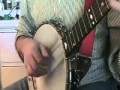 VIDEO: Fair Jennys Favorite, clawhammer jig (click to view) |  Sullivan's Hollow |
slc - Posted - 11/01/2012: 18:14:50
Well dang - that was the regular 'square' version of Sullivan's Hollow! And my 15 minutes are up so can't edit. Sorry for the confusion. I've attached the JIG one here.
O'Sullivan's Hollow |
captbanjo - Posted - 11/02/2012: 05:08:40
haha:
"And my 15 minutes are up"
quote:
Originally posted by slc
Well dang - that was the regular 'square' version of Sullivan's Hollow! And my 15 minutes are up so can't edit. Sorry for the confusion. I've attached the JIG one here.
nickshamrock - Posted - 11/04/2012: 02:37:27
The reason I want to learn the banjo was because while playing at an Irish session, a chap came with a banjo and the beat it gave worked well with my bodhran and fiddle, it was a 5 string, Ive always liked the sound if the banjo and wanted to learn, so I have embarked on a new journey, he was playing in fingerpicking and clawhammer so good luck to you.
neillconnor - Posted - 11/18/2012: 18:14:55
reader.mac.com/mobile/v1/http%...2Ffeed%2F
Listen to the last 10 minutes of the dan Walsh podcast on the above link broadcast a week ago and tell me the 5 string clawhammer dosnt sound good
Edited by - neillconnor on 11/18/2012 18:20:03
Julian44_4 - Posted - 11/19/2012: 02:06:17
Alec Slater & Lisa Schmitz
"With this volume, the reader is pleasantly surprised with two books in one- Section One by Alec Slater, and Section Two by Lisa Schmitz.
Alec's portion is intended as a guide for the clawhammer or frailing banjo player with some previous experience in this style. He stresses the fact that this style of music can be fully learned only from within the oral tradition in which it grew. The instruction included here is meant to provide a review, and not to take the place of qualified teacher. Alec recommends that "...anyone wanting to get this playing right, should find someone in your area who plays and have him/her teach you. Listen to it, watch it, and make it your own."
In Section Two, Lisa Schmits presents an extensive collection of 163 jigs, reels, polkas, hornpipes, strathspeys, waltzes, and songs from Ireland, Scotland, the Shetland Islands, Cape Breton, New England and Southern Appalachia for banjo solo. The national origin of each tune is indicated. Lisa offers personal, authoritative settings of a great variety of tunes at an intermediate level. Written in tablature only."
Edited by - Julian44_4 on 11/19/2012 02:08:39
Matt Buckley - Posted - 11/19/2012: 14:00:51
quote:
Originally posted by Julian44_4
Alec Slater & Lisa Schmitz
Complete Clawhammer Banjo
"In Section Two, Lisa Schmits presents an extensive collection of 163 jigs, reels, polkas, hornpipes, strathspeys, waltzes, and songs from Ireland, Scotland, the Shetland Islands, Cape Breton, New England and Southern Appalachia for banjo solo. The national origin of each tune is indicated. Lisa offers personal, authoritative settings of a great variety of tunes at an intermediate level."
I'm sure this book is a great resource, and probably a wonderful introduction to many styles. But I immediately bristle at the notion of anyone claiming "authoritative" settings of tunes, especially given the existence of countless regional and individual settings that each have a degree of legitimacy, and especially given anyone claiming expertise in each of the above named traditions, any one of which would take a lifetime's work of exploration and mastery.
Cheers.
Matt
Edited by - Matt Buckley on 11/19/2012 14:10:42
Julian44_4 - Posted - 11/19/2012: 15:20:20
I dont think Lisa makes any such claims. Just flowery language of Mel Bay blurb writers.
KnarfEK - Posted - 11/20/2012: 11:21:11
My takeaway from this thread, I'd better check out any Irish jams in person before showing up with a banjo.
Matt Buckley - Posted - 11/20/2012: 11:43:35
quote:
Originally posted by KnarfEK
My takeaway from this thread, I'd better check out any Irish jams in person before showing up with a banjo.
And even beyond this, I learned quite some time ago that it's best to check out an Irish session prior to showing up with ANY instrument. :)
Cheers.
Matt
neillconnor - Posted - 11/27/2012: 11:14:42
This bloke would be welcome at any Irish session
youtube.com/watch?v=VZS_ghFFSM...ta_player
Matt Buckley - Posted - 11/28/2012: 05:34:00
quote:
Originally posted by neillconnor
This bloke would be welcome at any Irish session youtube.com/watch?v=VZS_ghFFSM...ta_player
Could you re-post in a way that would allow us to click on the video?
Matt
captbanjo - Posted - 11/28/2012: 05:36:37
youtube.com/watch?v=VZS_ghFFSM...ta_player
quote:
Originally posted by Matt Buckley
quote:
Originally posted by neillconnor
This bloke would be welcome at any Irish session youtube.com/watch?v=VZS_ghFFSM...ta_player
Could you re-post in a way that would allow us to click on the video?
Matt
Matt Buckley - Posted - 11/28/2012: 09:13:57
quote:
Originally posted by captbanjo
youtube.com/watch?v=VZS_ghFFSM...ta_player
The guy plays really well, and I can't fault his technique. Looks like he'd be welcome at some Irish sessions.
But I disagree that he would be accepted at every Irish session. He's playing an Irish tune, but he's not playing in a traditional Irish style. No ornamentation at all, no shading of the tempo to bring out emphasis on particular beats, etc.
Again, I don't mean to be discouraging or unduly negative. The guy can play. But playing in a truly Irish style requires studying at the genre in real depth. And as others have stated, in a session setting you'd have to have multiple banjos to deal with instantaneous key changes within a set.
I'm currently studying Irish fiddle with a very fine player steeped in the tradition. Bowing direction means everything. I could play all the notes of an Irish tune, and still not be playing Irish traditional music. With proper bowing direction, I'm able to transform the notes into something truly Irish. Or a serious Irish player could play all the notes of an OT tune, and still not be playing traditional OT style.
Others can argue about whether you can technically play the notes on the 5-string. All I'm trying to say is that playing true to the tradition/genre is another matter.
Cheers.
Matt
Page: 1 2
Terms of Use | Privacy Policy | Privacy Consent (EU/GDPR Only)
Copyright 2026 Banjo Hangout. All Rights Reserved.


