
DVD-quality lessons (including tabs/sheet music) available for immediate viewing on any device.
Take your playing to the next level with the help of a local or online banjo teacher.
Weekly newsletter includes free lessons, favorite member content, banjo news and more.
Premier Sponsors


|
Please note this is an archived topic, so it is locked and unable to be replied to. You may, however, start a new topic and refer to this topic with a link: http://www.banjohangout.org/archive/221596
stigandr5 - Posted - 11/27/2011: 19:34:46
Last night was a good night. Not only did I get to hear some fantastic twoubadou music, but I got to see my first official, handmade Haitian banjo. I'd heard that twoubadou bands regularly made their own chordophones (suspiciously banjo-like), but up 'til recently I'd never seen one. The closest thing I'd seen was my own canjo.
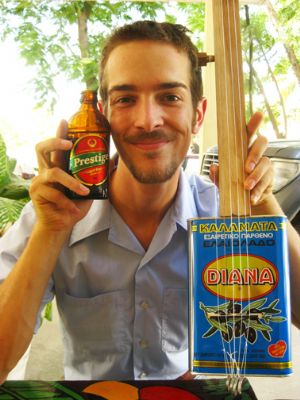
But that all changed when I met Sekretif. He was jamming on stage with a beautiful, handmade, 4 string banjo.

I happened to have my canjo with me. I showed it to Sekretif and we had a little show-and-tell session.

When I told Sekretif that I had a "real" banjo in the U.S., his eyes lit up. He said he wanted to know how he could get an American banjo. I told him his instrument was beautiful; why would he want an American one? "Paske yo pi fò!" (Because they're louder!) he told me. I said I'd do what I could for him. He graciously offered up 400 Haitian gourdes ($25) toward the purchase.
So here's the pitch: does anyone have a banjo they'd be willing to let go of for my new friend Sekretif? A sturdy Asian resonator banjo would be ideal.
Thanks for any help,
Nathan
P.S. Mods, not sure where the correct place for this is. The banjo does have a long history in Haiti, so I think it could be feasible to tie it up with Old-Time.
mojo_monk - Posted - 11/27/2011: 20:42:05
What a great story! Thanks for sharing, Nathan. Se yon bel banjo, wi? Si w we'l anko, di'l li konn dis dwet li. 
By the way, unless Haitian currency has shot up in value since I was there in August, isn't 400gd ($80 HD) a touch more than $10USD? That's a healthy chunk of change! I'll start looking around the local shops and see what I can find. Si'm jwenn yon m'ap voye w email touswit.
Pwoveb Kreyol: "Avek pasyans, w'ap jwenn lonbrit foumi!" (with patience you'll find the belly button of an ant)
N'ap kenbe kontak.
- Msye Sean
stigandr5 - Posted - 11/28/2011: 04:43:16
Sean,
You're right, my bad. Come to think of it, I don't remember if he said 400 gourdes or 400 Haitian dollars. In any event, it's probably not the full price of whatever he's looking for. I'm just tickled that he's willing to pay anything for it!
Thanks for your vigilance! Ak pasyans w'ap we tete foumi (the local variant of the proverb above).
Edited by - stigandr5 on 11/28/2011 04:44:56
mojo_monk - Posted - 11/28/2011: 04:52:02
quote:
Originally posted by stigandr5
Ak pasyans w'ap we tete foumi (the local variant of the proverb above).
HA! Even better
erikforgod - Posted - 11/28/2011: 04:53:24
I would mention it to Eric...maybe they could put it up on the front page and take donations?
Tinfoot - Posted - 11/28/2011: 05:22:41
I really like that proverb... and although I do not speak the language, the linguist in me has an idea what tete may mean -laughs-
But keep us posted! If a collection gets started to help out on the inevitable shipping costs, I'll chip in. :)
writerrad - Posted - 12/02/2011: 18:38:19
I live in Miami. I am retired now, but when I started playing banjo about 13 years ago I was working in a Transit Bus repair garage. When I would be taking the banjo from home to somewhere to take it to jam or be fixed, I couldnt leave it in my truck, but had to take it into the shop. Everyone else would be make deliverance jokes (a sign of how old we all were in this high senior plant, LOL) except a few of th Haitians who would talk about ho that was people in their country play.
Banjo playing is native to Haiti and we have reports of banjo playing in Haiti from the 1600s, while the Earliest US report is in the 1730s. Probably the oldest. Haiti is only one of many Caribbean nations with an indigenous banjo tradition that is still alive. That banjo tradition for the most part has shifted to people playing banjo models that became dominant in the US, Britain, and France in the 20th century.
The biggest hole in banjo roots research is in the Caribbean. All the people doing serious research on the banjo in Africa believe the banjo was NOT created in Africa but created out of African and European components in the Caribbean. All the people doing serious roots research in the US believe that the banjo came to the US from the Caribbean. The earliest banjos that we know about from pictures and old banjos come from Haiti and from Surinam and are in museums in Europe.
TT
writerrad - Posted - 12/02/2011: 18:40:24
Forgot to finish my post by saying the biggest hole in banjo research is nobody with serious knowledge of the Caribbean and its culture has done a study of the banjo there, The closest is Laurent Dubois a professor at Duke
gdechalus - Posted - 12/02/2011: 21:48:56
I have worked as a vodou drummer for many years in the Eastern United States. I have recently been studying early American music and most specifically black banjo playing styles of the few recordings available. I may have have a banjo for this gentleman. How do I contact you?
N'ap pale.
stigandr5 - Posted - 12/03/2011: 04:27:29
Guy, I got your message and sent you a reply. Mesi mil fwa!
Terms of Use | Privacy Policy | Privacy Consent (EU/GDPR Only)
Copyright 2026 Banjo Hangout. All Rights Reserved.


