
DVD-quality lessons (including tabs/sheet music) available for immediate viewing on any device.
Take your playing to the next level with the help of a local or online banjo teacher.
Weekly newsletter includes free lessons, favorite member content, banjo news and more.
Premier Sponsors


|
Please note this is an archived topic, so it is locked and unable to be replied to. You may, however, start a new topic and refer to this topic with a link: http://www.banjohangout.org/archive/220483
xnavyguy - Posted - 11/14/2011: 06:32:26
This past weekend while doing a banjo setup workshop I shared (without his permission) Steve Davis' idea of using a 10" straight edge and a coin as a reference for gauging head tension on a banjo. Steve has talked about this on several threads on the hangout but I believe the first time he mentioned it was on this one: banjohangout.org/topic/213489/1
I showed this method, along with tap tuning & using a peghead tuner attached to the rim while humming into the back of a banjo. I made the comment that "if you can get a nickel under the straight edge, your head is probably too loose". As time permitted, all the the workshop attendees took my straight edge & coins and used it to check their banjos and, sure enough, all of them were loose enough for a nickel to clear the straight edge. They all got their wrenches out and brought their head up to where a quarter would just touch the straight edge. To a man, all were much happier with the sound of their banjos after using this technique. Understand here, these were all bluegrass banjo pickers and the banjos were 11" flat head tone ring banjos.
This method might or might not equate to an exact head tap or tuner note but it does allow for a pretty accurate way to monitor your tension and know when it has changed.
I don't know how to attach Steve's photo so I took one of my own.
Edited by - xnavyguy on 11/14/2011 08:18:09
 Copy of Steve Davis' DIY Head Tension Gauge |
steve davis - Posted - 11/14/2011: 07:37:46
I appreciate your use of head deflection caused by bridge down-pressure,Jerry.
I don't use your method of tap tuning or use a tuner in any way,so we aren't ever going to get on the same page about the accuracy of the comparison of the deflection and the singular note of the head(not using a tuner or resonance of the entire air chamber.
A nickel gap under the straightedge (.075) represents a head note between G# and A
A quarter at .068 is a tighter A head.
I have studied this thoroughly,Jerry and this deflection method does indeed directly mirror the tapped note of weatherking heads on 11" flatheads.
You don't have an accurate way of identifying the head note so you really shouldn't speak on the accuracy of my method as it pertains to the head note.
When you say the method may or may not pertain to the head note,you are saying that you don't know what the head note is.
This is the reason I presented this simple method of achieving a good working head
tension that takes the mystery out of the question,"How tight should I make the head?"
I repeat,this method does equate to an exact head tap.
I tap a head note the exact way that Tony Trischka taps the head note of his Saratoga Star in this attached video.@2:40
The head note is identified totally by ear.
That being said,yes a nickel is a good working head tension.
youtube.com/watch?v=n-SZAvNLx3Q
Edited by - steve davis on 11/14/2011 07:45:41
The Colonel - Posted - 11/14/2011: 08:30:52
Anyone know which UK coin is closest in thickness to a 'nickel'? I'm not helped by the fact we work in metric here and the only dimension for a nickel I can find is .075!!
1p? 2p? 5p? 10p? £1?
Thanks,
Jonathan
steve davis - Posted - 11/14/2011: 09:07:49
quote:
Originally posted by The Colonel
Anyone know which UK coin is closest in thickness to a 'nickel'? I'm not helped by the fact we work in metric here and the only dimension for a nickel I can find is .075!!
1p? 2p? 5p? 10p? £1?
Thanks,
Jonathan
instockfasteners.com/TOOLS/met...rsion.ASP
A quarter is .068 inches(A head note)
A nickel is .075 inches(between G# and A head note)
You're in the 1.5 to 2 mm range on the conversion chart.
Edited by - steve davis on 11/14/2011 09:12:05
Roll Player - Posted - 11/14/2011: 12:30:21
According to the US Mint. a nickel is 1.95 mm., a quarter is 1.75 mm., a penny is 1.55 mm., and a dime is 1.35 mm. I think if you google "UK coin thickness" you can find the specifications for British coins.
Steve, I think the head note is totally irrelevant. There are many different ways of tapping to produce the "note," all of which produce different sounds composed of many resonances at unrelated frequencies. I have no idea which particular resonance you are listening to, but I find that my ears don't seem to agree with yours no matter which technique or resonance I use.
The glory of your wonderful straightedge-and-coin gauge is that the head note doesn't matter at all. There's no voodoo involved - no secret hearing or tapping technique or learning curve to worry about. The only other variables that can affect the reading are the tailpiece tension and the width of the bridge and I think these have only a minor effect.
I have found that a nickel of clearance is too tubby for my tastes and my hands, and that I'm a lot happier at the quarter level of clearance, or tighter. It's interesting that all the workshop participants seemed to agree. I think if you play much outdoors, or in large rooms, or with other instruments, the extra clarity of a tighter head is essential, but the nickel might be just fine for someone who regularly plays alone or in a small room, or whose right hand tends to produce a very bright sound.
Thanks for sharing this great setup technique, Steve.
Edited by - Roll Player on 11/14/2011 12:32:18
ShawnKirkpatrick - Posted - 11/14/2011: 12:43:56
I find my banjo sounds better when a dime just barely fit under the straight edge  . I don't know what note it would be tuned to.
steve davis - Posted - 11/14/2011: 13:36:41
I agree that the deflection negates the need for identifying the head note.
I only hear a singular,consistent note when I tap a head.
Tony Trischka only produces a singular head note (A) in the Saratoga video.
Tony isn't kidding himself when he says he's scratching a head tuned to A.
It sounds just the way it should when checking the singular note.
In connecting the head note to the amount of deflection,I thought it would
help people to start to be able to hear that head note.
BTW,if Tony removed his resonator and scratched the head,he'd get the same
"A" head note as with the resonator attached.
Edited by - steve davis on 11/14/2011 13:38:44
cframe - Posted - 11/14/2011: 14:10:53
For you Canadian pickers, our coins are (for our purposes) essentially the same as the U.S coins, nickel=1.76mm, quarter=1.58mm
Reference:en.wikipedia.org/wiki/Coins_of...an_dollar
Roll Player - Posted - 11/14/2011: 15:44:34
The Canadian nickel spec is about the same as the American quarter, which is 1.75 mm. American nickels are 1.95 mm, and our pennies are 1.55 mm. No wonder Canadian coins don't work in American vending machines.
Roll Player - Posted - 11/14/2011: 16:10:41
Steve, I think the difference is in what part of the tap tone you listen to. I listen to the initial thump and can hear the note, and I hear about a G#3 when a quarter will just pass under the straightedge. It moves up to about an A when a penny fits under. If I take the resonator off that note moves up to a D4 and is dramatically easy to identify in software such as Audacity's plot spectrum.
But that's not what you are listening to, you're listening to that "after-ping" that follows the thump and it's a more complex sound. I think it changes less with increases in head tension and indeed, does not change whether the resonator is on or off. I've looked at the spectrum plots in Audacity of that as well, both in scratches and taps but Audacity seems to think that's a D4 rather than an A4, which pretty much agreed with the resonator-off resonance.
I also took a look at Tony's tap in Audacity just now, and it "hears" the after-ping as a C#4 with an even stronger C#5 resonance
 Head tap spectrum |
steve davis - Posted - 11/14/2011: 16:18:54
And as you say,the stick and coin transcends all this and simply puts it in mechanical terms.
I see it as a very direct way of going to a a pre-discovered favorite tension/tone
with the added benefit of saving someone new to the thing a broken head.
Roll Player - Posted - 11/14/2011: 16:32:51
Exactly, Steve. That's what makes the stick-and-coin so great! Thanks for coming up with it.
steve davis - Posted - 11/14/2011: 16:53:00
I would never tune a head to C.
Way too close to the breaking point.
Edited by - steve davis on 11/14/2011 16:54:00
xnavyguy - Posted - 11/14/2011: 19:59:53
The pickers that came to my workshop really loved Steve's idea. It took, for them, the mystery and fear out of tightening their heads and they were able to achieve instant gratification because their banjos were so much improved after using the coin & straight edge. Turns out, what I had originally planned to be a 2 hour workshop turned into a 4 1/2 hour marathon because everybody was souping up their banjos.
The Colonel - Posted - 11/15/2011: 01:58:53
Its just struck me that the diameter of the coin also comes into play here. At a given head tension a coin with a larger diameter will not pass under the same straight edge as a coin with the same thickness but smaller diameter would.
Only one thing for it. Find the optimum tightness by ear and then find out which coin in your local currency to use to make sure the tension stays at that point.
Thanks for the interesting discussions.
Jonathan
PD Kirby - Posted - 11/15/2011: 02:29:02
All I know is I have personally changed two heads since reading Steve's first post on this subject. I also have the drum dial tensioner that Elderlys sells. So anyway I made a 10 inch straight edge out of a 12 inch metal ruler and went with Steve's method first and carefully and systematically tightened all of the nut's until I reached the point where the Quarter would barely pass under the straight edge (with bridge in place and strings tuned to pitch). The Banjo sounded great !!! I then took out my Drum Dial and measured in 8 places around the head per the instructions and the reading was 91 all around. Conclusion: I don't have a clue what the head note is but I do know the Banjo's both sound great and it took less than half the time it would normally take to change a head. Thanks to Steve for coming up with an ingenious and simple way to solve a hundred year old problem. It's a shame such a good idea will not generate some well deserved income for Steve but this should become standard teaching for all Banjo students from today on. I would like to further ask that going forward this be referred to as the "Steve Davis Method" of head tensioning as it is the right thing to do!
Edited by - PD Kirby on 11/15/2011 02:33:25
The Colonel - Posted - 11/15/2011: 02:48:25
 Just knocked up the following table in Excel for anyone who's interested.
Right.....back to work.
Jonathan
Edited by - The Colonel on 11/15/2011 03:02:44
xnavyguy - Posted - 11/15/2011: 03:30:41
quote:
Originally posted by The Colonel
Its just struck me that the diameter of the coin also comes into play here. At a given head tension a coin with a larger diameter will not pass under the same straight edge as a coin with the same thickness but smaller diameter would.
Jonathan
Definitely true. The diameter of the coin does come into play, as does how you go about placing the coin and which side of the bridge you use. There is a definite difference between the deflection, depending on whether or not the coin is on the bass or treble side. The most accurate and consistently repeatable way, for me, is to place the coin in front of the bridge foot with the edge of the foot just splitting the middle of the coin. Then place the straight edge over the coin as shown in the photo. When I do it that way, my results are more in agreement with what Steve says about the head note.
xnavyguy - Posted - 11/15/2011: 03:32:28
quote:
Originally posted by PD Kirby
I would like to further ask that going forward this be referred to as the "Steve Davis Method" of head tensioning as it is the right thing to do!
I would vote for that.
BobbyE - Posted - 11/15/2011: 03:50:08
I am having trouble coming up with a household item that is 10 inches in length and rigid enough to use. I did use a 7 or so inch pencil and if I remember correctly could not quite get 2 dimes under the space at the bridge. Still looking for that 10 inch item.
Bobby
xnavyguy - Posted - 11/15/2011: 04:01:35
quote:
Originally posted by BobbyE
I am having trouble coming up with a household item that is 10 inches in length and rigid enough to use. I did use a 7 or so inch pencil and if I remember correctly could not quite get 2 dimes under the space at the bridge. Still looking for that 10 inch item.
Bobby
Buy a cheap 12" ruler and cut 2" off one end or the other. In my case, I had a long Kelly-Moore wooden paint stirrer that I cut off. The ones from Home Depot & Lowes are too short.
steve davis - Posted - 11/15/2011: 05:00:20
I measure my deflection on the treble side as in my pics.
If you use the same coin all the time it doesn't matter how its diam. compares to other coins.
Wow,the Steve Davis Method?
I'm honored.
Sheldon - Posted - 11/15/2011: 09:20:53
Paul
Steve is a banjo picker. Earning money for banjo work would just spoil him . . .
Sheldon
steve davis - Posted - 11/15/2011: 09:45:16
I could sell "Specially Intonated" quarters for $2.50,cut off 10" rulers for $6.50
or the whole package for $12.
xnavyguy - Posted - 11/15/2011: 10:08:02
quote:
Originally posted by steve davis
I could sell "Specially Intonated" quarters for $2.50,cut off 10" rulers for $6.50
or the whole package for $12.
Sounds like a banjo player's marketing plan.
Brett - Posted - 11/16/2011: 16:21:58
Wow, I'm shocked something so simple can be so accurate. I had set-up all my banjos, and to me, I always sound the same pretty much, if the banjo is of reasonable quality and similar in build (you know, all flatheads with remo heads). I have been actively buying for years and have many quality flathead conversions and others with just interesting history and quality construction, and I'm pretty happy with all my banjos with 1 or 2 being my favorites. I think I can always adjust a banjo to sound pretty good (BUT I have always wanted to hire Charlie Cushman to chase my setup, because I think I set them up exactly the same and therefore they all basically sound the same). I could be just as happy on a gig with any of them, but some just have more comfortable necks/frets than others.
I just cut off a small metal ruler and got every swinging one of my banjos out and laid all of them out and started checking (again to see how accurate my set-up was). What I found was every one of my banjos, and they're all flatheads with remo weatherking heads except the newest one, which was American Banjo Company remo (heard they are tad thicker spray), were of exact same tightness (except the new head which had only been adjusted once and it had slipped to a nickel). I adjusted the brand new head up to a quarter. All of the older heads (stable) were slightly tighter than a quarter, you could kinda force it under and keep both ends of the ruler touching the head, but a dime easily slid without touching. And, that was all just tuning by ear, and picking, I have no drum dial or anything and cannot hear the tap tuning despite trying to learn. I'll go for awhile thinking I can hear the tapped note but then realize I'm chasing rabbits. This does seem to be a very simple and reliable technique to get your banjo dang close, I prefer slightly tighter than a quarter but a very very loose dime fit. Great stuff.
Brett.
Brett - Posted - 11/16/2011: 16:25:59
I just read what I posted and realize I quoted the new head manufacturer wrong, it's AMB, I suppose American Made Banjo?? My bad.
Rowland - Posted - 11/16/2011: 16:40:01
What a great, simple idea. As soon as I can find a quarter, I'm gonna try it ! I've never seen a group of banjo pickers with that much money. Did they share a quarter ?
Roll Player - Posted - 11/16/2011: 17:00:53
I checked my Fender Artist today after playing it for a while and really liking the sound. It was just like your banjos, Brett, a quarter pushed the straightedge up slightly but not enough to make it rock on it. A penny easily fit under the ruler (a penny is 0.20 mm. thinner than a quarter.)
I love this stick and coin thing!
cframe - Posted - 11/16/2011: 17:37:43
quote:
Originally posted by cframe
For you Canadian pickers, our coins are (for our purposes) essentially the same as the U.S coins, nickel=1.76mm, quarter=1.58mm
Reference:en.wikipedia.org/wiki/Coins_of...an_dollar
I don't like to quote myself, but of course, I screwed this up!  Thanks Roll Player for pointing out that the Canadian nickel is the same thickness as the American quarter.
BTuno - Posted - 11/17/2011: 08:32:32
Just read in another threat that for archtops, we can use the same method with a quarter to get a G#. Do others agree, and get the tone they want on their archtops?
dickinnorwich - Posted - 11/17/2011: 09:38:11
quote:
Originally posted by BTuno
Just read in another threat that for archtops, we can use the same method with a quarter to get a G#. Do others agree, and get the tone they want on their archtops?
Bruce:
Please see my recent post on the same subject on the archtop thread. Yes, Steve's method certainly works for archtops too.
Goldstarman - Posted - 11/17/2011: 12:50:29
Steve I agree, When Tony tapped that head it was a clear as a bell A note
Old Hickory - Posted - 11/17/2011: 16:11:36
I think this system works great. I can hear that my current AMB head is tuned to a B-flat. A quarter will not pass under the stick -- it wants to push up on the stick. So that's consistent with a quarter being A and something less than a quarter being higher.
BUT -- as I've commented in other threads -- I think for my banjo, the stick should be just over 10 inches. Maybe 10-1/4. I forget for sure. At 10 inches, if the ends of the stick are both resting just inside the tension hoop and on top of the tone ring, the stick passes too far away from the bridge. For the stick to pass close to the bridge and for the ends to be supported at the highest possible points on the head, the stick should be longer than 10 inches.
As Steve and others have commented, and what seems not to sink in for everyone, is that this system gives you a repeatable point of reference that has nothing to do with the head note or your ability to hear a head note. It's like a drum dial in that regard. A certain tension is going to produce a certain reading -- regardless of what note you do or don't hear. With the Steve Davis method, that reading is the thickness of coin that can pass under the stick -- showing you the amount head deflection as opposed to the amount of head tension. The Steve Davis Method assumes that head tension head deflection are related. And why shouldn't they be? Anyway, once you know what head tightness produces the banjo tone you like, just see what coin can pass under the stick.
Head note is completely out of it. Unless you want to approach head tightening like I do and try to hit and hear a note -- in which case, the coin and stick provides a point of reference.
steve davis - Posted - 11/17/2011: 16:36:33
I designed it around a 10" straightedge and I'm very happy with its performance.
Sheldon - Posted - 11/17/2011: 18:25:34
Steve
Maybe you have answered this already:
Do you lay the straight edge parallel to the strings or perpendicular?
Sheldon
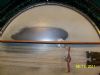
steve davis - Posted - 11/17/2011: 18:49:48
This weather king is tuned to A.
Edited by - steve davis on 11/17/2011 19:02:15
JAFO - Posted - 11/19/2011: 10:33:12
OK, I was just about to begin tightening my head when I thought "Wait". So before I begin, I have a really stupid newbie question: Do I loosen the strings or keep them tight as I pull up on the head? also, do I progressively tighten as I go around, or do I do it like a 'head torque pattern"?
I don't wanna make things worse.
Tom
Roll Player - Posted - 11/19/2011: 10:49:43
There's no need to loosen the strings. Tighten evenly all around the rim, no more than a quarter turn on each nut, one after the other. On an already pretty tight head, I like an eighth of a turn, so I won't miss the sweet spot or break the head.
Edited by - Roll Player on 11/19/2011 10:50:56
Terms of Use | Privacy Policy | Privacy Consent (EU/GDPR Only)
Copyright 2026 Banjo Hangout. All Rights Reserved.


