
DVD-quality lessons (including tabs/sheet music) available for immediate viewing on any device.
Take your playing to the next level with the help of a local or online banjo teacher.
Weekly newsletter includes free lessons, favorite member content, banjo news and more.
Premier Sponsors


|
Please note this is an archived topic, so it is locked and unable to be replied to. You may, however, start a new topic and refer to this topic with a link: http://www.banjohangout.org/archive/205165
Page: 1 2
xnavyguy - Posted - 04/22/2011: 19:19:54
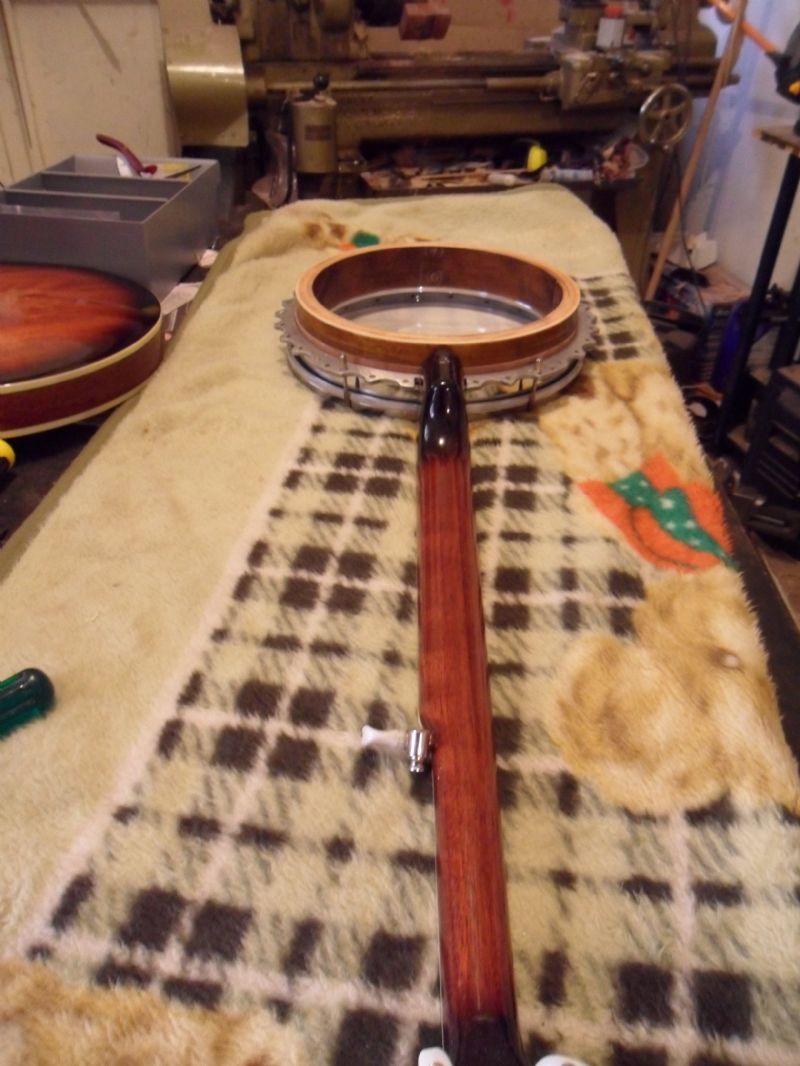
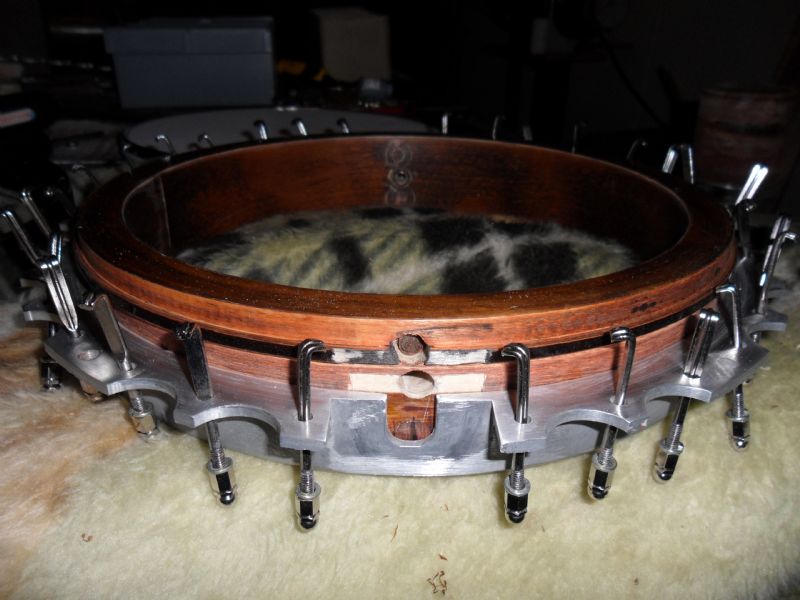
Late last year, I got a wild hair to build a banjo out of junk parts that involved stuffing a wooden banjo rim inside a pretty massive aluminum rim that was given to me by a friend of mine. That project, which I called Monstertone, turned out to be pretty successful so I managed to talk my friend and fellow hangouter, Art Horan (Roll Player) into letting me try something similar with his Korean Castilla brand bottlecap banjo. Those of you who are familiar with these bottlecaps know the difficulty of getting a decent, rich, & complex tone that is associated with much more expensive and heavy tone ring banjos.
Art agreed to let me chop up his banjo which, by the way, was pretty awesome because of other work & modifications we had done on it. I cut the skirt off the original rim. Then I cut down a junk 6 ply Maple openback rim and stuffed it up inside the modified aluminum bottlecap rim. The jury is still out, because this thing hasn't totally settled down yet but it appears that this little banjo might turn out to be as good as the Monstertone but will weigh in at around 7 lbs., just a bit lighter than the Monstertone.
I'm attaching photos of the Bottletone as well as MP3 recordings from the Monstertone when it was 2 hours old and the Bottletone at 2 days old. We're still chasing head tension on the Bottletone. We've gone through several rounds of head tightening on this new head which hasn't settled in yet. I used a 10" metal cutoff wheel in my table saw to cut the aluminum rim skirt off and used the regular saw blade to trim the wooden rim to go inside the metal rim. The skirt length and aperture dimensions on the banjo are the same as before the modifications. The Bottletone MP3 recording was made in my living room using a cheap MXL condenser microphone position 2-3 feet from the front of the banjo. The Monstertone recording was made, using a cheap digital reference dynamic microphone positioned one foot in front of the banjo. Both these recordings are un-adorned with no modifications other than the conversion from WAV to MP3.
Edited by - xnavyguy on 04/22/2011 19:23:27
 Nine Pound Hammer (Instrumental) Monstertone | Bottletone Music Sample |  Bottletone Banjo |  Bottlecap Banjo Neck Heel With Added Lag Bolt |
 Bottletone Banjo Modification Composite |
tinkersdam - Posted - 04/22/2011: 20:36:40
It would be interesting to hear a comparison of how the "bottlecap" sounded prior to the modification. Any chance a recording was done prior? It certainly sounds pretty good at this point....
Roll Player - Posted - 04/22/2011: 20:38:44
So... I dunno if anyone else is interested here, but I was pretty amazed at how this thing sounded. At about 7 pounds, it's verr-ry easy on the back and my recently-messed-up right shoulder. The tone with the newly modified rim is a good deal richer and more complex... not exactly a gibson-esque sound but it has a nice complexity and ring all of its own. Before, it had a tendency to a hollow sound with some unpleasant overtones that were very hard to remove. I think I'm gonna try it out at our nursing home gig where I typically have to stand for over an hour with the banjo strapped on. After about a half hour it seems to gain a pound every five minutes. With this banjo, I don't think it'll be a problem.
I'm very interested in hearing what others think of the tone as recorded in the sample. After I left Jerry's house this afternoon, I spent at least an hour sitting outside playing it in the backyard at Marsha's house. Not a Mastertone sound exactly, but a very nice, rich sound that works very well I think. Ver-ry nice. Jerry is quite an amazing craftsman at doing this kind of thing!! This sow's ear has made an amazing "silk-like" purse, thanks to his work and dedication (not to mention stubbornness.). 
Brings a whole new meaning to "hitting the bottle. 
Roll Player - Posted - 04/22/2011: 20:47:14
quote:
Originally posted by tinkersdam
It would be interesting to hear a comparison of how the "bottlecap" sounded prior to the modification. Any chance a recording was done prior? It certainly sounds pretty good at this point....
We didn't do any recording before the modification. I have only recorded this banjo once and it was with muting, a nut extender and a slide to produce a dobro-like sound. That file on my music page is called "It Amazes Me."
I can tell you that before the modification it had a strong tendency to a hollow sound with some slightly unpleasant overtones. The new sound is more "controlled" and focused, with sweeter overtones and much less of the hollow sound. It works better at a tighter head tension also. I expect it will sound better still as the parts all settle in and the head stretches out. (I do expect to do several more rounds of head tightening before it finally settles down.)
5strings3picks1banjo - Posted - 04/23/2011: 03:58:48
Hi Jerry, i did what you did in 2007 and I agree it bought a lot more tone to the thin sound it had previous. All these bottle caps pretty much sound the same so all you have to do tinkerdam is listen to some recording of others. The next one I did in 2008 was leave the bottom and have a complete wood top. Later on put a brass hoop ring on it. After that one I used the flange and made it like a one piece flange set up with bluegrass ring. The great thing about doing these mods is the low cost. I think for the cost it adds a ton of extra tone. Roughly what will it cost for people to send their bottle caps to you Jerry for the mod?
 complete before spary job | 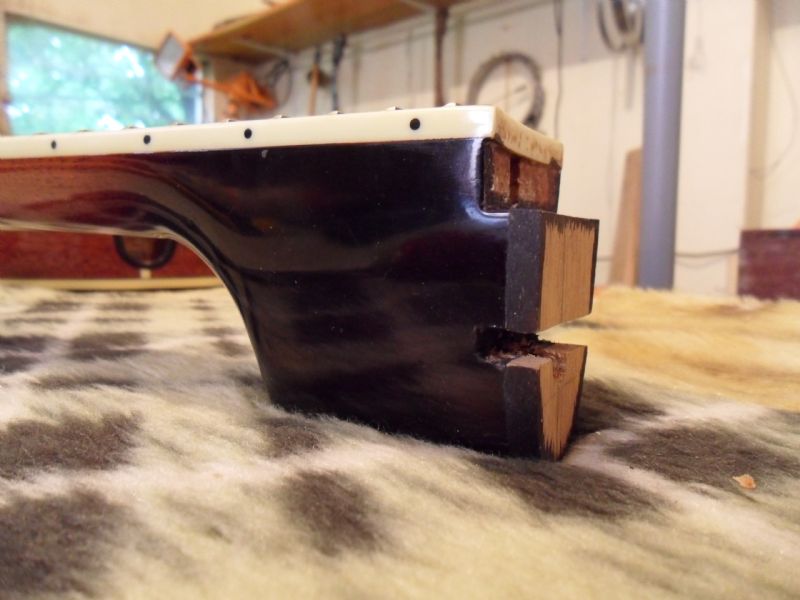 extended heel for bluegrass tonering and 3ply rim mod | 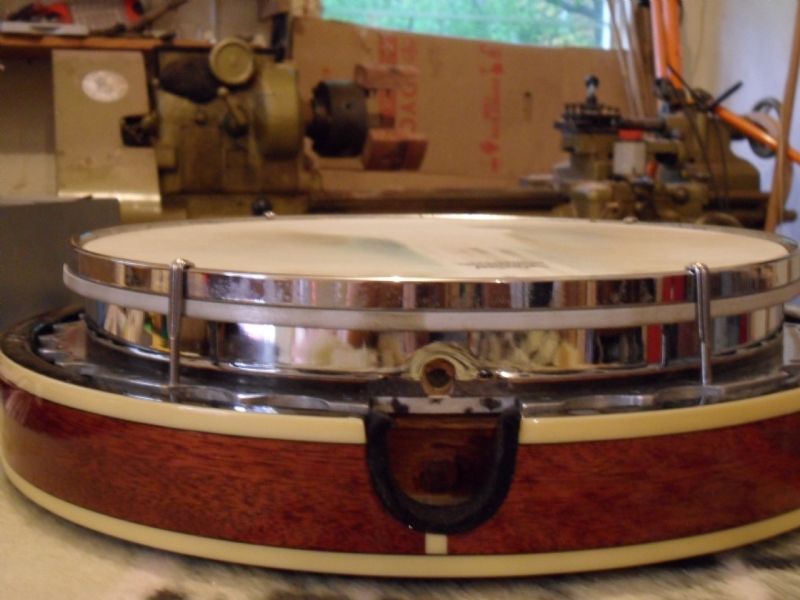 almost complete | 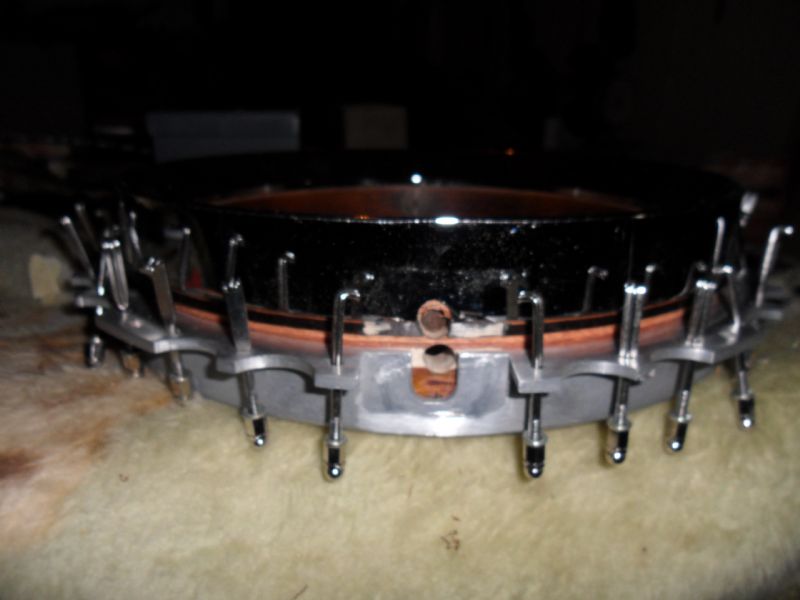 tonering fitted |
 3ply rim fitted |  | 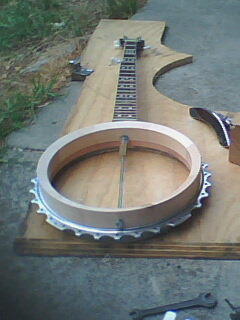 | 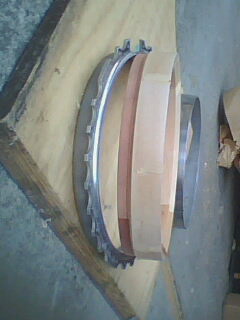 |
5strings3picks1banjo - Posted - 04/23/2011: 04:02:07
Forgot to say nice picking and sounds great guys
xnavyguy - Posted - 04/23/2011: 04:12:44
quote:
Originally posted by 5strings3picks1banjo
Forgot to say nice picking and sounds great guys
Leon, I knew you had done a lot of work along these lines and that, in part, plus Art's willingness to sacrifice his banjo, was what inspired me to try this out. And I'm not set up to do these mods for others. I just happen to have a few junk openback rims that I've been using. I have two more rims and two of my own bottlecaps to try this on. I enjoy the challenge of keeping things out of the landfills.
xnavyguy - Posted - 04/24/2011: 07:08:58
Since both the Monstertone & Bottletone rim stuffing projects have turned out so well, I've decided to to a similar modification to my Oscar Schmidt "Oscartone" bottlecap banjo. The Oscartone has been my main player and I've managed to keep it under control by using a 10 mil black drum head. While it sounds fantastic it still lacks the tonal richness and complexity it needs to be really, really good.
With this one, I plan to leave the bottlecap rim completely unaltered, except I will be adding a lag screw like I did on Art's Castilla banjo which, by the way, is getting better and better every day. The Oscartone will receive a thin 3 ply walnut rim that came out of some unknown openback banjo and was given to me by a friend. Once I make the mod, I will install a regular Remo frosted banjo head instead of the 10 mil drum head.
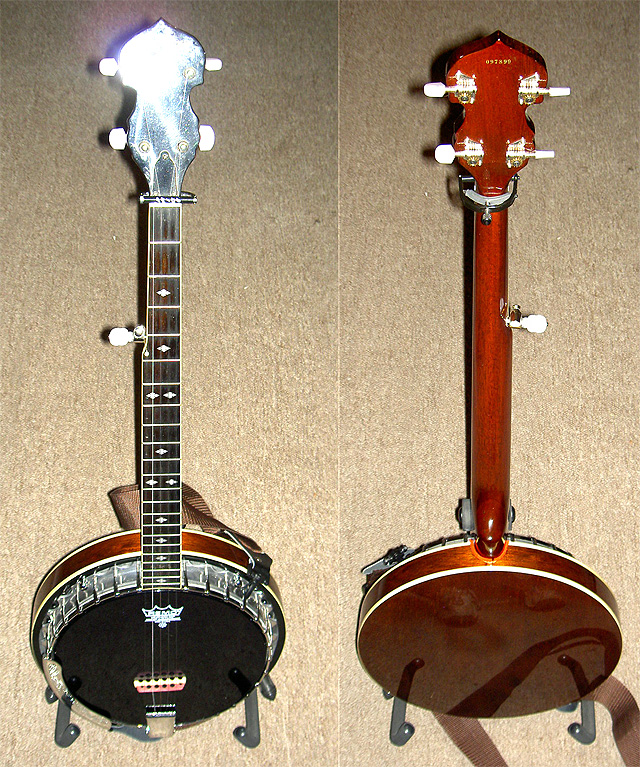 Oscar |
Tim13 - Posted - 04/24/2011: 09:08:59
Hi Jerry,
That's just about what I did with my bottlecap. I made a home brew tone ring out of red oak. The ring was larger than you'd typically see in a banjo, and it really tamed the aluminum rim. I was able to use a standard remo head as well.
Tim
xnavyguy - Posted - 04/24/2011: 10:11:33
quote:
Originally posted by Tim13
Hi Jerry,
That's just about what I did with my bottlecap. I made a home brew tone ring out of red oak. The ring was larger than you'd typically see in a banjo, and it really tamed the aluminum rim. I was able to use a standard remo head as well.
Tim
Tim,
Art & I were talking about this last night. It seem that adding some sort of wooden component to these banjos is what they need to take the edge off and add some richness & complexity to the sound. We definitely have a big advantage over most folks because we have access to my bridges which do a much better job of shaping the notes that are delivered to the rest of the banjo, no matter its composition.
xnavyguy - Posted - 04/28/2011: 05:04:39
Nearly done with the Oscartone modification. I've installed the thin 3 ply rim. After I stripped the old finish off the rim, I'm thinking it is Maple instead of Walnut. I've had to order a slightly larger head (11 1/16") so I am waiting on that to arrive. In the case of the Oscartone, I will not be adding the extra lag screw, nor did I cut off the original aluminum rim's skirt. The only alteration will be the addition of the wood rim. Both banjos, Art's Castilla and my Oscar Schmidt will be about the same mass with Art's banjo rim having a larger proportion of wood and mine having a larger proportion of aluminum. It will be interesting to note the differences in sound characteristics, if any.
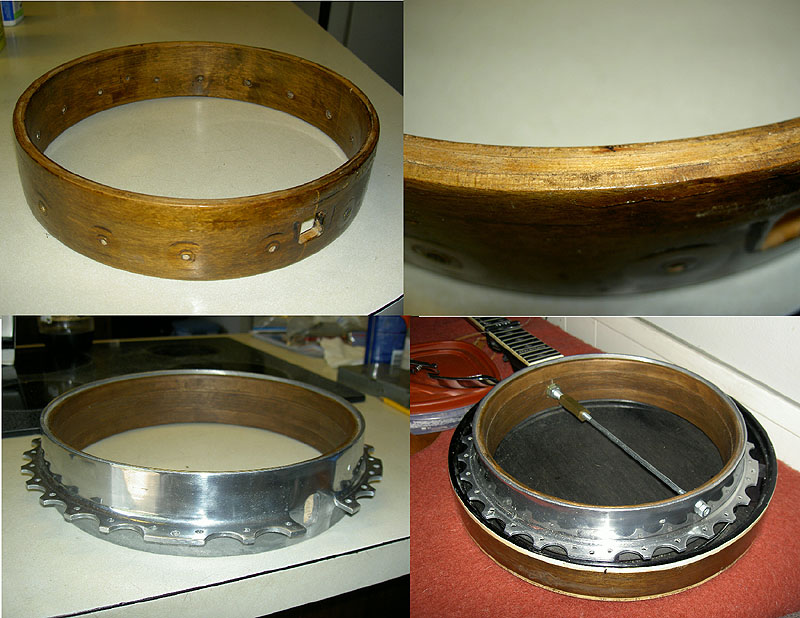 Bottle Cap Rim With 3 Ply Maple Rim Installed |
5strings3picks1banjo - Posted - 04/28/2011: 05:16:47
That looks very good. The first one I did was like that but yours looks prettier. I thought maybe I should try another one like you but this time I will lathe the inside wall true and thin as I can get it.
Have you thought of an arch top mod? Router the top outside of wood rim and leave a small wood raised lip. Push the rim up higher inside the alloy rim and there you have an arch top wood/alloy tonering. Drill holes if you want.
xnavyguy - Posted - 04/28/2011: 10:39:30
quote:
Originally posted by 5strings3picks1banjo
Have you thought of an arch top mod? Router the top outside of wood rim and leave a small wood raised lip. Push the rim up higher inside the alloy rim and there you have an arch top wood/alloy tonering. Drill holes if you want.
Ya' know, I might try that on one of my 2 other bottlecaps. I've got one more old rim that is pretty thick that I could mount inside. It's thick enough that the head bearing surface would be about the same distance from the edge as a standard archtop. If I did that, I would probably need to cut the top of the aluminum rim off to compensated for the elevation of the wooden rim inside.
Thanks for the suggestion.
xnavyguy - Posted - 04/30/2011: 17:54:55
Today, I met Art at a dinner party jam up in Belton. He brought his Gibson (Rich era) Earl Scruggs Standard and the Bottletone. During the first part of the party, he played the Bottletone. While he was eating, I had a chance to play the Bottletone and was pretty amazed at how responsive it was and how much richer the tone had become over the past week. Later in the jam, he broke out the Scruggs and I found it hard to decide which one I like the best, the Scruggs or the Bottletone. From the front, the Scruggs seemed to have a little bit more clarity & focus than the Bottletone but when I was standing behind Art, I couldn't seem to tell any difference.
FedEx delivered my new heads today so I should be able to get my Oscar Schmidt bottlecap put back together by tomorrow so we will have a couple of different variations of the modification to compare. I really had a great time today. Lots of great local pickers and some that drove down from St. Louis. Man, I love this country and I love this music!
 Art's Bottletone Banjo |
xnavyguy - Posted - 05/01/2011: 16:05:18
Well, golly folks. I got the Oscartone all put back together this morning and I have to say that I really like it, right off the bat. I can't say that I liked the way Art's Castilla sounded when I first put it back together. Even though these are both bottlecaps with identical rims to start. I made no modifications to my Oscar Schmidt rim. I merely stuffed the 3 ply wooden rim inside the aluminum rim. Not sure if there's a way to really quantify or describe what I'm hearing between these two banjos. Art's is a longer scale length so, when his bridge is intonated properly, it is in a different position on the head than mine. His resonator also has a different shape, and interior dimension even though both resonators have the same exterior dimensions. We will have a jam at our house tomorrow evening and, if the new head has settled down, I plan to play the Oscartone in that jam. One of our jammers is vision impaired and he always notices when I am playing a different banjo. He was with me yesterday at the jam where I played Art's banjo. He won't know that I've changed my Oscartone so I should be able to get a good read from him on whether or not my modification has done anything for the good.
Stay tuned.
Tim13 - Posted - 05/02/2011: 17:11:52
I am anxiously awaiting your vision impaired friends reaction to the updated banjo. I'm also hoping you will post a sound bite of it as well.
Tim
xnavyguy - Posted - 05/02/2011: 20:17:56
quote:
Originally posted by Tim13
I am anxiously awaiting your vision impaired friends reaction to the updated banjo. I'm also hoping you will post a sound bite of it as well.
Tim
Tim,
We just finished our jam & I didn't get a lot of feedback from my friend. I can, generally, get a pretty good feel for how a banjo sounds when I am playing with other instruments, especially in a jam. I felt pretty good about what I heard tonight. You have to understand that this particular banjo was my main ax and already sounded pretty darn good. It had been fitted with an 11" Remo Ebony Ambassador 10 mil drum head which really helped tame the metallic "edge" that is inherent in these banjos. With the wooden rim, I noted that it is much clearer and focused, particularly up the neck and the bottom end seems a lot more powerful and sweeter than it was. Tonally, the most dramatic change is how much better balanced the banjo seems to be.
The whole machine, including the new head, is going through a lot of change right now. I've gone through several rounds of head tightening, the last right before the jam tonight. I had the head right around a G# tonight but I think it wants to be a little tighter, closer to a concert A.
Our monthly jam in Pearl, TX is this weekend. We usually go down on Thursday with our RV. If I can get together with Art before we go to Pearl, we'll make some sort of recording with the Oscartone.
When I asked my wife what she thought about the sound of this banjo, her comment was that it was very loud and sounded real good but then she said that all my banjos sounded good.
IbexChris - Posted - 05/06/2011: 00:43:42
Hi Jerry,
I got a Samick bottlecap early 80th and I love the idea to put a wooden rim into it.
Maybe I'll follow your Oscartone design - no cut of the the original rim's skirt is needed.
Let me ask a question: How did you attach the wooden rim to the bottlecap rim? Is it a pressure fit or did you use some glue or epoxy?
Christian
xnavyguy - Posted - 05/06/2011: 15:06:11
quote:
Originally posted by IbexChris
Hi Jerry,
I got a Samick bottlecap early 80th and I love the idea to put a wooden rim into it.
Maybe I'll follow your Oscartone design - no cut of the the original rim's skirt is needed.
Let me ask a question: How did you attach the wooden rim to the bottlecap rim? Is it a pressure fit or did you use some glue or epoxy?
Christian
Christian,
In both Art's and my banjo it's a pressure fit. It ain't gonna fall out. On my Monstertone, I didn't fit the rim quite so tight as on these bottlecaps. It was more of a slip fit with 8 equally spaced 7/8" wide shims between the wood and the metal and attached at the neck and the tailpiece. For the bottlecaps, I had to carve out a notch for the thicker neck bolster where the neck attaches to the rim.
I'm out of town, attending a monthly jam at Pearl, TX. I played the Oscartone yesterday with a group of folks who have been listening to me play that banjo, in the past, with the thick drum head fitted on it. All who heard me play last night said the Oscartone has a much "rounder & fuller" tone and not as harsh as it was, even with the drum head that tamed a lot of the natural harshness of these banjos. I'm still tracking the head tension as it still hasn't totally settled in. I'll have all evening to play it an all day tomorrow so I'll see how things work out.
Jerry
xnavyguy - Posted - 05/09/2011: 06:15:23
Saturday morning, before the scheduled groups got on stage, some of us played a little memorial tribute to one of the Pearl regulars who passed away last week. I used the Oscartone for that event. Again, I couldn't tell, for sure, if it was a whole lot different than it was with the 10 mil drumhead on it.
Later that afternoon, I did some bridge/setup work on 3 other banjos. One was a '35 pre-war TB-1 conversion. One was a Deering Sierra. The other was an RB-5. When I got through, the pre-war, the Deering, & the RB-5 were very close in response, focus, & clarity, though slightly different in tone. The Oscartone definitely is not yet up to those standards. My Monstertone, which is into it's 6th month in this configuration was definitely on a par with those high end banjos even though it was 2/3 the weight.
Both my and Art's bottletone conversions are still quite recent, I'm thinking I need to go back in and loosen the fit between the wood and metal rims. That is, the relationship/fit needs to be more like the fit between a regular tone ring and rim. On both the bottlecaps, I used quite a bit of force to fit the rims together. The tight fit might be making these things more weather/humidity sensitive than they might be with a loose fit.
I'm still chasing the head tension on the Oscartone after a week and it will be several more days, I fear, before it finally settles down enough for me to get a good read on how this configuration will work.
xnavyguy - Posted - 05/12/2011: 10:09:09
Yesterday, I went through what I thought would be the final round of head tightening on the Oscartone. I tightened it up to just below a concert A and it was really starting to sound good. I was feeling very studly. This morning when I plucked it off the wall the tuning had gone flat and it was sounding a bit tubby. Upon careful inspection I found that the head had separated from the stretcher band. Now I'm depressed. Not the first time I've experienced a broken head but the first time I've had a new Remo head break.
To get even, I think I'll got take a power nap.
xnavyguy - Posted - 05/15/2011: 06:04:12
I can't be sure if anyone is still reading this thread but I'll still be posting comments about this project until I've run out of things to say. I managed to recover from my depression over the broken tension band on the Oscartone. I repaired the band and remounted the head. By yesterday morning it was settled in enough that I felt like playing it in public and took it to the Texas Pickin' Park jam in Fayetteville. Art showed up with his bottletone and we were able to spend quite awhile in the same jam. I had my guitar and Art switched back & forth between his banjo and my banjo. In the same jam there were two Stellings. One of the Stellings was a new Staghorn and the other was a Crusader that had been fitted with an archtop tone ring.
Both the bottletones held up well with the Stellings. Even though both bottletones had identical birch plywood bridges, because of the differences in scale length between Art's banjo and mine, my bridge location was 1/2" closer to the middle of the head than his. That, and the fact that his resonator, because of it's shape (different from my Oscartone resonator), allowed less total air volume within the rim/resonator assembly. These differences, I feel, caused the harmonic content/note complexity to be different, at least to my ears. The notes from Art's banjo were a little more complex and more focused than notes from the Oscartone, while the Oscartone leaned a little toward the "warmer" side. Head tension on both banjos was pretty close to the same, with the Oscartone just north of G# and Art's bottletone just south of A as far as their tap notes.
Our jam was held outside, against the wall of a building, so conditions weren't wide open but neither Art nor I changed our positions so I was able to get a pretty good read on the subtle but palpable differences between the two banjos. If I could characterize the differences between the two banjos, Art's banjo would lean more toward that of a Gibson, while mine sounded more like some Deerings and Nechvilles that I've heard. His banjo, in my opinion would stand up better than mine against a wall of Martin guitars, at least in his hands. I've got a pretty heavy right hand so I think "Oscar" will do just fine for me.
Art will be over here for band practice this evening. Maybe we will be able to take a little time to make another recording with these two banjos for comparison.
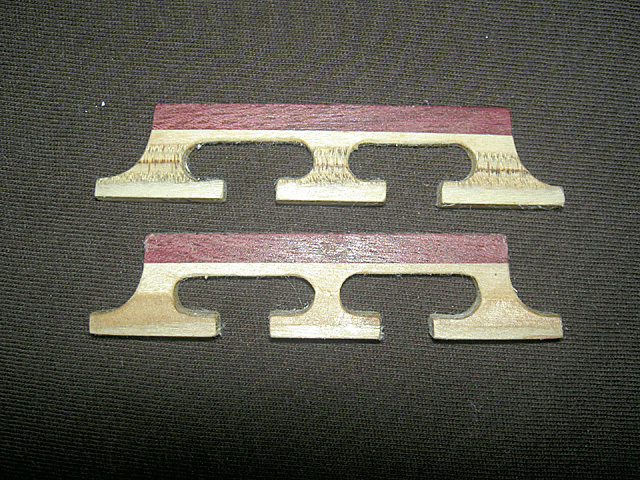 Plywood Bridges |
Roll Player - Posted - 05/15/2011: 12:32:31
Just wanted to add my thoughts to what Jerry had to say about the differences between our two "bottletones." I felt they both worked very well in the jam, but his had a drier, sound with fewer overtones. No doubt the bridge position being closer to the center of the head had something to do with that. They both held up well in the jam with other instruments and it was a pleasure to play without having the weight of a boat anchor hanging off my back. It would be hard to say which sound I preferred. I enjoyed both a lot, even though they were quite different. Neither had the hard metallic edge of a typical unmodified bottlecap banjo. And did i mention the light weight? 
Later, I played in two more jams with my Bottletone - one inside a large, echo-y enclosed area, the other completely out in the open. In both cases the jams were a bit smaller with only about 4 or 5 other musicians. The banjo fit in very well in both jams - a good thing since it was the only one I brought. As much as I enjoy the tone of my RK80 and Scruggs Standard, it's getting hard for me to justify lugging the weight of them around at festivals and jams now that I have this option.
Monday, I'll try playing it mic-ed at a "Geezer Grass" performance for a local nursing home and see how it works for that. I'll be wearing it while standing for over an hour, so that'll let me test how the weight factors in. I'm thinking my back will be a lot happier.
xnavyguy - Posted - 05/17/2011: 13:19:48
Art was over for band practice Sunday night but I was too worn out from 2 days of continuous picking and didn't feel like dragging out my gear to make a recording. We did take some time to do some comparison "listening" using his modified Castilla "Bottletone", my Oscar Schmidt modified "Bottletone", and 2 other bottlecaps, both heavily modified but neither with the "Bottletone" modification.
Of the four bottlecaps, Art's Castilla probably had a slight edge over my NeuTuMi no-name Korean bottlecap, with the Oscar Schmidt a close 3rd and my Global "Redneck" with a clear Remo head in 4th. Art doesn't care for the clear Remo heads because they all seem to have a characteristic "honking" sound, like a goose.
The NeuTuMi is the most heavily modified of the non-Bottletone bottlecaps. I've attached a photo of that banjo showing a 9" cake cooling rack glued to the floor of the resonator and a 7/8" x 1/4" x 10 3/4" piece of pine timber wedged inside the rim, just below the coordinator rod but not touching it. This banjo and Art's Castilla were almost identical, in tone, with a slight edge given to Art's modified Castilla. The Redneck with the clear head and the NeuTuMi are the only ones with cake racks in the resonators. The NeuTuMi resonator is shaped like the one on Art's Castilla but it does not have the added lag screw and the neck is quite a bit fatter than the neck on Art's banjo. His banjo is fitted with a Remo WeatherKing head and the NeuTuMi is fitted with the original Japanese plastic top-frosted head that came on my Aria Aluminum banjo that I bought for $80 from my granddaughter's pawn shop.
With all these differences plus the fact that my Oscartone head is still settling in, it's hard to say exactly what we've learned except that these banjos need wood inside the rim, whether its a whole 'nother wood rim or just a piece of timber or dowel like the one in the photo.
I wouldn't be embarrassed to play any of these banjos in a performance or a jam. They can hold their own against anything and are light-weight enough that you can play for a long time, standing or sitting, and not have to spend a lot of time in chiropractic re-hab to recover.
Art played his Castilla at our nursing home gig yesterday and, to me, through our monitors, it sounded as good as the RK-80 I am used to hearing at that venue.
Edited by - xnavyguy on 05/17/2011 13:21:38
 Existing NeuTuMi Bottlecap Modifications |
Klondike Waldo - Posted - 05/24/2011: 15:53:28
In the never-ending search for a slightly warmer tone from my Epi MB200, I cut two sections of hardwood dowel and wedged them into the rim along the lined of Jerry's NeuTuMi mod shown above. I have a lining of maple veneer I put in some time ago which the dowels actually press into, each about 3/4" on either side of the co-ord rod. I'm not hearing anything different tonight, but I'll give it a couple of days before I yank them out or decide to keep them. It's fun and doesn't cost much to play around with stuff like this.
paulac7 - Posted - 05/24/2011: 17:00:28
Wow--I have been reading (following) this thread with much interest, as I 'redid' an old Kay bottlecap that I had that was stuffed into the closet. Once I got it all put back together I found I managed to improve the sound somewhat--but it's still a little harsh. I spray painted the head flat black for lack of something better to do and felt daring doing that..............
Jerry--I wish I had the know-how to stuff a wooden rim into the thing, but that's above my pay grade, I think. I like my Kay because it is light, as due to a disability, I cannot have a 15 lb boat anchor on my shoulder without causing much grief.
You guys just amaze me with the amount of things that you can do with these banjos--I'm impressed!!
This thread is awesome, and thanks for keeping it alive (power naps and all  ).
).
Paula >^.^<
xnavyguy - Posted - 05/24/2011: 20:43:16
quote:
Originally posted by Klondike Waldo
In the never-ending search for a slightly warmer tone from my Epi MB200, I cut two sections of hardwood dowel and wedged them into the rim along the lined of Jerry's NeuTuMi mod shown above. I have a lining of maple veneer I put in some time ago which the dowels actually press into, each about 3/4" on either side of the co-ord rod. I'm not hearing anything different tonight, but I'll give it a couple of days before I yank them out or decide to keep them. It's fun and doesn't cost much to play around with stuff like this.
Bob, when I wedged that piece of timber into the NeuTuMi rim, the change to me, at least was immediate, but subtle. Understand that I already had the cake cooling rack in the resonator. In your case, the maple lining in your Epi may have already had the same effect as what I did with the bare-necked aluminum rim on my banjo. In the case of my NeuTuMi, I also have a huge pile of timber between the neck and the rim as shown in the photo. This change is enough to considerably alter the "normal" bridge position on this banjo, moving it closer to the middle of the head when it is properly intonated.
Art and I were talking on the phone this afternoon and concluded that these bottlecaps have way more potential than folks realize. The most significant thing that seems to do the most good is making sure that the neck, nearest to the bottom of the fretboard, needs to be in good contact with the rim and will, most likely, require adding some sort of shim. That, and the single coordinator rod needs to be pretty neutral. That means you shouldn't use it to push the neck up or down. The nut that holds the neck on, needs to be very tight, even bending the anchor screw that holds the end of the rod in the neck.
The new head on the Oscartone has finally started to settle down and it is acting like a real banjo now. Very responsive, with a sweet tone, quite a bit different than Art's Castilla which seems a bit more complex in tone. These things, modified or otherwise, seem to want a very tight head. Art is running the Castilla somewhere between a G# and an A. I've got the Oscartone right at an A since the head still seems to be stretching.
The other variable, which no one else has access to, is that all mine and Art's banjos are fitted with our bridge designs which are quite a bit more efficient than traditional bridges in delivering string energy to a banjo assembly.
As usual, I'm just reporting what I think I've learned with all this. YMMV
Jerry
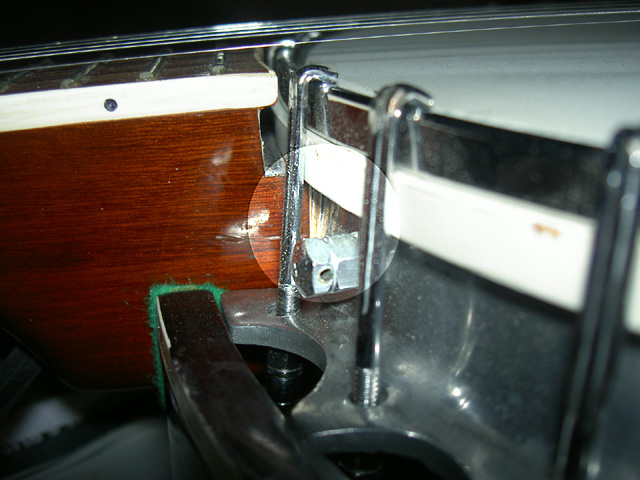 Neck Shims, Aluminum Pot Banjo |
xnavyguy - Posted - 05/24/2011: 20:53:30
quote:
Originally posted by paulac7
Wow--I have been reading (following) this thread with much interest, as I 'redid' an old Kay bottlecap that I had that was stuffed into the closet. Once I got it all put back together I found I managed to improve the sound somewhat--but it's still a little harsh. I spray painted the head flat black for lack of something better to do and felt daring doing that..............
Jerry--I wish I had the know-how to stuff a wooden rim into the thing, but that's above my pay grade, I think. I like my Kay because it is light, as due to a disability, I cannot have a 15 lb boat anchor on my shoulder without causing much grief.
You guys just amaze me with the amount of things that you can do with these banjos--I'm impressed!!
This thread is awesome, and thanks for keeping it alive (power naps and all
Paula >^.^<
Paula,
Thanks for you interest in our lunacy. I would be willing to bet that your paint job did have some effect on your banjo and very well could have helped. It's nice to know that there are others that are willing to color outside the lines.
By the way. I was sorry to hear about Abby. I'm a hard-core dog lover and understand the heartbreak when you have to make a decision to let one go. My heart goes out to you.
Jerry
paulac7 - Posted - 05/25/2011: 03:18:44
Jerry,
Thanks for the nice words about Abby--it's been 2 weeks, and it just seems *odd* without her here, but then life goes on, I guess.....
I hear you about the tight head thing--since I put the 'K' back together again, it seems like about every day, I have to give the j-hooks another round of tightening, even though the head is the one that was on it when I got it. (but it was really loose when I took it off). Now I'm curious to see what kind of tone I would get with another type of head--renaissance or a 'real' black one-- but that will have to wait a bit as finances are a bit low right now. When I first put the head on and left it sit overnite, when I played it a bit to see what it sounded like, YIKES!!! I got some *major* overtones? reverb? I don't know what you would call it, but it was a frightening sound. This has since gone away as the banjo is settling in, and much tightening of the head bolts.
Interesting about the bridge--that might be one of the critical factors that makes the sound what it is. Right now I'm running a 5/8 that Klondike Waldo so graciously sent me--the action is still a little higher than I'd like, but it's doable for right now. I just need to buy another cake rack to stick in there, as I don't want to sacrifice the one I have right now.
Have a good day!
Paula >^.^<
BTW--I really like the NeuTuMi name brand--it took me a little while, but when I read it out loud, then I 'got' it. That's quite clever!!
Edited by - paulac7 on 05/25/2011 03:27:38
xnavyguy - Posted - 05/25/2011: 04:36:28
Paula,
The NeuTuMi was my first bottlecap banjo. A friend bought it for $60 at a garage sale. The action was so high and the neck mount so crooked that it was totally unplayable. He called me and offered to swap it for one of my bridges and some setup work on his Goodtime. It was that banjo and the modifications I had to make to get a proper neck set that turned me on to seeing what I could get out of one of these things. Shortly after I made the initial mods, I took it to the Argyle festival, near Ft. Worth. I was in an impromptu jam with Gerald Jones & he played the banjo. He couldn't believe the sound that was coming out of it. He also mentioned that it was exactly like his first banjo. Another picker from Louisiana offered to pay me whatever I wanted if I would just sell him that banjo.
Modifying and setting up banjos can certainly have it's scary moments. When I first put Art's Castilla back together, it almost made me sick to my stomach, how it was sounding while the head was settling in and still stretching. Talk about overtones.... It was "chirping" and, at times, "quacking" like a duck. Once the parts began to marry back up and Art went through several more head tightening sessions, it really started to settle down and began to develop a tonal richness that you might expect to hear in a much more expensive banjo. I've had similar but less dramatic issues with my Oscar Schmidt.
If there's one weakness in all of this, it has to be the j-hooks on these banjos. There are 30 of them and you would think that's more than enough to get the head up to pitch. I've found that the closer you get the head to full tightness, these hooks are right on the verge of bending or popping off the tension band. Usually when I have them all off, I take the time to re-bend the hooks before I reassemble the banjo. Most times, when I'm through with a tightening session, some of the hooks are twisted a little and I use a small tack hammer to tap them back square against the tension band. It makes things look a little neater.
If your action is too high with the 5/8" bridge, it might be worth the time to loosen the strings, loosen the neck and slide a shim between the neck and rim to set the neck angle down a little. The shim will also improve the neck to rim contact and should help the tone.
Klondike Waldo - Posted - 05/25/2011: 14:03:32
Paula, I would suggest you try what Jerry said about shimming the neck- I did that to my Epi shortly after I got it and put on a 5/8" bridge. Shimming will do at least two good things for your banjo: tilt the neck back a bit providing lower action and give better neck-to rim contact. On some bottlecap banjos it will also free up the head for adjustment because on some of them the fingerboard is jammed up against the tension hoop when they come from the factory. I agree about the J hooks- the stock J hooks are not tempered right or something. I'm also re-bending them every time I work on old Molly. I have some Golden Gate hooks which look like they might fit, so that might be my next modification.
I'm too busy right now with piping gigs and preparing for an opera concert (I'm a tenor) to try making bridges like Jerry's, but that's definitely on my to-do list.
paulac7 - Posted - 05/25/2011: 15:08:32
Thanks for the advice, both of you! What kind of wood should I use to shim it up--just anything I have laying around? Or go to my local home improvement store and buy some?? I am basically learning as I go with this............
I agree the J-hooks are a pain--with 30 of them, you would think they would do a better job of holding tension--so far mine are holding, but that may be prone to change.
At least if I totally mess the 'K' up, they are dirt cheap and I can get another. I have learned so much from just ripping this one down and putting it back together.
>^.^<
xnavyguy - Posted - 05/25/2011: 17:01:26
quote:
Originally posted by paulac7
Thanks for the advice, both of you! What kind of wood should I use to shim it up--just anything I have laying around? Or go to my local home improvement store and buy some?? I am basically learning as I go with this............
>^.^<
Paula, I don't think it makes any difference. Art had put some sort of dowel, probably oak, in his Castilla before I put the wood rim in it. That piece of timber in my NeuTuMi photo is a piece of yellow pine that I had cut off some board in my junk wood pile. I had tried several different pieces of timber and settled on the rectangular shaped piece of pine. I don't know how long they are or if they would be too short to fit, but the easiest thing to try might be one of those freebie paint stirring sticks that Home Depot gives away. I remember, back when I put that piece of timber in the NeuTuMi, that I noticed that it reduced some of the very high frequency harmonics (overtones) that were present with the unmodified rim.
Tim13 - Posted - 05/25/2011: 17:07:54
I wish I had heard about putting a little more bend into the hook to get a little more tension on the hoop before failure. I ended up losing one hook with my bottle cap trying to get that last little bit of tension in the head while using a drum dial as a reference. If I had kept the banjo, I was going to buy 10 or 12 standard hooks, work them over with a Dremel to make them fit the the hoop, and then intersperse them with the cobra hooks. This would/should take some of the pressure off of the cobras, and allowed easy adjustments from 90 - 92 on the DD.
Even though my bottle cap was just a winter project to kill cold snowy evenings, I now have my eyes open for another. If I find one cheap, it will definitely follow me home. These can be made into pretty good players, and given the right tweaks, they sound nice as well.
Tim
paulac7 - Posted - 05/25/2011: 17:38:53
I have some of those paint stirrer stick things!! I'll have to give it a try and see what happens. I need to get a drum dial, as I am guessing tension by the 'tighten the nuts until they feel the same' method, which probably isn't the best way to go about it--If the head explodes, I know I tightened it too much!!
Also adding some timber to the 'K' will lower the action a little, as Klondike Waldo mentioned, so I could be killing 2 birds with one stick, so to speak. (sorry--bad joke, I know).
I've renamed the Kay the 'K'--because on the peghead--that is what's on it--a black raised medallion about the size of a quarter with a gold K in it--just wish I could narrow down the year a little--haven't seen any Kays with that particular marking on it. No biggie, though--just wondered for my own info is all.
>^.^<
xnavyguy - Posted - 06/01/2011: 15:24:41
It's a bit embarrassing for me to say that I've been a bit envious of Art and his Castilla Bottletone. His just keeps getting better and better and I'm still chasing the head tension on my Oscartone. The main problem is that, when it was fitted with that drum head, I had to bend the J-hooks so they would clear the thicker tension band on the drum head. Now they are gradually straightening back out as I go through head tightening sessions. Yesterday, it finally started to wake up and is now developing a similar, sweet, firecracker like tone. Art describes it as sounding like a firecracker going off inside a bell. With those J-hooks slowly relaxing, as they straighten out, I feel like I will have to go through a few more tightening sessions before things fully stabilize. This afternoon, my bride admonished me to start playing the darn thing instead of cranking on the nuts every time I pick it up.
Bottom line, I think this modification has merit. As Art said, it turns a banjo shaped object into a real banjo, not physically heavy but heavy in response and tone. Then there's the fun of watching the looks of amazement on peoples faces when they hear one of these things.
xnavyguy - Posted - 06/03/2011: 17:17:14
Art (Roll Player) came over this afternoon and brought his Castilla Bottletone so that we could do some comparisons between his modified bottlecap and my modified Oscar Schmidt bottlecap. Even though both banjos have pretty much settled in, my Oscar Schmidt was still a little "dry" with quite a bit less sustain than the Castilla. I'm pretty sure this difference is related to the shorter scale length on my Oscar Schmidt, requiring the bridge to be 1/4" closer to the middle of the banjo head. To compensate for the lack of complexity & sustain, we decided to install a Kat Eyz Spice bridge. I picked the Kat Eyz because, to me, it is one of the best, more or less, conventional bridge on the market and mine was in the right weight range for the type of setup I have on my banjo at 2.0 grams.
Turns out, the Spice bridge was just the ticket, adding enough sustain & complexity to the tone without sacrificing any power, focus & clarity. I'm no longer jealous of my friend Art because his Bottletone seemed to be so much better than mine.
We also did some comparisons between his Castilla Bottletone and my NeuTuMi that is fitted with the cake cooling rack and the rectangular wooden rod stuffed inside the rim. Turns out that the Castilla and the NeuTuMi were very close to the same, tone wise. This leads me to believe that you may be able to get some very good results by merely adding the cake rack and wedging some sort of wooden element into the rim. This is all conjecture, of course, because the NeuTuMi, while it looks nearly identical to Art's Castilla, has a much heavier, thicker neck and is fitted with a 30 year old Japanese manufacuted head that was originally on my Aria.
I'll be taking the Oscartone with me tomorrow to an all day jam in Pearl. I'll be able to evaluate it under a lot of different acoustical situations, both outside in the open and in large acoustically unfriendly rooms. Depending on how many bands show up, I might even be able to play it, miked, on stage. I'll have a better feel for its potential after tomorrow.
Jerry
gmo - Posted - 06/04/2011: 13:02:11
This is a very interesting topic to me. I have messed with a "bottle capper" over the years trying to get a "real" banjo sound from it. I never tried stuffing wood inside it, but was relatively successful with shimming the neck, tightening the head to near bursting replacing the bridge with a good bridge and installing a tailpiece that would allow controlling the tension on the strings . This banjo , while not sounding like a wood rimmed, tone ringed "mastertone" type banjo had a very clear nonringy tone much better than the stock bottlecap tone. I wish I had known of the benifits to be had from the addition of the wood to the rim . This banjo has since been disassembled and the neck and resonator used in yet another aluminum rimmed instrument using a rim from a Saga RB-45 (flat head aluminum rim also used in the Saga Style III) . this banjo also sounds very good for an aluminum job, but I may try stuffing it with something ( I have an RK mahogany rim from an early model RK-50 that could be turned down a bit and slip right up inside this Saga rim.) From what I am reading on this thread, I believe that might be worth trying. I hope this topic keeps on going, It's a good read.
George
xnavyguy - Posted - 06/04/2011: 20:33:34
George if you've got an RB-45 rim, you're probably better off than we are with these bottlecaps. Based on my monstertone which, mass-wise was pretty equal to an RB-45 rim, you should get amazing results with a wood rim inside it. In fact, with a very tight Fiberskyn head, responsive bridge and strings, an RB-45 rim can be very Mastertone like in response and performance, un-altered. At least, that has been my experience with that style Saga rim.
From my piddling and experience, and in the real world of real banjos, it takes quite a bit of metal, along with some decent wood, to get that special kind of focus, clarity, & tonal richness that we all seek.
xnavyguy - Posted - 06/04/2011: 20:39:21
I forgot to mention. I took my Oscartone to Pearl today and spent the afternoon jamming with it in a room that literally "eats" up sound making it difficult to hear any single lead instrument. My lovely bride was sitting on the other side of the room and told me the banjo sounded "great" and she had no trouble hearing it. Her comments made me feel pretty good because, no matter how loud you think your banjo is, if the notes coming from it are not percussive, focused and clear, it won't be heard in an acoustically hostile environment.
Klondike Waldo - Posted - 06/07/2011: 18:56:02
The latest modification to my Epiphone MB200, Molly (Mollymod- I like that): i took out the tow pieces of dowel i had wedged into the rim, as I think for me all they added was some weight, not any notable warmth to the sound. As Jerry said, maybe lining the rim with some maple veneer took it as far in that direction as I wanted to go for now.
So I got to thinking- what's the one weakness with this set-up? The brackets are soft, so a really tight head is not easy to achieve. I rummaged around in my spare parts locker and behold I had 24 Golden Gate round hooks. Hmmmm... I know round hooks are made for a notched hoop and so shouldn't work with the plain non-notched, non-grooved hoop on the Epi, but they do!. This afternoon replaced all but three of my brackets with 24 Golden Gate hooks and three StewMac hooks. The Golden Gate hooks have the same threads as the original Epi and so can use the same nuts.
Now I need to get another 6 GG hooks to complete the experiment, but the (Renaissance)head is definitely tighter. I need to play it a while to decide if that's it, but it's something, at least.
gmo - Posted - 06/08/2011: 01:04:18
Jerry, I also have a Saga kit rim which I think will benifit greatly from the wood mod. I agree that the RB-45 rim is a really good aluminum rim and it has amazing sound when set up with a tight head and good bridge. I'm sure the addition of wood "would" boost it into an even higher plane tone wise, but there is a draw back, that rim has what Saga refers to as "buttressing", cast in ribs around the side which add mass and were probably meant to add support to the extended "shelf" at the top of the rim ( part of the arched top that this rim origionally had way back when- they just cut the raised head portion out making it a flathead-at least I think that is correct.). Anyway, these ribs would interfer with putting a wood rim inside so I'm not going to do that. The Saga kit rim has straight sides ( no buttresses) and it is an arch top .The rim I have has the nicest clear bell tone when tapped and I'm thinking it's going to make a fine sounding banjo with the wood rim in it . That is the plan for now . I will keep you posted on the results as they happen . Thanks for the inspiration . I like the concept.
George
xnavyguy - Posted - 06/08/2011: 06:00:37
George,
Seems that I remember the RB-45 rim is flangeless with through holes for the bracket hook shoes, leaving a relatively short distance between the bottom of the rim and the screws that hold the shoes to the rim. It might be worthwhile to try to fit some sort of "partial" rim below those screws. The glue might be a problem but, on the market, there are some wooden 7/8" wide iron-on veneers. It's been awhile since I've bought any but there were several wood species available in some generous lengths that were less than $10 for a roll. Maybe adding something like that to the Rover rim would be some benefit. If you think about how little wood, relatively speaking, there is in a Nechville rim, it's pretty obvious that banjo rims don't have to have a lot of wood in them.
The thing that I remember about my Monstertone project was "that" heavy aluminum rim/flange combination rang sweet like a high quality bell. The bottlecap rims ring a little more like a frying pan, but I'm pleased with the results we were able to get with Art's Castilla, and my Oscar Schmidt.
Monday night, at our jam, one picker who hasn't been to my jam since last winter said "Jerry, where did you get that banjo, it sounds great". Of course, it's the same one I had been playing, unmodified, and fitted with the thick black drumhead. Another nice thing about it, is that it seems to be getting better the more I play it.
gmo - Posted - 06/08/2011: 11:32:41
Jerry, I'm thinking I will go with the Saga kit rim with the mahogany rim stuffed into it. It is also a bracket shoe type rim and the mahogany rim will extend below the screw holes so I will drill through the wood rim and bolt through it and the aluminum rim . Because of the "buttressing" ribs inside the RB-45 rim, it would be difficult to fit any wood inside it and anyway, I like the sound I'm getting out of it in the banjo I have it in now, so I think I will let "sleeping dogs lie" on that one !!(If it ain't broke,..........!) I've got to round up a few more pieces before I can go ahead with it and get the wood rim turned down to fit, but when I do, I will be doing it. Thanks for your input, it's much appreciated.
George
Jethro Aberdeen - Posted - 06/09/2011: 05:30:30
Great post, very creative, it shows what can be done with a little ingenuity and a little skill. I'm inspired.
Kevin
Klondike Waldo - Posted - 06/09/2011: 07:17:16
Jerry, those iron-on veneers, in maple are what I have inside my Epi pot. I think maybe to or three layers might be the ticket- More on that in a couple of weeks, I hope.
xnavyguy - Posted - 06/09/2011: 19:36:42
Tonight, I got to play my modified Oscar Schmidt at a live, miked venue. This was the first time I've played it in such a setting since I installed the 3 ply openback rim in the aluminum bottlecap rim. I have to say I was more than pleased with the way it performed. It was a bluegrass open mike at a local restaurant and a lot of the audience were pickers who were pretty amazed at both the volume and the tone of this banjo since the mods. I got a lot of compliments on the banjo and the sound. I've played it many times before in this same setting but never had so many people comment on the banjo. Two other pickers played it and I was able to sit in the audience and listen and it sounded like a real banjo to me. I can't think of anything else I can do now, other than to play the heck out of it and enjoy it.
gmo - Posted - 06/18/2011: 14:00:51
Well, I completed my modified Saga kit rimmed jo last night. I can't call it a "bottletone" since it is not a "capper" so I'll just call it an "alumitone" !! It has the mahogany rim (turned down to fit) stuffed inside the Saga arch top aluminum rim which I have converted to a flat head with the addition of a 5/16" brass hoop 11" dia. resting on the outer edge of the archtop rim, thus raising the head about 1/8" above the inner "archtop" portion of the pot. The bracket shoes are bolted through the mahogany rim and the aluminum rim. I'm using a Saga kit neck and resonator, a Kateyez bridge and presto tailpiece. I don't know the tap tone of the head but it is tight, probably "G sharp" or better. It has a loud , bright tone but not ringy or harsh like the plain aluminum archtop can have. It is still settling in, so I expect it will mellow out quite a bit, it already has some. I wish now I had assembled it without the wood first (as a flathead) so I could know just how much difference the wood made. Maybe some day when I'm feeling extra enerjetic (or bored!!) I will disassemble it and try it that way. For now, I'm just going to enjoy it this way. I don't have any way to post audio samples so I can't do that, but you can take my word for it, it was worth doing. I'm glad you brought up this topic, I might not have thought of it on my own.
xnavyguy - Posted - 06/18/2011: 15:16:31
George,
Great news, and I'm glad you think it was worth the effort to make the modification. I just got home from a jam where I played my modified Oscar Schmidt and I have to say that I am liking it more each time I get a chance to play it in a large jam. The notes are very percussive, focused and clear. These things may not sound like Mastertones but they have their own unique voice and quality that, in my opinion, put them on the same level as much more expensive pedigreed instruments. The best part of all is that they're easy on the back.
Page: 1 2
Terms of Use | Privacy Policy | Privacy Consent (EU/GDPR Only)
Copyright 2026 Banjo Hangout. All Rights Reserved.


