
DVD-quality lessons (including tabs/sheet music) available for immediate viewing on any device.
Take your playing to the next level with the help of a local or online banjo teacher.
Weekly newsletter includes free lessons, favorite member content, banjo news and more.
Premier Sponsors


|
Please note this is an archived topic, so it is locked and unable to be replied to. You may, however, start a new topic and refer to this topic with a link: http://www.banjohangout.org/archive/196500
spoonido - Posted - 01/12/2011: 20:55:28
I'm playing a gig this weekend and noticed that my stored Lange banjo-uke's calfskin head has been sinking from the bridge tension. I've read somewhere that one way to tighten up the head is to loosen the strings, remove the bridge, loosen the head, and place a damp cloth in the center for a while to humidify the skin. Once the skin is dampened, remove the cloth, allow the skin to dry overnight, and reverse the steps for set-up.
I've done this before and it seems to work nicely. Anyone with knowledge on this subject care to comment or illuminate? Much thanks.
davehead - Posted - 01/12/2011: 22:58:58
I am not sure about the damp cloth procedure but I have been told not to store a skin head banjo with the bridge in place, always to lay it down when not playing/storing....
Rob MacKillop - Posted - 01/13/2011: 00:17:13
The 19th-century minstrel guys used to warm the skins by holding the back of the banjo head over a candle before they went out to play. Percussion players do the same.
goldtopia - Posted - 01/13/2011: 00:17:41
The skin vellum should be of even tightness all round. Because calf skins are from animals they are not always of uniform thickness all over. It may be that you have one of these skins. It does not happen often but it is a possibility.
Bill.O
motleyminstrels.co.uk
almost-here.co.uk
tomberghan - Posted - 01/13/2011: 03:56:26
Getting skin wet then dry then wet then dry (over and over) is not good for skin as anyone who ever had to do a lot of dish washing knows!
Skins take one moisture when it is humid (Summer months) and lose moisture when it is dry (Winter months). The skin loosens when it takes on moisture and tightens when it loses moisture.
It is best to tighten the tension by tightening the J-Bolts rather than by applying heat with a candle or hair dryer . . . unless you have a tackhead banjo and then you have no choice but to use heat.
It is best to keep the head always tight versus tightening and loosening repeatedly. That weakens the skin (it is bad). Doing so is like folding paper back and forth and eventually it weakens, cracks and tears. Also, really dry skin will eventually crack. It is leather afterall.
I travel a great deal, always flying on planes and I have found that the best way to keep the skin stabile is to keep it appropriately moist rather than dry. (NOTE: This is the exact opposite of what many think to do) Why? Well, it is easy to keep the moisture content of the skin on the moist side rather than the dry side. This is simply done. Use a Dampit to keep the skin appropriately moist and keep the tension constant on the head (keep it tight all the time). The dry periods (Winter) are when you need to be most careful. If you have the skin nice and tight and it loses too much moisture during a dry period (Winter or dry desert conditions), it could become too tight and rip. But that usually takes a LOT of tension. A well-cared-for head should last for many decades.
Dampits are very inexpensive and can be purchased at any shop that sells violins. They are also available at online sellers.
dampits.com/
Another trick to keep the skin stabile is to spray it with a spray-on water-proofer (silicon). You can buy this at any shop that sells shoes. Just give it a light spray (follow the instructions on the can). This keeps the skin from taking on a lot of moisture and from loosing moisture . . . it helps keep the moisture content more even. Variation the enemy in this case. You want stability . . . constant moisture content and constant tension.
Edited by - tomberghan on 01/13/2011 03:59:55
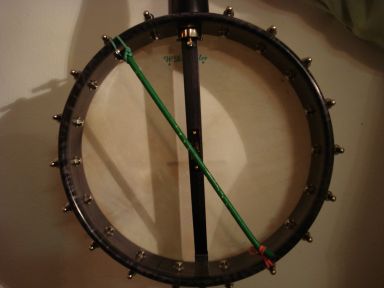 New Technology for keeping your skin head safe |
jbalch - Posted - 01/13/2011: 04:32:07
Don't wet it. Just tighten it a little.
I think Tom's approach is right. Keep the skin tight...and take steps to manage the humidity as much as possible.
Edited by - jbalch on 01/13/2011 04:49:53
tomberghan - Posted - 01/13/2011: 05:03:09
quote:
Originally posted by jbalch
Don't wet it. Just tighten it a little.
I think Tom's approach is right. Keep the skin tight...and take steps to manage the humidity as much as possible.
Hotrodtruck - Posted - 01/13/2011: 07:06:35
Has anyone tried to use Scotchguard, to make the skin more moisture resistant? (Not waterproof). I know that there is no foolproof way to completely stop the problem, but could this help? Scothhguard should not add a significant amount of mass to the head.
I haven't had a skin head on my banjo in over 30 years, so I don't know what else is out there to help with the problem of moisture.
Mike
spoonido - Posted - 01/13/2011: 07:47:22
You folks do know your stuff. I'm glad I posted the question. This morning the head is quite a bit tighter after moistening the center. I don't often moisten the head. This is perhaps only the second time. But it looked like it needed a little something more than just tightening the J bolts.
So what I've got from this is:
1. Keep the head tight.
2. When storing the banjo, remove the bridge.
3. Consult with the Banjo forum gurus!
tomberghan - Posted - 01/13/2011: 13:51:17
Personally, I would not use Scotchgard. I went to 3M's website. It has other chemicals in it. It is designed more to protect fabrics from stain.
Keep it simple use a leather water-proofing spray . . . for leather. It does not darken the skin. It will be undetectable to you. It does in fact help stabilize the skin. I always treat a new skin with it and the experts all reccomend it (i.e. Mister William Miller of banjoseen.com recommends leather water-proofing spray)
The Old Timer - Posted - 01/13/2011: 15:21:44
Use waterproofing leather boot spray, gently, to help it be somewhat more humidity resistant.
The old timers used to warm their banjo head up at the fireplace before playing.
Also, the famous internal electric light bulbs were to warm and dry the head. If you have a heat lamp you might shine that on it. Or use a hair blow dryer to warm/dry it.
Hard to believe a banjo head could be suffering from high humidity in January though, unless you're in the Caribbean.
fletch29 - Posted - 03/10/2011: 13:59:49
Hey Tom,
Which model Dampit is that? Looks like it's a nice fit for a 11" pot...
beenjammin - Posted - 03/10/2011: 19:46:07
"Hard to believe a banjo head could be suffering from high humidity in January though, unless you're in the Caribbean."
or Newfoundland, Canada.....British Columbia....anywhere near the ocean really.
tomberghan - Posted - 03/10/2011: 20:41:20
It's the Dampit for violin, not the viola.
Don't apply heat to your skin head. If you need to tighten it use the j-bolts. Only use heat if you have a tack head banjo and there is no other way to tighten the head.
As for humidity in Winter . . . Huh!?
I live in Seattle right next to Ocean water. The humidity DROPS on winter. I use to live in New Orleans, which is VERY VERY humid and in winter the humidity DROPS not rises. Use the Dampit in the winter months especially.
beenjammin - Posted - 03/10/2011: 21:03:46
"I live in Seattle right next to Ocean water. The humidity DROPS on winter. I use to live in New Orleans, which is VERY VERY humid and in winter the humidity DROPS not rises. Use the Dampit in the winter months especially."
well that's interesting, here it drops but not so much as to approach anything even remotely as dry as inland. its so wet mold is still an issue in the older houses...i use a dehumidifier mostly in the winter months and remove a bucket of water daily, its crazy. I'd thought seattle would share some of the weather patterns as B.C which is pretty wet.
that said...the skin head on my prust banjo is actually surprisingly stable. its given me a lot of confidence in maybe getting a better banjo with skin.
oh and thanks for the tips, i'll be remembering them.
Edited by - beenjammin on 03/10/2011 21:04:51
tomberghan - Posted - 03/11/2011: 03:51:34
>>>I'd thought seattle would share some of the weather patterns as B.C which is pretty wet.<<<
No, we are VERY similar (West Coast B.C. and West Coast Washington State) . . . Don't confuse precipitation (raining) with DEW POINT. We have buckets of rain day after day, just like you do . . . slugs all over the place, moss starts growing between our toes, etcetera . . . but the dew point drops in winter. When the air is colder it doesn't hold as much moisture.
My earlier comments were inaccurate . . . I should have made referrence to DEW POINT and not humidity.
But, to your ears, the difference between how your banjo sounds when the dew point is high versus low EQUALIZES at right around 3 beers or two ounces of whiskey. I have made a very scientific study on this point.
;-)
dculgan - Posted - 03/11/2011: 05:03:05
Just a quick note about silicone leather water-proofing: I play big minstrel style banjos at civil war reenactments in the mid-atlantic region all summer. Its humid, it rains a lot. I was skeptical about the silicone spray, for years and years I wouldn't try it. I thought it would be oily and dampen the skin and make it looser. I applied it to one of them and it was fine. I could notice a difference. After a while I might get up the gumption to apply it to my other banjo. Conservatively, D. Culgan
farmer bob - Posted - 03/11/2011: 06:37:02
Would blasting the head with a hair dryer tighten up a skin head?... Bob.
Helix - Posted - 03/11/2011: 07:12:23
First, I would want to know if that's your hat, or a canvas wig.

Edited by - Helix on 03/11/2011 07:15:19
dculgan - Posted - 03/11/2011: 07:16:06
Yes, very effectively. Just keep it in motion, keep one hand in the pot, touching the head, the rim, etc. to sense that its not too hot. One candle does not seem to work for me. Nor do I like kero heater (they put out a lot of moisture) or propane (same reason). Electric heat is very dry. Campfires work well too. In remote outdoor locations with no access to electricity, or a typical campfire, I frequently use a small charcoal brazier (looks sort of like a hibachi) just off stage when conditions permit. I'll light it well before a performance set to let it burn down some and stop smelling and can usually get an hour or two use before it needs refilled. As long as there is some dry heat there it will tighten a banjo head. Yes, I am putting these heads through a lot of stress this way I suppose but my performance requires a good bit of volume and a very tight natural banjo head. My bandmates will say I obsess over this and the banjo probably wonders what it did wrong to spend so much time in hell. Its the first thing I think about when I am at a new venue, how is the weather and what are my options if it is not optimal. Haven't singed it yet! And even though George puts a tampion in each ear whenever he hears me say it - this is a Wunder banjo.
Helix - Posted - 03/11/2011: 07:29:58
Here's a Maritime version, sorry it's so big, but I want you to see the Ebony tennis shoes under the bridge. That's for wet weather, you take them out when it's dry. Think New Orleans street musicians competing with fiddles, then it rains.
Notice the players of these noisy crickets really know their stuff.
I've seen a Boron player keep a damp rag during the gig. I would like to see that in super slow motion.
Great thread. ( ))='=::}
Edited by - Helix on 03/11/2011 07:33:10
beenjammin - Posted - 03/11/2011: 07:38:29
thanks for the clarification of terms Tom. I think maybe that points to why i'm so surprised at how stable my prust is in tone, despite its relative sagging or tightness. and if your idea of scientific study were shared by more we'd all be much happier people.
beenjammin - Posted - 03/11/2011: 08:06:53
yes Bodhran players use heat and damp towels to keep the drums in tune all the time. is a banjo skin head more sensitive to this than a drum?
tomberghan - Posted - 03/11/2011: 10:48:29
quote:
Originally posted by beenjammin
yes Bodhran players use heat and damp towels to keep the drums in tune all the time. is a banjo skin head more sensitive to this than a drum?

beenjammin - Posted - 03/11/2011: 11:00:03
i've been wondering why people seem to have not read the five times you've said that in this thread. I have and hence my question, since its seem to be totally acceptable to the bodhran crowd, but you're right most bodhrans are tackheads.
if you'll be patient while i ask a potentially naive question. how much risk is involved in overtightening? if you compensate by tightening the j-bolts then a sudden a dry spell hits the head (lets say overnight) are you seriously damaging the head any more than the occasional heat application?
dculgan - Posted - 03/11/2011: 12:07:10
Re. using the hardware the banjo came with to make head adjustments: the Boucher replica I posted about has 6 or 8 (forget which) hooks / nuts. They are small diameter brass, and are anchored to the single ply hoop with fabricated eye bolts. In theory they should be able to tighten or loosen the head but in practice they are not strong enough to pull the head down beyond a certain point. OK for seasonal climate adjustments, but not compensating for very humid weather. There is a lot of friction between the head and rim. This system is really more like a tackhead that's easy to replace a head on. Sure, I'd love to just pull out a drum key, its just not an option on some of these large diameter minstrel banjos with a low hook/nut count.
spoonido - Posted - 03/11/2011: 13:41:45
quote:
Originally posted by tomberghan
USE THE J-BOLTS TO TUNE YOUR BANJO HEAD!!!
tomberghan - Posted - 03/11/2011: 14:20:57
quote:
Originally posted by beenjammin
if you'll be patient while i ask a potentially naive question. how much risk is involved in overtightening? if you compensate by tightening the j-bolts then a sudden a dry spell hits the head (lets say overnight) are you seriously damaging the head any more than the occasional heat application?
tomberghan - Posted - 03/11/2011: 14:28:25
quote:
Originally posted by dculgan
Re. using the hardware the banjo came with to make head adjustments: the Boucher replica I posted about has 6 or 8 (forget which) hooks / nuts. They are small diameter brass, and are anchored to the single ply hoop with fabricated eye bolts. In theory they should be able to tighten or loosen the head but in practice they are not strong enough to pull the head down beyond a certain point. OK for seasonal climate adjustments, but not compensating for very humid weather. There is a lot of friction between the head and rim. This system is really more like a tackhead that's easy to replace a head on. Sure, I'd love to just pull out a drum key, its just not an option on some of these large diameter minstrel banjos with a low hook/nut count.
Frisco Fred - Posted - 03/11/2011: 15:26:02
Has anyone ever experienced mold growing inside the case when using a humidifier?
tomberghan - Posted - 03/11/2011: 16:35:32
quote:
Originally posted by Frisco Fred
Has anyone ever experienced mold growing inside the case when using a humidifier?
Frisco Fred - Posted - 03/11/2011: 17:33:53
Thanks for the advice Tom. As a shortgap method for preserving my fathers violin, I put some damp cotton in a baggie inside the case. When I checked it a month later it had some black mold in the cotton.
Got hygrometers in everything and I can tell you for sure that it gets mighty dry in those cases in the winter with the non-humidified, central heating is running.
I need a whole bunch of Dampits.
Ronnie - Posted - 03/12/2011: 13:40:43
My L&H calfskin head is over 100 years old and it never asked me for a drink.
Terms of Use | Privacy Policy | Privacy Consent (EU/GDPR Only)
Copyright 2026 Banjo Hangout. All Rights Reserved.


