
DVD-quality lessons (including tabs/sheet music) available for immediate viewing on any device.
Take your playing to the next level with the help of a local or online banjo teacher.
Weekly newsletter includes free lessons, favorite member content, banjo news and more.
Premier Sponsors


|
Please note this is an archived topic, so it is locked and unable to be replied to. You may, however, start a new topic and refer to this topic with a link: http://www.banjohangout.org/archive/191979
pfc54u - Posted - 11/19/2010: 06:00:34
This is a serious question, and I don't know the answer at all. Why are there typically so many hooks holding down the tension ring on a banjo? I know that historically there were banjos that had more than the current crop typically has. I know that some cheaper banjos have fewer hooks. Is the ring less rigid than I imagine it is? Are there local distortions in the ring and uneven head tension if fewer hooks are used? Is there some spreading the load issue? How screwed up would a banjo be if it only had, say, 6 hooks in total? How problematic is it that some standards of hook positions give more or less space for the neck and the tailpiece?
sunburst - Posted - 11/19/2010: 06:06:23
High quality drums often have 8 "lugs" (they correspond to the hooks on a banjo). I don't know where the tradition of banjos having so many hooks came from, using fewer would surely work to tension the head, though drum hoops are often stiffer and stronger than banjo hoops.
Beetle_bombshell - Posted - 11/19/2010: 06:19:37
As someone who is about to start making hooks and shoes by hand for a 16 inch cello banjo I await the definitive answer to this eagerly. Could save me a lot of time.
Jim D - Posted - 11/19/2010: 06:30:00
The purpose of multiple hooks is to provide even tensioning.
Someone on this forum... as I recall it was a luthier.... reported that his experiments showed it took only 10 hooks on an 11" rim to assure even tension around the perimeter.
Someone else suggested in the same thread that the modern day "standard" of 24 hooks is based more on achieving a "traditional look" ("Earl did it") than any functional practicality.
pfc54u - Posted - 11/19/2010: 07:10:53
Great answers. So it is looking like fewer than 24 is needed (for functionality . . . maybe not for looks) and that there may be a trade-off between the number of hooks and the rigidity of the hoop. I conclude this based on sunburst's answer regarding drums and on Jim D's response on previous experiments. Maybe if the hoop were beefed up, then 8 hooks would be sufficient to provide even tension. What do you think of that?
Are drum hoops steel? For a small drum, would the height and width of the hoop section be bigger than that of a banjo? I'm trying to tease out how you would go about beefing up a banjo hoop at reasonable cost and so that it would fit common heads. If you had to make the hoop taller, a tall head might be too short.
This morning I saw an antique banjo on ebay that might have had 48 hooks. It also seemed to have huge gaps for the neck and tailpiece. I'll admit that, from what I could see, it looked like the hoop was real flimsy. If they needed all those hooks for even tension, how could they leave huge gaps?
Bart Veerman - Posted - 11/19/2010: 07:14:54
Too few hooks and there's too much tension on the hook itself. This is problematic for the 16 hook budget banjos made in Asia - getting the head up to proper tension puts so much stress on the budget flat hooks that often they'll simply unfurl and slip off the tension hoop.
Tackhead - Posted - 11/19/2010: 07:37:21
quote:Does plastic or skin make a difference? Seems like fewer hooks with a skin head wouldn't be a big issue. For example, my Bowlin has 10 hooks.
Originally posted by Bart Veerman
Too few hooks and there's too much tension on the hook itself. This is problematic for the 16 hook budget banjos made in Asia - getting the head up to proper tension puts so much stress on the budget flat hooks that often they'll simply unfurl and slip off the tension hoop.
mralston - Posted - 11/19/2010: 07:49:56
This Pollman has 52 shoes & hooks, the most I've ever seen on a standard banjo pot, and definitely over-the-top. I think there was a period in time when some banjo makers got into a "my banjo has more hooks than yours" race. 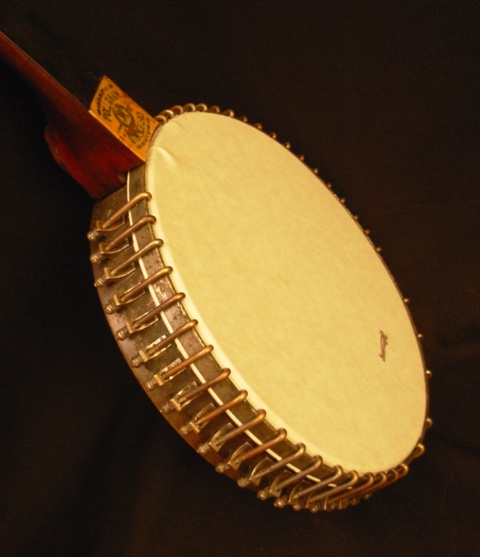
pfc54u - Posted - 11/19/2010: 08:26:20
quote:
Originally posted by mralston
This Pollman has 52 shoes & hooks, the most I've ever seen on a standard banjo pot, and definitely over-the-top. I think there was a period in time when some banjo makers got into a "my banjo has more hooks than yours" race.
pfc54u - Posted - 11/19/2010: 08:31:01
From what I can see on pictures, Nechville uses 18 integrated "hooks" plus whatever is going on under the neck. I suspect that there is no gap there. So what he has done is to make more competent hooks . . . I suspect that the hoop may be more rigid too, altho I have no real evidence for that.
timmo_1949 - Posted - 11/19/2010: 08:43:58
I should hesitate to enter this discussion. Theoretically, given a perfectly rigid tension hoop and infinitely strong hooks, you only need two. I have seen anywhere from 4 (very inexpensive skin head, gut string models ca. 1890) to 60 (see above).
From practical experience, I think 8 is the minumum for a skin head, gut string minstrel style banjo. If you are going to the modern Mylar head bluegrass type banjo, 16 will work fine with adequately strong hooks (for example, the older Goodtime models). Twenty-four is merely copying Gibson without any other thought put into it. Twenty-four and above looks cool, too. I've built some 28 and 30 bracket heads that look cool but it is overkill.
Flame away. Just remember, there is no right answer.
mikehalloran - Posted - 11/19/2010: 09:10:21
A grooved stretcher with flat hooks should have at least 24 hooks. This keeps the top of the hook from bending or breaking if you tension a modern head evenly. Small diameter and low tension minstrel type banjos need fewer hooks.
Notched stretchers use stronger round hooks so fewer are needed but try finding a notched band nowdays that doesn't have 24.
If you use those round hooks on a plain stretcher as many plain banjos do, you can get away with 8 on a 10"-11" pot.
Edited by - mikehalloran on 11/19/2010 09:13:28
leemysliwiec - Posted - 11/19/2010: 12:45:15
I suspect that the thickness of the head and the tension needed to get it to the players liking would also affect how many hooks are necessary. I could be wrong.
mike gregory - Posted - 11/19/2010: 13:10:11
Fewest I recall seeing, was six.
And, as was previously mentioned, there was a time when the makers were trying to convince the buyers that (more hooks)=(more quality).
Which resulted in some very nice looking banjos.
The Old Timer - Posted - 11/19/2010: 13:50:37
There are photos of real old time home made banjos with 4 hooks, held on with old hand made wing nuts!
As Ralph Stanley said in his book, in the old days of commercially made banjos, as from catalog sellers, somehow the marketing buzz was "the more brackets, the more valuable".
Mechanical engineering wise, if you know the stiffness of the tension hoop, and the tensile strength of the bracket hook bends at the top (that's the weak spot, I've broken 'em off) you could easily calculate how many are "needed" to exert X pounds of tension on the head. without deflecting too much or breaking.
rudy - Posted - 11/20/2010: 05:51:36
Good information here. The info on flat hooks given in previous posts is spot on, and one of the reasons I prefer the round hooks on a fairly substantial notched tension band.
I've settled on 16 hooks on a notched tension ring as my preferred number because it allows equal spacing around the rim that leaves enough room between shoes for the neck heel. I feel that this is important if you are trying to achieve equal tension on the head without the larger gaps necessary with a higher number of hooks. It also provides plenty of tension on any type of head without fear of straightening the hooks.
I'm pretty confident that many of the early banjos featuring large numbers of hooks did so for marketing reasons. "More is better" is part of our culture. Those of you old enough to remember the early days of the "modern transistor radio" will remember the ads that prominently boasted about the large number of transistors in their particular brand. One of the hobbyist electronics magazines exposed them when they reviewed the claims and found that many manufacturers installed non-working transistors in their radios to fulfill the letter of the law relating to their claim.
I promptly disassembled my new "21 transistor" radio and noticed that many of them had red dots on the top of the transistors. Upon close inspection I found that these marked components had all three leads soldered to the same pad on the circuit board. They had cleverly found a way to actually market and sell defective components to the unsuspecting consumer!
I wonder if these early radio manufacturers studied banjo marketing to see how they could boost their sales and make their product more desirable over their competitors.
Maybe we’ll see our car makers go back to the “Who has the largest fins” competition. This time around they can claim advanced “aerodynamic properties” instead of purely esthetic reasons.
pfc54u - Posted - 11/20/2010: 07:35:34
I agree with Rudy that 16 provides for enough space for the neck, any neck including my wide strat necks, with about 2.25 inches between hooks. I'm not home now so I can't measure the neck space between hooks on a standard hoop . . . isn't it around 2.25 inches? Even spacing for 16 would clearly take care of my complaining about how it is that even tension is desired yet the old banjos frequently left big gaps for the neck. Of course, this could be said of even smaller numbers too, altho Timmo 1949 indicates that 16 is the minimum for a modern head. I think that what I will do is to experiment the next time I put together a pot (it should be in a week or two if I get off my duff). It will have 24 slots in the hoop. So I'll try 8 and 12 hooks to see if I cannot eliminate variation in head tension using a drum dial gizmo. mikehalloran thinks I can get away with 8. I'll hold tension constant at some level. I assume that this would be an appropriate test. Altho I would not be able to say that what can be gotten away with at 88 on the drum dial is also true at 92 and so on.
Obviously, if one wanted to actually produce a banjo with non standard number of slots for hooks, it would be necessary to invest in some machining. I'll bet there are people on this site who could do it.
Timmo 1949 cracked me up with "given a perfectly rigid tension hoop and infinitely strong hooks." This sounds like an economist.
Rudy, I had one of those multi transistor radios that I could listen to in my bedroom when I was supposed to be asleep. It was a Zenith, I think.
rudy - Posted - 11/20/2010: 11:57:33
quote:
Obviously, if one wanted to actually produce a banjo with non standard number of slots for hooks, it would be necessary to invest in some machining.

chadp - Posted - 11/21/2010: 09:17:24
i think i remember someone on here saying that the more brackets you have, the less a calfskin head will slack up in humid weather. can anyone confirm or deny this?
pfc54u - Posted - 11/21/2010: 10:37:34
quote:
Originally posanted by chadp
i think i remember someone on here saying that the more brackets you have, the less a calfskin head will slack up in humid weather. can anyone confirm or deny this?
Klondike Waldo - Posted - 11/21/2010: 17:07:21
quote:
Originally posted by pfc54uquote:
Originally posanted by chadp
i think i remember someone on here saying that the more brackets you have, the less a calfskin head will slack up in humid weather. can anyone confirm or deny this?
I'll comment here without actually knowing anything. Some of the old banjos with oodles of hooks and which were likely to have skin heads also sometimes had huge gaps in the hooks for the neck and the tailpiece. If anything might cause the head to pucker up, I would think these gaps would do it. And yet we see this configuration over and over. I don't know what to make of it.
mralston - Posted - 11/22/2010: 02:48:26
Klondike -
The wrinkle in the head is due to my installation, not due to the banjo or # of hooks. That's a Yellowstone head and, if I recall correctly, the wrinkle eventually pulled (mostly) flat after some wrestling. The spacing between most hooks is about 3/4", and the hooks are 3" apart at the neck. In the picture, there is also a hook missing near the neck, which makes the gap look wider.
A 3-inch gap should be no problem for a skin head with a good flesh hoop and tension hoop, or a plastic head with an integral flesh hoop. The Yellowstone heads are more difficult than skin to install and definitely more prone to wrinkles than skin.
I mostly agree with Timmo about the least # of hooks needed, although I would say that the least numer is 3 (so that the tension hoop can't tip to one side). The hooks force the tension hoop down onto the flesh hoop, which pulls the head tight against the pot. If a poor-fitting, un-joined (i.e., un-welded) flesh hoop is used, then there is a potential for a gap in the flesh hoop and unequal tension on the head, which could cause a wrinkle. If the tension hoop is a poor fit to the banjo, then the flesh hoop can pull up under the tension hoop, which can result in a wrinkle. If a round cross-section flesh hoop is used, then the head can slip over the flesh hoop. Some people used tape or other material to make the flesh hoops grip better. Vega used square cross-section brass flesh hoops, which grip better than round cross-section hoops.
The number of hooks changes the mass of the pot, changes the ratio of metal to wood, changes how the pot vibrates, and changes how the head vibrates on the pot. I suppose that there may be a slight difference in sound with more hooks, but my ear isn't good enough to distinguish a definite difference.
I view the # of hooks as "bling". I like the look of the old, primitive banjos that have fewer than a dozen hooks. I also like the look of the over-accessorized banjos with more than three dozen hooks.
Chuck Lee - Posted - 11/22/2010: 07:14:34
I have tested hook counts down to 10 hooks on a 12" rim without any concerns of any kind. I believe high hook counts fill into "if one is good, two has to be better" and used as a sells tool. I have used 14, 18, 20, 24, 26 and 28 hook counts. All work fine in my opinion. Today, I am using 18. Don't know what I will do next year. It's no fun doing the same thing over and over again.
Chuck Lee
ChuckLeeBanjos.com
pfc54u - Posted - 11/22/2010: 09:11:31
[/quote]
I do it pretty easily without a heavy cash outlay in machinery. A fine tooth hacksaw and a good file will do wonders. It doesn't hurt one bit to make the tension band notches with an angled flat bottom as that matches the shape of the inside bend of the J hooks after they are formed. The notches formed in the tension bands shown below are made that way.
[/quote]
Rudy, where do you get the unslotted hoops. If you make them, do you start with flat stock and weld them. TIG or ox-acet? What sort of gear do you use to get them round?
By the way, I like your curved-slotted jig in the vise.
pfc54u - Posted - 11/22/2010: 09:50:44
Is the slotting of the hoop a cause of the need for more hooks. I am suggesting here that slotting . . . let's say removing approximately 20% of the material measured vertically and at the top and not, say, in the middle . . . causes the hoop to be less rigid.
What I am learning from all this discussion is that fewer hooks can work. This view is pretty much across the board. I am especially heartened by those who have done actual testing and/or incorporating their views on this subject in their banjos.
vintagewells - Posted - 11/23/2010: 07:24:15
That 52 bracket banjo seems to have a thick tension hoop, which is, in my opinion necessary. Many older spun over rims with lots of brackets have a wrinkle in the spun over metal, caused by the wooden rim shrinking/compressing by the pressure of so many hooks.
I have one with 30 and one with 36, and I just like the looks of them.
One of these days I will get the brackets, nuts, shoes and tension hoop replated. Tone wise, it has a really pleasant tone.
I like the idea of 16 brackets for the even spacing. I really think that having a good solid tension hoop is essential, no matter the number or type of brackets.
I have some stock that in too thin and ran into trouble with it warping. Lesson learned.
Lorna
frianm - Posted - 11/23/2010: 08:03:19
In the FWIW I believe that a significant issue was the material used for the hooks. I had an old SS Stewart with brass hooks so a similar banjo might need more hooks so as to share the tension. Many of the old brass ones had been overtightened and this was a 24 hook setup. They had to be replaced. I have an older banjo now with 48 hooks - it shares the load and would do well with brass hooks tho actually it has steel ones.
pfc54u - Posted - 12/01/2010: 16:46:17
I promised to report on an experiment regarding the number of hooks. I ran a simple version of the experiment today. I considered only the case of 8 hooks using a standard hoop. So I cranked up the tension on those 8 hooks until I got a reading of 88 on the drum dial and an approximate G# from my imperfect hearing. (The head is an amber elite) I could not detect any variation in tension beyond the width of the pointer on the drum dial, however I must admit that those 8 hooks were working real hard. So I left the thing alone for a few hours, came back and used the drum dial all the way around again. I got the same readings as before . . . no significant variation. My conclusion is that even tension can be produced with very few hooks (8 in this case). The problem is that conventional hooks may not be strong enough to stand up to the load. They were squealing when I tightened them or loosened them for that matter.
Chuck Lee - Posted - 12/02/2010: 06:06:36
Thanks Peter...I only tested down to10 hooks and wondered about testing down to 8 hooks.
Chuck Lee
chuckleebanjos.com
Terms of Use | Privacy Policy | Privacy Consent (EU/GDPR Only)
Copyright 2026 Banjo Hangout. All Rights Reserved.


