
DVD-quality lessons (including tabs/sheet music) available for immediate viewing on any device.
Take your playing to the next level with the help of a local or online banjo teacher.
Weekly newsletter includes free lessons, favorite member content, banjo news and more.
Premier Sponsors


|
Please note this is an archived topic, so it is locked and unable to be replied to. You may, however, start a new topic and refer to this topic with a link: http://www.banjohangout.org/archive/160635/2
Page: 1 2
tomberghan - Posted - 10/23/2009: 09:10:18
Lyle is exactly right . . . with regard to transposing to banjo-friendly keys (for playing solo, not necessarily in the fiddle-friendly key) you can transpose the tune the old fashioned way by hand, or you can use free online software. Example: The tune is written in D-Major with two sharps but you want it in C-Major with no sharps. This software will do the job for you.
http://www.ibiblio.org/fiddlers/
People who sight read really, really well (not me) can transpose at sight (instantly). That is because they are seeing the intervals more than they are seeing the notes.
But don't let all this scare you. Hundreds of the tunes in these books are just single line melodies and after you have read through a few tunes in D major you will quickly start to learn where the notes are on your fret board.
I really liked what Joel (deuceswilde) wrote!
Edited by - tomberghan on 10/23/2009 09:12:10
R.D. Lunceford - Posted - 10/23/2009: 10:02:37
The thing to keep in mind with fiddle tunes is that there is a specific key they need to be played in if you have any idea of playing with fiddlers at some point. In OT stringband music, the primacy of the fiddle is a given. The specific key requirement is one factor in the evolution of alternate tunings for the banjo, and a capo can make life easier as well ( though only as an aid to keep from tuning up from gDGBD to aEAC#E, etc. In my opinion you should not be using a capo above the 2nd fret. The purpose of the capo is not to replace the alternate tunings). Of course you can set the tune in whatever key if you want to solo on it.
Myles Krassen authored two books- "Appalachian Fiddle" and "Clawhammer Banjo", printed by Oak Publications. They are companion books. Most of the tunes in the fiddle book are also in the banjo book. In comparing the two, you may see how one may take a fiddle tune and set it for CH banjo. The fiddle book is in standard musical notation and the banjo book uses tablature. According to the author, the banjo parts are typical of CH banjo as played in SE West Virginia and the Galax area. He cites Wade Ward, Franklin George, Glen Smith, and Kyle Creed as the main influences on the settings. He also mentions Franklin George as the biggest influence on his fiddling. The settings in the fiddle book are overwhelmingly single-note melody lines with the occasional drone or double-stop added.
As a general statement, I'd like to mention that learning everything in one tuning (gDGBD) is to be discouraged.
R.D. Lunceford- "Missourian in Exile"
Model 1865 Bowlin Fretless Banjo
****************************************************
"Drink from the Musselfork once, and you'll
always come back." -Dr. Bondurant Hughes, 1917
trapdoor2 - Posted - 10/23/2009: 11:07:51
quote:LOL
Originally posted by R.D. Lunceford
As a general statement, I'd like to mention that learning everything in one tuning (gDGBD) is to be discouraged.


tomberghan - Posted - 10/23/2009: 12:24:09
Uh . . . well yes Marc . . . we will "exempt" Jens Kruger and Bill Keith from our advice!
(you goof ball!)
BrittDLD1 - Posted - 10/23/2009: 13:40:42
Kind of amazing...
Except for Deuceswild's, round-a-bout mention of 19th C banjo, I find it hard to
believe that -- after quickly scanning 3 pages of text, about reading notation --
nobody SPECIFICALLY mentioned the CLASSIC banjo, The American Banjo Fraternity...
http://www.classicbanjo.com/
OR --- Rob MacKillop's own website:
http://www.classicbanjorm.com/
???? Possibly the strangest discussion I've ever seen, here.... (from the point of
omitting the obvious...)
But... while I've been a member of the ABF for about 35 years (currently in
poor standing...) -- I don't actually indulge in reading notation. But I do
wish I could.
Somewhat like OWC, I have some numerical dyslexia -- which has gotten
somewhat worse, lately... I've tried learning notation a number of times --
but it never really "took".
A side note:
I found I COULD read melody lines easily and directly from notation -- on an
English Concertina. The left hand is the lines, the right hand the spaces.
You just march up and down -- without having to mentally "translate" much of
anything. Except the length of each note. (Odd keys, with lots of sharps and flats,
are a problem...)
Otherwise, I found it quite amazing... from a "Human Factors" point of view.
(And the English Concertina's two-handed keyboard-layout has actually been "reinvented"
several times, over the last 30 years... As a "NEW" "innovative" keyboard for computers...)
Best-
Ed Britt
••• A good fiddle tune will bring two or more people together who might otherwise be enemies. •••
R.D. Lunceford - Posted - 10/23/2009: 13:49:21
quote:
Originally posted by tomberghan
Uh . . . well yes Marc . . . we will "exempt" Jens Kruger and Bill Keith from our advice!
(you goof ball!)
 Yeah, it's probably all they can do to keep in tune in one tuning
 trapdoor2 - Posted - 10/23/2009: 17:39:48
quote:That's because you've learned to skip over my posts over the years, Ed.
Originally posted by BrittDLD1
Kind of amazing...
Except for Deuceswild's, round-a-bout mention of 19th C banjo, I find it hard to
believe that -- after quickly scanning 3 pages of text, about reading notation --
nobody SPECIFICALLY mentioned the CLASSIC banjo

majikgator - Posted - 10/23/2009: 18:15:26
well yes reading melodies is easy enough but if you want to know how something is played on a banjo, guitar or any strung instrument excluding piano standard notation is sadly lacking, where is a middle C on a banjo, guitar, mandolin or fiddle, more like which middle C. Tab though imperfect and can use additional notation itself to be truly descriptive gives a much clearer picture of what is being played. as far the ear, nothing is more valuable than a trained ear and listening to whatever musician you are playing with fiddler or other is essential. nothing wrong with learning to read standard notation and if that is the only source you have then great use it, i certainly would not want to teach banjo or guitar using it though. My only problem with the other thread is that is listen to the fiddler becomes follow the fiddler which is ok but let the fiddler follow the banjo player sometimes too
jk
BrittDLD1 - Posted - 10/23/2009: 22:15:21
quote:Marc--
Originally posted by trapdoor2quote:That's because you've learned to skip over my posts over the years, Ed.
Originally posted by BrittDLD1
... I find it hard to believe that -- after quickly scanning 3 pages of text, about reading notation --
nobody SPECIFICALLY mentioned the CLASSIC banjo
Paul Roberts - Posted - 10/23/2009: 23:48:50
Regardless of what instrument one learns to read music on - 5-string, tenor banjo, trumpet, ukulele, concertina, tuba - the fact that one CAN read music means one has tons of tunes to pick from; it's a way to dig through vast amounts of musical information very quickly. It's groovy when a tune I haven't heard, jumps off the page and starts dancing around through my fingers - just because it's so happy to be liberated from a page in a book.
"Free encrypted melodies!"
Pablito
http://www.banjocrazy.com/ all Gold Tone instruments for sale
http://www.youtube.com/user/strumstering my YouTube channel
Couchie - Posted - 10/24/2009: 05:16:36
I would think that once you can learn to read music, it is only a short hop to applying it to just about any instrument that you care to play, including the banjo.
Don.
O=='=(::}
http://www.doncouchie.com
BRUNO25 - Posted - 10/24/2009: 05:26:11
It doesn't sound to me like any of our 'notation supporters' are suggesting that notation is anything more than another good tool to have in your bag. I don't believe it has been suggested that it would be a good way to 'teach' banjo. But for someone who is already fairly accomplished, it can be a useful way to get at a tune.
I'm thankful for tab. I probably couldn't have ever started playing banjo without it. But, I kinda hate using tab now. It sorta makes me crazy. Well, it makes me crazy to try and play a tune the way it is written. None of us really approach a tune quite the same way. So it might feel more right for me to do a pulloff when the tab is asking me to play the 5th or drop-thumb or whatever.
Whenever I use tab now I really try and read around all the crap and just get the melody out. Then, once that melody is in my head, fill out the tune my way. I barely understand notation, but I think, it might more clearly give me what I want when learning a tune; the melody and not all the techniques. I'm gonna try and learn how to read it and see, anyway. The more I learn about music the more I feel that it doesn't hurt to learn and understand as much as you can handle, when you can handle it.
Dan Levenson's 'Festival Tunes' book offers both tab and notation. That might be a good way to play around with the two approaches. Think I'll give it a try.
Interesting topic, Tom. Thanks for lighting the fire.
John
tomberghan - Posted - 10/24/2009: 08:21:16
John writes: "Think I'll give it a try"
Excellent John! I want to see you (and others) build some confidence, so try this first. Tune your banjo in double-C. Then give this a try. To get you started, the last note is your 4th string open. The music begins 4th string/4th fret.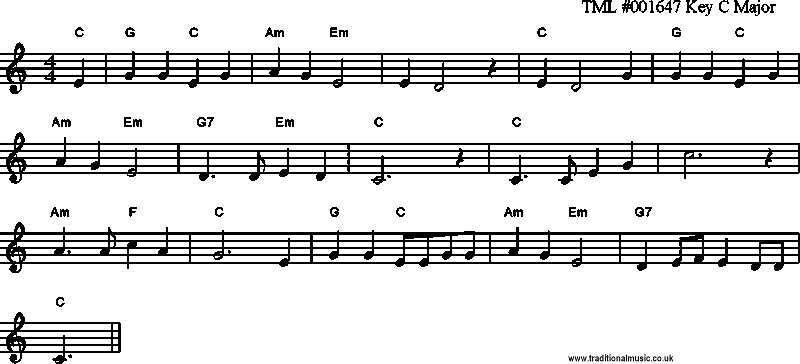
See? Its a piece of cake!
Now, add some Clawhammer like you know how to do. Then make your own version. Also - you don't "have" to play those eighth notes. You don't need to totally obey the staff notation anymore than you have to obey the tab!
Edited by - tomberghan on 10/24/2009 08:31:00
janolov - Posted - 10/24/2009: 08:36:14
That was a good piece of cake!
Sometimes I think I am a little tone deaf. However sometimes I can hear the music from notation (and tablature). I took only a few bars to hum the melody and identify it (without the banjo). Doo-da doo-da!
.
Jan-Olov
Paul Roberts - Posted - 10/26/2009: 13:45:17
From the perspective of using a 4-string tenor tuned like a fiddle/mandolin, but an octave lower,
the importance of reading standard notation really kicks in. There's more than a ton of material out there, easily accessible through written music. There are only a certain number of notes - not that hard to memorize what they are and where they are on a 4-string tuned in 5ths.
Pablito
http://www.banjocrazy.com/ all Gold Tone instruments for sale
http://www.youtube.com/user/strumstering my YouTube channel
Page: 1 2
Terms of Use | Privacy Policy | Privacy Consent (EU/GDPR Only)
Copyright 2026 Banjo Hangout. All Rights Reserved.


