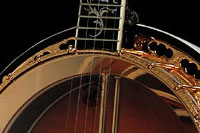
Hello Deering owners. I have a Deering Golden Era 2006, I think. I love it, however, when I add the capo at the second fret for playing in A, I always have to re-tune the 5th string as normal, but I also have to re-tune the 3rd and 2nd string. Why? I recently put on a new boot for my capo thinking it might help, but it didn't. So I am thinking it must be a fret issue. It looks like the fret has some wear. Does anyone have any suggestions? Is this a common for this model? Help! Serial Number: 05140507 K299
10 Comments |
 | Tatersoup says:
6/15/2013 10:30:30 AM
What a great question. It could be a couple of things.
First is that unless the banjo has a compensating bridge then the 2nd and 3rd strings won't be perfectly in tune up the neck.
Second is it might be the method you use to mount the capo. I used to place mine about half way between the frets and had the same problem as you. I started putting the pad of the capo "on" the fret and it made a huge difference as far as staying in tune. Also keep in mind you don't need the capo very tight at all; its only job is to hold the string below the fret.
|
 | RUSTYSTILL says:
6/15/2013 10:47:21 AM
Hi Bill, First, check where you are putting your capo and that your capo's surface that hits the strings is even, level and has no gouges in it, making sure it's straight and not too tight, just enough for strings to make a clean sound against the fret. When strings get pulled hard behind the frets they can stretch more and that tightens them, the same as if you tightened with the tuner. If the capo surface is not even it can also pull each string unevenly.
Next, check the intonation of your neck. Play a harmonic at the 12th fret and then finger the note at the 12th fret (5th string use the 17th fret). The two pitches should be EXACTLY the same. If they are not, and similar difference occurs on each string then your bridge is out of position. Move it towards the neck to raise the harmonic pitch, toward the tailpiece to lower the harmonic pitch. If only one or two strings are out then some compensation on the bridge top might be necessary or some adjustment to the neck.
Do you have a 5th string capo or a spike at the 7th fret?
Getting necks set up properly is a common job for luthiers on guitars, even ones fresh from the factory (yes, even Martins often come from the factory poorly setup and I suspect Deerings are no less likely to come with poor setups). If you are not happy with the intonation of your banjo, taking it to a luthier you trust for an evaluation is time well spent.
Jim
|
 | Bill Barker says:
6/15/2013 10:50:44 AM
Thanks for the help, I tried mounting the capo on the fret and it didn't seem to help much at all. Any other thoughts?
|
| Bill Barker says:
6/15/2013 11:29:23 AM
@Rusty. Thanks for some good input. I will try all your suggestions. I am intriqued about the intonation. PS: I use spikes for the 5th string capo.
|
 | rhnewsome says:
6/15/2013 1:50:17 PM
Check the location of your bridge, and also, check the height of the strings as they exit the nut. It the strings are too high (the slots in the nut not cut deep enough) it can cause the capo to stretch the strings too much. Check the height of your action in general. The lower the action, the less stretch. Good luck......
|
| Bill Barker says:
6/15/2013 2:44:56 PM
@rhnewsome. thanks will check it.
|
| Bill Barker says:
6/15/2013 3:02:08 PM
@all you players. Thanks for all your input. Problem is now resolved. Your help has caused me to re-check several things. BTW, I am using a Intelli tuner IMT 500 Tuner. I have done several tweaks. The intonation check was good. I loosened the tailpiece about 1.5 turns. During this time, I noticed that as I moved the Capo up the neck, fret by fret each note was consistently sharp by about 10-15 mhz. I then re-tuned my open G as precise as I could during a heavy rain storm and guess what? IT CURED THE PROBLEM, which means, my open G tuning was off 5 mhz, the capo stretched it higher. It is amazing being off even 5 mhz in open G can do. I hope others can learn how important it is to be precisely at the right freq. before using your capo. I might consider switching to a snark which is a little easier to read (at least for me). Thanks again my banjo friends.
|
| Tatersoup says:
6/15/2013 5:01:27 PM
A Snark is indeed a very good thing.
|
| Bill Barker says:
6/15/2013 7:37:08 PM
Thanks Tatersoup. They seem to be pretty popular these days. Are they more accurate?
|
| Tatersoup says:
6/16/2013 3:51:58 AM
I have an SN-8 model and like it a lot. I doubt it is any more accurate than any other clip-on tuner but I do like the display.
|
Post a Comment
|
You must be logged in and a member of this group to post a comment.
|