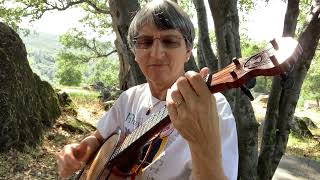
The Goods
1941 (Aug., Recorded by Alan Lomax at Galax, VA)
From archive.org, so not guaranteed to prersist
https://www.youtube.com/watch?v=Vjb1GNXzpmo
1958 (recorded by Eric Davidson at Ward’s house) Released as the LP “Uncle Wade”
https://www.youtube.com/watch?v=-9rYoWZgVMI
Liner Notes at https://folkways-media.si.edu/docs/folkways/artwork/FW02380.pdf
1959 (June, recorded by Peter Hoover at Ward’s house)
https://fieldrecorder.bandcamp.com/track/chilly-winds-2
1959 (Aug. 31, recorded by Alan Lomax at Ward’s house)
Three recordings of Chilly Winds at: https://archive.culturalequity.org/solr-search/content/grid?search_api_fulltext=Chilly%20Winds (ID yourself as human for the three takes).
1966 (Aug. 12-13, recorded at the 30th Annual Galax Old-Time Fiddler’s Convention)
https://www.youtube.com/watch?v=bWijzeSel1U&list=RDbWijzeSel1U
Jan. 18, 2018 (a 12-13 year old Nora Brown at the Jalopy Roots and Ruckus, Brooklyn, NY)
“Fred Cockerham’s” Chilly Winds (originally from Carlie Holder via Tommy Jarrell)
https://www.youtube.com/watch?v=8uZkES3RKPo&list=RD8uZkES3RKPo
Tommy Jarrell’s Chilly Winds (Mike Seeger on guitar)
https://www.slippery-hill.com/content/chilly-winds-0
The Tune
There have occasionally been Wade Ward TOTWs (notably, the 31st TOTW [2/20/09] was “John Lovers Gone”), but “Chilly Winds”, Ward’s iconic tune, has never made the list. tunearch.org gives some excellent information on Chilly Winds but is a bit telegraphic in the information it provides. Wade Ward’s “Chilly Winds” is rather different from “Fred Cockerham’s version,” both of which are described in tunearch. org According to Tommy Jarrell, Jarrell learned this version from Carie Holder, an earlier generation Round Peak fiddler who was never recorded. My rather uneducated guess is that this was Charles Franklin Holder (1885-1941) who was from Mount Airy and whose mother was a Cockerham. From Jarrell the tune was picked up within the Round Peak domain, and consequently widely spread across the US. tunearch.org also states that Chilly Winds is “a version of "Lonesome Road Blues," recorded by Ward on a 78 RPM for OKeh records, but not released.” The information here is from the liner notes (see notes for second CD, Track 5) for Mike Yates (2002) two CD set "Far in the Mountains". The OKeh recording of Ward's Chilly Winds Yates was referring to is from a (ca.) Sept. 1, 2025 recording seesion in Asheville, NC. At the session Ward recorded four tunes including Chilly Winds, but none of these recordings were released, although one was released a century later as part of a compendium. The liner notes for the compendium indicate that "Regrettably, the surviving test pressing of “Chilly Winds” is heavily damaged and
of such poor sound quality that we decided against its inclusion here." That is unfortunate as, from Mike Yates' linear notes, Ward did sing on this recording of Chilly Winds. Ward had suffered from whooping cough and as a result he sang very rarely, and the 1925 recording seems to be the only one where he ever sang to Chilly Winds. Regarding the relationship between "Chilly Winds" and "Lonesome Road Blues/Goin' Down the Road Feelin' Bad" (see Jan Olav's excellent TOTW posting), there are certainly a lot of lyrics that are shared with versions of "Chilly Winds," so it would be useful to know what Ward sang in 1925.
Of the 11 *.mp3s that are at the hangout, only one is Wade Ward’s version. Maybe there will be some more *.mp3s of Wade Ward's version in the offing. Ward learned Chilly Winds when he was 14 years old on a trip to Tennessee with his older brother Crockett (see https://musicofourmountains.com/wade-ward/ for that information and for much, much more about Wade Ward). This means that Wade Ward would have learned this tune around 1906 when he had only been playing banjo for about three years. Ward played Chilly Winds using bar chords (or parts thereof) at the 5th and 12th frets, something unusual among his banjo tunes. With that said, there are elements to his playing of Chilly Winds that are typical for other of his tunes (such as alternate string pull-offs). Regarding the key (G or A) Ward used for Chilly Winds, Charles Faurot on page 6 of Carlin and Levenson’s “Wade Ward: Clawhammer Banjo Master” publication wrote that:
“Wade never used a capo. Furthermore, he never seemed to be pitched to standard A=440. What I used to do was tune one string to the key Wade was playing in, e.g., third string up to match Wade’s third and tune the other strings to that.”
Incidentally, Ward used "gDGBD" when playing Chilly Winds. The quotes are because his fifth string was tuned anywhere from 382 Hz to 455 Hz (more on that below).
Now for the deep dive regarding whether Ward played at more moderate tempos and then the recordings were sped up. Also, how consistent was he in his tunings, given Faurot’s comment above? First, for the simpler part, which is BPMs for Chilly Winds:
Uncle Wade album: 139 BPM
Lomax first recording: 132 BPM
Lomax second recording: 129 BPM
Lomax third recording: 132 BPM
1966 Galax recording: 136 BPM
1941 Galax ecording: 139 BPM
Hoover recording: 127 BPM
I see no evidence that the recordings were sped up. He really played that fast. The BPMs are too consistent across recordings to suggest that they were all sped up. As to the fast pace, Phil Jamison’s text states on page 23 that: “Southern dance figures are not timed to the musical phrase, the music can be fast—sometimes as fast as 140 beats per minute.”
What about the pitch? Below are the keys he was playing in including "cents." There are 100 cents in a semitone, so an A# -46 cents is about half-way between an A and an A# (or 54% sharp of an A)
Uncle Wade: A# -42 cents
Lomax (all 3 takes): A -28 cents
Hoover: G -42 cents
1966 Galax: A +20 cents
1941 Galax: A# -46 cents
He was internally consistent on his tuning, in that he didn't have strings that were out of tune with each other. But he wasn't tuning to any standard.
The Banjo
Much has been made of the fact that Wade Ward played a Gibson RB-11 banjo. His banjo is in the Smithsonian collection, so you can get a good look at it. I had long pondered over the markings on that banjo’s head. They are written on the underside of the head, so I mirrored an image and was able to see that what is written are parts of three dates: July 1935, Dec 1954, and Aug 1963. I have “parts of” because the rest of the information is obscured by where the thumb was hitting the calfskin by the fifth string. Roger Siminoff’s site gives a very complete history of Gibson banjos, and he notes that the Gibson model 11 line was introduced in 1931. The Smithsonian information indicates that Ward’s banjo was made “around 1935” which I assume was taken from the July 1935 date on the underside of the head.
Why “model 11”? This Gibson line had an 11” rim, so that part is easy. The complete line included:
Gibson RB-11 (RB = “Regular banjo”, 5 string with 22 frets and 26.25" scale length)
Gibson PB-11 (PB= “Plectrum banjo”, same as RB but without 5th string)
Gibson TB-11 (TB = “Tenor banjo,” 19 frets, 22 & 7/8”)
Gibson MB-11 (“Mandolin banjo” [banjolin])
Having been introduced near the beginning of the Great Depression, Gibson wanted a relatively cheap line that was the “flashiest five-string banjo made” (from their 1935 catalog) and that sounded (relatively) good. To cut down the price but go for that flashy look, Gibson used perloid (“mother-of-toilet-seat”) on the fretboard which had been silk-screened with red and black ink for position “inlays”. For the fretboard they tended to use maple rather than the more traditional ebony or rosewood so that the dark color of those woods would not show through the white perloid. The peghead overlay was similarly treated with silk-screened perloid so that again there was no need for inlays. The back of the resonator also received the silk-screened perloid treatment, which was formed first and then treated so it could be applied to the convex back of the resonator. The wood then received a dark blue treatment. Opinions vary on whether this was to make the banjo “flashier” or to cover flaws in the wood. Incidentally, Wade Ward’s RB-11 was in remarkably good condition given how long he played it. The dark blue finish on the Gibson model 11 line was notorious for flaking and wearing away, especially on the back of the neck. Ward’s banjo had a tiny flake missing near the heel on the first-string side, but that's it.
The Man
Benjamin Wade Ward (Oct. 15, 1892-May 29, 1971) was the nineth of nine children of Enoch David Ward and Rosamond J. Carrico. While Enoch Ward played fiddle, Wade Ward learned to play music from his older brother, first born David Crockett Ward (Feb. 9, 1873-Apr. 23, 1964). Wade started playing banjo at age 11 and fiddle at age 16. This means he started playing banjo around 1903. What was the first banjo Wade Ward had? There is no way to know. My guess is that it was a mail order banjo. Grayson Co., VA was certainly remote at this time, but mail order was still a possibility. I bring this whole issue of Ward’s first banjo because of this quote from https://musicofourmountains.com/wade-ward/: “When Wade was 14 he traveled to Tennessee and saw for the first time “chording” and picked up the tune “Chilly Winds” from local musicians there.” The (partial) bar chords that Ward used at the fifth and particularly the twelfth fret would have been difficult if he was playing a homemade fretless banjo. Maybe he played a fretless banjo when he started playing at age 11, was inspired in Tennessee by seeing someone play Chilly Winds with bar chords up the neck on a fretted (?) banjo, and then later acquired a fretted banjo. We will never know for sure.
There is so much information available about Wade Ward on the net that I'll just pass along some links (https://www.culturalequity.org/sites/default/files/2018-06/WavetheOceanBooklet.pdf , see Side 1, A1, https://country-music.fandom.com/wiki/Wade_Ward, https://folkways-media.si.edu/docs/folkways/artwork/FW02380.pdf , https://musicofourmountains.com/wade-ward/ , https://banjonews.com/2012-03/wade_ward_clawhammer_master.html, https://banjonews.com/2021-08/wade_ward.html ). If you want to see a video of Wade Ward playing banjo you are pretty much out of luck. There is a brief video of him playing the RB-11 at Galax:
but the music on this advert is not what the band is actually playing.
There is an incredible amount of Wade Ward’s music online, with solo or with his bandmates in The Ballard Branch Bogtrotters and The Buck Mountain String Band. If you come across The New Ballard Branch Bogtrotters, they are the real deal with Eddie Bond on fiddle and Josh Ellish on banjo. All of the Roscoe Holcomb and Wade Ward LP is available on YouTube and liner notes are available. Walt Koken’s Wade Ward tribute is definitely worth a watch. You won’t hear Wade Ward himself, but Koken plays back performances he (and Highwoods for one song) did of Wade Ward tunes. You can also get a view of Koken’s massive collection of CDs. And all of Alan Lomax’s recordings of Wade Ward in August 1959 are available at: https://archive.culturalequity.org/solr-search/content/grid?search_api_fulltext=Galax%208/59. On the subject of Alan Lomax's recordings, I should point out that while many, many were made while he was under contract with the Library of Congress, many are now digitally available. https://lomaxky.omeka.net/about is a good example.
The Tabs
Bob Carlin's tab in Carlin and Levenson’s “Wade Ward: Clawhammer Banjo Master” is a note for note transcription of Chilly Winds.
For all the tenor banjo players out there, I’ve tried to do a couple of tenor banjo tabs of Wade Ward’s Chilly Winds. This is rough stuff to play on a tenor banjo, because Ward’s Chilly Winds, unlike most of the TOTWs, is not a fiddle tune. It is strictly a five-string banjo tune and is difficult to play on a tenor banjo with the strings tuned in fifths. Anyhow, following is a tab that would match Wade Ward’s playing in pitch and then a low version that is an octave below Ward’s.
Edited by - LyleK on 08/05/2026 04:20:21

"This is rough stuff to play on a tenor banjo..." Yup. But thanks for the tab. I'm pretty sure there is no chance it will sound like the Nora Brown clip. I wonder what Enda could do with this.

Lucky me, Lyle! I worked on this six years ago for an Instagram TOTW. I had turned to Wade Ward and also to Cathy Fink and Marcy Marxer, two banjo legends of our time, to hear a sung version. Now I can focus on your voluminous presentation and really learn something about Wade Ward.
Thank you for the wealth of information in your post. A lot to catch up with
This haunting little tune is one of my favorites. I learned it from a tab of Ward's playin in Art Rosenbaum's book and a few recordings I heard. According to Rosenbaum the tune is "first cousin to Going Down the Road Feeling Bad."
Thanks for the comments guys. In the "rush to press" I made a large number of errors. I have tried to fix those, and also to reduce the length of the text, which was overly long. I'll probably have to make a few more edits, but I'm hoping this is pretty stable.
Janet: That is fantastic! I'm glad you had that one in the hopper. It is the only time I've heard Wade Ward's "Chilly Winds" with "Goin' Where Those Chilly Winds Don't Blow" (the way that I distinguish the two versions). I've transcribed the lyrics from Fink and Marxer as they show the relationship to "Going down the road feeling bad:"
I’m goin’ where chilly winds, chilly winds don’t blow
I’m goin’ where chilly winds don’t blow
I’m goin’ where chilly winds, chilly winds don’t blow
Goin’ to my long lonesome, long lonesome home
Headed for my long lonesome home
I’m goin’ where the weather suits, weather suits my clothes
Goin’ where the weather suits my clothes
I’m goin’ where the weather suits, weather suits my clothes
Goin’ to my long lonesome, long lonesome home
Heading for my long lonesome home
I’m goin’ where the water tastes, the water tastes like wine
Goin’ where the water tastes like wine
I’m goin’ where the water tastes, the water tastes like wine
Goin’ to my long lonesome, long lonesome home
Heading for my long lonesome home
Now when I die, don’t you cry, don’t you cry for me
When I die, don’t you cry for me
Now when I die, don’t you cry, don’t you cry for me
Goin’ to my long lonesome, long lonesome home
Heading for my long lonesome home
All except the last verse seem to be "floating" verses that can be found somewhere in "Going down that road feeling bad." I haven't found the last verse, but there's a lot of territory on that long lonesome road.
https://mudcat.org/@displaysong.cfm?SongID=1165
Chilly Winds
I'm going where those chilly winds don't blow, darling baby
I'm going where those chilly winds don't blow
When I'm going to my long lonesome home
Now who'll be your daddy when I'm gone, darling baby
Now who'll be your daddy when I'm gone
When I'm going to my long lonesome home
Oh, who'll hoe your cotton when I'm gone...
Oh, it's way down in jail on my knees...
Oh they feed me on corn bread and beans...
Oh I'm going where the climate suits my clothes...
So make me a pallet on your floor...
As sung by Cisco Houston
From A Treasury of Folk Songs, Kolb
Thanks Carl. Yes, "Goin' Where Those Chilly Winds Don't Blow" (often abbreviated as just "Chilly Winds" for the title) definitely made the folk circuit, like the example you gave from Cisco Huston: https://www.youtube.com/watch?v=C6v_virA0Uw
And then also The Kingston Trio:
But also much earlier in the blues, such as "Papa" Charlie Jackson's 1925 recording. "Sonny Boy" Williamson's 1938 recording of "Down South" is not Chilly Winds, but it does have that floating verse about "Goin' where the climate suits my clothes."
Edited by - LyleK on 08/02/2026 19:01:18
Terms of Use | Privacy Policy | Privacy Consent (EU/GDPR Only)
Copyright 2026 Banjo Hangout. All Rights Reserved.